Pakistan Telecom, IT, Tech updates

Mobile operators have upgraded a total of 1,136 sites to 5G across Pakistan.

The development indicates that operators are making substantial investments in expanding next-generation mobile connectivity despite the absence of a specific government-mandated FDI target linked to 5G deployment.

The government had conducted the 5G spectrum auction in March 2026, paving the way for commercial rollout of next-generation mobile services in the country.
Read Also
 

Nayatel S3 Object Storage for Pakistani Businesses Managing Large-Scale Data​

By Sponsored | Published Aug 24, 2026 | 1:58 pm

As Pakistani businesses generate more data than ever before, the need for reliable, affordable, and locally hosted storage has become a pressing concern. Nayatel has responded with the launch of its S3 Object Storage service, a cloud storage solution built for modern businesses that need to store, access, and manage large volumes of data without relying on international providers.

What Is S3 Object Storage​

S3 Object Storage is a type of cloud storage designed to handle any kind of data at scale, from documents and business records to large media files, application data, and AI training datasets. Unlike traditional file storage, object storage is built to grow without limits, making it a natural fit for businesses dealing with continuously expanding data needs.

Nayatel’s implementation is hosted entirely within Pakistan, giving businesses faster access to their data, stronger compliance with local data regulations, and full ownership and control over what they store.

Pricing and Setup​

The service is billed at PKR 15 per GB per month with no setup costs and no hidden charges. Businesses pay only for what they use, which makes it accessible for startups managing modest datasets as well as enterprises storing terabytes of critical information.

Security and Reliability​

All data stored on Nayatel’s S3 Object Storage is protected with AES-256 encryption, applied
during both upload and storage. The infrastructure is backed by Nayatel’s high-speed fiber network and supported by a team of experts available around the clock. Enterprise-grade uptime and dedicated monitoring ensure data remains accessible whenever it is needed.

Who Can Use It​

The range of use cases is broad. Businesses can use it for off-site backup and disaster
recovery, media companies can store and deliver large video and audio files, development
teams can use it as scalable backend storage for applications, and organisations managing
surveillance footage or IoT data from connected devices will find it equally capable. It is also well suited for document archiving, where businesses need to maintain compliance-ready records over the long term, and for AI and machine learning teams that need a reliable home for large training datasets.

Why Local Hosting Matters​

For Pakistani businesses, storing data on international platforms often means dealing with currency exchange costs, data transfer fees, and servers that are physically far from their users.

Nayatel’s locally hosted infrastructure removes these friction points entirely. Data stays within
Pakistan, access speeds are faster, and businesses avoid the unpredictability of
dollar-denominated billing.
 

Nayatel S3 Object Storage for Pakistani Businesses Managing Large-Scale Data​

By Sponsored | Published Aug 24, 2026 | 1:58 pm

As Pakistani businesses generate more data than ever before, the need for reliable, affordable, and locally hosted storage has become a pressing concern. Nayatel has responded with the launch of its S3 Object Storage service, a cloud storage solution built for modern businesses that need to store, access, and manage large volumes of data without relying on international providers.

What Is S3 Object Storage​

S3 Object Storage is a type of cloud storage designed to handle any kind of data at scale, from documents and business records to large media files, application data, and AI training datasets. Unlike traditional file storage, object storage is built to grow without limits, making it a natural fit for businesses dealing with continuously expanding data needs.

Nayatel’s implementation is hosted entirely within Pakistan, giving businesses faster access to their data, stronger compliance with local data regulations, and full ownership and control over what they store.

Pricing and Setup​

The service is billed at PKR 15 per GB per month with no setup costs and no hidden charges. Businesses pay only for what they use, which makes it accessible for startups managing modest datasets as well as enterprises storing terabytes of critical information.

Security and Reliability​

All data stored on Nayatel’s S3 Object Storage is protected with AES-256 encryption, applied
during both upload and storage. The infrastructure is backed by Nayatel’s high-speed fiber network and supported by a team of experts available around the clock. Enterprise-grade uptime and dedicated monitoring ensure data remains accessible whenever it is needed.

Who Can Use It​

The range of use cases is broad. Businesses can use it for off-site backup and disaster
recovery, media companies can store and deliver large video and audio files, development
teams can use it as scalable backend storage for applications, and organisations managing
surveillance footage or IoT data from connected devices will find it equally capable. It is also well suited for document archiving, where businesses need to maintain compliance-ready records over the long term, and for AI and machine learning teams that need a reliable home for large training datasets.

Why Local Hosting Matters​

For Pakistani businesses, storing data on international platforms often means dealing with currency exchange costs, data transfer fees, and servers that are physically far from their users.

Nayatel’s locally hosted infrastructure removes these friction points entirely. Data stays within
Pakistan, access speeds are faster, and businesses avoid the unpredictability of
dollar-denominated billing.

Be careful with cloud storage. PBS (USA company ) recently lost access to 50TB of data from its cloud storage provider !


Make sure you have redundancy in your data, by having a different data provide as backup etc.
 

Govt withdraws controversial telecom bill, to bring new draft of proposed legislation


Iftikhar A. Khan
August 28, 2026

ISLAMABAD: The government on Friday withdrew a controversial bill that sought to give telecom licensees sweeping powers to install infrastructure on public and private land, saying it would introduce a new draft of the proposed legislation.

The bill, seeking changes to a 1996 act, was originally tabled by Khawaja and approved by the National Assembly on June 11 by a majority vote, a day before the presentation of the federal budget 2026-27. It was then taken up in the Senate, where objections were raised about its clauses.

On Friday, a motion to withdraw the Pakistan Telecommunication (Re-organization) (Amendment) Bill, 2026 was moved in the upper house of Parliament by Minister of State for Interior Tallal Chaudhry on behalf of Information Technology Minister Shaza Fatima Khawaja.

The motion was passed by the House as the stipulated 90-day period for the bill’s passage was nearing expiry.
 

IT exports eye the next leap

August 25, 2026
BR Research

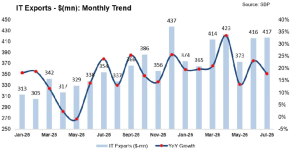
Pakistan’s IT exports have started FY27 on a strong footing, maintaining the momentum built over the previous year. Export receipts stood at USD417 million in July-26, up 18 percent year-on-year and broadly unchanged from USD416 million in June.

This is also the second-highest monthly export figure in the recent series, after the USD437 million recorded in Dec-25.


The bigger story is no longer an occasional monthly spike. IT exports have now consistently stayed above the levels seen a year earlier. On a trailing 12-month basis, exports reached USD4.66 billion, up 20 percent from $3.87 billion in the corresponding period last year.

That makes technology one of the few export segments where Pakistan continues to build scale without a large corresponding import bill. For an economy repeatedly constrained by foreign exchange availability, the sector’s high net-export content matters as much as the headline growth rate.

Unlike merchandise exports, where imported raw materials and energy can take away a significant part of the gross receipts, IT and IT-enabled services generate a much larger net addition to the external account.
 
1787916301520.png

The importance of this growth is also visible in the services balance, where stronger ICT and other business services exports are helping offset part of the widening goods trade deficit.

FY26 already provided a strong base. ICT export remittances reached around USD4.6 billion, increasing by 20.6 percent from USD3.8 billion in FY25.

Policy facilitation has helped. IT exporters can retain up to 50 percent of their export proceeds in foreign currency accounts, while banking procedures for export receipts and international payments have been eased.

Dedicated banking desks, simpler documentation, and quicker processing of transactions through Exporters’ Special Foreign Currency Accounts have reduced some of the frictions that previously encouraged exporters and freelancers to keep receipts outside the formal system.
 
The IT ministry has separately outlined a USD 25 billion ICT target for 2030, including USD 15.3 billion from IT and IT-enabled services and USD 9.8 billion from telecommunications.

The targets look ambitious relative to the present base, but the ecosystem is attracting greater attention from global technology firms. Google’s decision to establish its first local office in Pakistan in Aug-2026 is an important signal in that regard, bringing one of the world’s largest technology companies into the market with a more formal presence.

Its expansion has also been linked with Pakistan’s digital-export ambitions through an agreement covering digital skills, AI, innovation, and export competitiveness, including Google Career Certificates, greater access to AI tools and plans for an AI Center of Excellence in Islamabad.

A joint task force is also expected to prepare a roadmap for IT exports and competitiveness.

The challenge, therefore, is shifting. Pakistan has demonstrated that IT exports can grow at around 20 percent annually. But moving from roughly USD4.6 billion to double-digit billions will require more than additional freelancers and low-end outsourcing.

The next leg has to come from higher-value software engineering, AI services, cloud and cybersecurity, gaming, product companies, and scalable technology businesses.
 

Users who are viewing this thread

Pakistan Defence Latest

Country Watch Latest

Back
Top