Pakistan: The Archaeological Marvel

Few things better represent the power of ancient Indus cities in their time - much like subways and digital switches do modern cities - than brick drains.

Five drains from Harappa in Punjab and Moenjho-daro in Sindh show that the volume of water that flowed through these structures must have been like nothing seen before by ancient wayfarers.

John Marshall writes: "A remarkable feature of the city of Mohenjo-daro is the very elaborate drainage system that exists even in the poorest quarters of the city. Every street and lane had one or two water-channels with brick or stone covers that could easily be lifted to remove obstructions."

"In some cases the water-channels were so considerable in width that it was found impossible to bridge them by ordinary means. This difficulty was overcome by closing them with corbeled roofs."
(Marshall, I, pp. 278-9)

1. Inside of the Harappa phase drain. This view along Drain [8] into the mound shows details of the brick construction, the robbed out area at the east end of the drain (background), sloping strata above indicating the existence of an open street drain along the same line as the earlier baked brick drain, and the later Period 3C architecture built after the open drain was filled in and the area leveled. The bricks from the eastern part of the drain were robbed by tunneling into the sediment along the line of the drain from the East.

2. Drain, Harappa. Excavated by the Harappa Archaeological Research Project in 1993, this large corbelled drain was built in the middle of an abandoned gateway at Harappa to dispose of rainwater and sewage.

3. Corbelled Arch Drain, Mohenjo-daro. The corbelled arch drain from the great bath in Mohenjo-daro is large enough to walk into. It has a small ledge on either side of the actual drain channel.

4. Corbelled Drain exiting the Great Bath, Mohenjo-daro. his drain cuts through the edge of the so-called granary. If the entire drain were constructed along with the Great Bath, this feature would indicate that the original "granary" was built before the great bath.


476806431_9443592969033936_6664913464956807559_n.jpg


478468651_9443592989033934_3075068380606330371_n.jpg

85
 
The Romani People of Europe...our distant cousins?

We often talk about the various migrations of people that have taken place to the Indus Valley...be it the Aryan migration, the Sheedis, the Baloch and countless others. These various migrations over the past 3000 years played an important role in Pakistan's multiethnic population.

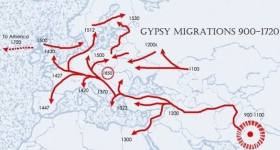
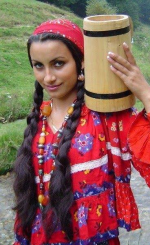
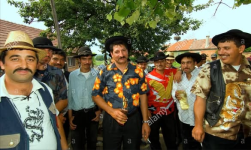
However, we rarely talk about migration of people out of the Indus Valley. The next time you're in Europe and come across a Romani, or "Gypsy", chances are you'll be coming across a distant cousin.

The Gypsies are said to have migrated to Europe about 1000 years ago from the Thar desert region of Sindh and Punjab, as well as western Rajasthan. Myths say that the Sassanid monarch, Bahram Gul, imported around 10,000 musicians and dancers from this region, and established their colonies all Persia. Many of these ‘ancient Meerasis’ continued their migration to Byzantine and settled throughout Europe.

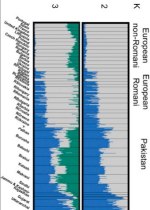
Next week I'll be diving deeper into the history of the Romani people as well as who they are genetically the closest to and reasons why they migrated in the first place.


1748288984500.png


1748289001711.png


1748289021017.png


1748289064183.png
 

The Indus Valley is Genetically Distinct from North India​


ArainGang
Feb 18, 2021
https://medium.com/m/signin?actionU...----------post_audio_button------------------

1*lwQksilwP2EulQ9Eq8vfKw.png


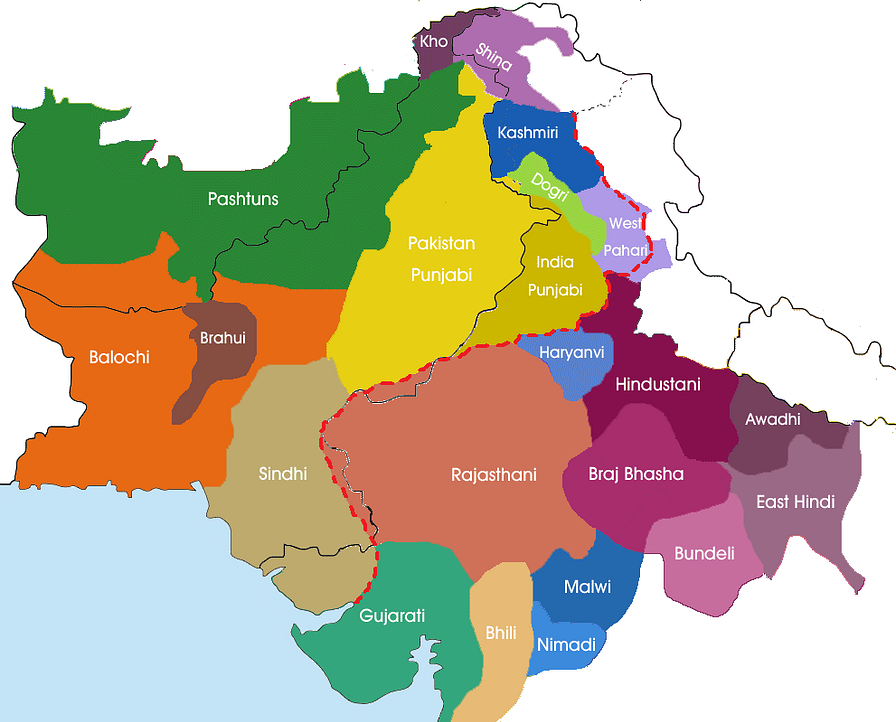
Approximate border between the Indus Valley and Gangetic Basin
Conventional wisdom has long held that the principal genetic divisions in South Asia are generally tied to linguistic differences. Indo-Aryan speakers (North Indians) form one broad cluster, Dravidian speakers (South Indians) form a second cluster, Iranic speakers (Western Pakistan) form a third, etc. While allowances are made for caste-differences and geography, the above formulation is more-or-less accepted by the casual observer. Its often wrong however, particularly at the margins.

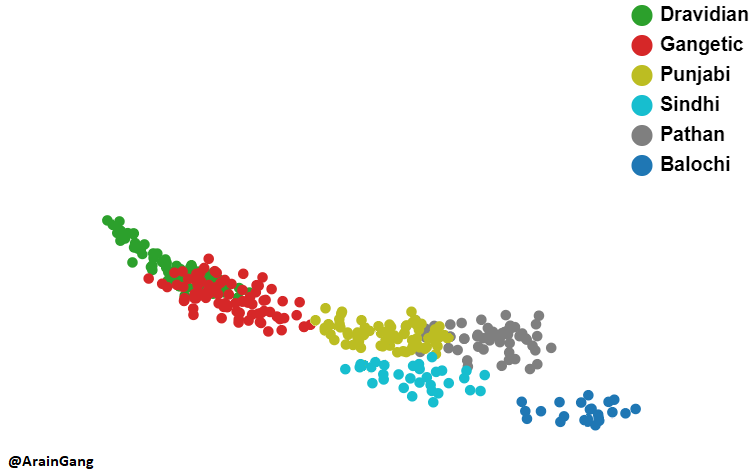
One such case I want to highlight is the genetic gap between two neighboring Indo-Aryan regions; the Indus Valley (specifically Punjab and Sindh), and Gangetic North India (Uttar Pradesh, Rajasthan, Gujarat). Below is a PCA chart constructed from Harappa ancestry samples, which will help us visualize the genetic distance between these ethnic groups.

1*bW_yGv3Y_fQWOxj4DMzfWQ.png

Outlier Populations (Dalits, Adivasis, Brahmins) excluded

As can be seen from the figure above, there is little genetic overlap between the Indus Valley and Gangetic North India. In contrast, despite both a linguistic and geographic divide, Gangetic North India does exhibit significant overlap with Dravidian South India. Indus Punjabis show a similar relationship with Iranic Pathans, however Indus Sindhis and Iranic Balochis do not seem to overlap.

Hopefully this will help caution readers against lumping all Indo-Aryan ethnic groups together. These populations not only have significant cultural differences, but from a genetic standpoint they can often diverge considerably.

Notes:

-
The Dravidian sample includes individuals from Kerala, Tamil Nadu, and Andhra Pradesh. The Gangetic sample includes individuals from Uttar Pradesh, Rajasthan, and Gujarat. The Punjabi sample includes both Pakistani and Indian Punjabis. The Pathan sample includes individuals from the Eastern Pashtun grouping.

- Its possible that many of these groups will demonstrate greater or lesser genetic overlap once more South Asian genetic samples become available. This post is not the last word on the topic, simply an observation.

- The phenomenon of linguistically similar Indian groups diverging significantly from a genetic standpoint (even after adjusting for caste) is also seen with Malayalis visa-vis Dravidians, and Marathis visa-vis Indo-Aryans. Time permitting, I hope to write about both of these cases.

- Data source comes from Harappa Ancestry Project, with scores from individuals being largely collated from forums like Anthrogenica. This info is publicly available, and analysis can be reproduced by anyone willing to collate the scores and run them through a PCA program. I used BioVinci, but there are free programs available as well.
 
Anarkali's love triangle was Ist mentioned by British William Finch in 1611 at Lahore.
Edward Terry was 2nd person who wrote about Anarkali in Early Travels in India. Imtiaz Ali Taj influend by French historian Alain Desoulires research, fabricated the story in his play Anarkali.

Image


Sobha Singh converted Anarkali's tomb into Police Station. Ranjit Singh made its garden's a military ground & shifted its marble to Amritsar. Kharak Singh was crowned in its gardens, his mother cremated there. Gen Ventura & Avitable lived in it. Was a British era office & church.

A relatively unknown British named Sir Thomas Herbert is the third person who mentions Anarkali. He briefly indicates that one of Akbar's favourite wives was named Pomegranate (Anar) who was harassed by Salim.
 
'Authentic' artefacts: 'Talajah Fort was built around 2,000 years ago'

1633595612510.png


LAHORE: An archaeology team of the Punjab University has found 'authentic' artifacts that have suggested the historic Talajah Fort in Soon Valley was built around 2,000 years ago instead of 5,000 years. The artifacts came to light when an archaeology team of the PU Khushab chapter recently started work on the outskirts of tehsil Nowshera to discover archaeological and historical sites, artifacts and developing tourist points.

Punjab Archaeology Department Chairman Dr Muhammad Hameed said that according to local traditions, Talajah Fort was built 5,000 years ago but according to the preliminary research it was about 2,000 years old. He said the architecture of the houses and the artifacts discovered in Talajah Fort gave traces that the Muslim population was settled there.

"It is a presumption that archaeological and historical sites before the Muslim era in South Asia can also be discovered from Talajah Fort," Dr Hameed said in a statement issued on Sunday. He added that according to local tradition, Muslims lived in the Fort before the arrival of Jalaluddin Khwarazm, the ruler of Central Asia.

"An authentic statement can be possible after excavation and research of the residential block and rest of the city located at 22-acre of land in Talajah Fort," he said, adding that the discovery of the Fort can reveal many facts for the archaeologists besides promoting tourism.

According to Dr Hammed, the research team has also discovered engraved manuscript on the stone of Mehmood Ghaznavi era during an excavation in Nandana Fort. Commenting on the matter, Punjab Chief Minister Usman Buzdar said in a statement that discovery and preservation of thousands of years old archaeological and historical sites in Punjab are being carried out. "As a result of archaeologists' successful expedition, thousands of year's old authentic artifacts have been discovered from Talajah Fort in Soon Valley," he added.

According to the CM, the discovery of archaeological and historical sites and artifacts will help them in making Punjab "a tourism hub". He said the discovery of archaeology will attract foreign tourists and researchers in Pakistan and the local economy will be boosted by promoting tourism in the province.

www.brecorder.com

'Authentic' artefacts: 'Talajah Fort was built around 2,000 years ago'

www.brecorder.com
 
1748431351611.png

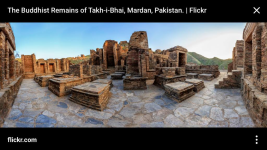
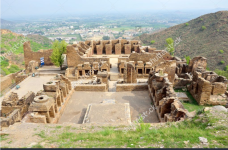
Takht-i-Bahi is a renowned Indo-Parthian archaeological site and ancient Buddhist monastery located in Mardan, Khyber-Pakhtunkhwa, Pakistan. It's considered one of the most significant Buddhist relics in what was once known as Gandhara.

The site, which translates to "throne of the water spring," is remarkably well-preserved and offers a glimpse into Gandhara's Buddhist civilization.

Key Features and Significance:

Monastery Complex:
Takht-i-Bahi is a monastic complex situated on various hilltops, ranging from 36.6 meters to 152.4 meters in height, a common feature for Buddhist sites.

Early 1st Century A.D.:
The monastery is thought to have been founded in the early 1st century A.D.

Architectural Complexity:
The complex is considered representative of the architecture of Buddhist monastic centers from its time period.

UNESCO World Heritage Site:
Takht-i-Bahi, along with the neighboring city remains at Sahr-i-Bahlol, was listed as a UNESCO World Heritage Site in 1980.

In Use until the 7th Century:
The monastery was in use until the 7th century A.D.

Relatively Complete:
It's considered one of the most complete Buddhist monasteries in Pakistan.
Well-Preserved:

The site is exceptionally well-preserved, despite having been attacked multiple times.

Different Interpretations of the Name:

"Takht-i-Bahi" can be interpreted as "throne of the water spring," "spring from the top," or "throne of origin".
Other Notable Points:

Sahr-i-Bahlol:

Takht-i-Bahi is situated near the remains of a small fortified town called Sahr-i-Bahlol, also from the same period.

Popularity:
Once remote, the site is now accessible by road and has become a popular tourist destination.

Different Types of Structures:
The complex includes stupas, monastic chambers, a temple complex, and a Tantric monastic complex.

Gandhara's Buddhist Civilization:
A visit to Takht-i-Bahi provides insight into the history and architecture of Gandhara's Buddhist civilization.
 
Mohenjodaro

The name literally translates to Mound of the Death. Situated 350 miles from Karachi, the capital of Sindh, Mohenjodaro is one of the most important archaeological sites in Pakistan. It was one of the largest settlements of the ancient Indus Valley Civilization, and one of the world’s earliest major urban settlements. The civilization existed from 2500 B.C. to about 1500 B.C. after which it disappeared. Mohenjodaro was declared a UNESCO World Heritage Site in 1980.

The citadels found here seem to have once housed palaces, granaries, and grand baths used for ablutions. The town was laid out in rectangular patterns. Houses were two-storied and had drainage systems that led into brick-lined sewers.

Trade and agriculture formed the backbone of the ancient economy. Many copper, bronze, and clay fashioned remains have been found. An important find are the seals. These are engraved with animal figures and a line of pictograph script. On some seals there is a tree or the Hindu god Shiva drawn. The script has yet to be deciphered.

It is mostly accepted that the civilization fell in 1500 B.C. to invading Aryans.
For those who may be interested: Its not "Mohenjodaro." Its "Moa'an Jo Darho."

Mohenjodaro or Mohen jo Daro = My Mound
Mohenjo/Mohanjo = My or mine

Moa'an Jo Daro = Mound of the Dead
* 'Moa' = Dead (plural)
* 'an' is a stand along addition to signify both 'plural' aspect and connection to 'of'
* 'Jo' = Possessive article, i.e., of
* Darho = Mound
 
Mapping the Single Largest Ancestral Component in South Asian populations.


View attachment 123882
Indian syllabi need to reflect the reality that north India, the Indus Valley Civilisation, and Pakistan comprehensively and unequivocally share substantial ancient IRAN-ORIGIN DNA.

They cannot accept this scientific reality though, as it flies in the face of "native DNA only policy".

Intriguing how the IVC is so worshipped by Indians as their own precursor civilisation, yet in the same breath, those Indians will deny "foreign" influence of any kind.

North Indian DNA, the sanskrit language, and vedic Hinduism ALL have majority or complete origin points outside of the subcontinent, yet all we ever hear about is "islamic invasions".
 
North Indian DNA, the sanskrit language, and vedic Hinduism ALL have majority or complete origin points outside of the subcontinent
Not at all. If it did at least one text would talk about their migration story or any god's or lands where they come from. But the Vedic texts mark only the lands in here. Not Central Asia, not Eurasia. So just like Buddhism, Jainism, Sikhism it originated here.
 
Bhambore : the city of mystery and romance

Humera Naz

A panoramic view of the ruins of Bhambore

A panoramic view of the ruins of Bhambore

Associated with the story of Sassui Punhun that was immortalised in the poetry of Shah Abdul Latif Bhittai, the ancient city of Bhanbore was situated 37 miles north of Karachi, near Gharo. The 10th century capital of Bhambo Raja, the city reached the height of its fame as the most important crossroad of the ancient trade route to China and Middle East.

It is believed that Bhambore was destroyed around 1250 CE, but it still lives in the world of romance and folklore. Sassui’s grave lies at a site known as ‘Sassui waro chodo’, 14 miles from Karachi on the road to Kech Makran.

The story of Sussui-Punhun owes its origin to the Soomra period (1024-1351CE), which is known as the period of chivalry and romance. Through the Bhats and the Charans, this story spread far and wide. The first documented source mentioning Bhambore is found in the poetry of Shah Abdul Latif Bhitai’s grandfather Shah Abdul Karim Bulri (1536-1623CE) who while narrating the story of ‘Sussui - Punhun’ says:
Sussui says, “When I came outside Bhambore and cried out, if my cries would have been heard by my beloved, he would have not left me.”

Surprisingly, there is no factual evidence that proves whether the city really existed or is just a romantic fantasy in literature

After Shah Abdul Karim, many references to this city can be traced in the literature of Sindh. Mir Muhammad Masum Bakhari (d. 1606CE)), the great historian and poet of Sindh also narrated this story under the title of Masnawi Husn-o-na’az in Persian some time around 1594CE. Besides, Mian Shah Inayat (d. I719CE) and Shah Abdul Latif Bhitai (d. 1752CE) also narrate the famous folklore of Sussui-Punhun in their poetry using different variations in spelling and pronunciation of Bhambore such as ‘Bhombore’ or ‘Banbhore’, both of which are still used by the people of Sindh.

Nevertheless, the origin and history of Bhambore is mostly obscure and its location controversial. For instance, David Ross thought the ruins of Bhambore are ‘Deebal’. Sir Henry George Elliot and Alexander Cunningham consider it to be the ancient ‘Barbarikan’ which, according to Maris Erythraei the author of the Periplus, was the delta seaport during Alexander’s time (c. 324 BCE).

“There are ruins of great antiquity in ‘Bambura’, comprising ramparts, bastions, towers and houses which show a large population and trace at one time,” wrote David Ross in his book titled The Land of the Five Rivers and Sindh: Sketches Historical and Descriptive when he first saw the site in the 19th century CE. Henry Cousens in, Antiquities of Sind says, “Natives of Sindh consider it as the oldest port of the province.” And that he himself would take it to be a port of Alexander’s days.

Notwithstanding, there is no factual evidence that proves whether the city of Bhambore really existed or is just a fantasy. No one could find the traces of this place or its name from any authentic historical source. It might be possible that this city existed during the earlier time and was adopted in the folklore later, however this conception does not have a strong footing.

According to Sindhi folklore, the story of Sussui-Punhun is associated with the region that spreads from Kuch valley to southern Sindh. This region is generally considered a part of the ancient trade route towards Iraq, on which Bhambore seems to be situated 37 miles south-east from Karachi.

There are three reasons that substantiate this assumption. First, the ruins of Bhambore are situated on the old course of River Indus; second, in the north west of the ruins, the quarters of textile dying workers are found that are associated with the story of Sussui-Punhun; and thirdly, Sussui took this route while looking for Punhun after he was kidnapped by his brothers and the place where her monument has been erected is situated in the north-west of Karachi near the hills of Pubb and the valley of Sanghar.

Remains of the fort


Remains of the fort

Dr N.A. Baloch, who carried out substantial research on this issue, argues that in the name of ‘Bhambore’ there appears to be a convincing philological clue to the name of the old Buddhist temple at Deebal, namely (Bhanmbor = Ban-Bahar) Vana-Vihara which probably may have been the name of the Buddhist temple that stood at this site which should be Deebal.

Buddhist temples are known as ‘Viharas’ and in the Fathnama-i-Sindh alias Chachnama (c. 1216 CE), the earliest historical source on Sindh, we get names of some other Buddhist temples in Sindh at the time of Arab conquest.

The accounts of Debal speak of the temple which stood approximately 14 yards high. At Bhambore, high on the hillock stand some old foundation of walls eight to 10 feet wide with bastions. This high platform may have been the site of the temple and later on of the mosque that Bhambore is largely known for.

It is believed that Bhambore, which is 35km from the open sea today, was only 20km from the sea during the 13th century, and when Alexander came here in 324 BCE, it was probably on the sea itself or a mile or two in land on the Kalri branch of the Indus. The ancient fort existed much before the Arab conquest but was repaired periodically.

The sandstone used in its construction, and also of houses, came from hillocks just outside the settlement but mud bricks were used for the poor men’s quarters and in core fortification. The settlement occupies about 55 acres, though only 10 per cent of the conspicuous area has been excavated and much cannot be known about the life of the common man. As there is mystery about the origin of this city, it has the same controversy about its end. No authentic and final conclusion has been drawn about its destruction yet.

There are numerous versions regarding the destruction of this ancient city. Some believe that a major change took place in the course of River Indus and the city that was situated on the bank of the river was deserted. Another reason that is given is that the city came to a sudden end following a violent earthquake around 1250CE. Some historians believe that the city was put to fire in the event of a civil war or a foreign invasion. Another account says that the destruction of Bhambore could have been caused when during the mid-13th century CE, Jalal al-Din Khwarzim Shah invaded Sindh, and devastated and conquered many coastal areas of Sindh.

The writer is assistant professor, Department of General History, University of Karachi, [email protected]
 
Not at all. If it did at least one text would talk about their migration story or any god's or lands where they come from. But the Vedic texts mark only the lands in here. Not Central Asia, not Eurasia. So just like Buddhism, Jainism, Sikhism it originated here.
Will discuss in a separate thread in due course. Don't lose any sleep over it.
 
The Gori Jain Temple was built in 1375-1376 CE.

1630100111733.png


The temple was exclusively allocated to the 23rd Jain Tirthankar Lord Parshwanath. Located in Tharparkar desert of Sindh
 
More than 2700 years ago a huge university existed in ancient Pakistan, near Islamabad where over 10,500 students including students from 16 different countries came for higher studies.

Great scholars taught over 64 different disciplines. This was Taxila (Takshashila) University.

1630327667548.png


Taxila (Takshashila) University was world's Ist International University. It comprised 300 lecture halls, laboratories, observatory & a huge library housed in 3 buildings. For 10,500 students, almost 2,000 master-teachers taught 64 different subjects.
 
Professor Noam Chomsky attributes the origin of linguistics, as also a product of Taxila (Takshashila) University.

Literally meaning "City of Cut Stone" or "Rock of Taksha", Taxila at the time was described as wealthiest city of Indus Valley, Pakistan. Taxila University attracted international students from 16/17 different countries including China, Arabia, Egypt, Syria, Babylonia & Greece.

2700 years old Taxila (Takshashila) University of Pakistan was world's first International University. It comprised 300 lecture halls, laboratories, observatory & a huge library housed in 3 buildings. For 10,500 students, almost 2,000 master-teachers taught 64 different subjects.

John Marshal in his book "A Guide to Taxila" mentions that, Taxila is frequently mentioned as a university center where students could get instruction in almost any subject, from religious to secular, from mathematics to medicine, even to astrology and archery.

2700 years old Taxila (Takshashila) University is part of Pakistan's ancient history and heritage. It has nothing to do with Republic of India.

Languages, grammar, philosophy, medicine, surgery, agriculture, politics, archery, warfare, astronomy, governance, commerce and music etc. were taught. There were even certain unique subjects taught, like the art of discovering hidden treasure and decrypting encrypted messages etc.

Taxila (Takshashila) University of Pakistan thrived for approximately 1000 years, with a resurgence under King Kanishka the Great, an emperor of Kushan dynasty in the 2nd century (127–150 AD), until it was destroyed by Shaivite [Hindu] King Mihirakula in 6th century AD.
 

Users who are viewing this thread

Country Watch Latest

Back
Top