Navigation
Install the app
How to install the app on iOS
Follow along with the video below to see how to install our site as a web app on your home screen.
Note: This feature may not be available in some browsers.
More options
Style variation
You are using an out of date browser. It may not display this or other websites correctly.
You should upgrade or use an alternative browser.
You should upgrade or use an alternative browser.
Pakistan Weather News / Updates
- Thread starter ghazi52
- Start date
More options
Who Replied?


ghazi52
THINK TANK: CONSULTANT
- Thread starter
- #918
At least 11 dead in last 24 hours in rain-related incidents nationwide: NDMA
Met department says Karachi likely to receive light rain, drizzle over next two days
Aftab Khan/Web Desk/Afzal Talib
July 26, 2026
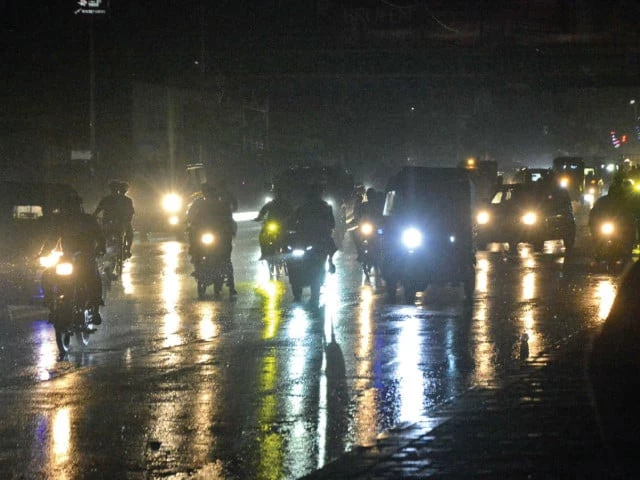
Traffic moves slowly along Korangi Road during light rain, as headlights and taillights reflect on the wet asphalt, creating a shimmering nighttime scene of cars and motorbikes navigating the slick streets. PHOTO: JALAL QURESHI/EXPRESS
LAHORE/ KARACHI: At least 11 people were killed and 25 injured in rain-related incidents across the country over the past 24 hours, bringing the nationwide monsoon death toll to 97 since late June, the National Disaster Management Authority (NDMA) said on Sunday.
According to a daily situation report issued by the NDMA, Punjab recorded the highest number of casualties during the reporting period, with seven deaths and 20 injuries, followed by Sindh with two deaths and two injuries, Khyber-Pakhtunkhwa with one death and three injuries, and Gilgit-Baltistan with one death.
ghazi52
THINK TANK: CONSULTANT
- Thread starter
- #919
According to the authority, house collapses accounted for 54.5% of the fatalities, followed by drowning (27.3%) and lightning strikes (18.2%).
The cumulative toll from June 26 to July 25 now stands at 97 deaths and 297 injuries nationwide. K-P has reported the highest number of fatalities with 52 deaths, followed by Punjab reporting 29 deaths, Azad Jammu and Kashmir reporting seven, Balochistan recording 6, Sindh with two deaths, and G-B with one death reported.
The NDMA said 22 houses were damaged in the past 24 hours, including 17 partially damaged and five destroyed, while eight livestock were lost. Since the start of the monsoon season, 447 houses have been damaged—338 partially and 109 completely—and 269 livestock have perished.
It added that 0.9 kilometres of roads were damaged by landslides and rising water levels in K-P and G-B, disrupting traffic at several locations, with restoration work underway.
The cumulative toll from June 26 to July 25 now stands at 97 deaths and 297 injuries nationwide. K-P has reported the highest number of fatalities with 52 deaths, followed by Punjab reporting 29 deaths, Azad Jammu and Kashmir reporting seven, Balochistan recording 6, Sindh with two deaths, and G-B with one death reported.
The NDMA said 22 houses were damaged in the past 24 hours, including 17 partially damaged and five destroyed, while eight livestock were lost. Since the start of the monsoon season, 447 houses have been damaged—338 partially and 109 completely—and 269 livestock have perished.
It added that 0.9 kilometres of roads were damaged by landslides and rising water levels in K-P and G-B, disrupting traffic at several locations, with restoration work underway.
ghazi52
THINK TANK: CONSULTANT
- Thread starter
- #920
River levels remain low despite high flows at Chenab, Ravi
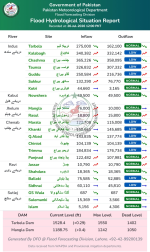
Meanwhile, the PMD Flood Forecasting Division (FFD) said the country's overall flood situation remained under control, with most major rivers flowing at low or below-low flood levels despite elevated flows on parts of the Chenab and Ravi rivers.
According to the FFD's daily flood bulletin, the Chenab River is at a high level at Marala and the Ravi is high at Balloki, while the Indus remains at low flood level at Tarbela, the Kabul River at Nowshera and the Jhelum at Mangla. The Sutlej continues to flow below low flood level.
Hydrological observations recorded at 6:00am showed the Indus at Kalabagh, Chashma and Taunsa, the Chenab at Marala, Khanki, Qadirabad, Chiniot Bridge and Trimmu, and the Ravi at Balloki and Sidhnai were all within the low flood category, while all other major river gauging stations were flowing normally.
Meanwhile, the PMD Flood Forecasting Division (FFD) said the country's overall flood situation remained under control, with most major rivers flowing at low or below-low flood levels despite elevated flows on parts of the Chenab and Ravi rivers.
According to the FFD's daily flood bulletin, the Chenab River is at a high level at Marala and the Ravi is high at Balloki, while the Indus remains at low flood level at Tarbela, the Kabul River at Nowshera and the Jhelum at Mangla. The Sutlej continues to flow below low flood level.
Hydrological observations recorded at 6:00am showed the Indus at Kalabagh, Chashma and Taunsa, the Chenab at Marala, Khanki, Qadirabad, Chiniot Bridge and Trimmu, and the Ravi at Balloki and Sidhnai were all within the low flood category, while all other major river gauging stations were flowing normally.
ghazi52
THINK TANK: CONSULTANT
- Thread starter
- #921
New glacial lakes may form in Gilgit-Baltistan, KP amid accelerated glacier melt: PMD
- Warns of GLOFs, flash floods, landslides in northern regions
BR Web Desk
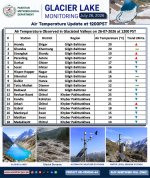
The Pakistan Meteorological Department (PMD) on Sunday extended its Glacial Lake Outburst Flood (GLOF) alert for Gilgit-Baltistan and Khyber Pakhtunkhwa, warning that continued warm temperatures and intermittent rainfall could accelerate glacier melt and heighten the risk of flash floods and landslides until the first week of August.
According to the PMD, the combined effect of a warm thermal regime and ongoing intermittent precipitation is expected to substantially increase snow and ice melt in glaciated valleys, keeping river and stream levels high. Existing glacial lakes may rapidly expand, while new glacial lakes could also form due to the large volume of meltwater.
The department warned that vulnerable downstream communities and low-lying areas near streams and riverbeds could face sudden high flows, while flash flooding remains possible in narrow valleys. It also cautioned that rapidly expanding glacial lakes could trigger GLOF incidents by destabilising natural ice or moraine dams.

hussain0216
Elite Member

Nothing has changed in the last 19 years. Pakistan cannot plan or implement measures to safeguard its people. No proper dams or reservoirs have been built to save water, manage flooding, etc. ~20 years is a long time. We have seen this report many times every year since the end of Gen [ret] Musharraf's time. If I start collecting stories from the last 10 years, I can easily use AI to create news alerts about flooding across Pakistan without knowing any facts, and they would all be similar. This is how bad our planners and implementers are.
To be fair, we have wanted to build dams for decades
But even dams become a ethnic issue for us
Some of the dams could have been built decades ago for much less cost
ghazi52
THINK TANK: CONSULTANT
- Thread starter
- #923
The PMD further warned that thawing permafrost, coupled with excess surface water, could trigger heavy mud and debris flows, while the likelihood of landslides has increased in steep mountainous terrain.
Residents and tourists have been advised to stay away from riverbanks, streams, local nullahs and glacial lakes, avoid camping and trekking in vulnerable mountain valleys, and closely monitor official weather advisories.
The Met Office also urged disaster management authorities and relevant departments to remain on 24/7 alert, coordinate with Community-Based Disaster Risk Management Committees (CBDRMCs), and disseminate timely warnings through all available communication channels.
The PMD advised all concerned authorities and the public to remain vigilant and take precautionary measures to avoid any untoward incidents.
Residents and tourists have been advised to stay away from riverbanks, streams, local nullahs and glacial lakes, avoid camping and trekking in vulnerable mountain valleys, and closely monitor official weather advisories.
The Met Office also urged disaster management authorities and relevant departments to remain on 24/7 alert, coordinate with Community-Based Disaster Risk Management Committees (CBDRMCs), and disseminate timely warnings through all available communication channels.
The PMD advised all concerned authorities and the public to remain vigilant and take precautionary measures to avoid any untoward incidents.
ghazi52
THINK TANK: CONSULTANT
- Thread starter
- #924
Monsoon showers likely to lash Karachi, Lahore, other cities: PMD
- Warns of urban flooding, flash floods, landslides and windstorm-related damage
BR Web Desk
The Pakistan Meteorological Department (PMD) on Tuesday forecast another widespread spell of monsoon rains across the country from July 29 to August 5, with Karachi and Lahore among the major cities expected to receive rain.
The Met Office also warned of possible urban flooding, flash floods, landslides and windstorm-related damage in several regions during the forecast period.
According to the PMD, strong monsoon currents from the Arabian Sea and the Bay of Bengal will begin affecting upper and central parts of the country from July 29, while a westerly weather system is expected to intensify from August 1.

ghazi52
THINK TANK: CONSULTANT
- Thread starter
- #927
Pakistan cannot control how much it rains, but it can control the extent to which it turns into a disaster
Most Pakistani cities have no comprehensive flood-risk maps, no functioning drainage master plans, and no clear chain of command for who acts first as the water rises.Urban flooding
EditorialAugust 2, 2026
THE warning from the disaster management and weather authorities that a new monsoon spell could trigger urban flooding in major cities across Punjab and Sindh is yet another reminder of how poorly prepared our cities are for heavy rainfall.
Cities from Rawalpindi, Lahore and Multan in Punjab, to Hyderabad, Umerkot and Tando Allahyar in Sindh, have been flagged for urban flooding. This is not unusual during the monsoons.
However, what makes this year’s warning worth pausing on is the Met Office’s forecast of below normal rainfall this year. Still, less rainfall will not eliminate the risk of flooded cities if a burst of rain arrives faster than the ground and drains can carry it away. This says more about the state of our cities than about the weather.
The problem of urban flooding in Pakistan is no longer limited to low-lying neighbourhoods. It has become a structural feature of how the country has grown and urban centres have developed. Unplanned construction has taken place over drainage channels and wetlands that once absorbed rain. Waterways have been encroached upon, storm-water systems are built for outdated rainfall patterns, and drains are choked with solid waste that no longer has any place to go.
The response is reactive across the provinces. Drains are cleared only when the rain starts to fall; pumps arrive after roads are under water; and warnings are issued, repeated, then forgotten until the next spell.
ghazi52
THINK TANK: CONSULTANT
- Thread starter
- #928
This is crisis management dressed up as preparedness. Most Pakistani cities have no comprehensive flood-risk maps, no functioning drainage master plans, and no clear chain of command for who acts first as the water rises.
Drainage, roads, water supply and disaster response sit in separate departments that rarely coordinate before a flood and mostly trade blame after one.
Climate change has broken the old planning assumptions. Cities now need infrastructure built for short, intense downpours capable of overwhelming drains within minutes, not the gradual rainfall patterns those systems were designed around decades ago.
Every new road, housing scheme or commercial project should be assessed for how it disrupts the natural water flow before approval, not after the damage becomes visible. Existing drains need redesigning and expanding to match current rainfall intensity, rather than being patched up just before the monsoon.
Pakistan cannot control how much rain falls. But it can control the extent to which the rain turns into a disaster. The recent warning is not a new problem; each year, governments assure the public that they are ready for the rains.
Unfortunately, the very first intense downpour exposes their claims. What the country needs is sustained investment in drainage infrastructure and local governments to maintain it between the monsoons, not just during the rainy season.
Drainage, roads, water supply and disaster response sit in separate departments that rarely coordinate before a flood and mostly trade blame after one.
Climate change has broken the old planning assumptions. Cities now need infrastructure built for short, intense downpours capable of overwhelming drains within minutes, not the gradual rainfall patterns those systems were designed around decades ago.
Every new road, housing scheme or commercial project should be assessed for how it disrupts the natural water flow before approval, not after the damage becomes visible. Existing drains need redesigning and expanding to match current rainfall intensity, rather than being patched up just before the monsoon.
Pakistan cannot control how much rain falls. But it can control the extent to which the rain turns into a disaster. The recent warning is not a new problem; each year, governments assure the public that they are ready for the rains.
Unfortunately, the very first intense downpour exposes their claims. What the country needs is sustained investment in drainage infrastructure and local governments to maintain it between the monsoons, not just during the rainy season.
ghazi52
THINK TANK: CONSULTANT
- Thread starter
- #929
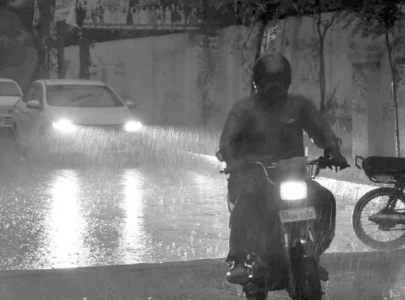
Monsoon death toll rises to 126 as electrocution tops causes of fatalities
Web Desk
NDMA reports Punjab worst hit with 47 deaths since June 26, Karachi on alert as showers expected
ghazi52
THINK TANK: CONSULTANT
- Thread starter
- #930
Pakistan records seventh-warmest July on record in 2026
August 7, 2026By Recorder Report
KARACHI: Pakistan experienced its seventh-warmest July on record in 2026, while the country’s night time temperatures ranked as the fourth-warmest, according to the Pakistan Meteorological Department’s monthly climate summary.
The report said the national area-weighted rainfall during July was 54.4 millimetres, which was slightly below average, with a negative departure of 11 percent.
The national mean temperature was 32 Celsius, which was 0.7 Celsius above the long-term average of 31.3 Celsius.
The report said the country-level night time (minimum) temperature averaged 26.1 Celsius, which was 0.8 Celsius higher than the nationwide average of 25.3 Celsius, making it the fourth-warmest July night time temperature on record.
The country-level daytime (maximum) temperature averaged 37.9 Celsius, which was also warmer than average, with a positive anomaly of 0.5 Celsius.
The report highlighted several weather extremes recorded during the month.
The highest temperature of July was recorded at Turbat, Balochistan, on July 7, 12, 30 and 31, when the mercury reached 48.5 Celsius.
However, Sibbi, Balochistan, was the warmest place overall during the month, recording a mean monthly maximum temperature of 44.8 Celsius.
The coldest night of the month was recorded at Bagrote, Gilgit-Baltistan, where the temperature dropped to 8 Celsius on July 26.
The same station was also the coldest place in Pakistan during July, with a mean monthly minimum temperature of 13.4 Celsius.
Users who are viewing this thread
Total: 6 (members: 0, guests: 6)
Pakistan Defence Latest
-

-
Federal cabinet gives nod to imposition of emergency in KP; summary sent to president (72 Viewers)
- Latest: prothought
-
-

-
Country Watch Latest
-

-

-
-
 Iran - Israel/US War: Israel-US declare war on Iran, Iran responds (1,165 Viewers)
- Latest: Khorasan Black Flags
-
Latest Posts
-
-
-
-
Iran - Israel/US War: Israel-US declare war on Iran, Iran responds (1,165 Viewers)
- Latest: Khorasan Black Flags
-