Pakistan Weather News / Updates

Over 110 dead since late June as monsoon rains wreak havoc in Pakistan​


NDMA issues warning for further heavy rainfall across country between July 15 to 17

AFP
July 14, 2025
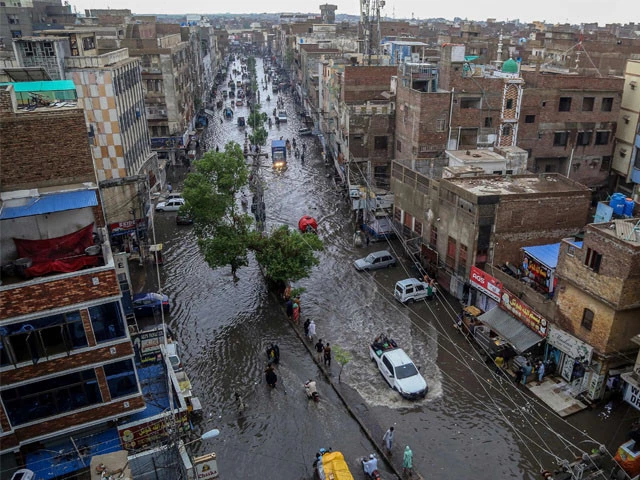
commuters make their way through a flooded street during heavy monsoon rains in hyderabad on july 14 2025 photo afp


Commuters make their way through a flooded street during heavy monsoon rains in Hyderabad on July 14, 2025. Photo: AFP


Monsoon rains in Pakistan have been linked to more than 110 deaths including dozens of children since they arrived in late June, according to government figures released Monday.

Data from the national disaster agency between June 26 and July 14 showed that electrocution was the leading cause of fatalities, followed by flash floods.

In late June, at least 13 tourists were swept to their deaths while sheltering from flash floods on a raised river bank. In its latest report, the disaster agency said 111 people including 53 children have been killed, with the highest number of deaths in the most populous province of Punjab.

Meanwhile, the national meteorological service has issued a warning for further heavy rainfall in the northern and eastern regions of the country, with the potential for urban flooding, landslides, and infrastructure damage due to strong winds.

To view this content we will need your consent to set third party cookies.
For more detailed information, see our cookies page.


The Pakistan Meteorological Department (PMD) warned that “heavy to very heavy rainfall” could unleash flash floods in Khyber-Pakhtunkhwa, Punjab, parts of Balochistan, Kashmir, Islamabad and Rawalpindi.

Hill torrents in Dera Ghazi Khan and mudslides in Gilgit-Baltistan are also possible, while windstorms may damage trees, poles, vehicles and standing crops.

“The combination of monsoon currents from the Arabian Sea and Bay of Bengal, and a strong westerly wave, will intensify rainfall across the country,” said a Met Office spokesperson. This dual weather system is likely to persist over the coming days.
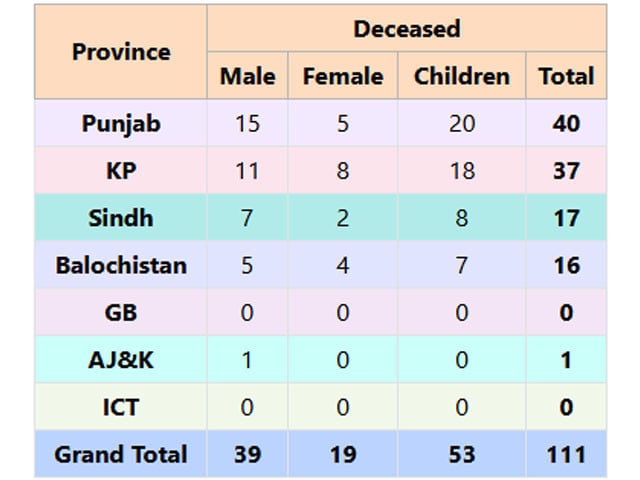

Photo: NDMA


In the past 24 hours, Okara (72mm), Sahiwal (66mm), and DG Khan (51mm) led rainfall reports in Punjab, while Swat, Kalam, and Malam Jabba received steady precipitation in K-P. Urban flooding remains a significant concern for cities like Lahore, Rawalpindi, Gujranwala, and Peshawar.

Pakistan is one of the world's most vulnerable countries to the effects of climate change, and its 240 million residents are facing extreme weather events with increasing frequency.

In 2022, unprecedented monsoon floods submerged a third of Pakistan and killed 1,700 people, with some areas yet to recover from the damage. In May, at least 32 people were killed in severe storms, including strong hailstorms.
 

28 killed across Punjab in rains in past 24 hours, says rescue official


Imran Gabol
July 16, 2025

At least 28 people were killed and 90 others injured in rain and storms across Punjab in the past 24 hours, provincial rescue service spokesperson Farooq Ahmed said on Wednesday.

Monsoon rains fall across the region from June to September, offering respite from the summer heat and replenishing water supplies and agriculture. They are crucial to the livelihoods of millions of farmers and food security. However, they also trigger deadly floods, landslides and displacement, particularly in vulnerable, poorly drained, or densely populated areas.

In the last 24 hours, roof collapses killed 12 people in Lahore, eight in Faisalabad, three in Sheikhupura, two in Okara, and one each in Pakpattan, Nankana Sahib and Sahiwal, according to the spokesperson.

Those seriously injured in rain-related roof and wall collapses across Punjab were immediately transported to the hospital, the spokesperson added.

The PDMA has issued a flood warning for the Jhelum River, reporting that “exceptionally high” flooding ranging between 350,000 to 450,000 cusecs of water was expected upstream at Mangla. It also warned that associated nullahs of the river may attain high level flooding in the next 24 hours.

Addressing the high death and injury tolls across Punjab today, PDMA Director General Irfan Ali Kathia said that the injured were being provided with “the best medical assistance”, adding that assistance would also be provided to the families of the deceased.

The DG requested citizens to take precautionary measures in view of the rainy season to avoid loss of life and property.

Citizens were requested not to live in old mud houses, as the highest number of deaths were recorded due to roof collapses in dilapidated buildings and houses.

“Take care of children and never let them near electric wires, poles, or low-lying areas,” he added.
 
This year, 77 civilians were killed and 214 injured due to monsoon rains, according to a Punjab PDMA spokesperson, who added that 74 houses were affected and six livestock killed due to the rains.

Monsoon rains recorded in most districts of Punjab in last 24 hours​

Sheikhupura recorded 217 millimetres of rain, Okara 170mm, Sahiwal 80mm, Chichawatni 130mm, Hafizabad 90mm and Kasur 85mm of rain in the last 24 hours, according to a PDMA spokesperson.

Additionally, maximums of approximately 170mm of rain were recorded in Lahore, 60mm in Faisalabad, 32mm in Mandi Bahauddin and 29mm in Jhelum. Rains were also recorded in Rawalpindi, Sialkot, Mianwali, Multan, Gujarat, Layyah, Sargodha, Rajanpur, Dera Ghazi Khan, Bahawalpur and Toba Tek Singh.

More rains are forecast in Lahore, Gujranwala, Faisalabad, Sahiwal, Sargodha, Multan, DG Khan and Bahawalpur divisions. This series of monsoon rains will continue till July 17, according to the PDMADG , who directed all the relevant departments to remain alert.

The PDMA spokesperson added that rains are expected to continue in Punjab today.

“There is a possibility of heavy rains in the upper reaches of rivers, including Lahore,” he said, adding that the PDMA’s provincial control room and district emergency operation centres were alerted.

Heavy rain and wind are expected in Lahore, Rawalpindi, Faisalabad, Gujranwala, Sargodha, Multan, Sahiwal, Bahawalpur, Jhelum, Attock, Chakwal, Murree, Galiat, Mianwali, Narowal, Gujrat, Sialkot, Toba Tek Singh, Mandi Bahauddin, and DG Khan.

The PDMA said that there is a risk of flooding in rivers and canals in low-lying areas due to heavy rain, which poses a risk of landslides in the mountainous areas of Murree.

“Tourists and travellers should be extremely cautious during the forecast period,” it said, adding that citizens should also take precautionary measures.

Citizens are directed to call the PDMA helpline, 1129, in case of civil emergencies.
 

Editorial:

The 2022 floods were not a freak event — they were a preview


Pakistan, and others vulnerable to climatic extremes, must heed the warning before the next deluge arrives — because it surely will.

The next deluge

July 16, 2025

A THIRD of our people were directly impacted by the 2022 floods. Nearly 1,500 lives were lost, over $30bn just evaporated from the economy and agricultural lands turned into stagnant ponds. The world took notice, albeit briefly.

The deluge was not just an act of God. A study in Natural Hazards finds that it was the perfect storm of both climate change and human failings. Southern Pakistan was emerging from a multi-year drought when it was struck by punishing pre-monsoon rainfall, double the historical average.

Soils were already sodden when the monsoon itself arrived, with rainfall more than five times the norm. To make matters worse, the region was warming rapidly. Higher temperatures accelerated snowmelt in the high Himalayas, compounded by rain-on-snow events that unleashed torrents into the Indus and its tributaries. Streamflows at Sukkur Barrage surged to 170pc above average.

Our own actions — or inaction — made things worse. Cropland expansion and population growth along riverbanks have erased natural buffers that once absorbed excess water. Urban sprawl, especially in Sindh, has further buried the land beneath concrete, making drainage all but impossible. Reservoirs upstream, such as Tarbela and Mangla, were not drained pre-emptively, missing a critical opportunity to mitigate downstream flooding risks. What happened happened, but unfortunately it was a taste of things to come.

The study warns that if global emissions keep rising unchecked, Pakistan will face far more frequent multi-day extreme rainfall by 2100. Temperatures are forecast to climb by 7°C in the upstream basins by the end of the century. Combined, these trends point to more intense floods, driven by heavier rain and faster glacier melt. With our weak economy and poor public services, we run the risk of each flood not just washing away our homes, but our very futures.

What then is to be done? Pakistan must get serious about managing rivers and the land surrounding them. Reservoirs must be managed with real-time data on snowmelt and rainfall to prevent flooding. Urban planning, too, is in need of a radical rethink. For one, building further into floodplains must be banned. Green belts along rivers need restoration, not destruction.

Moreover, investment in climate-resilient infrastructure — flood defences, drainage systems, early-warning networks — is of critical importance. Pakistan will need international support, not least because it is a negligible contributor to the carbon emissions warming the planet. However, the primary responsibility lies with the state itself, to prepare for a future where extreme floods are not just possible, but probable.

The 2022 floods were not a freak event. They were a preview. Pakistan, and others vulnerable to climatic extremes, must heed the warning before the next deluge arrives — because it surely will.
 

Floods trigger ‘emergency’ in parts of Punjab as rains claim dozens of lives in past 24 hours

Imran Gabol | Zaheer Abbas Sial | Muhammad Taimoor | Umar Bacha
July 17, 2025

1752758331473.png

Operations are underway to rescue citizens trapped in flooded areas in Jhelum.— Photo via Imran Gabol

1752758258164.png

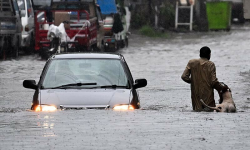
A man along with his dog while a car wade through a flooded street during heavy monsoon rains in Rawalpindi on July 17, 2025. — AFP

1752758292636.png

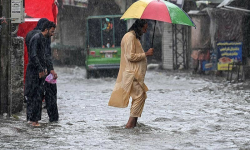
People wade through a flooded street during heavy monsoon rains in Rawalpindi on July 17, 2025. — AFP

A state of emergency was declared in several districts of Punjab on Thursday as heavy rains triggered flooding and claimed over 60 lives across the province in the past 24 hours, according to authorities.

The Pakistan Meteorological Department (PMD) on Monday issued a warning of torrential rains with wind-thundershowers that would last throughout the country till today. The National Disaster Management Authority (NDMA) has forecasted that heavy rains will continue to lash parts of the country over the next 24 hours.

“Sixty-three citizens have died while 290 were injured due to monsoon rains [across the province] in the past 24 hours,” read a statement by the Punjab Provincial Disaster Management Authority (PDMA) spokesperson.

“At least 15 were reported dead in Lahore, nine in Faisalabad, five in Sahiwal, three in Pakpattan and nine in Okara,” the PDMA statement detailed, adding that the families of the deceased will receive compensation from the government.

Subsequently, Punjab Chief Minister Maryam Nawaz announced that “a rain emergency has been imposed in different areas of Punjab due to unprecedented torrential rains and a flood situation.”

She added that directives were issued to keep the public alert through sirens and announcements. The chief minister urged the public to cooperate with the local authorities and take safety precautions.

In Jhelum, rescue operations were underway to evacuate citizens trapped in floodwaters in Dhok Biddar, Dhok Shah Arif, Sohawa, Rasoolpur, Chak Muhammad and Bhampar villages, according to Punjab Rescue 1122 spokesperson Farooq Ahmad.

Around 57 people have been rescued so far with the help of the Pakistan Army, he said in a statement, with more than 50 rescue boats involved in the Jhelum operations.

The spokesperson added that rescue teams have been deployed across the province, including Mianwali, Rawalpindi, Chakwal, Attock, Dera Ghazi Khan, Rahim Yar Khan, Rajanpur and Layyah. Over 15,000 rescue personnel and 800 rescue boats were on high alert, Ahmad added.

“Pakistan Army personnel and rescue teams are currently rushing the citizens to safe locations,” he said.

Punjab Water and Sanitation Agency (Wasa) Director General Tayyab Farid said that “rivers have overflowed due to heavy rains in Rawalpindi, Chakwal and surrounding areas”, leading to a flood situation.

“Citizens have been advised to avoid unnecessary travel, stay away from power lines and open manholes,” the Wasa DG said in a statement.

The PMD’s Flood Forecasting Division (FFD) warned that urban flooding was expected in Rawalpindi, Gujranwala and Faisalabad divisions during the next 24 hours.

However, it added that the wet spell was likely to subside in the next 48 hours.

In a post on X, the PMD said the heavy monsoon rains triggered a “significant surge” in water levels at the Tarbela, Mangla, Khanpur, Simly and Rawal reservoirs.

The water level at Khanpur witnessed a gain of 4.5 feet, while the other four recorded an increase of a foot each.

In a weather outlook, the FFD said the water flows in the eastern rivers were likely to increase from July 21.

Pakistan experiences monsoon rainfall from June to September every year. The heavy rains also trigger deadly floods, landslides and displacement, particularly in vulnerable, poorly drained, or densely populated areas.
 
To view this content we will need your consent to set third party cookies.
For more detailed information, see our cookies page.
 
To view this content we will need your consent to set third party cookies.
For more detailed information, see our cookies page.
 

Flood alert issued for Rawalpindi​

Earlier today, the PMD issued a flood alert for the Gawalmandi and Kattarian stations in Rawalpindi as the water level in the Leh Nullah rose.

At 10:50am, the Gawalmandi and Kattarian gauges had crossed the 20ft level, at which evacuation is supposed to be ordered. However, the water levels soon started to recede, reaching 7ft at Gawalmandi and 8ft at Kattarian at 4:21pm, according to the PMD’s real-time monitor.

Water levels recorded at the Gawalmandi and Kattarian gauges in Rawalpindi at 4:21pm on July 17, 2025. — PMD’s FFWS website

Following the flood alert in the morning, the PDMA imposed a rain emergency in Rawalpindi, with Director General Irfan Ali Kathia noting that a local holiday has been announced in the district.

DG Kathia urged residents of low-lying areas near Leh Nullah to “cooperate with the administration if evacuation becomes necessary”. In a statement, he warned that strict action will be taken against those gathering or bathing near Leh Nullah.

In a separate statement, the PDMA also detailed the equipment provided to the Rawalpindi administration for its relief efforts. This included 16 outboard motor boats, 205 life jackets, 31 ambulances, 19 fire brigade vehicles and four rescue vehicles.

The PDMA provided 28 de-watering sets, five suction pumps, six tractors and as many jetting machines to Wasa.

Another five de-watering sets, seven mini trucks and three jetting machines were given to the Rawalpindi Municipal Corporation (RMC), the statement added.
 
To view this content we will need your consent to set third party cookies.
For more detailed information, see our cookies page.
 

Chakwal records 400mm of rain in 10 hours​

Punjab’s Chakwal district was among the heaviest hit by the recent rains as it recorded 400 millimetres of rain overnight due to a cloudburst, triggering flash floods across the city, a statement from the PDMA said.

“Chawkwal recorded 400mm of rain in 10 hours, which left many areas flooded,” the PDMA said in a statement issued in the early hours of Wednesday.

However, a rainfall record issued by it at 8am stated 142mm of rainfall in the previous 24 hours.

Footage aired by DawnNewsTV showed water gushing across vast swathes of land, with floodwater entering various buildings, including a Rescue 1122 office.

In a statement, the PDMA said water levels had begun to recede with the cessation of the downpour, and evacuation efforts were underway to rescue trapped citizens.

DG Kathia spoke on the phone with Chakwal Deputy Commissioner Sarah Hayat, who briefed the former on the relief efforts.

She said the relevant departments, including Wasa, Rescue 1122 and other civil personnel, were present on the ground to take part in the rescue operation.
 

NDMA forecasts more heavy rainfall across country​

The NDMA has forecasted more heavy rains over the next 24 hours, Radio Pakistan reported.

“Various districts in Punjab — including Lahore, Chakwal, Attock, Jhelum, Khushab, Sargodha, Gujrat, Gujranwala, Faisalabad, Sialkot, Narowal, Okara, Kasur, Sheikhupura, and Hafizabad — are likely to experience thunderstorms and heavy rain in the next 12 hours,” the report read.

1752758791217.png

A man pushes a car through a flooded street during heavy monsoon rains in Rawalpindi on July 17. — AFP

Amid heavy rains and flooding in Punjab, authorities in the federal capital were also directed to remain on high alert by Islamabad Chief Commissioner Muhammad Ali Randhawa.

“Field teams should provide all possible assistance to citizens in case of an emergency,” Randhawa, also the Capital Development Authority (CDA) chairman, said.

The chief commissioner directed that strict monitoring of all highways, drains and waterways of Islamabad should be ensured.

In case of any emergency, citizens were advised to contact the CDA and district administration on 16 and 1334, respectively.
 

Section 144 imposed across Punjab, ‘emergency’ in parts as rains claim dozens of lives in past 24 hours


Imran Gabol | Zaheer Abbas Sial | Muhammad Taimoor | Umar Bacha
July 17, 2025

Section 144 was imposed across Punjab along with a state of emergency in several districts on Thursday as heavy rains triggered flooding and claimed over 60 lives across the province in the past 24 hours, according to authorities.

The Pakistan Meteorological Department (PMD) on Monday issued a warning of torrential rains with wind-thundershowers that would last throughout the country till today. The National Disaster Management Authority (NDMA) has forecasted that heavy rains will continue to lash parts of the country over the next 24 hours.

“Sixty-three citizens have died while 290 were injured due to monsoon rains [across the province] in the past 24 hours,” read a statement by the Punjab Provincial Disaster Management Authority (PDMA) spokesperson.

“At least 15 were reported dead in Lahore, nine in Faisalabad, five in Sahiwal, three in Pakpattan and nine in Okara,” the PDMA statement detailed, adding that the families of the deceased will receive compensation from the government.

An order from the Punjab Home Department said there was a significant increase in the accumulation of rainwater in low-lying areas, streets and open spaces, posing serious risks to the safety of children who often bathed in standing water.

“Dams, rivers, canals, ponds, lakes and distributaries across the province of Punjab experience heightened water levels and stronger currents during these periods, making swimming and unauthorised boating activities extremely hazardous for human life, leading to a high potential for drowning and other tragic incidents.

“Prevailing weather conditions and the inherent dangers associated with these activities, necessitates immediate preventive measures to safeguard public safety and prevent loss of precious human lives,” the order said.

It added that the home secretary was thus imposing a complete ban under Section 144 of the Code of Criminal Procedure across the province on bathing in accumulated rainwater on streets, roads, open spaces, or any other area where rainwater has collected; swimming in dams, rivers, canals, ponds, lakes and distributaries, and boating by any unauthorised person or for unauthorised purposes in dams, rivers, canals, ponds, lakes and distributaries.

“This order shall remain in force for a period of 45 days from the date of issuance unless withdrawn.”
 
Build as many dams as you possibly can

We need somewhere we can put this water to mitigate flooding and other issues, the water can then be used in times of need
 
I don’t know how to post a video but I received a clip showing entire Tubbar of Nawaz Sharif ran off to Murri to avoid flooding and water clogged streets ….

Amazing problems these bastard family has to deal with ….
 

Users who are viewing this thread

Pakistan Defence Latest

Back
Top