Navigation
Install the app
How to install the app on iOS
Follow along with the video below to see how to install our site as a web app on your home screen.
Note: This feature may not be available in some browsers.
More options
Style variation
You are using an out of date browser. It may not display this or other websites correctly.
You should upgrade or use an alternative browser.
You should upgrade or use an alternative browser.
Pakistan Weather News / Updates
- Thread starter ghazi52
- Start date
More options
Who Replied?



13 Assassins
Trusted Member

There is not a single year where Pakistan has not been affected by floods. The poor people will continue to suffer while Shabaz Shareef and his crooks do nothing except continue to develop Lahore.

ghazi52
THINK TANK: CONSULTANT
- Thread starter
- #259
Climate adaptation must be treated as a survival priority, not an afterthought
The floods of 2010, 2022 and now 2025 mark an unbroken chain of escalating disasters.Unprepared nation
EditorialPublished August 17, 2025
WEEKS of monsoon rains since late June have culminated in catastrophe.
In just two days, torrential downpours and cloudbursts unleashed flash floods across KP, killing more than 300 people. Entire villages have been erased from the map. A provincial rescue helicopter crashed in Mohmand during operations, claiming the lives of five crew members.
In Azad Kashmir, mudslides buried whole families, while in Gilgit-Baltistan glacier-fed torrents destroyed homes, bridges and farmland. Nationwide, the National Disaster Management Authority has reported at least 645 deaths and 905 injured since the start of the season, with KP bearing the brunt. With fresh rains forecast, the full scale of devastation is yet to be counted.
This is not some freak weather event. Pakistan is enduring the second massive flooding crisis in just three years. The 2022 floods, caused by record monsoon rains, submerged one-third of the country, killed 1,700 people and displaced 33m.
Those floods were described as a “climate catastrophe”, drawing global attention to Pakistan’s vulnerability. Today, the scenes from Buner and Ghizer echo that same nightmare — except the destruction is concentrated in the north, where steep terrain turns cloudbursts into deadly torrents. Could this scale of loss have been prevented? Scientists have long warned that climate change is making Pakistan’s monsoons more erratic, cloudbursts more violent, and glacier melt more destructive.
While no state can stop the rain, much of the tragedy stems from human failure. The Met Department’s Aug 12 advisory did warn of heavy rain in KP, AJK and GB but it was scant on details for preparedness. Then there is the lack of land-use planning and weak enforcement of building restrictions in flood-prone areas. And our disaster response mechanisms leave much to be desired.
With more rain on the way, immediate measures are essential. Relief corridors must be cleared, with the army’s engineering units building temporary bridges and restoring communication lines. Schools and mosques should be converted into evacuation centres, stocked with dry food and medicines. Wireless radios should be distributed where towers are down.
In the longer term, adaptation must be treated as a survival priority, not an afterthought. The state must invest in a national observatory app, providing instant alerts and safety tips. With mobile penetration above 80pc, even simple voice-based or pictorial warnings could save lives. Alongside this, the Met Department must be upgraded with real-time monitoring capacity.
Local governments need to build resilient housing, enforce safe construction zones, and strengthen embankments. Disaster insurance and relocation options for high-risk settlements are also overdue. The floods of 2010, 2022 and now 2025 mark an unbroken chain of escalating disasters. If Pakistan is to break this cycle, adaptation must move from rhetoric to reality. Lives depend on it.
Published in Dawn, August 17th, 2025
ghazi52
THINK TANK: CONSULTANT
- Thread starter
- #260
Mass funeral amid rubble and grief in Buner
Manzoor AliAugust 17, 2025
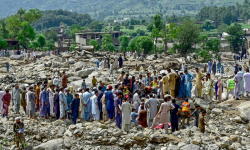
Residents watch as rescue personnel remove the rocks in front of their houses a day after flash floods in the Buner district of the monsoon-hit KP on Aug 16, 2025. — AFP
AT BATAI, a couple of kilometres upstream of Pir Baba Bazaar in Buner, hundreds of mourners gathered on the bank of the Pachay stream under the blazing Saturday morning sun to offer a mass funeral for more than 40 people who had perished in the devastating floods a day earlier.
Locals from nearby villages thronged the makeshift funeral ground, set up on flood-flattened cornfields now covered with a thick layer of alluvial deposits left in the deluge’s wake. The bodies were laid in two rows, with some cots carrying two corpses, blood stains still visible on the shrouds. Villagers jostled to get a final glimpse as elders tried to restrain mobile-wielding youths.
Suddenly, the restless calm was broken by a group of wailing women arriving to say goodbye to their relatives. “Stop filming, stop filming,” some among the crowd shouted, while others muttered, “What are the women doing here? They should not be here.”
Jehan Bar, a bulky local elder, addressed the mourners, urging them not to return home after the burial. “Our family members and friends’ bodies are still lying beneath rubble and sand from Qadir Nagar to Daggar, and we should not leave them this way,” he bellowed. “We will continue the search and give them the proper burial they deserve.”
Before the funeral prayers, I met a shell-shocked Mukhtiar Khan standing beside the rows of bodies. Mukhtiar, a resident of Qadir Nagar — a hamlet a few kilometres further upstream of Batai, one of the worst-affected areas — said he had lost 11 family members, including nephews, nieces and a daughter-in-law.
Along with his extended family, 35 people were either dead or missing. “The bodies of seven of my family members are here for their final rites,” he said quietly, adding that it was Allah’s will, and as a Muslim he bowed before whatever the Almighty had fated for him.
The mourners later resolved the dispute over women’s presence, and after the funeral prayers, the bodies were carried aside to where the women waited, saying their final goodbyes away from the prying male gaze.
We walked along the Batai Kalay road after the prayers until an Al-Khidmat Foundation volunteer offered us a ride across the Pachay stream to Malik Pur, through a detour. From there, it was still an hour-and-a-half walk to reach Beshonai, the worst-hit village in the district.
Driving through Narbatwal and other hamlets, the devastation was everywhere: several feet of mud and debris filled once-bustling shops, snapped power lines and uprooted pylons lay scattered, and people gathered their ruined possessions into piles in front of damaged homes. Wrecked cars were strewn along the roadside.
At the entrance to Malik Pur, police had set up barricades, allowing only pedestrians to proceed as crews cleared the upstream road. The uphill walk along the Kawga stream was filled with locals — volunteers, survivors and onlookers.
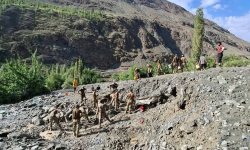
Beshonai, once a vibrant village straddling the stream of the same name, now lay buried under massive boulders. Only fragments of houses stood in eerie silence. At three sites, villagers clawed at the rocks with bare hands and whatever tools they could find. “We start digging whenever we smell decomposing bodies,” said Kamran Khan, a resident who had lost several relatives.
By Saturday afternoon — more than 24 hours after the disaster — no government machinery had reached Beshonai. Kamran said from his house on a higher slope he had watched the village disappear in minutes. “It was raining heavily on Friday morning, then suddenly darkness fell, followed by a rumble. Within minutes, the village was gone.”
The village, home to no more than 120 houses, had lost over 80 lives, he said. “Many still do not know if their relatives are dead or alive.”
ghazi52
THINK TANK: CONSULTANT
- Thread starter
- #261
Welfare bodies in Swabi send relief supplies to Buner
Our Correspondent
August 17, 2025
SWABI: Local charities sent the much-needed relief supplies collected in Swabi to the calamity-hit areas of Buner district on Saturday.
Speaking to Dawn before leaving for Buner, activists of welfare organisations said that the people in their neighbouring district were in dire need of foodstuff and drinking water after flash floods swept away their houses and crops and badly damaged road infrastructure.
Al-Khidmat Foundation, Swabi, president Wajid Ali Shah said that they had sent medicines worth Rs1 million along with five doctors and 15 paramedical staff to Buner.
“Similarly, on our request five trucks containing dry foodstuffs have reached Buner from our Rawalpindi wing and 15 ambulances of medicines and paramedical staff have also commenced their duty in the affected areas,” Mr Ali said.
“We have also planned to dispatch more foodstuff, tents and medicines to Buner by Saturday evening,” he said. “Right now, we are focused on three areas, including medicines, foodstuffs and tents. These things are badly required in Buner.”
Similarly, Bahrul Amin, president of Sitara Welfare Organisation, Maneri Bala, said that they have collected sugar, rice, drinking water, and about Rs0.2 million cash, which would be distributed among the affected people.
ghazi52
THINK TANK: CONSULTANT
- Thread starter
- #262
Sindh government dispatches aid to flood-hit regions
Dawn Report
August 17, 2025
KARACHI: The Sindh government has dispatched a water filtration plant to Khyber Pakhtunkhwa (KP) and 10 trucks loaded with ration bags and other essential food items for the flood-affected families, a statement said.
Sindh Chief Minister Murad Ali Shah also held a telephonic conversation with the governor of Gilgit-Baltistan (GB) and extended condolences over the loss of lives caused by the floods. The Sindh CM Secretariat also established contact with the GB CM Secretariat to coordinate possible assistance.
CM Shah conveyed deep grief over the loss of lives in GB and assured that the Peoples Party government will extend every possible support to the flood-hit population of the region.
“The Sindh government shares the pain of our brothers in Gilgit-Baltistan and will provide all possible assistance in this time of need,” he affirmed.
ghazi52
THINK TANK: CONSULTANT
- Thread starter
- #263
Buner worst hit as K-P floods leave 314 dead, 156 injured: PDMA
159 houses damaged, 157 cattle perished in floods
Web Desk
August 17, 2025
Source: X
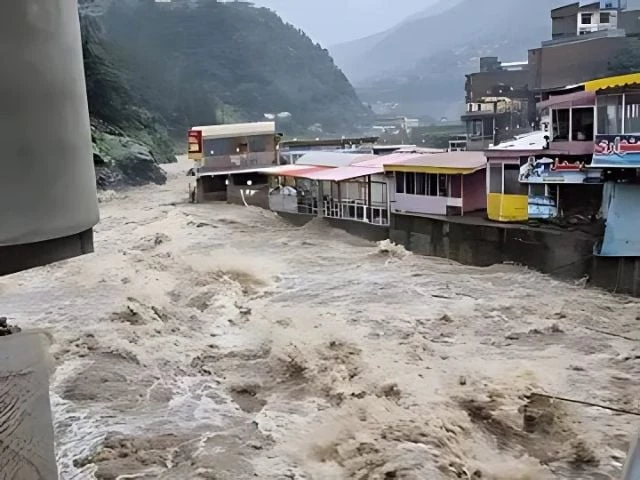
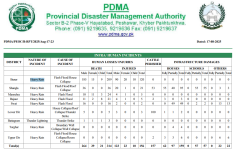
At least 314 people have died and 156 sustained injuries across Khyber-Pakhtunkhwa (K-P) due to floods, heavy rains, and related incidents from August 15 to 17, the Provincial Disaster Management Authority (PDMA) reported on Sunday.
Buner emerged as the worst-hit district with 209 fatalities, followed by Shangla with 36, Bajaur 21, Mansehra 24, Swat 16, Battagram three, and Lower Dir five.
ghazi52
THINK TANK: CONSULTANT
- Thread starter
- #266
PM deploys ministers to oversee flood relief in K-P
PDMA says at least 314 people have died, 156 have been injured across province due to floods and heavy rains
Web DeskAugust 17, 2025
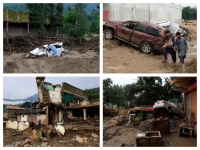
Prime Minister Shehbaz Sharif has deployed federal ministers to supervise relief efforts in flood-affected districts of Khyber-Pakhtunkhwa, after devastating floods and heavy rains left 314 people dead and 156 injured across the province between August 15 and 17, Radio Pakistan reported on Sunday.
Federal Minister for Kashmir Affairs and Gilgit-Baltistan, Engineer Amir Muqam, will oversee relief operations in Shangla and Buner, while the Power Division minister has been tasked with monitoring activities in Buner. Minister for Religious Affairs Sardar Yousaf will supervise operations in Mansehra, and Special Assistant to the Prime Minister Mubarak Zeb will coordinate relief in Bajaur.
ghazi52
THINK TANK: CONSULTANT
- Thread starter
- #268
KPK
Buner emerged as the worst-hit district with 209 fatalities, followed by Shangla with 36, Bajaur 21, Mansehra 24, Swat 16, Battagram three, and Lower Dir five. No deaths were reported from Torghar and Upper Dir, according to PDMA figures.
The report also recorded significant infrastructure losses, including 159 houses either fully or partially damaged in Lower Dir and Shangla, as well as 57 schools and 22 other facilities affected in different districts. Additionally, 157 cattle perished during the floods.
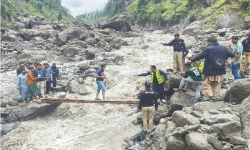
"Heavy rainfall, landslides and washed-out roads are severely hampering rescue efforts, particularly the transportation of heavy machinery and ambulances," said Bilal Ahmed Faizi, spokesman for K-P's rescue agency.
"In some areas, workers are forced to walk long distances to reach disaster sites," he said. "They are trying to evacuate survivors, but very few people are relocating due to the deaths of their relatives or loved ones being trapped in the debris."
Buner's district deputy commissioner, Kashif Qayum Khan, also said rescuers were forced to find new ways to reach remote areas. "Many more people may still be trapped under the debris, which residents cannot clear manually," Khan told AFP.
Buner emerged as the worst-hit district with 209 fatalities, followed by Shangla with 36, Bajaur 21, Mansehra 24, Swat 16, Battagram three, and Lower Dir five. No deaths were reported from Torghar and Upper Dir, according to PDMA figures.
The report also recorded significant infrastructure losses, including 159 houses either fully or partially damaged in Lower Dir and Shangla, as well as 57 schools and 22 other facilities affected in different districts. Additionally, 157 cattle perished during the floods.
"Heavy rainfall, landslides and washed-out roads are severely hampering rescue efforts, particularly the transportation of heavy machinery and ambulances," said Bilal Ahmed Faizi, spokesman for K-P's rescue agency.
"In some areas, workers are forced to walk long distances to reach disaster sites," he said. "They are trying to evacuate survivors, but very few people are relocating due to the deaths of their relatives or loved ones being trapped in the debris."
Buner's district deputy commissioner, Kashif Qayum Khan, also said rescuers were forced to find new ways to reach remote areas. "Many more people may still be trapped under the debris, which residents cannot clear manually," Khan told AFP.
RealNapster
Elite Member
Flash floods hit Buner hardest as death toll in northern areas surges to over 340
Umar Bacha | Zahid Imdad
August 16, 2025
View attachment 141248
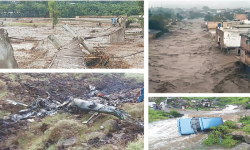
An overturned freight vehicle on the flood-affected Alpuri-Bisham Highway in KP’s Shangla on Aug 15, 2025. — APP
View attachment 141245
Residents walk in front of the damaged houses a day after flash floods in the Buner district of the monsoon-hit KP on Aug 16, 2025. — AFP
View attachment 141244
People gather near a damaged vehicle and scattered debris after the road washed out following a flash flood in Mingora, the main city of Swat Valley, in monsoon-hit KP on Aug 16, 2025. — AFP
View attachment 141246
People prepare a mass grave in KP’s Buner after over 200 people died in the district due to flash floods, on Aug 16, 2025. — via Umar Bacha
View attachment 141247
Rescue personnel at a flooded site in Mansehra following flash floods, on Aug 16, 2025. — Rescue 1122 via Um
The death toll from recent flash floods in Khyber Pakhtunkhwa surged to 327 on Saturday as various districts, especially hard-hit Buner, reported more loss of lives, the Provincial Disaster Management Authority (PDMA) said on Saturday.
This adds to the casualties in Gilgit-Baltistan and Azad Jammu and Kashmir, where the unprecedented floods have claimed at least 12 and nine lives, respectively, besides causing widespread destruction.
KP witnessed devastating scenes yesterday as flash floods caused by heavy rainfall and cloudbursts in multiple districts claimed over 200 lives in a day, including five crew members of a provincial government chopper that crashed in Mohmand during relief and rescue efforts.
Buner was the worst-affected district in the province with 204 lives lost in the past 48 hours, according to a PDMA situation report. It added that 120 people were injured, while Deputy Commissioner Kashif Qayum Khan’s office reported that 50 were still missing.
According to a PDMA report seen by Dawn.com earlier today, Shangla reported 36 deaths, Mansehra 23, Swat 22, Bajaur 21, Battagram 15, Lower Dir five and a child drowned in Abbottabad.
Detailing infrastructure damage, the report said 11 houses were destroyed while 63 were partially damaged due to the floods. Two schools in Swat and another in Shangla were also affected.
Buner have seen major damage. Locals saying some 500+ are killed or missing in the floods. A village of 80 homes was completely washed away. An elderly man lost 22 members of his family. Another man lost his 4 daughters, wife and a son. They are finding it difficult to dig so many graves. Allah

hussain0216
Elite Member
Make more dams
Make more water reservoirs
Make more canals
Take the water to other areas
The writing is on the wall, this is going to be common, climate change is making Pakistan into a funnel and we are going to become a wetter country and greener country and that water has to go somewhere
Enforce housing and planning laws to stop people building in dangerous areas
Any ethnic bullshit about dams and reservoirs should be punished
Make more water reservoirs
Make more canals
Take the water to other areas
The writing is on the wall, this is going to be common, climate change is making Pakistan into a funnel and we are going to become a wetter country and greener country and that water has to go somewhere
Enforce housing and planning laws to stop people building in dangerous areas
Any ethnic bullshit about dams and reservoirs should be punished
Users who are viewing this thread
Total: 2 (members: 0, guests: 2)
Pakistan Defence Latest
-
 Federal cabinet gives nod to imposition of emergency in KP; summary sent to president (19 Viewers)
- Latest: Goenitz
-

-

-
-

Country Watch Latest

Latest Posts
-
 Makkah Defence Alliance: Turkey, Saudi Arabia, and Pakistan, news & updates (49 Viewers)
- Latest: Hussain
-

-

-
 China does not recognize so-called 'Arunachal Pradesh' illegally set up by India, says spokesperson (8 Viewers)
- Latest: Panda_Hi
-