Pakistan Weather News / Updates

113mm rain lashes Lahore, disrupts routine businesses


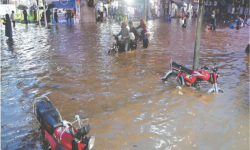
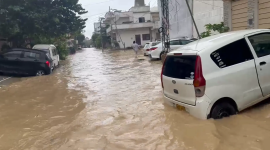
Heavy rain has lashed most areas of Lahore, inundating roads and localities and disrupting routine business.

According to the Water and Sanitation Agency (Wasa), the city received maximum rain (113mm) till 7pm at Paniwala Talab and its surrounding localities, followed by Iqbal Town with 97mm, Lakshami Chowk 96.5mm and Gulberg, 77.5mm.

The rain disrupted the electricity supply system in the provincial capital, tripping nearly 80 feeders of 11kV distribution capacity.

“Lahore has a combined drainage network/system that means the domestic/commercial sewage water and rainwater drain fall together into the Ravi after flowing into the main lines. Ideally, the drainage system for rainwater should be separate,” explained an official.

1757416685937.png
 

Lightning, rains continue to take toll on life and livestock in Sindh


Almost the entire Sindh has been hit by varying intensities of monsoon rains, in some areas for a third consecutive day, causing human and animal casualties as well as widespread destruction in terms of property and crops.

Six children were among seven killed in rain-related incidents, while an unspecified number of animals were also lost.
 

Over 260 Katcha dacoits mulling surrender due to impending flood in Sindh


Amid an ongoing operation against gangs operating in riverine areas, more than 260 dacoits have contacted police and expressed their willingness to surrender along with their weapons, on the condition that the government facilitates their reintegration into society.

Well-placed sources say that the present flood situation in the riverine areas was one of the key factors behind the dacoits’ willingness to surrender.

They said that the development was discussed during the inaugural meeting of the Katcha Areas Monitoring Committee (KAMC), which reviewed the ongoing anti-bandit operations, the security situation and the provincial government’s broader strategy.

The sources said that the Larkana police have informed their high-ups that more than 250 dacoits in the Katcha area have expressed their willingness to surrender in view of the impending flood threat.
 
To view this content we will need your consent to set third party cookies.
For more detailed information, see our cookies page.
 

Karachi rain deaths rise to 6; over 300 relocated as heavy showers swell Lyari, Malir rivers


Dawn.com | Imtiaz Ali
September 10, 2025

1757504702554.png

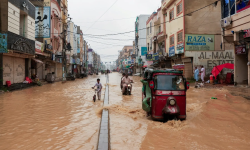
The image shows a flooded street in Saadi Town, Karachi on Sept 10, 2025. — DawnNewsTV

1757504869058.png

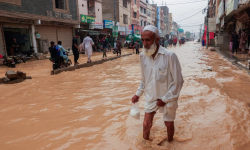
A resident wades through a flooded street after a rain, following a recent monsoon season, in Karachi on Sept 10, 2025. — Reuters/Akhtar Soomro

1757504757371.png

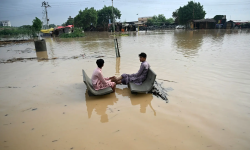
Youths rest on inundated benches along a flooded street after rainfall in Karachi on Sept 10, 2025. — AFP

1757504786416.png

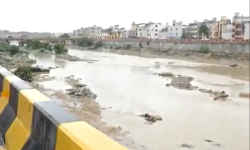
The image shows Malir river inundated following heavy monsoon rains in Karachi on Sept 10, 2025. — X/sindhinfodepart


1757504910960.png


The death toll from rain-related incidents in Karachi rose to six on Wednesday, while over 300 people were relocated to safety after heavy monsoon showers swelled the Malir and Lyari rivers.

Lyari and Malir rivers serve as Karachi’s main storm drains, channelling rainwater through a network of nullahs into the Arabian Sea. Once natural seasonal streams, they are now heavily constricted by urban sprawl, encroachments, and solid waste, turning many drains into open sewers. This blockage reduces their capacity to carry stormwater, causing frequent urban flooding during monsoon downpours.

Three more persons died in rain-related incidents in the metropolis today, raising the death toll since yesterday to six, while three were missing, according to rescue services.

Edhi rescuers recovered the bodies of a man and a woman after a van carrying four people fell into the rain-filled Konkar Nadi in Gadap Town, a statement issued by the Edhi Foundation said. The deceased were identified as 60-year-old Nabu Gulab and 45-year-old Javed Shah.

The rescue operation to find the other two missing people was underway, the statement added.
 
To view this content we will need your consent to set third party cookies.
For more detailed information, see our cookies page.
 
By using a road to works like a dam is a development planning problems. Water is a source of force, when volume accumulate , nothing can stand its way.

Creating a bank against a river bed and then putting a road on top isn't the hard part, done world over.

But when you make the foundation out of compacted sand and rock, because you don't think it's gonna rain that much and you wanna skimp on money (and get the repair contract), guess what's gonna happen?

In my village near Gujrat, the main road towards the town gets rebuilt EVERY year or so. With the same thin as paper tar layering on top. And the same chap gets to build it every time. With the new motorway plans and Shahbazpur bridge it's changed, but yeah.

Take the example of the new flyover at the F9 interchange in Islamabad (or was it the Aabpara one, can't remember now). The whole patch sunk, not even a year after opening.

Corruption runs rife in public sector construction.
 
Creating a bank against a river bed and then putting a road on top isn't the hard part, done world over.

But when you make the foundation out of compacted sand and rock, because you don't think it's gonna rain that much and you wanna skimp on money (and get the repair contract), guess what's gonna happen?

In my village near Gujrat, the main road towards the town gets rebuilt EVERY year or so. With the same thin as paper tar layering on top. And the same chap gets to build it every time. With the new motorway plans and Shahbazpur bridge it's changed, but yeah.

Take the example of the new flyover at the F9 interchange in Islamabad (or was it the Aabpara one, can't remember now). The whole patch sunk, not even a year after opening.

Corruption runs rife in public sector construction.


It looks like a rural road build on a flood area in flash flood what could go wrong?

Reality of today’s engineering courses ☹️
 
To view this content we will need your consent to set third party cookies.
For more detailed information, see our cookies page.


The lie to defend this corruption is even more hilarious.

To view this content we will need your consent to set third party cookies.
For more detailed information, see our cookies page.


So you built a roadway on a river bed without doing any feasiblity or design study, just YOLO it, and within a year water flows enough that you have to cut int?

I swear when you don't read Pakistani news the day goes by very happily.
 

‘The river is flowing like a river’: Karachi mocks mayor Murtaza Wahab’s post as the city floods again


From Ravi to Lyari, residents are pointing out the same lesson --- build on riverbeds, and rivers will take their course.

It’s been raining in Karachi for two days straight, and the city is once again paralysed. Floodwater has swallowed roads, leaving residents fearing another full-blown urban disaster. In the midst of this very real crisis, Mayor Murtaza Wahab posted a Facebook status that has now become the internet’s newest punchline.

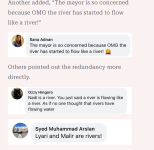
“It’s still raining like crazy and the situation at Lyari Naddi is a major concern. It’s flowing like a river at this point in time,” he wrote.

Karachiites didn’t let that one slide.

For one, the Lyari “naddi” is the Lyari River and rivers do indeed flow like rivers. Social media quickly tore apart the mayor’s observation.

One exasperated user wrote, “Lyari naddi is flowing like a river because it is a river! Fix it, let it flow!”
 
1757534915400.png

The bigger picture

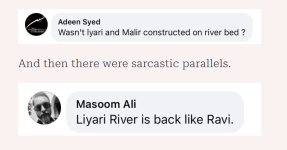
As funny as the mayor’s gaffe is, the bigger picture isn’t. Karachi’s two rivers, Lyari and Malir, are seasonal rivers that once brought fresh water from the city’s outskirts down to the Arabian Sea.

Over the decades, they’ve been encroached upon, blocked, and converted into open sewage drains. The floodplains that should have acted as natural buffers now host housing schemes and katchi abadis.

So when rain lashes Karachi, there’s nowhere for the water to go.

This isn’t just a Karachi problem either. Lahore’s Ravi River — also a river, for the record — has faced similar treatment. The Ravi Riverfront Urban Development Project saw extensive construction along a 46km stretch of its banks.

Earlier this season, entire communities lost billions in housing and businesses when the river reclaimed its path and floodwater swallowed what was never meant to be built there in the first place.
 

Users who are viewing this thread

Back
Top