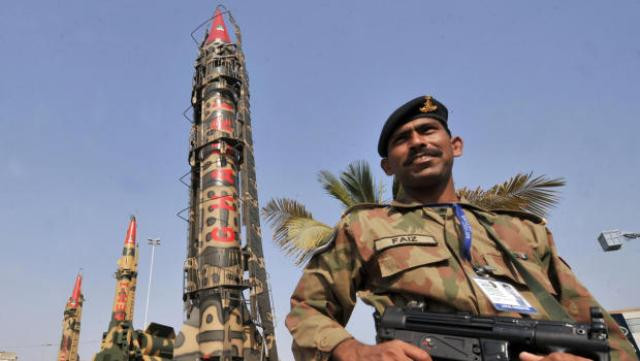
Pakistani Nuclear Forces

Many Indians are getting the wrong idea that they too can do what Israel did to the Iranian missile reponse from a few days ago.

Besides the fact that Iran purposefully allowed their oldest missiles to be flown in such a way as to get shot down easily, the Indians are getting ideas that Pakistan’s current missiles are up to the task, via a vi their ABM systems.

To resolve this misconception, Pakistan needs new missile systems, warhead systems, decoys, and to increase the size of the arsenal, as well as the yield of the warheads. Pakistan’s own ABM systems are also coming along, but it’s the Indian offensive thoughts that are destabilizing. To re-stabilize the balance and return to Minimum credible deterrence, Pakistan can achieve this most cost effectively, IMHO, by rapidly growing arsenal and building a Fast Breeder reactor, similar to the two being build in China, each of which can yield 330 kg of plutonium a year. This is enough fissile material for at least 20 warheads a year, if not many more if combined with the HEU in two-stage devices. Even a modest 200 more warheads a decade could keep India guessing.

Indians need to know that there are enough warheads and modern missiles that enough will get through their defenses, that they should not consider testing Pakistan’s red lines.
There is a baffling belief among the Indian public and policy making circles, that India can win a nuclear war.

Pakistan publicizing the fact that it has Salted Cobalt bombs would help dispel such delusions.
 

IAEA refutes Indian media reports of radiation leak in Pakistan​

IAEA says no radiation leak or incident detected at any nuclear site in Pakistan, dismissing all speculation.

News Desk
May 16, 2025

tribune


As Pakistan and India trade accusations over nuclear weapons mismanagement, the International Atomic Energy Agency (IAEA) confirmed to BBC Urdu on Thursday that “no radiation leakage or incident has been detected at any nuclear site in Pakistan.”

The issue came up after unverified reports emerged in Indian media, alleging that Indian airstrikes targeted Pakistan’s Kerana Hills, where a stockpile of nuclear missiles is reportedly located.

Amid the media speculation, the IAEA confirmed to the British broadcaster that “based on available data, no radiation leakage or incident has been detected at any nuclear site in Pakistan.” The Indian Air Force also denied striking any nuclear facility.

Earlier, Indian Air Marshal AK Bharti was asked at a press briefing whether reports of a strike on the Kirana Hills nuclear site were accurate. “Thank you for informing us that there is a nuclear facility there—we didn’t know,” he said sarcastically, adding, “we did not target Kirana Hills, regardless of what is or isn’t there.”

India and Pakistan traded accusations of nuclear weapons mismanagement on Thursday, days after reaching a ceasefire agreement following days of escalation.

India’s Defence Minister Rajnath Singh said that the IAEA should take control of Pakistan’s nuclear weapons—just days after the two nuclear-armed neighbours concluded one of their worst military escalations in nearly three decades.

“Are nuclear weapons safe in the hands of such an irresponsible and rogue nation?” Singh asked while addressing soldiers in Srinagar, the capital of Indian Illegally Occupied Jammu and Kashmir (IIOJK). “I believe that Pakistan’s nuclear weapons should be taken under the supervision of the IAEA.”

Pakistan responded firmly, calling the remarks “provocative” and aimed at undermining the credibility of its nuclear deterrent. The Foreign Office strongly condemned the Indian Defence Minister’s comments, labelling them “irresponsible” and reflective of India’s “frustration and insecurity.”

“These remarks are not only misleading but also reflect a lack of understanding of the IAEA’s mandate,” said the FO spokesperson, adding that Pakistan does not rely on nuclear blackmail to maintain deterrence—unlike India.
 
To view this content we will need your consent to set third party cookies.
For more detailed information, see our cookies page.
 
Youm-e-Takbir, which translates to "Day of Greatness," is a national day in Pakistan celebrated on May 28th, commemorating the Chagai-I and Chagai-II nuclear tests that took place on that day in 1998.

These tests made Pakistan the seventh nation and the first Muslim nation to possess nuclear weapons.

The day is marked by flag hoisting, atomic energy exhibitions, award ceremonies, patriotic songs, entertainment, military programs, and speeches.
 

Youm-e-Takbeer: A historic day makes Pakistan’s defense impregnable​


BySaif Ur Rehman
May 27, 2025

PESHAWAR (APP): The people of Khyber Pakhtunkhwa are all set to celebrate Youm-e-Takbeer on Wednesday with patriotic fervor, marking the 27th anniversary of Pakistan’s successful nuclear tests conducted in Chagai, Balochistan on May 28, 1998.

Citizens from all walks of life—ranging from Chitral to Dera Ismail Khan and Kohistan to Khyber—along with government officials, civil society members, students, and political activists will participate in rallies, seminars, walks, and speech competitions to honour this pivotal day in Pakistan’s history.

On this day in 1998, Pakistan had successfully responded to a series of Indian nuclear tests by detonating six nuclear devices, becoming the seventh nuclear power in the world and the first in the Muslim world. The bold move of the then PMLN Govt established strategic balance in South Asia and was widely seen as a significant achievement in the nation’s defense capability.

The day will begin with special prayers across mosques for the country’s progress, peace for the martyrs, and the freedom of Indian-occupied Jammu and Kashmir.

The government has declared May 28 a public holiday, with the national flag to be hoisted on the government buildings across the country including Khyber Pakthunkhwa.

Glowing tributes will be paid to former Prime Ministers Muhammad Nawaz Sharif and Zulfikar Ali Bhutto, as well as the country’s scientists, engineers, and strategic institutions for their invaluable roles in achieving the much needed nuclear capability.

Speaking to APP, Ejaz Khan, former Chairman of International Relations at the University of Peshawar, said Pakistan’s nuclear tests have restored regional deterrence and significantly elevated our country’s international stature.

“It was a moment of great pride for the entire nation and the Muslim world as 27 years ago on this historic day Pakistan joined the prestigious club of nuclear states,” he remarked,” he said, adding former PM Nawaz Sharif’s decision of going for the tests have proved correct today after India’s unprovoked attacks on May 7, 2025.

Brigadier (R) Mahmood Shah, former Secretary of Law and Order of erstwhile FATA, highlighted the persistent security challenges Pakistan has faced since its inception. He noted that India’s aggressive policies, including the illegal occupation of Jammu and Kashmir since 1947, four wars, and more recent hostilities such as the Balakot air strike and attacks inside Pakistan and Azad Kashmir in May 2025, compelled Pakistan to fortify its defense.

“India’s hegemonic ambitions left Pakistan with no choice but to respond decisively in 1998,” Brig Mehmood said, adding that Pakistan’s military strength has consistently foiled hostile designs of the enemy.

Ikhtiar Wali Khan, the Prime Minister’s Coordinator on Information and KP Affairs, emphasized former Prime Minister Nawaz Sharif’s leadership in resisting international pressure to proceed with the nuclear tests. “Had Pakistan not responded on May 28, it would have remained vulnerable to regional threats,” he said.

Condemning acts of sabotage, such as the arson attack on the Chagai Mountain model at Radio Pakistan Peshawar in 2023, he called it an attack on national pride and demanded bringing perpetrators to justice.

Experts lauded the success of recent operations of Iron Wall and Marak-e-Haq, in which Pakistani forces proved their advanced operational capabilities, including downing multiple Indian warplanes.

Showing its superiority against India during operation Iron Wall, Pakistani forces have shotdown six IAF warplanes including Rafale jets besides destroyed bases and military infrastructure of the enemy.

Dr Ejaz said Pakistan and India should come to the negotiating table and resolve the issue of Jammu and Kashmir for durable peace in the region. He said that Pakistan had lost about 90,000 people in the war against terrorism, besides enduring economic losses worth $150 billion and time has come to inform the world community about Pakistan’s sacrifices in war against terrorism.

He appreciated Prime Minister Muhammad Shehbaz Sharif recent visit to brotherly countries of Turkey and Iran, saying that such high profile visits were the need of the hour on the diplomatic front after Indian naked aggression.

They said India had unleashed baseless propaganda against Pakistan about the Pahalgam incident and killed innocent people and children in Pakistan and Azad Kashmir’s missile attacks.

Dr Ejaz said that it was India that rejected the sincere offer for an investigation at an international level about the Pahalagam incident and launched unprovoked attacks inside Pakistan and Azad Kashmir that badly tarnished the Modi Govt image.

The experts said the aggressive designs of fascist Modi Govt have put peace in South Asia at stake, urging the UN Security Council to implement its resolution on Kashmir.

They said that the road to peace in South Asia was passing through Kashmir and another war between nuclear powers would put peace of the entire region into jeopardy.

They reiterated that national security goes hand in hand with economic stability and praised the government’s efforts to steer the country towards economic resilience and growth despite past sanctions and crises.

Youm-e-Takbeer remains a symbol of Pakistan’s unwavering commitment to its sovereignty and the unity of its people in the face of adversity. They said Youm e Takbeer was a proud day in the history of Pakistan and people of KP are ready to celebrate it with national enthusiasm.
 
Hidden in Plain Sight, Striking without Warning.
A Mirage IIIE/R sitting at PAF Base Sargodha....


1690229704823.png
 
To view this content we will need your consent to set third party cookies.
For more detailed information, see our cookies page.
 
To view this content we will need your consent to set third party cookies.
For more detailed information, see our cookies page.
 

Analysis: 27 years after Chagai: nuclear shadows & doctrinal dilemma


Pakistan’s quid pro quo plus aims at preventing all-out conflicts, but India’s reckless behaviour to expand geographic scope risks nuclear catastrophe.

Baqir Sajjad Syed
May 28, 2025

Twenty-seven years after Pakistan’s nuclear tests, a pressing doctrinal dilemma has come into focus: while the nuclear arsenal has succeeded in deterring full-scale war, a troubling pattern has emerged — India’s growing reliance on calculated and limited conventional strikes. This evolving challenge requires a clear and adaptive strategy to effectively counter it.

These operations, which Delhi has designed to stay below the nuclear threshold, have manifested the shrinking space in which our deterrence operates in the highly volatile South Asian environment. The time has come to rethink and update our understanding of deterrence — one that reflects the realities of today, where conflict no longer arrives with armies massing at borders, but with drones in the sky and missiles that strike and disappear before the world has time to respond.

On May 7, India launched “Operation Sindoor” — a coordinated assault involving air strikes, drone swarms, and missile attacks deep inside Pakistani territory. The strikes hit a disturbing range of targets from religious institutions like mosques to strategic military installations.

Pakistani armed forces that follow a “quid pro quo plus” policy with regards to India, responded robustly and swiftly, downing multiple Indian aircraft — including Rafale, Mirage 2000, MiG-29, and Su-30 jets in a short span of less than an hour — employing stand-off weapons and air defence systems to signal its resolve.

But instead of de-escalating, India escalated further.

Pakistan’s quid pro quo plus aims at preventing all-out conflicts, but India’s reckless behaviour to expand geographic scope of its strikes risks miscalculation resulting in a nuclear catastrophe

By the next morning, a wave of drones swarmed Pakistani skies, followed a day later by fresh missile attacks on airbases. It was a moment of real danger. The international community scrambled to contain what was quickly becoming a runaway crisis. Deterrence, while not broken, was undeniably shaken.

India’s willingness to act and expand geographic scope of its strikes, echoing Uri in 2016 and Pulwama-Balakot in 2019, points to a gap in Pakistan’s ability to deter reckless Indian behaviour due to emergence of newer technologies. To put it simply, Pakistan’s shield is holding, though it may be fraying at the edges.

Pakistan’s nuclear weapons programme, born from the trauma of 1971, was built on a simple promise: to make any future aggression against the country unthinkable. Between 1998 and 2015, that promise largely held. Even during moments of extreme tension like the Kargil crisis of 1999, months-long military standoff in 2002 or the aftermath of the 2008 Mumbai attacks, India refrained from crossing the Line of Control and the international border or undertaking major strike in Pakistani heartland. But that calculus began to shift post-2015 especially following the Gurdaspur attack barely weeks after Indian Prime Minister Narendra Modi had met then Pakistani prime minister Nawaz Sharif at Ufa. First came the claimed “surgical strikes”, then the 2019 aerial incursion following Pulwama.

“South Asia has neither crisis stability nor arms race stability. While I do not expect a crisis for some time — perhaps several years — the region remains unstable and dangerous,” said Christopher Clary, a security affairs expert at the University at Albany, the US.

The May 2025 clash — an intense 88-hour exchange of air strikes, drones, and missile fire — marked a deeper evolution of this trend of a rapid escalation under the nuclear overhang. It laid bare a dangerous new reality: India believes it can operate in a “grey zone” just below the nuclear threshold, using limited, precise force to impose costs without triggering all-out war. Indian leaders appear beholden to the idea that they can hit Pakistan without provoking an uncontrollable escalation. From Uri to Balakot, and now Pahalgam, the visible trend is that each strike is a calculated test of Pakistani resolve, and each one pushes the boundaries a little further.

Pakistan’s “quid pro quo plus” policy, adopted after 2016, meant to meet Indian aggression with a harder blow, aimed to slam this door of a military conflict below nuclear rung shut. But three incidents in nine years show Pakistani “plus” isn’t scaring India enough. The policy’s success is bittersweet: it prevents all-out conflict, but India does exploit some space to commit aggression.

Elizabeth Threlkeld, director for South Asia at the Stimson Center, the US, agrees “the limitations of Pakistan’s quid pro quo plus approach are becoming more visible in light of India’s increasing willingness to engage in limited conventional actions.”

Misstep towards catastrophe

Each Indian operation is designed to normalise limited raids in the eyes of the world. If this continues, and strikes on mainland Pakistan are repeated, it would increase the risk of a misstep towards nuclear catastrophe as each crisis raises the stakes. Getting an opportunity to dump the payload on a Balakot hill in 2019 gave way to mainland strikes in 2025, setting a higher baseline for the next clash. A more worrying aspect is that if this cycle will persist, each round will compress decision making windows in a world of hypersonic weapons.

India’s playbook is clear: use modern technology — drones, standoff missiles — to inflict pain while staying below nuclear tripwires. Modi is therefore attempting, at least on his part, to rewrite the rules, projecting strength to domestic audiences and signalling that Pakistan’s nuclear shadow won’t paralyse India. Whispers of pre-emptive counterforce strategies, meanwhile, have in the past few years circulated with growing frequency, though such a gamble remains improbable.

“In March 2022, an Indian BrahMos missile landed in Mian Channu. Delhi called it an error, Pakistani leadership accepted the explanation, but I saw it as a deliberate test of our defences, including our response time. BrahMos is central to India’s pre-emptive strike plans, its speed and precision leave little time to respond, making such incidents dangerously destabilising for Pakistan,” Dr Shireen Mazari, who was a federal minister in 2022, said, alluding to the debates within the system at that time.

India’s confidence in multi-domain warfare, blending crewed and uncrewed platforms, creates a false sense of control, as if escalation can be neatly managed.

The proponents of such an approach forget that wars don’t always proceed as per calculated decisions, rather they often unravel through confusion.

A single misstep, like a missile or an artillery piece gone astray or a misunderstood signal, can unravel restraint and push a tense standoff into full-blown catastrophe.

What makes it scarier in Indian case is that the extremist Hindutva mindset currently dominating New Delhi and electoral pressures push the government to demonstrate strength through limited strikes, confident they can avoid nuclear escalation. This dynamic perpetuates the very crises their leaders must manage.

“The very presence of recurring conventional engagements highlights the precariousness of the situation, where misperceptions of red lines could lead to inadvertent escalation between the two nuclear-armed adversaries,” Threlkeld maintained.

Deception or internal dysfunction?

Following India’s aerial strikes on the morning of May 7 and Pakistan’s forceful retaliation, Indian External Affairs Minister S. Jaishankar and National Security Adviser Ajit Doval conveyed messages through international intermediaries indicating that New Delhi wanted to de-escalate. But to Islamabad’s surprise, shortly after it received these signals, Pakistan’s airspace was swarmed by hostile drones. Whether this was a deliberate act of deception or a sign of internal dysfunction within the Indian system remains unclear.

However, one plausible explanation is that hardliners within India’s security establishment pressured the military to climb the next rung of the escalation ladder — targeting Pakistani military installations with unmanned platforms, despite diplomatic overtures suggesting restraint.

In this scenario, Pakistan faces a stark choice: continue pursuing a doctrine that punishes India after the incident or forge one that stops India cold.

First, there is a need to strengthen our conventional arsenal, which includes acquisition of modern fighter jets, advanced air defences, rapid-response units, and precision munitions, to make limited strikes too costly. Second, ambiguity, using cyber-attacks, economic pressure, or international legal action to raise India’s costs without nuclear risks, should be embraced. The ‘catalytic posture’, which involves signalling nuclear readiness to draw international mediation has worked well so far in South Asian environment, but its overuse risks diminishing returns.

Dr Adil Sultan, a dean at the Air University and a former SPD official, while explaining his vision of next generation of deterrence, said, “The future conflict is likely to be more intense, complex, and short, thus requiring quick response through ‘multi-domain integration’ (MDI) of all three services, and ground and space-based assets, with PAF being in the lead due to its inherent agility and capacity to act in a shortest possible time with maximum effect.”

Pakistan should also re-emphasise red lines through robust crisis channels especially after the targeting of the airbases.

So here we are back, 27 years later, on the same razor’s edge — thanks to the technological advancement. The nuclear bombs remain the ultimate guarantor of Pakistan’s sovereignty and territorial integrity, but every knife-edge attack or missile/drone strike cannot be stopped. The nukes can only promise that if the worst comes, both sides will pay an unthinkable price.

Published in Dawn, May 28th, 2025
 

Nuclear deterrence

Aizaz Ahmad Chaudhry
May 26, 2024

FIFTY years ago, in May 1974, India detonated its first nuclear device, calling it Operation Smiling Buddha. While the world remained largely silent, Pakistan’s foreign minister declared Pakistan would “never submit to nuclear blackmail” or “accept Indian hegemony over the subcontinent”. Earlier, Zulfikar Ali Bhutto had expressed the resolve that if India ever built a nuclear weapon, Pakistan would ‘eat grass’, but build one of its own.

Given India’s role in dismembering the country in 1971, the Pakistani leadership found it imperative to restore the power equilibrium by nuclear capability to deter further Indian aggression.

In 1998, South Asia became overtly nuclearised. On May 11, 1998, India tested its nuclear devices. Given the significant conventional asymmetry, Pakistan followed suit on May 28 as it could not remain vulnerable. Its nuclear tests restored the strategic balance and re-established nuclear deterrence, which essentially means deterring an adversary from conventional or nuclear aggression due to concerns that there would be retaliation that could eventually lead to mutual assured destruction.

Nuclear weapons are political weapons, ideally not intended for war-fighting. Their main purpose is to deter wars. Since 1998, South Asia has not seen a major war, primarily due to nuclear deterrence. However, nuclear deterrence could not prevent confrontations below the nuclear overhang — for instance, clashes in Kargil in 1999, troops mobilisation in 2001-2, and Indian aggression in Balakot in 2019.

While none of these confrontations assumed the proportions of a major war, owing to nuclear deterrence, the risk of kinetic confrontations escalating into the nuclear dimension could not be ignored. With India’s aggressive doctrines like Cold Start, Pakistan opted for a full-spectrum deterrence posture, while remaining within the ambit of credible minimum deterrence to deter all aggression — from tactical to strategic level.

That said, nuclear deterrence is not a panacea to deter all forms of aggression and resolve our conflict with India. Pakistan has to rely on other instruments of national power, including conventional capabilities, to tackle threats on its borders. Political stability, economic strength, and public support for defence also enhance deterrence. Diplomacy, too, has an important role. Both countries agreed in 1988 not to attack each other’s nuclear facilities. There is also an agreement to prevent airspace violations (1991). The Vajpayee-Sharif meeting in Lahore in 1999 introduced several confidence-building measures to reduce the danger of nuclear warfare. An agreement was reached on advance notification of missile testing in 2005. In 2006, both sides agreed to reduce the risk of nuclear accidents or the unauthorised use of nuclear weapons.

Nuclear weapons are political weapons.

Given the dangers of a nuclear conflagration, both countries have, directly or indirectly, engaged in discussions on how to maintain strategic stability in South Asia. In nuclear parlance, strategic stability is often defined as removing incentives for the use of nuclear weapons or for engaging in a nuclear arms race.

Another view of strategic stability, to which Pakistan subscribes, is that the nuclear discourse cannot be segregated from regional geopolitics. US-India nuclear cooperation has created an environment of discrimination and imbalance in South Asia, which can be destabilising. Strategic stability requires that there should be no armed conflict or unresolved dispute or even grave mutual grievances, which could lead to instability or a wider war.

The need for regional adversaries to show nuclear restraint and responsibility, nuclear safety and security, and effective command and control cannot be over-emphasised. India’s accidental firing of a BrahMos missile into Pakistan and its failure to inform Pakistan well in time could have easily escalated matters. Nuclear arms must never fall into unauthorised or the wrong hands. Equally important, the leadership must eschew irresponsible rhetoric and brandishing of nuclear weapons (Diwali fireworks, ‘qatal ki raat’).

Emerging technologies, particularly AI, multirole drones, hypersonic missiles, and cyberspace, could also adversely affect nuclear deterrence and strategic stability. Of particular danger are lethal autonomous weapons that can search and engage targets without human intervention.

International negotiations have made little progress towards evolving an international regime that could minimise the dangers of emerging technologies.

It is of utmost importance that India and Pakistan engage in meaningful dialogue to avert risks of escalation in crisis situations, enhance understanding of each other’s nuclear postures, and address mutual threat perceptions.

The writer is former foreign secretary and chairman of Sanober Institute, Islamabad.

Published in Dawn, May 26th, 2024
 
To view this content we will need your consent to set third party cookies.
For more detailed information, see our cookies page.
 
To view this content we will need your consent to set third party cookies.
For more detailed information, see our cookies page.
 

Pakistan’s endeavors for peaceful nuclear energy​

The Frontier Post

1649441344124.png


According to media reports, Unit 3 of the Karachi nuclear power plant has successfully reached 100% capacity for the first time on 31 March. The hot functional testing of Karachi 3 which simulates the temperatures and pressures that the reactor systems will be subjected to during normal operation and is carried out before loading nuclear fuel was completed ahead of schedule on 4 November last year. As said, the reactor achieved its first criticality on 21 February and was connected to the national grid on 4 March.

The Pakistan Atomic Energy Commission (PAEC) has told the media that various functional and commissioning tests have since been carried out at power levels of 25%, 30%, 50%, 75%, and 87% capacity, and completion of testing at full capacity, while the plant will perform a 100-hour demonstration run, after which it will enter commercial operation.

The huge financial investment and hard work of Pakistani Engineers and Chinese nuclear experts have made this dream a reality over the last six years.

Being a Security state and an inherited existential threat from an eternal enemy, Pakistan initiated its nuclear program in the 1960s, however, at that time, its prime objective was to strengthen its military capabilities instead of the generation of nuclear energy.

Pakistan did not sign Nuclear Non-Proliferation Treaty (NPT) because Pakistan did not intend to surrender its ambition of being a nuclear-armed state, thus western nations, and the Nuclear Supplier Group (NSG) refused to cooperate with Pakistan in the nuclear domain, therefore Pakistan’s civil nuclear program could not achieve its full potential in the past. However, Pakistan and China kicked off bilateral cooperation in nuclear energy through an agreement in 1986.

Due to Chinese cooperation, Pakistan was able to construct five nuclear power plants with a production capacity of 2242 MWe, which constitutes about 8% of the country’s total energy needs. After completion of the K-3 Nuclear Power Plant, an additional 1104 MWe will be added to the mainstream Thus, the share of nuclear energy in the national electricity grid would reach 10 percent of total consumption.

The Pakistan-China nuclear cooperation is successfully touching new heights as both nations had jointly constructed six nuclear power plants in the past three decades including the newly completed K-3 which successfully attained all operational standards.

PAEC had struck a deal with Chinese Nuclear energy firm China National Nuclear Corporation (CNNC) for the construction of four additional Hualong one Pressurized Nuclear Reactors commonly known as HPR-10000 in August 2021.

According to reports, the Chinese firm will construct two Hualong one nuclear reactors in Karachi (K-4, K-5), and two similar reactors will be constructed at Muzaffargarh (M-1, M-2) in the coming years. Both China and Pakistan had laid the foundations of a substantial and long-term cooperation that would strengthen the Pakistan Nuclear Energy industry through the construction of additional nuclear plants, aiding uranium exploration, nuclear waste management, nuclear fuel, and nuclear technology application.

Presently, Pakistan is in negotiation with the IAEA for the provision of IAEA’s nuclear safeguards for its nuclear power plants which would further pave the path for Pakistan- IAEA cooperation in the future.

Pakistan has attained significant expertise in nuclear technology hence it should initiate dialogue with NSG for nuclear cooperation that could lead to its unhindered access to the latest nuclear technologies in the future.
,.,.,.,,
 
June 1998 , a month after the nuclear tests, one of my siblings had a chance to meet Dr A Q Khan and requested a signed photograph.
He said ok , and asked for address, which was given to him on a piece of paper.

He sent it to us at our home address on 5th of July 1998.
He remembered his words .

IMG-20250528-WA0006.jpg
 

Users who are viewing this thread

Back
Top