Pakistan's Airborne Early Warning and Control Aircrafts

Well that only goes to prove the point I was making, the fact the PLAF did not procure that ZDK and instead opted for a more advanced version, the KJ500, meant that the PAF were then left with a high risk high cost, platform. If what you're saying is true, then it seems the ZDK was more of a test bed for the KJ500, and the PAF took the technical risk to procurement this, instead of thr KJ200 or wait for that KJ500. Either way, it was a bad choice.
The ZDK was not a natural PAF choice. It was a Musharraf-era imposed solution. Chinese interests were pressing hard for a larger share of Pakistan's procurement spend at a time when the PAF wanted to prioritize F-16s and Erieye, and they did not want to watch that money flow elsewhere. The actual opening came from the integration problem around bringing the JF-17 into a network still shaped around Western systems, especially the question of how to handle Link-16 connectivity across mixed fleets. That hurdle was seized on by people who wanted a Chinese answer, and the ZDK was pushed into the picture despite the fact that important circles in the PAF were deeply unhappy with it. In plain terms, the platform was less an operational preference and more a politically driven procurement outcome dressed up as a technical necessity.
None of this should be read as anti-Chinese. This is how the world works. Every serious supplier state leans on buyers when defense money is on the table. The Chinese do it, the French do it, the British do it, the Swedes do it, and the Americans do it most aggressively of all. Anyone pretending this sort of pressure, lobbying, and kickback politics is some uniquely Chinese behavior is either naive or sanctimonious.

The real issue was never that the Chinese were behaving for their interests. The issue was that Pakistan's procurement system was weak enough to let outside pressure and internal opportunists turn a technical hurdle into a bad purchase.
 
With any technology, the sooner you adopt it, the sooner you stand to benefit; however, you simultaneously face a correspondingly higher level of technical risk.

Consider another case in point:

China utilized the JF-17 program to test its proprietary DSI technology. You remain free to criticize this approach as much as you wish.

From Pakistan's perspective at the time, the choice was clear: either accept this arrangement—thereby assuming the associated technical risks within the context of the JF-17 project—or wait until China had fully matured the technology on other platforms before applying it to the JF-17. The latter option, however, could have entailed a delay of many years.

The research findings derived from this initiative were ultimately applied to other fighter aircraft, such as the J-10C and J-20. Nevertheless, the JF-17 holds the distinction of being the world's first mass-produced fighter jet to incorporate DSI technology.

If you believe that Pakistan should have waited for the technology to reach full maturity before adopting it, I invite you to calculate the resulting timeline for yourself.

================

Any perspective that adheres strictly to a rigid, either-or dichotomy is ill-suited for a meaningful discussion of topics such as this.
Your entire premise relies on a completely fabricated timeline. China did not "invent" DSI technology, and Pakistan was not taking some massive blind leap of faith on an untested concept.

Lockheed Martin invented and optimized Diverterless Supersonic Inlet (DSI) technology in the early 1990s. They completely proved the concept in the real world when they successfully bolted a DSI onto an F-16 Block 30 and flew it at Mach 2.0 in December 1996. Lockheed secured the patents for it in 1998.

The JF-17 development program, as a joint venture, did not even formally commence until 1999. The JF-17's design was not finalized until 2001, and the DSI was not incorporated into the prototypes until years after Lockheed had already publicly proven the aerodynamics of the bump inlet.

So your "choice" between taking a massive technical risk or waiting years for China to mature it is a false dichotomy. The aerodynamic principles of DSI were already de-risked and validated by the Americans before the first piece of metal was cut for the JF-17. China simply reverse-engineered a proven American concept and applied it to the FC-1/JF-17 airframe. Yes, the JF-17 became the first operational aircraft to use it because the F-35 development cycle was vastly longer and more complex, but that does not mean Pakistan was acting as a blind crash-test dummy for unproven science.

The research findings derived from the JF-17 were certainly useful for the J-10B/C and J-20, but framing Pakistan as taking on the primary "associated technical risks" of a brand new technology is just historical revisionism. You are trying to make a basic technology transfer look like a grand, high-risk strategic gamble.
 
With any technology, the sooner you adopt it, the sooner you stand to benefit; however, you simultaneously face a correspondingly higher level of technical risk.

Consider another case in point:

China utilized the JF-17 program to test its proprietary DSI technology. You remain free to criticize this approach as much as you wish.

From Pakistan's perspective at the time, the choice was clear: either accept this arrangement—thereby assuming the associated technical risks within the context of the JF-17 project—or wait until China had fully matured the technology on other platforms before applying it to the JF-17. The latter option, however, could have entailed a delay of many years.

The research findings derived from this initiative were ultimately applied to other fighter aircraft, such as the J-10C and J-20. Nevertheless, the JF-17 holds the distinction of being the world's first mass-produced fighter jet to incorporate DSI technology.

If you believe that Pakistan should have waited for the technology to reach full maturity before adopting it, I invite you to calculate the resulting timeline for yourself.

================

Any perspective that adheres strictly to a rigid, either-or dichotomy is ill-suited for a meaningful discussion of topics such as this.

False equivalence. You can't really compare a DSI intake to a significantly more complex system like an AWACS aircraft.

But you're still not getting the main point, it was a bad choice for the PAF, for many reasons, including the fact that it wasn't adopted by the PLAF and lacked development support. It's nothing to do with anything anti-Chinese, but purely a criticism of the system. You have to ask yourself, if it was a good system, why didn't the PLAF adopt it? If the current news reports are to be believed, the PAF is happy to adopt a system that is inducted by the PLAF and has support, like KJ500.
 
are all 10 AEWCS operational ? if so that will be really good number... If PAF gets six KJ500A that will be an awesome news.
6 is a big number giving it's per unit cost. Only 2-3 will be procured.
 
I heard 10 Erieye and 5 normal Saab 2000

You can see here


Anyway, it is about twice as many as India with less then a 5th of the landmass to cover

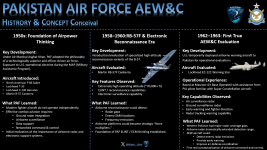
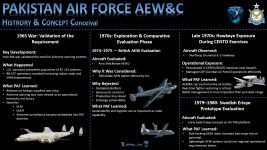
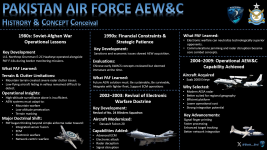
Worth highlighting that the PAF currently operates 12 Erieyes, including 05 later-inducted “ER” variants. While exact figures are not public, the general consensus places the Erieye ER’s detection range at around ~600–650 km Vs ~500 km for the earlier version.

There have also been unconfirmed reports suggesting that the older Erieyes may be undergoing MLU to ER standard at PAC Kamra. Notably, in the post-clash briefing the following day, the PAF spokesperson confirmed that the Erieye ER was part of the 7th May night package.

As always, the PAF has kept details regarding the Erieye fleet and Blinders Squadron fairly limited — and at times somewhat confusing — in the public domain.
 
No one really knows for sure. 2-3 is not enough to have one in the air 24/7

Minimum capability for AEW is 4 planes
We need to have 1-2 for KSA, because given the rising threat from the "Gods Chosen" people, I think PA troops, jets and a AWACS can give us some time if they decide to get naughty with us again.
 
We need to have 1-2 for KSA, because given the rising threat from the "Gods Chosen" people, I think PA troops, jets and a AWACS can give us some time if they decide to get naughty with us again.
Saudis have Saab 2000 Erieye of their own!
 
Worth highlighting that the PAF currently operates 12 Erieyes, including 05 later-inducted “ER” variants. While exact figures are not public, the general consensus places the Erieye ER’s detection range at around ~600–650 km Vs ~500 km for the earlier version.

There have also been unconfirmed reports suggesting that the older Erieyes may be undergoing MLU to ER standard at PAC Kamra. Notably, in the post-clash briefing the following day, the PAF spokesperson confirmed that the Erieye ER was part of the 7th May night package.

As always, the PAF has kept details regarding the Erieye fleet and Blinders Squadron fairly limited — and at times somewhat confusing — in the public domain.
Never heard 12 as a number what we all know is either 7 or 9 .ost probably 9 operation while 10th written off
 

Users who are viewing this thread

Country Watch Latest

Latest Posts

Back
Top