Pakistan's Minorities Citizens

Pawan Kumar, who had arrived at the temple from Punjab Chowrangi, said that he had been coming there every day. This time he was taking with him boxes of vegetable biryani. “It is a prasad offering as well as delicious food,” he said. “I’m just going to safely place the boxes inside my car before going back to play Holi,” he smiled.

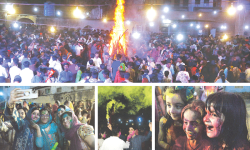
There was loud music playing famous Holi songs from Bollywood movies along with the dowsing and splashing of colours until it was time to set ablaze the Holi Mata. Then you could only hear bhajans as the fun turned into rituals of faith.

With a microphone in hand, one of the temple volunteers, Vinod Madhani, led the bhajan singing with “Om Jai Jagdish Hare”, which gradually turned into a chorus with everyone else joining in. The children too stopped their games until the Holi Mata had burned down completely. Then it was back to the festivities.
 

Holi and Ramazan come together in desert city of Mithi

Local police, administration officials say the city has a low crime rate, allowing them to easily make arrangements for the major religious festivals.

AFP
March 14, 2025

In the desert city of Mithi, Hindus prepare meals for fasting Muslims, who in turn gather to welcome a Holi procession, a rare moment of religious solidarity.

Discrimination against minorities runs deep, but those tensions are not to be found in Sindh’s Mithi, an affluent city of rolling sand dunes and mud-brick homes.

“All the traditions and rituals here are celebrated together,” Raj Kumar, a 30-year-old Hindu businessman told AFP.

“You will see that on Holi, Hindu youth are joined by Muslim youth, celebrating together and applying colours on each other,” he added.

“Even at the end of the Muslim call for prayer, the imam says ‘peace to Hindus and Muslims’.”

This year, the Hindu festival of Holi and the holy month of Ramazan fell together. Both events move each year according to the lunar calendar.

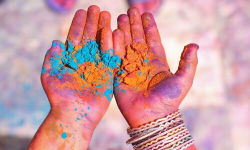
Holi, the festival of colour, has for centuries marked the arrival of spring and raucous crowds playfully throw coloured powder and water over each other.

Hindu residents buy coloured powders to celebrate the festival of Holi in Mithi on March 13. — AFP


Hindu residents buy coloured powders to celebrate the festival of Holi in Mithi on March 13. — AFP

On Thursday, hundreds of Hindus held a procession through the streets of Mithi, one of the few cities where they form the majority, to be warmly welcomed at the city square by their Muslim neighbours.

“We have learnt to live together since childhood. This has come to us through generations, and we are following it too,” said local Mohan Lal Mali, 53, after arranging a meal for Muslims to break their fast.

Cows, considered sacred in Hinduism, roam freely through the streets of Mithi, while women wear traditional embroidered sarees embellished with mirror work.

There is no beef shop in town, as the meat is prohibited in Hinduism, and Muslims only sacrifice goats during festivals.

People celebrate the Hindu festival of Holi in Mithi on March 13. — AFP


People celebrate the Hindu festival of Holi in Mithi on March 13. — AFP

Mithi, a city of around 60,000 people, is predominantly Hindu — in a country where 96 per cent of the 240 million people are Muslim and 2pc are Hindu.

Fozia Haseeb, a Christian woman, travelled from Karachi, around 320 kilometres away, to witness the blended occasions.

“People following three religions are here: Christians, Hindus and Muslims,” she said. “We wanted to see for ourselves whether this was correct, and there is no doubt it is.”
 

‘No divisions among us’​

Ramazan is a month of peaceful prayer and reflection in Islam, and Hindus respected their Muslim neighbours would not join Holi celebrations with the usual fervour due to religious observance.

A Muslim couple break their fast with a meal prepared by Hindus at a shrine of Muslim Sufi in Tharparkar district of the desert town of Mithi on March 13. — AFP


A Muslim couple break their fast with a meal prepared by Hindus at a shrine of Muslim Sufi in Tharparkar district of the desert town of Mithi on March 13. — AFP

“Today, you might not see colours on me, but in the past, they would drench me in colours,” said Muslim cleric Babu Aslam Qaimkhani while applying powder to the face of local Hindu PPP MNA Mahesh Kumar Malani.

“If a Hindu runs for office, Muslims also vote for them, and vice versa,” said Malani, the only elected minority MNA in the National Assembly.

As Hindus celebrated with processions and visits to temples, there was no armed security — a stark contrast to other parts of the country.

Freedom of religion or belief remains under constant threat in the country, with religiously motivated violence and discrimination increasing yearly, according to the Human Rights Commission of Pakistan.

State authorities, often using religious unrest for political gain, have failed to address this crisis, the commission said.

Mulim cleric Babu Aslam Qaimkhani (L) puts coloured powder on the face of local Hindu parliamentarian Mahesh Kumar Malani (C) as local police official Adil Memon (R) looks on in Mithi on March 13. — AFP


Muslim cleric Babu Aslam Qaimkhani (L) puts coloured powder on the face of local Hindu parliamentarian Mahesh Kumar Malani (C) as local police official Adil Memon (R) looks on in Mithi on March 13. — AFP

But in Mithi, 19-year-old Muslim labourer Amaan Ullah told AFP: “There are no divisions among us. We all are humans, and we all are equal.”

Local police and administration officials said the city has a low crime rate, with “no major security challenges”, allowing them to easily make arrangements for the major religious festivals.

“Their businesses, their daily lives and their interactions have been together for centuries and they are still standing strong,” said local official Abdul Haleem Jagirani.

Locals say Mithi’s peaceful existence can be traced back to its remote location, emerging from the sand dunes of the Tharparkar desert, which borders the modern Indian state of Rajasthan.


Mohan Lal Mali, (C) a local Hindu prays at the Muslim sufi saint shrine with a Hindu family in Tharparkar district of the desert town of Mithi on March 13.— AFP


Mohan Lal Mali, (C) a local Hindu prays at the Muslim sufi saint shrine with a Hindu family in Tharparkar district of the desert town of Mithi on March 13.— AFP
 
With infertile soil and limited water access, it was spared from centuries of looting and wars, and the bloody Partition violence of 1947 when India and Pakistan were created, and many Hindus fled across the new border.

But several residents told AFP that in recent years the prosperous city has seen a rise in newcomers as a result of its growing infrastructure.

A major coal project nearby has brought labourers from other provinces to the city, and with it, supporters of the religiopolitical Tehreek-i-Labbaik Pakistan (TLP) party.

On the city’s central square, a large banner hangs for the TLP, which put the explosive issue of blasphemy as its central concern.

“People coming from outside the city are causing some doubt and a slight sense of fear,” Padma Lodha, a 52-year-old Hindu headmistress at a local girls school, told AFP.

“But overall, things are still well-controlled and peaceful.”

1741985943598.png

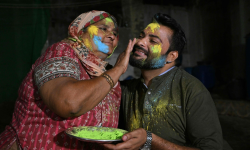
A mother paints the face of her son as they celebrate the Hindu festival of Holi in Mithi on March 13.
 

Hindu community celebrates Holi in Rawalpindi

Aamir Yasin
March 14, 2025

1741986058964.png

RAWALPINDI: The Hindu community on Thursday celebrated Holi, the festival of colours. More than 50 families gathered at Krishna Temple in Saddar and Priest Jai Ram led the religious rituals of the day.

Young and old alike came out and splashed colours on each other. The function started with prayers (Pooja) of Krishna, Ram, Durga and Hanuman. The celebrations were followed by distribution of sweets and fruits.

Before the function, the Hindu community prayed for the prosperity of the country and countrymen. They prayed that the festival of colours may bring peace, prosperity and brotherhood.

“Though breaking of an earthen pot full of milk and cream is associated with the birthday of Lord Krishna, this time we hanged the earthen pot full of colours as Lord Krishna also celebrated the Holi this way,” said Sardar Heera, chairman of Pakistan Hindu-Sikh Social Welfare Council, while talking to Dawn.

He said the Hindu community living in the twin cities of Rawalpindi and Islamabad arrived at Krishna Mandir to celebrate Holi. Throwing colours on each other was to celebrate the spring season and end differences within the community.

Priest Jai Ram explained that Hindus celebrated Holi, which is one of the biggest festivals in the Hindu calendar. He said Holi symbolised the victory of good over evil, and colours were thrown at each other as a sign of celebration and victory of God.

He said there was a Raja namely Hiranyakashipu in Multan who presented himself as god before the people. However, his son Prahad refused to admit him as a god. He said Prahad was a staunch devotee of Vishnu. The Raja asked his sister Holika, who was believed to have been gifted with the power that she would not burn when she wore her clock, to carry Prahad into the great fire lit for the purpose. However, Holika was burnt and Prahad escaped due to the blessings of Hindu god Vishnu.

Due to this great escape, the Hindus throughout the world celebrate Holi. Jai Ram said the tradition of playing with colours on Holi draws its roots from a legend of Radha and the Hindu god Krishna as both also celebrated this festival.

Published in Dawn, March 14th, 2025
 
1753300398837.png


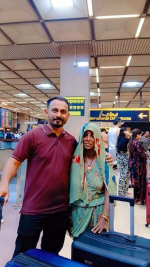
KHIPRO, Sindh: Bharat Meghwar, a talented young man from a backward area like village Bawarlo, Fateh Ali Rajar, left for the US to pursue his PhD after receiving a fully funded scholarship on merit in mechanical engineering.
He was pictured leaving with his mother at Karachi airport. :love::love:
 

In first, Lahore government promotes Christmas celebrations​


by Shafique Khokhar
12/23/2025, 11.52

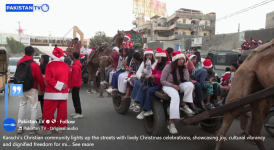
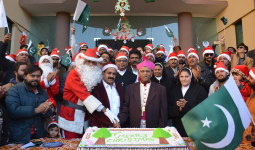
The Punjab government has promoted the Christmas Interfaith Harmony Rally. Thousands of participants, with the capital decorated for the festivities. The Christian community rejoices at this sign of recognition and public dignity and the fight against discrimination. A step by Maryam Nawaz's administration towards the inclusion of Christians in Pakistani society.


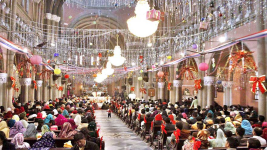
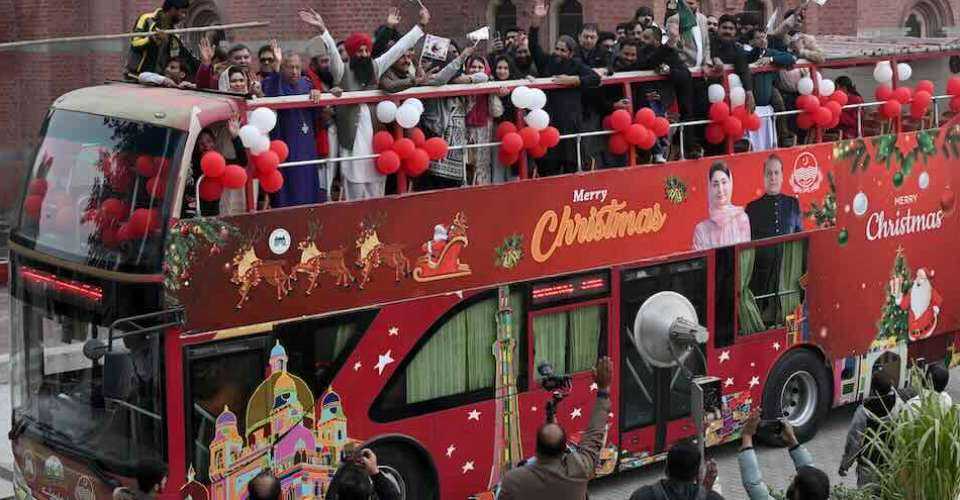
Lahore (AsiaNews) - For the first time in history, the Lahore government has promoted a large interfaith Christmas event. On Sunday, thousands of people took part in the Christmas Interfaith Harmony Rally: 7 km from the Cathedral of the Sacred Heart to the Liberty roundabout.

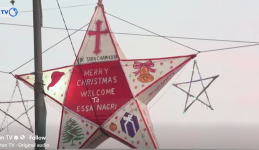
Many shopping centres are decorated with Christmas trees. Liberty Market and Canal Road with Christmas celebrations: lights, decorations and a festive atmosphere. This is a positive and encouraging trend, considering the manipulations that this holiday faces, which instead spreads love, humility, peace, compassion and reconciliation, despite the small number of Christians.

The Christian community is over the moon about this event. Lahore is becoming as beautiful as many cities around the world, which are particularly decorated during the Christmas season. Seeing Lahore shine with the same spirit is deeply moving and long-awaited.

These beautiful public displays are more than just decorations: they are moments of recognition, belonging and shared celebration. This is exactly what Pakistani Christians have been missing for a long time: the dignity of being visible in public spaces during their most cherished festive moments. Christians are grateful to Prime Minister Maryam Nawaz.

Speaking to AsiaNews, Aftab Alexander Mughal, director of Minority Concern UK, called the Christmas Interfaith Harmony Rally ‘a positive step’ that could have a ‘lasting impact’ on Pakistani society.

‘At a time when intolerance and religious fanaticism are on the rise in Punjab province, initiatives of this kind are urgently needed to promote a message of brotherhood and equal citizenship for all Pakistanis,’ he added. Christmas-related activities organised by Christians and the government help to address the fear of persecution and discrimination that Christians often face.

‘Although the government aimed to counter negative propaganda about Pakistan with this gathering, the event also gave Christians a positive public presence, which can help bring Christians and Muslims closer together. Christians were delighted that Christmas was officially celebrated.’
 
1766614739635.png

Pakistani Christians take part in a rally for Christmas celebrations in Lahore, Pakistan, Sunday, Dec. 21, 2025. (AP Photo/K.M. Chaudary)​


Pakistani Christians attend a grand ceremony at the FGA Ground during a Christmas celebration in Lahore, Pakistan


Pakistani Christians attend a grand ceremony at the FGA Ground during a Christmas celebration in Lahore, Pakistan (ANSA)
 
1766614892716.png


Pakistani Christians light candles as they gather during Christmas celebration


Pakistani Christians light candles as they gather during Christmas celebration (ANSA)
 

Punjab hosts Pakistan’s first govt-sponsored Christmas rally​

A Muslim cleric expressed concern about the 'broader Muslim public' staying away from such programs
Christians in Lahore, along with others, take part in a Christmas rally on Dec. 14, in what Christian leaders called the first government-sponsored Christmas rally in Pakistan.


Christians in Lahore, along with others, take part in a Christmas rally on Dec. 14, in what Christian leaders called the first government-sponsored Christmas rally in Pakistan. (Photo by Arif ALI / AFP)

By Kamran Chaudhry
Published: December 15, 2025

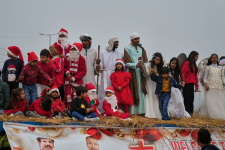
Thousands of Christians attended the first government-sponsored Christmas rally in Pakistan’s Punjab province, an event community leaders described as a sign of improved religious freedom in the Muslim-majority country.

Catholic and Protestant clergy joined Punjab’s Minister for Minority Affairs, Sardar Ramesh Singh Arora, to lead the seven-kilometer rally on Dec. 14 from Sacred Heart Cathedral to a downtown Lahore roundabout.

Participants sang Christmas carols and chanted slogans during the four-hour procession, riding on two double-decker buses and container trucks decorated with red-and-white balloons.

Addressing the rally, officially named Christmas Interfaith Harmony Rally, Arora said it sent a message to the world and to what he described as “forces engaged in negative propaganda against Pakistan,” including some non-governmental organizations and political actors.

Speaking to the media at the cathedral compound, Arora said religious minorities enjoyed freedom in Pakistan, citing a 300 percent increase in the Punjab government’s 2025 budget allocation for the Minority Affairs Department.
 

Users who are viewing this thread

Back
Top