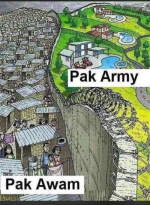
Zardari had once said that I will destroy you brick by brick(tam logon ki ant se ant baja don ga) He did in way it will be remembered for centuries. Army lost big time and Pakistan lost big time.must read the article and conclusion.
In Pakistan’s volatile political landscape, a dangerous game of revenge has been playing out for years. Once the country’s most respected institution, the Pakistani military has found itself outmanoeuvred, used, and discredited by the very politicians and figures it once supported or defended. What was once an unshakeable force has now been reduced to a story of downfall, brought about by its own leadership, manipulative politicians, and a judiciary that turned against its own values. The military’s reputation is shattered, with analysts predicting it won’t recover for decades.
Nawaz Sharif’s Masterstroke: Using Asim Munir to Dismantle the Army
Nawaz Sharif, often ridiculed for his political missteps, executed one of the most cunning and strategic moves against the military. Having been ousted from power by the military in 1999 through a coup led by General Pervez Musharraf, Nawaz harboured a deep-seated resentment against the institution that had humiliated him. However, he understood that direct confrontation would not work. Instead, Sharif employed a more insidious approach: use the army itself to destroy its reputation.
Sharif’s genius was in the selection of General Asim Munir. Unlike other generals, Munir was more loyal to Sharif’s cause than to the military institution he was supposed to serve. Sharif knew this well, and he played his cards brilliantly. Munir, known for his questionable loyalty and perceived as a “deceiver” within military ranks, was the perfect candidate for Sharif’s plan. By promoting Munir to key positions, Sharif ensured that the military’s leadership would be compromised from within.
Asim Munir’s rise was instrumental in pulling the army deeper into political controversies, making it look like a compromised, political pawn rather than the formidable force it once was. The general, more loyal to Sharif’s vision than to the institution, allowed the army to be further entangled in political affairs, slowly but surely eroding its credibility and turning it into a laughingstock in the eyes of the public. Munir’s mismanagement ensured that the army, once seen as an untouchable force, was now perceived as corrupt and ineffective.
Sharif used Munir in a way that few could have anticipated. The army, under Munir’s compromised leadership, became a tool of the political elite, used to manipulate and coerce rather than defend. By the time the military realised what was happening, its once untouchable image had already been shattered. Nawaz Sharif, often dismissed as politically incompetent, had outplayed the military, using its own leadership to destroy it from within.
Bilawal Bhutto: A Clumsy Pawn in the Game
Bhutto Zardari, though widely seen as an inexperienced and foolish politician, also played his part in the downfall of the military, albeit more clumsily than Nawaz Sharif. Bilawal, son of Benazir Bhutto, has long sought revenge for the deaths of his mother and grandfather, both of whom his family believes were victims of military conspiracies.
Although Bilawal’s strategy has often been erratic and foolish, he managed to contribute to the military’s downfall by constantly dragging it into the political quagmire. With his public rants and misplaced criticism, Bilawal helped further tarnish the army’s reputation, turning it into a symbol of political incompetence. While Bilawal may be perceived as a puppet and a poor strategist, his constant needling of the military—combined with their involvement in political affairs—further cemented the army’s image as a meddling and corrupt force.

Chief Justice Isa: Revenge Against the Judiciary Itself
No political betrayal is more damning than the one Chief Justice Qazi Faez Isa exacted on his own institution. Having once been protected by his fellow judges when corruption cases were brought against him, Isa turned on the judiciary the moment it suited him. Instead of standing firm to uphold the law, he aligned himself with the political forces that sought to undermine the country’s judicial integrity.
When the 26th Constitutional Amendment came into play, it was widely viewed as an attack on the military’s autonomy. However, this amendment also revealed the judiciary’s role in its own undoing. Justice Isa, under the guise of legality, helped facilitate the passage of the amendment, thus ensuring that both the military and judiciary would be further politicised and weakened. The amendment, which gave more power to civilian politicians and chipped away at military influence, was passed with the active cooperation of a judiciary that had once prided itself on its independence.
Chief Justice Isa, instead of defending the constitutional rights and upholding the sanctity of the court, betrayed the institution that once saved him. The Supreme Court, which had long protected the military’s involvement in critical national decisions, now found itself undermined, with Isa helping the very politicians who sought to diminish both military and judicial autonomy. His revenge against the judiciary, much like the revenge of the politicians against the military, was subtle but devastating.
The 26th Constitutional Amendment: The Final Blow
The 26th Constitutional Amendment has been the most significant and final blow to the military’s power and the judiciary’s independence. Brought forward by a political class hungry for power, this amendment was cloaked in language promoting civilian rule and reforms but was in reality a way to strip the military of its autonomy and independence.
By aligning themselves with the amendment, politicians like Nawaz Sharif, Bilawal Bhutto, and Maulana Fazlur Rehman ensured that the army would become a shadow of its former self, manipulated and weakened beyond recognition. The Supreme Court, through Justice Isa’s betrayal, allowed the amendment to pass without challenge, thus securing the political elite’s victory over the institutions that once held power in Pakistan.
The 26th Amendment was illegal and clear attack on the very foundations of Pakistan’s power structures. It has left the military humiliated, reduced to a political tool for civilian elites. More importantly, the judiciary—once a bastion of independence—has been compromised, now little more than an accomplice to political whims. The military and judiciary, once pillars of stability in Pakistan, have been utterly destroyed, and the damage will likely take decades to repair.
Conclusion: A Story of Betrayal and Revenge
Today, Pakistan stands at a crossroads. The military, once the most powerful institution in the country, is now a shell of its former self, reduced to political manoeuvring, with a reputation in tatters. The judiciary, once a beacon of hope, has been exposed as corrupt, willing to betray its own values for the sake of political power. And behind it all are the politicians—Nawaz Sharif, Bilawal Bhutto, and Maulana Fazlur Rehman—who masterfully manipulated these institutions, using them to further their own personal vendettas.
Chief Justice Isa, who was once saved by the judiciary, turned his back on the very institution that protected him, allowing corrupt political forces to push through amendments that have forever weakened Pakistan’s military and judicial structures. In their quest for revenge, these political actors have left Pakistan’s once strong institutions broken, corrupt, and discredited.
What’s left is a nation that no longer trusts its military or its courts, a public that sees the army not as a defender of the state but as a pawn of corrupt politicians, and a judiciary that has lost its credibility. The army, disrespected and humiliated, may not recover for the next 30 years if at all. The politicians may have won their personal battles, but Pakistan as a whole has lost. The very institutions that once held the country together are now stories of betrayal and defeat.