GoodDonkey43
Registered Member


Original Article
This article is based entirely on publicly available sources. All views are my own. Nothing here constitutes investment or legal advice.
Update, 15 July 2026: The Financial Times has since reported that Saindak's managing director warned operations may cease within a month due to transport disruptions in Balochistan.
Update, 16 July 2026: Reuters has since reported that Pakistani officials told Iran that attacks on Saudi Arabia by the Houthis constitute an attack on Pakistan, with one official calling it "our red line." Pakistani troops are confirmed deployed near the Saudi-Yemen border. An Iranian delegation visit to Islamabad was delayed amid the escalation.
Summary: Barrick slowed development at Reko Diq in April 2026 and extended its review of the project to mid-2027, citing security conditions in Pakistan and the region. This article examines the project’s economics against current copper and gold prices and a projected supply gap; the water, power, fuel and export logistics its design depends on; the storage buffers that determine how long operations could ride out disruption; the security environment along its corridors, including the insurgency’s evolving methods; whether development benefits can weaken that insurgency; the financing package and its close; and the geopolitics of a project balanced between the United States, China, Saudi Arabia and Iran, with a war on the border.
On 2 April 2026, Barrick, one of the world’s largest miners, said it would slow development at Reko Diq. The giant copper and gold deposit lies in Chagai District in Pakistan’s Balochistan province, roughly 40 to 55 kilometres from the Iranian border.
 Sunset at Dakk, elsewhere in Chagai District. Photo: Najamuddin Shahwani, via Wikimedia Commons, licensed under CC BY 3.0.
Barrick is among the few major miners that routinely commit capital to jurisdictions many competitors avoid, including the Democratic Republic of the Congo, Mali and Papua New Guinea. That record makes its decision a meaningful signal. The company extended its review to mid-2027, citing escalating security problems in Pakistan and the region, and warned that the disclosed cost ranges could increase significantly and the timetable could lengthen.
Barrick had previously targeted first production for the end of 2028. It has not announced a replacement date. An August 2025 disclosure by Pakistani shareholder OGDCL said lender assumptions had already incorporated a six-month delay into 2029.
Ten weeks after Barrick’s April announcement, Pakistan’s prime minister announced that the United States and Iran had reached an agreement ending a war that had run since late February. Formally signed on 17 June, the “Islamabad Memorandum of Understanding” created a timetable for negotiating a permanent settlement.
The ceasefire did not hold. Tankers were attacked near the Strait of Hormuz in early July, the United States and Iran exchanged strikes, and the US president declared the ceasefire over.
Reko Diq could generate the export earnings and tax revenue Pakistan needs to reduce its dependence on foreign financing and demonstrate that it can deliver projects of global scale. Yet that same financial dependence has pulled Pakistan into relationships and commitments that can alter the mine’s security environment. The question is whether Islamabad can manage that loop throughout Reko Diq’s planned 37-year life.
Why Reko Diq matters
Reko Diq holds probable reserves containing 14.6 million tonnes of copper and 25.6 million ounces of gold, on a 100 per cent project basis, according to Barrick’s technical report, filed in February 2025 with an effective date of 31 December 2024.At three-year trailing average prices of $4.03 per pound of copper and $2,045 per ounce of gold, Barrick’s model produces roughly $70.2 billion of undiscounted after-tax net cash flow and an after-tax net present value of around $13.0 billion at an 8 per cent discount rate. The model uses constant 2024 US dollars and assumes a 100 per cent equity basis, with no debt.
At the lower prices used to calculate reserves, $3.00 per pound of copper and $1,400 per ounce of gold, the same model produces about $34.0 billion of undiscounted after-tax net cash flow and an after-tax net present value of about $4.0 billion at an 8 per cent discount rate.
Both cases sit well below the market. On 14 July 2026, copper traded at about $6.34 per pound and gold at about $4,020 per ounce. Barrick announced its slowdown in April with both metals far above the model’s assumptions; the constraint the company cited was security, not price.
Over a 37-year life, the same forces could favour the project. The International Energy Agency projects that mined copper supply from announced projects will fall about 30 per cent short of projected demand by 2035 under current policy settings. The feasibility study projects average production of 460,000 tonnes of copper a year in the first decade after the Phase 2 expansion, from 2034 to 2043, across the period of the projected gap. If that gap materialises, later production could enter a tighter market. Delay changes when the copper is sold rather than whether the reserves exist, although it also extends exposure to cost inflation and financing risk, and a delay that hardened into permanence would remove those revenues entirely.
By 31 March 2026, capitalised project spending had reached $1.083 billion on a 100 per cent basis, including $234 million during the first quarter. That implies $849 million had been spent by the end of 2025. The Phase 1 capital range under review was previously disclosed as $5.6 billion to $6.0 billion.
Balochistan
Balochistan is Pakistan’s largest province by area and one of its poorest. On 2019–20 data, about 70 per cent of its people lived in multidimensional poverty.The province has experienced five waves of insurgency since 1947. The current wave intensified after the military killed Baloch leader Nawab Akbar Bugti in 2006.
The ESIA records that many Baloch tribes feel the province’s natural resources are “exploited without any benefit or investment toward the people of Balochistan”. In a separate institutional consultation, the Balochistan Levies classified the project area as medium to high risk and said additional mining projects were likely to increase regional security risks and “may attract more insurgency”.
A project rebuilt
The original Reko Diq venture began in 1993 and collapsed into arbitration. A 2019 award against Pakistan comprised about $4.09 billion in compensation and $1.75 billion in interest. Pakistan’s potential exposure later climbed towards $11 billion as interest accrued.A 2022 settlement brought Barrick back as operator with 50 per cent of the reconstituted project. Pakistan’s three federal state-owned enterprises hold 25 per cent of the project. Balochistan holds the remaining 25 per cent, comprising a 10 per cent free-carried, non-contributing interest held directly and 15 per cent held through the wholly province-owned Balochistan Mineral Resources Limited.
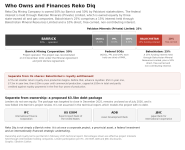
Note: The proposed package also involves the International Development Association, the US International Development Finance Corporation, Export Development Canada, Euler Hermes AG and KfW IPEX-Bank GmbH of Germany, Exportkreditnämnden (EKN) of Sweden and Finnvera Oyj of Finland, together with a covered commercial bank tranche.
Financing is approved, but the close is uncertain
The IFC and IDA approved blended support, the Asian Development Bank approved a $410 million package, and the US Export-Import Bank approved a direct loan of exactly $1,249,999,999 to support US equipment and services. Pakistan’s finance minister also welcomed a formal commitment by the Japan Bank for International Cooperation (JBIC) to join the lender group, and separately emphasised the government’s responsibility to protect foreign investors.Approval, financial close and disbursement are distinct steps. At Davos on 21 January, Pakistan’s finance minister described an approximately $3.6 billion syndication as closed. Barrick’s later April update continued to place project financing under review, while EXIM’s transaction list, updated on 2 July, still classified its $1.25 billion facility as “Authorized”. Pakistan has announced a close, but Barrick has not publicly confirmed that the financing became operational on those terms.
The diverse spread of international backers in the project raises the cost of disruption. A serious incident would affect Pakistan’s relationships with the US, Japan and several multilateral institutions as well as with Barrick.
What “the year’s budget” meant
Mark Bristow, long the project’s most visible champion, stepped down as Barrick’s chief executive in late 2025. His successor, Mark Hill, was appointed permanent president and chief executive in February 2026. Hill told investors in May that existing contracts would continue and that “the year’s budget will still come in on that range”. He estimated a rough review or holding run rate of about $20 million a month.
The figures help explain this comment. Barrick reported $234 million of capitalised project spending during the first quarter of 2026 on a 100 per cent project basis, alongside its previously disclosed attributable range of $600 million to $700 million for the year. Barrick’s 50 per cent share of the first-quarter spending was about $117 million; added to the $480 million to $580 million identified for the rest of 2026, that gives roughly $597 million to $697 million, matching the original attributable range.
The comment covered 2026 spending, not the total construction budget: Barrick’s filing repeatedly said the timing and amount of Reko Diq expenditure remained under review, while its April update warned that total costs and the schedule could rise significantly. Hill also said several contractors had issued force majeure notices and that Barrick was reconsidering its contracting strategy with Pakistan’s government.
Fiscal protection and layered security
The project has an initial 30-year fiscal stabilisation period, running to 15 December 2052, supported by legislation and a favourable opinion of Pakistan’s Supreme Court.Security is organised through a multi-tiered system. A private contractor provides mine-site security, while the Balochistan Levies and Frontier Corps Balochistan South provide public security. Under a December 2022 agreement with the provincial and federal governments, four Frontier Corps forts are planned outside the mine’s perimeter fence, each designed for about 50 guards. The ESIA says public and private personnel are to receive training under the Voluntary Principles on Security and Human Rights and international law-enforcement principles.
Water and power
Phase 1 depends on a buried water-supply system from the Northern Groundwater System. The technical report places the borefield about 70 kilometres from the mine, while the ESIA describes a pipeline corridor of about 80 kilometres.The ESIA says the roughly 80-kilometre early-works pipeline would be buried between 1 and 1.5 metres deep for security and to prevent freezing or excessive movement, and that the operational pipelines would likewise be buried to mitigate accidental or intentional damage.
Burial protects the pipe itself but the borefield, pumps, substations and maintenance access remain distributed across a vast remote corridor. At the mine, two raw-water compartments, each with a capacity of 200,000 cubic metres, provide five to seven days of storage.
The project is not expected to connect to Pakistan’s national grid until its fifteenth year of operation. Until then, it would rely on an on-site combination of heavy fuel oil (HFO), diesel and solar generation.
The two principal project documents describe different power baselines. The technical report specifies HFO and diesel generation, a 150 MW solar array and a 50 MW/100 MWh battery energy storage system. The ESIA instead describes about 20 per cent solar penetration and says a battery system was not economically feasible at that stage. With Barrick now reviewing all aspects of the project, the final configuration remains uncertain.
Rail
Concentrate would travel along a railway route of about 1,326 kilometres between the project and Port Qasim. Pakistan’s existing railway runs about 46 kilometres south of the project. The new mine-site spur connecting the mine to that network has not yet been built and, under the technical report’s schedule, is planned only after production begins.The railway the project would join is poorly suited to the traffic expected of it. The ESIA describes single-track sections, numerous speed restrictions and frequent interruptions caused by floods and sandstorms. It identifies immediate work covering hundreds of kilometres of track renewal, sleeper replacement, bridge repairs and flood protection.
From the planned junction, the route would cross desert where the Balochistan Liberation Army, or BLA, operates. It would turn near Spezand, south of Quetta, and descend through the Bolan Pass, a narrow chokepoint of tunnels and bridges. It would then join the main line between Karachi and Peshawar at Rohri and continue south. Even at Port Qasim, the journey would not end by rail: containers would be trucked from the rail yard to the export terminal.
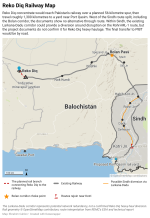
The ESIA compared rail transport to Port Qasim with road haulage and a buried slurry pipeline to Gwadar. Port Qasim was selected because it already has operational bulk-handling infrastructure that could be adapted for concentrate and was assessed as carrying significantly lower security risk than the two Gwadar alternatives. The proposed road and pipeline routes to Gwadar would traverse higher-risk parts of Balochistan.
Buffers
Under the technical report’s baseline, the mine would have about 30 days of final concentrate storage. HFO storage would equal 43 days of supply with solar generation or 32 days without it. The water system would provide only five to seven days of raw-water storage at the mine.The buffers work differently. If trains cannot carry concentrate out, production can initially continue while product accumulates. If trains cannot deliver HFO, the mine progressively consumes the fuel supporting its principal source of continuous power. If the water system fails, management has a much shorter period in which to restore supply or curtail water-intensive operations.
Solar generation would slow HFO consumption, while the 100 MWh battery described in the technical report could help balance shorter fluctuations. Neither could sustain normal, round-the-clock production once the HFO tanks were exhausted.
Management could also act before any store reached its design limit. If repairs were uncertain, it could cut throughput early, slow the accumulation of concentrate and preserve fuel and water for essential systems. The published figures are design capacities rather than exact shutdown dates.
The unresolved fuel hand-off
That schedule leaves an unresolved transition in the public documents. The technical report places construction of the mine-site spur after production begins, yet says operational HFO will be delivered by rail. The ESIA describes the planned 56-kilometre connection between the mine and the existing railway and separately assumes that diesel, HFO and other fuels will be railed from Port Qasim.Public documents do not explain the interim hand-off. Diesel is to be delivered by road before the rail spur is completed, so tanker access is planned; however, the reports do not say whether road haulage could supply operational HFO at scale, how many tankers would be needed, what transfer point would be used before the spur opened, or whether security conditions would permit a sustained emergency operation. The gap is most likely one of disclosure rather than evidence that the mine has no contingency.
Seasonal risks can compound
The technical report’s longer HFO endurance case assumes that solar PV is contributing. Seasonal conditions could reduce that contribution. The ESIA records that high-speed winds and most dust storms at Reko Diq occur from June to August, even though the mine itself receives little summer-monsoon rain.NASA POWER’s MERRA-2 climatology covering 2001 to 2020 estimates only about 9 millimetres of rain at Reko Diq from June to August. Over the same months, the estimates rise to 96 millimetres at Sibi, 77 millimetres at Dadu, 122 millimetres around Kotri and 135 millimetres at Pipri, an ESIA monitoring point on the Port Qasim railway corridor.
These grid-cell estimates are not readings taken directly from the railway points, but they show a strong eastward increase in summer rainfall along the proposed route. The ESIA identifies flood-prone sections requiring protection and reports that an underlying railway study found previous flood closures lasting three to eight months.
Those conditions can also depress solar output. The ESIA says cloud cover can produce significant variability and that major panel models may lose about 0.26 to 0.41 per cent of output for each 1°C increase in cell temperature above 25°C. Dust accumulating on panels is also an established source of energy loss.
An attack, whether intentionally timed or not, coinciding with these conditions would be more disruptive than an identical attack at another time. HFO deliveries could stop while solar generation was depressed and flooding complicated repairs or alternative transport. Public sources do not quantify how often these conditions would coincide, how much faster HFO would be consumed or how much production would be lost.
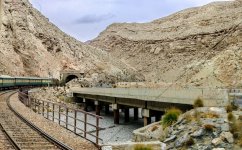
A train entering the tunnel at Bolan, Balochistan. Photo: Arslan Arshad via Wikimedia Commons, licensed under CC BY-SA 4.0.
When disruption outlasts the buffers
The deeper threat is not one isolated track blast but a prolonged or repeated campaign that prevents the mine from rebuilding fuel stocks and clearing accumulated concentrate between disruptions. A rail closure combined with attacks on road deliveries, repair crews, pumping infrastructure, the power station or the solar installation would be much harder to absorb than damage to one section of track.On 24 May 2026, a suicide car bombing struck a shuttle train carrying security personnel and their families in Quetta. Two provincial officials later told Reuters that more than 30 people had died, although Pakistan’s government and military have not issued a final official toll. The attack showed that the railway system intended to support the mine is also the same one that moves the workers, security personnel and contractors on whom an operation of this scale depends.
A mine whose lifelines include a remote buried water corridor, borefield, pumping stations, solar installations, roads and extensive railway presents a much wider attack surface than its fenced central site. Perimeter security can protect the mine itself, but it cannot place every kilometre of supporting infrastructure behind the same fence.
In February 2026, the BLA announced a drone unit, the Qazi Aero Hive Rangers, and claimed it had flown its first operations during the group’s late-January offensive. No government or independent agency has verified the claims. Analysts assess that the group’s documented systems are commercial quadcopters carrying improvised payloads of a few hundred grams, that its media wing works to make the organisation appear more capable than it is, and that any weaponisation expertise would most plausibly come from the Pakistani Taliban, with no indication of a joint command. Nothing public suggests the BLA holds anything comparable to state-manufactured systems.
The announcement still matters because of the cost structure it points to. Ironically, neighbouring Iran itself has provided one of the clearest demonstrations of this asymmetry: during the 2026 Gulf conflict, Shahed drones costing roughly $50,000 drew Patriot interceptors costing about $4 million, while a drone strike on Abu Dhabi’s Ruwais complex sparked a fire and prompted the precautionary shutdown of a refinery capable of processing up to 922,000 barrels a day.
The mine sits at the opposite pole: its security costs run every day of a planned 37-year life, while an attacker’s costs run only when it chooses to act. If the BLA’s aerial claims remain theatre, the threat model is unchanged; if they mature even modestly, the defender’s problem along the corridors becomes harder in a way that additional guards do not fix.
But the asymmetry is not unconditional. Barrick and the state command far greater financial resources than the insurgency. For the BLA, a drone programme that failed to produce results would consume funds a clandestine organisation cannot easily replace, although the documented systems are cheap enough that the downside is still bounded.
The money itself is also a target, and the tools for squeezing it predate the American loan mentioned earlier. Pakistan designated the BLA as a proscribed entity in 2006. The United States listed it as a Specially Designated Global Terrorist in 2019, and an executive order that September gave such listings teeth in the banking system: The Secretary of the Treasury can cut a foreign bank off from the US financial system if it knowingly handles significant transactions for the group, and can blacklist anyone who materially supports it. Neither happens automatically and both require a Treasury determination.
The 2025 Foreign Terrorist Organization designation added a different kind of pressure. Under the federal material-support statute, knowingly providing the group with support of almost any kind, whether money, training, equipment or personnel, is a crime that US prosecutors can charge. Mere contact is not enough, and the law’s knowledge and jurisdiction limits apply, but its reach extends well beyond bank transfers.
The approved EXIM loan adds no new legal tool; what it adds is interest. Washington now holds a concrete prospective fiscal and export stake in the project’s continuity. That stake may strengthen the incentive for US agencies to trace and disrupt financing beyond Pakistan’s reach, but this is an inference rather than an announced policy.
How hard any of this could bite is unknowable from outside. There are no reliable public figures establishing the group’s income, its drone budget or the weight of any single funding stream. The same caution applies to smuggling across the Iranian border: if it feeds the group’s finances, weaker enforcement would loosen a revenue stream Islamabad is trying to squeeze, but public evidence does not establish its scale.
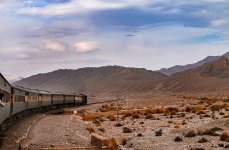
A train near Kolpur in the Bolan Pass, the highest operational station on Pakistan’s rail network. Reko Diq’s concentrate would descend this corridor to reach Port Qasim. Photo: Arslan Arshad, via Wikimedia Commons, licensed under CC BY-SA 4.0.
Can the Saindak model scale?
Pakistan already has proof that it can extract and export mineral wealth in Balochistan. Saindak, a smaller copper and gold mine in Chagai District, recorded annual losses under state management before being leased to a Chinese operator in 2002. It has operated ever since under a security model involving the military.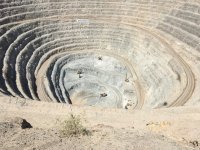
A mine pit at the Saindak copper-gold project in Chagai District, photographed in 2016. Saindak is substantially smaller than the planned Reko Diq development. Photo: Faiqah A Jabbar, via Wikimedia Commons, licensed under CC BY-SA 4.0.
According to Pakistan’s state news agency, Saindak produced 290,000 tonnes of copper and generated nearly $2.6 billion in foreign exchange over 20 years. Pakistan’s copper exports, led almost entirely by Saindak, exceeded $800 million in 2024.
However, Saindak is smaller and primarily served by road. Reko Diq is far larger and designed around rail. Saindak answers whether Pakistan can mine in Balochistan, but it cannot answer whether that model can scale to a much larger logistical system.
Can development weaken the insurgency?
Alongside conventional security, Reko Diq is pursuing a development strategy. Under the Mineral Agreement, Balochistan receives advance royalties before production: $5 million in the first year, $7.5 million in the second and $10 million a year thereafter until commercial production. The payments are capped at $50 million and partly credited against the province’s separate 5 per cent net smelter return royalty during the first production years.The ESIA defines a local worker as a native or registered resident of Balochistan. For 2025 to 2030, the minimum targets of Reko Diq Mining Company (RDMC) require local workers to comprise 60 per cent of its unskilled employees, 10 per cent of its skilled employees and 3 per cent of its professional or management employees. For the period to 2035, those targets rise to 70, 15 and 5 per cent respectively. These percentages apply to RDMC employees rather than the entire contractor workforce.
The same workforce table forecasts 8,455 contractors and 1,881 RDMC employees during Phase 1 construction, producing a combined workforce of 10,336 at its peak. It also forecasts another peak of more than 10,000 while Phase 1 is operating and Phase 2 is under construction.
RDMC has established a training centre intended to improve the skills and employment prospects of Balochistan residents. The ESIA also records that four primary schools were re-established in Humai, Durban Chah, Nok Kundi and Nok Chah. The Humai school had been closed since 2014.
RDMC and the Indus Hospital and Health Network have established community health centres in Humai and Nok Kundi, together with a mobile unit serving smaller settlements. At the time of the underlying surveys, most settlements in the mine study area lacked basic health facilities, and some were 67 kilometres from the nearest rural health centre in Nok Kundi.
At Porgera in Papua New Guinea, Barrick returned to a mine suspended since 2020 under a new framework that gave Papua New Guinean stakeholders 51 per cent of the equity and 53 per cent of the economic benefits. Barrick has described Reko Diq as following the same broad host-country partnership logic.
What history and research suggest
A wage, a school and a clinic can compete with an insurgency for legitimacy and recruits in a way that no garrison can. History suggests this mechanism can work, but only as part of a wider political solution.In Oman’s Dhofar province in the 1970s, Sultan Qaboos combined military pressure and amnesty with civil development. Teams drilled wells, built schools and clinics and delivered medical care, while oil revenue funded broader expansion of education, healthcare and infrastructure. Development was only one component of a campaign that also relied on local forces and extensive foreign military support.
Panguna in Papua New Guinea shows the opposite pathway. The mine became a central grievance amid claims of environmental damage, inadequate compensation and unequal benefits. Sabotage and violence culminated in its closure in 1989. The conflict widened into a civil war that killed about 20,000 people, and Panguna has remained out of production since 1989.
Research is similarly mixed. In Iraq, small, locally targeted reconstruction projects were associated with lower violence. A randomised cash-transfer programme in the Philippines reduced conflict and insurgent influence in treated villages. A different Philippine development programme initially produced more insurgent-initiated violence, consistent with militants trying to sabotage a programme that threatened their support. The difference appears to lie in the design of these programmes. In the first study, cash was disbursed directly to households, largely by electronic transfer, and was hard to derail, while the sabotaged programme built visible infrastructure through public community processes, and the violence was concentrated in the preparation phase, before benefits arrived.
None of these cases predicts Reko Diq. Balochistan’s political economy is shaped by tribal authority, the sardari system, weak institutions, military influence and long disputes over provincial autonomy and resource distribution. If the project’s benefits are credible and fairly distributed, they can reduce some grievances and recruitment pressures. They cannot, however, resolve the conflict entirely on their own.
Three sources of capital
Pakistan created the Special Investment Facilitation Council in June 2023 as a single window for foreign investment. Its apex committee includes Field Marshal Asim Munir, the army chief and Chief of Defence Forces, while serving officers occupy other key roles. Concentrated authority can bypass some of the bureaucratic paralysis that contributed to the original project’s failure.
Yet the council has struggled to attract large-scale investment to Pakistan. Foreign direct investment fell 31 per cent in the first ten months of the 2025/26 fiscal year, while a November 2025 IMF governance diagnostic called the council’s transparency and accountability provisions “untested”.
The three sources of foreign capital are distinct: US and multilateral finance funds the mine itself; Chinese capital surrounds the project without holding a stake in it; and Gulf deposits support the state that hosts it.
China
China complicates the picture for Pakistan. Pakistan’s largest trading partner operates Saindak, and the railway Reko Diq would use was once slated for an upgrade under the China-Pakistan Economic Corridor. Delays to Chinese financing pushed Pakistan towards the ADB instead.Chinese smelters refine roughly half the world’s copper and dominate global concentrate demand. Reko Diq’s future offtake buyers have not been publicly disclosed. In the absence of any disclosed restriction on sales to China, some concentrate would plausibly be sold to Chinese smelters.
Part of the resulting refined copper could then return to international markets inside goods manufactured in China. Wood Mackenzie estimates that about 20 per cent of China’s total first-use copper demand, or 3.3 million tonnes, is subsequently exported in finished goods. The ratio is economy-wide rather than project-specific, but it maps the pathway.
Although EXIM approved a loan to finance US equipment and services for Reko Diq, that financing does not guarantee US offtake rights over the mine’s copper. American public finance could therefore help construct a mine whose concentrate might ultimately be processed, in substantial part, within China’s dominant smelting and refining system.
The loan would still serve its immediate export-finance purpose. The wider strategic limitation is that financing new extraction does not by itself reduce dependence on Chinese processing. Even so, without disclosed offtake agreements or product-tracing data, there is no objective way to estimate how much Reko Diq copper would follow that route.
Reko Diq is separate from Project Vault
At the February 2026 Critical Minerals Ministerial, the US State Department listed EXIM’s $1.3 billion Reko Diq loan and the $10 billion Project Vault loan as separate entries within EXIM’s broader critical-minerals portfolio.Several pieces of secondary commentary have described Reko Diq as part of the Project Vault framework. Official records do not use that classification. EXIM approved Reko Diq in November 2025 and announced Project Vault in February 2026 as a distinct transaction. Its project-finance transaction list, updated on 2 July, records Reko Diq as a standalone $1.25 billion Pakistan mining transaction. Project Vault does not appear on that list.
The geopolitical connection is still real: Washington is using export finance to support US equipment and services for a major overseas copper project while also building a domestic strategic reserve.
Structural tension without proof of Chinese opposition
In September 2025, Pakistan’s Frontier Works Organisation signed a $500 million memorandum with US Strategic Metals covering critical minerals and a proposed polymetallic refinery. That cooperation did not name Reko Diq, and there is no public evidence that Beijing has opposed the project itself.But the issue did reach Beijing. After claims circulated that China’s October 2025 rare-earth export controls were retaliation for Pakistan’s mineral engagement with the United States, China’s foreign ministry denied any connection. In doing so, however, its spokesperson disclosed that Beijing and Islamabad had been communicating about Pakistan-US mining cooperation, and said Pakistan had stressed that its interactions with Washington “will never harm China’s interests or its cooperation with China”.
The exchange did not mention Reko Diq, but it showed that Islamabad has already had to reassure Beijing that closer mineral ties with Washington would not come at China’s expense.
China has reasons to welcome new concentrate supply and stronger security around its own assets in Balochistan, such as Saindak. The frictions are structural all the same.
Saudi support, Iranian exposure
On 17 September 2025, Pakistan and Saudi Arabia signed the Strategic Mutual Defence Agreement. Its public clause says aggression against either country will be treated as aggression against both.In April 2026, the UAE recalled about $3.5 billion in deposits, a move reportedly linked to Pakistan’s position during the Iran war and the UAE’s deepening ties with India. Saudi Arabia then provided $3 billion in fresh deposits and extended an existing $5 billion deposit for a multi-year term.
Pakistan’s liabilities to Riyadh stood at roughly $8 billion, equal to more than 40 per cent of the central bank’s $18.471 billion in reserves as of 3 July. The figures measure different things, but they show the weight of Saudi support in Pakistan’s external position.
The financial relationship carries a signal of its own. The UAE’s April recall showed that deposits function as leverage as well as support. Each new tranche from Riyadh deepens an alignment that Tehran must weigh against Islamabad’s mediating role. For Iran, the question is not whether Pakistan formally joins its adversaries but how much Pakistani dependence on them is compatible with treating Islamabad as an honest broker.
Reuters later reported, citing three security officials and two government sources, that Pakistan had deployed about 8,000 troops, roughly 16 fighter aircraft, two drone squadrons and an HQ-9 air-defence system to Saudi Arabia under the pact. The sources said Saudi Arabia financed the deployment and Pakistani personnel operated the equipment.
That deployment makes Pakistan’s balancing act progressively harder. In this conflict or any future Saudi-Iranian escalation, pressure to reinforce or employ those forces would sharpen the choice between Pakistan’s obligations to Riyadh and its credibility with Tehran as a neutral mediator.
Yet Pakistan hosted direct US-Iran talks in Islamabad and helped broker the June framework. Pakistan had forces deployed to Tehran’s rival while brokering peace in the Middle East.
The border is the real exposure
No credible public source documents any diversion of units from Balochistan. The exposure lies instead along Pakistan’s roughly 900-kilometre border with Iran, which passes through Baloch-majority territory on both sides.Two distinct insurgencies operate around that frontier. The BLA fights Pakistan, while Jaysh al-Adl, a Sunni Islamist organisation, fights Iran. The two organisations are not allies, but instability, smuggling and reduced enforcement on one side can increase pressure on the other.
In January 2024, Iran struck alleged militant targets inside Pakistan, and Pakistan struck back inside Iran. The countries then de-escalated and expanded security cooperation. Iranian media even reported that the leader of Jaysh al-Adl had been killed in a coordinated Iran-Pakistan operation.
That cooperation was still functioning in June during the 2026 conflict. A Pakistani Foreign Office spokesman described “good arrangements for security cooperation” along the frontier. Iran’s Interior Minister visited Islamabad in June 2026 and the two countries’ interior ministers agreed to deepen counterterrorism and border coordination shortly before the ceasefire collapsed.
That cooperation has direct value for both capitals. Jaysh al-Adl’s targets are in Iran while its reported sanctuaries lie across the border, so suppressing it requires Pakistani action that Iran cannot replicate alone. A state at war with the United States, and watching an unstable Afghan frontier, has reasons to keep its south-eastern province quiet. The logic runs the other way as well. Pakistan’s January 2024 strikes inside Iran were aimed at what Islamabad described as Baloch militant hideouts, and whatever depth those groups hold on the Iranian side is depth that only Iranian enforcement can deny. Border cooperation is not a courtesy between neighbours but a hedge that each side needs more as the region destabilises.
The risk
One risk scenario is that Tehran, believing Pakistan had moved from balance to opposition, could reduce border cooperation. Another is less deliberate: prolonged conflict could simply leave Iran with less capacity to police a remote, rugged and expansive frontier.Either pathway could make smuggling and militant movement easier. No public evidence shows that Iran has deliberately relaxed enforcement to assist the BLA.
Pressure is also arriving from Pakistan’s Afghan frontier, where fighting between Pakistan and Afghanistan intensified in early 2026. Reduced Iranian cooperation would compound an already crowded threat environment.
The war itself reached the frontier when US strikes overnight into 9 July hit Chabahar, Iran’s port in Sistan-Baluchestan near Pakistan.
Yet Balochistan’s escalation predates the war in the Gulf. On 31 January, the BLA launched a coordinated offensive across more than ten districts. Pakistani authorities also allege that the BLA has operated with support from the Pakistani Taliban. Public evidence of the relationship’s structure, scale and importance remains limited.
What the June deal changed
The June agreement showed that Pakistan could help manage this tension, at least temporarily. Under the 14-point Islamabad Memorandum of Understanding, the United States and Iran declared an end to military operations and agreed that commercial traffic through the Strait of Hormuz would restart while safe passage was restored. Washington subsequently issued a 60-day waiver permitting Iranian oil and petrochemical sales. The two sides soon disagreed publicly over nuclear inspections and the use of unfrozen Iranian assets.By 14 July, the diplomatic opening had narrowed further. Iran said it had struck a US air base in Jordan, while the US military said it had completed five hours of attacks on Iran; Tehran said it was keeping the Strait of Hormuz closed, while Washington said a southern route remained open for two-way traffic. Iran said the latest US strikes had made de-escalation efforts futile, although Trump continued to leave the door open to talks. Pakistan remained among the mediators, but the conflict’s military dynamics had overtaken the June framework.
Pakistan’s mediation still matters because it gives Tehran an additional reason to preserve a working relationship with Islamabad.
What comes next
The drivers of the Baloch insurgency remain untouched by any memorandum: political inequality, poor education, weak governance and long-running disputes over resources and autonomy.During its January offensive, the BLA’s media wing released footage of the group’s leader, Bashir Zaib Baloch, filmed between Chagai and Kharan; in the Jamestown Foundation’s account, the video conveyed a message to foreign investors that the group will not allow projects it considers against the will of the Baloch community. The districts in the footage contain Reko Diq and Saindak.
The frontier cuts both ways. Cooperation with Iran may reduce one channel of risk, while a frayed border may increase it. But the forces sustaining the insurgency also lie inside Balochistan, beyond the reach of any diplomatic agreement.
Reko Diq’s response combines provincial ownership, advance royalties, local hiring, schools, clinics, environmental controls and a large security presence. Whether that mixture builds legitimacy will depend less on what the agreements promise than on what communities experience.
The project’s geology is exceptional. Its economics are potentially transformative. Its difficulty lies in keeping water, fuel, concentrate, finance and political consent moving across a fragile system for decades. Whether Reko Diq helps Pakistan finance its way out of dependence or not will be decided along all of those corridors at once.
Source:
Not Applicable
Not Applicable