Navigation
Install the app
How to install the app on iOS
Follow along with the video below to see how to install our site as a web app on your home screen.
Note: This feature may not be available in some browsers.
More options
Style variation
You are using an out of date browser. It may not display this or other websites correctly.
You should upgrade or use an alternative browser.
You should upgrade or use an alternative browser.
Remittances from Overseas Pakistanis - Updates
- Thread starter ghazi52
- Start date
More options
Who Replied?


ghazi52
THINK TANK: CONSULTANT
- Thread starter
- #108
Remittance boom: A blessing or a crutch?
BR Research
February 12, 2025

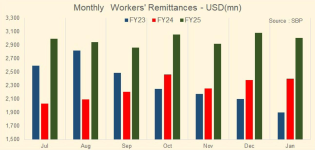
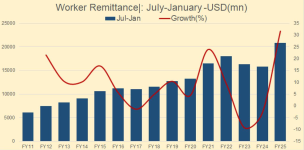
In January 2025, Pakistan’s workers’ remittances crossed $3 billion again, marking a 25.2 percent increase compared to January 2024. Cumulatively, from July 2024 to January 2025 (7MFY25), remittances amounted to $20.8 billion, reflecting a 31.7 percent year-on-year rise from the $15.8 billion recorded during the same period in the previous fiscal year. Saudi Arabia remains the top contributor, followed by the UAE, the UK, and the USA, with inflows from these regions amounting to $728.3 million, $621.7 million, $443.6 million, and $298.5 million, respectively during the Jan-25.
The steady increase in remittances can be attributed to several factors. The depreciation of the Pakistani rupee has incentivized expatriates to send more money home, as their remittances yield higher value in local currency.
Additionally, rising unemployment within Pakistan has driven more individuals to seek employment opportunities overseas, particularly in Gulf countries, contributing to sustained remittance inflows.
Government policies have also played a role in this surge, with measures such as streamlined remittance channels, tax exemptions, and incentives for using formal banking systems making it easier and more attractive to send money through official means.
The recent spike in remittances, often linked to holiday spending and end-of-year obligations, has further supported these figures, while domestic inflation has prompted expatriates to remit more funds to help families cope with rising living costs.
While remittances serve as a crucial component of Pakistan’s economy, an overreliance on them poses significant risks. Heavy dependence on remittances can discourage policymakers from addressing fundamental economic issues, such as industrial growth and export diversification, as easy inflows create a false sense of economic stability.
Moreover, remittance flows are subject to volatility, being highly sensitive to global economic conditions. A slowdown in host economies or the imposition of stricter immigration policies could substantially impact these inflows, leaving the country vulnerable to external shocks.
Despite the large remittance figures, much of the money sent is spent on consumption rather than being directed into productive investments, which limits its long-term economic benefits.
ghazi52
THINK TANK: CONSULTANT
- Thread starter
- #109
To mitigate the risks associated with overdependence on remittances, the country must take steps to ensure sustainable economic growth.
Diversifying the economic base by focusing on industrial growth and export expansion will reduce reliance on remittances and create more domestic employment opportunities. Encouraging expatriates to invest in productive sectors can amplify the economic impact of remittance inflows.
Furthermore, investing in education and skill development will allow Pakistanis to access higher-value job markets abroad, leading to increased remittance earnings from professionals in addition to low-skilled laborers.
While the recent surge in remittances is a positive economic indicator, the government must implement policies that channel these inflows into sustainable development rather than temporary relief.
Diversifying the economic base by focusing on industrial growth and export expansion will reduce reliance on remittances and create more domestic employment opportunities. Encouraging expatriates to invest in productive sectors can amplify the economic impact of remittance inflows.
Furthermore, investing in education and skill development will allow Pakistanis to access higher-value job markets abroad, leading to increased remittance earnings from professionals in addition to low-skilled laborers.
While the recent surge in remittances is a positive economic indicator, the government must implement policies that channel these inflows into sustainable development rather than temporary relief.
ghazi52
THINK TANK: CONSULTANT
- Thread starter
- #110
Editorials
EDITORIAL:
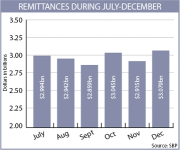
Home remittances registered a 32.89 percent growth July-December 2024 against the same period the year before. In total terms, remittance inflows were 17.845 billion dollars during the first six months of the current fiscal year as opposed to 13.845 billion dollars in the same period the year before and 14.435 billion dollars in July-December 2023.
The percentage rise July-December 2024 surpasses the rise in July-December 2021 of 24.9 percent, which should form the basis of comparison as inflows were allowed to suffer dramatically in 2022 due to the then Finance Minister Ishaq Dar’s flawed policy to intervene in the foreign exchange market in spite of the dwindling reserves that plummeted to a low of under 3 billion dollars, giving rise to multiple exchange rates that, in turn, led to the remitters using the hundi/hawala system instead of the official channels.
Remittances rose in July-December 2023 as the Dar policy was abandoned after agreement with the International Monetary Fund team for the 3 billion dollars nine-month-long Stand-By Arrangement.
If one projects the first six months remittance inflows till the end of the fiscal year on 30 June 2025 then total remittances would be around 35.690 billion dollars, higher than the fiscal year 2021-22 total of 31.2 billion dollars by 4.45 billion dollars.
True that the government not only abandoned Ishaq Dar’s policies but also further incentivised remittance inflows through official channels yet an Asian Development Bank (ADB) working paper dated July 2024 titled Understanding the Drivers of Remittances to Pakistan noted that: “we identify economic activity, domestic interest rates, and domestic inflation as having significant effects on remittance growth.
We also find that the relative importance of these macroeconomic drivers has shifted over time — particularly during the deep crises of the Global Financial Crisis (2007-08) and the Covid-19 pandemic.
Additionally, we find that remittances are largely influenced by structural factors outside of the variables identified in our model and that migrants’ motivations, as identified in the microeconomic literature, likely underpin the persistence of remittance flows.“
Significant increase in home remittances
February 15, 2025EDITORIAL:
Home remittances registered a 32.89 percent growth July-December 2024 against the same period the year before. In total terms, remittance inflows were 17.845 billion dollars during the first six months of the current fiscal year as opposed to 13.845 billion dollars in the same period the year before and 14.435 billion dollars in July-December 2023.
The percentage rise July-December 2024 surpasses the rise in July-December 2021 of 24.9 percent, which should form the basis of comparison as inflows were allowed to suffer dramatically in 2022 due to the then Finance Minister Ishaq Dar’s flawed policy to intervene in the foreign exchange market in spite of the dwindling reserves that plummeted to a low of under 3 billion dollars, giving rise to multiple exchange rates that, in turn, led to the remitters using the hundi/hawala system instead of the official channels.
Remittances rose in July-December 2023 as the Dar policy was abandoned after agreement with the International Monetary Fund team for the 3 billion dollars nine-month-long Stand-By Arrangement.
If one projects the first six months remittance inflows till the end of the fiscal year on 30 June 2025 then total remittances would be around 35.690 billion dollars, higher than the fiscal year 2021-22 total of 31.2 billion dollars by 4.45 billion dollars.
True that the government not only abandoned Ishaq Dar’s policies but also further incentivised remittance inflows through official channels yet an Asian Development Bank (ADB) working paper dated July 2024 titled Understanding the Drivers of Remittances to Pakistan noted that: “we identify economic activity, domestic interest rates, and domestic inflation as having significant effects on remittance growth.
We also find that the relative importance of these macroeconomic drivers has shifted over time — particularly during the deep crises of the Global Financial Crisis (2007-08) and the Covid-19 pandemic.
Additionally, we find that remittances are largely influenced by structural factors outside of the variables identified in our model and that migrants’ motivations, as identified in the microeconomic literature, likely underpin the persistence of remittance flows.“
ghazi52
THINK TANK: CONSULTANT
- Thread starter
- #111
The growth rate has also stagnated and the government has optimistically as usual budgeted a 3.5 percent growth rate for the current year though independent economists are cutting this projection down by between one and 0.8 percent.
The ADB study acknowledged that “remittances have historically served as a useful buffer to withstand Balance of Payment shocks, understanding better how these flows might evolve amid challenging global conditions is critical.”
The focus of the government appears to be on incentives for official inflows and more proactively going after the illegal hawala/hundi system but there must be concern not only about the deportation of illegal Pakistani labour seeking jobs outside the country, many succumbing to poor transit conditions, but there is a brain drain as well as the economy is not able to generate new job opportunities.
It is, therefore, imperative that the government seeks to strengthen the economy through implementing reforms and slashing, in the interim period, its own current expenditure with the objective of gaining leverage with the multilaterals that would enable the policymakers to undertake pro-poor policy measures.
The ADB study acknowledged that “remittances have historically served as a useful buffer to withstand Balance of Payment shocks, understanding better how these flows might evolve amid challenging global conditions is critical.”
The focus of the government appears to be on incentives for official inflows and more proactively going after the illegal hawala/hundi system but there must be concern not only about the deportation of illegal Pakistani labour seeking jobs outside the country, many succumbing to poor transit conditions, but there is a brain drain as well as the economy is not able to generate new job opportunities.
It is, therefore, imperative that the government seeks to strengthen the economy through implementing reforms and slashing, in the interim period, its own current expenditure with the objective of gaining leverage with the multilaterals that would enable the policymakers to undertake pro-poor policy measures.
ghazi52
THINK TANK: CONSULTANT
- Thread starter
- #112
Remittances jump 40pc in February, total $3.12bn
The Newspaper's Staff Reporter
March 11, 2025
KARACHI: Remittances from overseas Pakistani workers soared by nearly 40 per cent year-on-year in February 2025, reaching $3.12 billion, according to State Bank of Pakistan (SBP) data released on Monday.
Compared to January 2025, remittance inflows increased by 3.8pc, providing much-needed financial support to the economy, government reserves and liquidity for importers.
For the first eight months of FY25 (July-February), total remittances reached $23.97bn, marking a substantial 32.5pc rise compared to the same period a year ago.
The government had projected total remittances of $35bn for FY25, around $5bn more than last year. However, remittances have already exceeded expectations, with additional inflows of $5.9bn in just eight months.
ghazi52
THINK TANK: CONSULTANT
- Thread starter
- #113
Inflows near $24bn in eight months, up 32.5pc
For economists and financial analysts, the rise in remittances is both a positive and negative indicator — while the surge in inflows has helped stabilise the rupee and support the economy, it reflects the government’s increasing dependence on remittances, rather than boosting exports, to sustain foreign exchange reserves.
Despite an ambitious export target of $60bn, actual exports remain sluggish and are projected to reach only $30bn by the end of FY25.
ghazi52
THINK TANK: CONSULTANT
- Thread starter
- #114
Remittances by country
The inflows noted a record increase from the United Arab Emirates during July-February as it rose to $4.857bn with a growth of 55.7pc. Similarly, the highest remittances came from Saudi Arabia, increasing by 34.6pc to $5.896bn during the period.
The inflows from the United Kingdom and the United States were $3.565bn and $2.402bn, respectively.
Interestingly, remittances from European Union countries — at $2.829bn — surpassed inflows from the Gulf Cooperation Council (GCC) nations — $2.396bn — during the eight months.
In February, the remittances inflows were mainly sourced from Saudi Arabia ($744.4 million), the United Arab Emirates ($652.2m), the United Kingdom ($501.8m), and the United States ($309.4m).
In an effort to increase remittance inflows, the government is pushing for more overseas employment opportunities for Pakistani workers.
However, high unemployment rates in Pakistan have already driven hundreds of thousands of youth to seek jobs abroad annually, contributing to the record surge in remittances.
The inflows noted a record increase from the United Arab Emirates during July-February as it rose to $4.857bn with a growth of 55.7pc. Similarly, the highest remittances came from Saudi Arabia, increasing by 34.6pc to $5.896bn during the period.
The inflows from the United Kingdom and the United States were $3.565bn and $2.402bn, respectively.
Interestingly, remittances from European Union countries — at $2.829bn — surpassed inflows from the Gulf Cooperation Council (GCC) nations — $2.396bn — during the eight months.
In February, the remittances inflows were mainly sourced from Saudi Arabia ($744.4 million), the United Arab Emirates ($652.2m), the United Kingdom ($501.8m), and the United States ($309.4m).
In an effort to increase remittance inflows, the government is pushing for more overseas employment opportunities for Pakistani workers.
However, high unemployment rates in Pakistan have already driven hundreds of thousands of youth to seek jobs abroad annually, contributing to the record surge in remittances.
ghazi52
THINK TANK: CONSULTANT
- Thread starter
- #116
Exchange firms see $5bn inflow by end of Ramazan
Shahid Iqbal
March 9, 2025
KARACHI: Inflows of remittances are higher than ever and the exchange companies alone could accumulate $5 billion by the end of Ramazan, said exchange companies on Saturday.
“We have already sold $3.5 to $4bn to the banks during the first 8 months of FY25 while Ramazan would add more to the total,” said Zafar Paracha, Secretary General of the Exchange Companies Association of Pakistan.
The country received $20.9bn in remittances in July-January FY25 compared to $15.8bn a year ago, up 32.27pc, exceeding the $5bn growth projection for FY25 in the first seven months.
“We are sure by the end of Ramazan we would be able to sell $5bn to the banks, which would be a great achievement,” said Mr Paracha.
The exchange companies have been asking the government to facilitate overseas Pakistanis for boosting inflows instead of doling out subsidies to exporters.
ghazi52
THINK TANK: CONSULTANT
- Thread starter
- #117
“The IMF will provide $7bn in 37 months while the overseas Pakistanis provide $35bn in one year,” remarked a market expert, requesting anonymity.
“These Pakistanis should be given more care than the IMF,” said an exchange company owner. The higher inflows of remittances have stabilised the exchange rate and helped the State Bank maintain foreign exchange reserves by purchasing dollars from the interbank market. The SBP bought about $3.8bn from banks in the first four months of the current fiscal year.
“These Pakistanis should be given more care than the IMF,” said an exchange company owner. The higher inflows of remittances have stabilised the exchange rate and helped the State Bank maintain foreign exchange reserves by purchasing dollars from the interbank market. The SBP bought about $3.8bn from banks in the first four months of the current fiscal year.
ghazi52
THINK TANK: CONSULTANT
- Thread starter
- #118
Historically, the central bank buys dollars to keep substantial reserves to stabilise the exchange rate. However, the money market experts said the amount raised by the SBP is too big compared to the commercial borrowings the country has made during the period.
Mr Parach said the average monthly inflows through the exchange companies during the first 8 months of the current fiscal year were $400 to $450 million.
One of the key reasons for the higher remittances was the government’s crackdown against illegal currency businesses. At the same time, money-laundering has also gone down, said a currency expert.
Mr Parach said the average monthly inflows through the exchange companies during the first 8 months of the current fiscal year were $400 to $450 million.
One of the key reasons for the higher remittances was the government’s crackdown against illegal currency businesses. At the same time, money-laundering has also gone down, said a currency expert.
ghazi52
THINK TANK: CONSULTANT
- Thread starter
- #119
While providing updates on the country’s economic progress, the minister said the remittance inflow for Feb 2025 had reached an impressive $3.1 billion.
“We estimate an all-time high remittance inflow of $36bn by the end of the fiscal year,” he said while addressing a press conference along with Federal Information Minister Attaullah Tarar.
While expressing gratitude to the Pakistani diaspora, Aurangzeb acknowledged their invaluable contribution to the nation’s economy.
“On behalf of the prime minister, the government, and the cabinet, we extend our heartfelt thanks to all our Pakistani brethren and sisters working abroad and sending remittances back home,” he said.
The finance minister also shared the results of several independent surveys conducted in the past quarter, including those by Gallup, ICC, Overseas Shapers, Ipsos, PricewaterhouseCoopers and a recent one by the State Bank of Pakistan, all of which showed a noticeable uptick in business and consumer confidence.
“We estimate an all-time high remittance inflow of $36bn by the end of the fiscal year,” he said while addressing a press conference along with Federal Information Minister Attaullah Tarar.
While expressing gratitude to the Pakistani diaspora, Aurangzeb acknowledged their invaluable contribution to the nation’s economy.
“On behalf of the prime minister, the government, and the cabinet, we extend our heartfelt thanks to all our Pakistani brethren and sisters working abroad and sending remittances back home,” he said.
The finance minister also shared the results of several independent surveys conducted in the past quarter, including those by Gallup, ICC, Overseas Shapers, Ipsos, PricewaterhouseCoopers and a recent one by the State Bank of Pakistan, all of which showed a noticeable uptick in business and consumer confidence.

hydrabadi_arab
Trusted Member
State Bank Governor Jameel Ahmad on Monday said that remittances were at a record $4.1 billion during the month of March.
Remittances from overseas Pakistani workers had soared year-on-year in February 2025, reaching $3.12bn.
Compared to January 2025, remittance inflows increased by 3.8pc, providing the much-needed financial support to the economy, government reserves and liquidity for importers.
For the first nine months of FY25 (July-March), total remittances have reached $28.07bn, marking a substantial 33pc rise compared to the same period a year ago.
Speaking at the Pakistan Stock Exchange (PSX) today, the SBP chief highlighted that foreign reserves were now projected to exceed $14bn by June.
He also added that foreign debt repayment obligations stood at $26bn for FY25 — from which $16bn was expected to be rolled over or refinanced, reducing actual repayment pressure to around $10bn.
On a positive note, he noted that economic activity had “shown signs of revival”, adding that if agricultural had matched last year’s performance, the country’s GDP growth would have been more than 4.2pc.
However, due to a weaker-than-expected agricultural season, Ahmad said GDP growth was now projected to be around three pc.
“Every indictor is indicating that the economic activity has substantially picked up,” he said, adding that it was “not fully reflected in the growth numbers” because of agriculture.

Remittances recorded region- wise— provided by AKD Securities
Remittances from overseas Pakistani workers had soared year-on-year in February 2025, reaching $3.12bn.
Compared to January 2025, remittance inflows increased by 3.8pc, providing the much-needed financial support to the economy, government reserves and liquidity for importers.
For the first nine months of FY25 (July-March), total remittances have reached $28.07bn, marking a substantial 33pc rise compared to the same period a year ago.
Speaking at the Pakistan Stock Exchange (PSX) today, the SBP chief highlighted that foreign reserves were now projected to exceed $14bn by June.
He also added that foreign debt repayment obligations stood at $26bn for FY25 — from which $16bn was expected to be rolled over or refinanced, reducing actual repayment pressure to around $10bn.
On a positive note, he noted that economic activity had “shown signs of revival”, adding that if agricultural had matched last year’s performance, the country’s GDP growth would have been more than 4.2pc.
However, due to a weaker-than-expected agricultural season, Ahmad said GDP growth was now projected to be around three pc.
“Every indictor is indicating that the economic activity has substantially picked up,” he said, adding that it was “not fully reflected in the growth numbers” because of agriculture.
Remittances recorded region- wise— provided by AKD Securities
Users who are viewing this thread
Total: 5 (members: 0, guests: 5)
Pakistan Defence Latest
-

-
-

-
-
 Federal cabinet gives nod to imposition of emergency in KP; summary sent to president (33 Viewers)
- Latest: hydrabadi_arab


