Microsoft President: Saudi Arabia is moving from exporting oil to exporting artificial intelligence
With the company preparing to operate the largest and most modern data center in Dammam in 2026 to meet local and global demand

Saudi Arabia is witnessing a historic moment of transformation that is leading the region towards the age of artificial intelligence thanks to Vision 2030 and clear political will (Shutterstock)
As Saudi Arabia accelerates its national transformation under the umbrella of “Vision 2030,” the regional technology scene is witnessing a major inflection point. For the first time, “the region is not only participating in a global transformation, but is clearly at the forefront of it,” according to what Microsoft President for the Middle East and Africa, Naim Yazbek, said during an exclusive interview with Asharq Al-Awsat.
Yazbek believes that Saudi Arabia today stands at the forefront of a technological scene that is considered “a moment of historical transformation the likes of which we have not witnessed in the past hundred years,” a moment defined by sovereign cloud architectures, artificial intelligence, and national innovation capabilities.
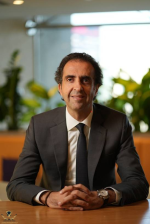
Naim Yazbek, President of Microsoft for the Middle East and Africa (Microsoft)
Saudi national transformation
Yazbek believes that the clear political will in the Kingdom is behind this acceleration. The country is not only seeking to modernize its infrastructure, but also views artificial intelligence as a strategic pillar that is historically equivalent to oil. If oil has formed the basis of the economy for decades, then artificial intelligence has become the new resource on which the Kingdom is betting in its economic future.
Yazbek notes that the recent visit of Prince Mohammed bin Salman, Crown Prince and Prime Minister of Saudi Arabia, to the United States carried an important significance, as the issue of artificial intelligence and advanced technologies came at the forefront of the talks, which reflects the seriousness of the Saudi approach towards building a knowledge-based economy with global influence.
This trend has opened the door to a new phase in which the Kingdom is not content with consuming artificial intelligence technologies from abroad, but rather developing its local capabilities and building a knowledge production system that can be exported, which strengthens the principle of technical sovereignty and establishes an economy based on innovation.
Advantages of the Saudi technology market
Yazbek confirms that the entire regional scene is witnessing a unique transformation, as the Gulf countries, especially Saudi Arabia, are no longer just adopting artificial intelligence technologies, but have also entered the stage of developing and re-exporting them to global markets. The Kingdom is working to build advanced infrastructure capable of running huge models and providing enormous computing capabilities, making it part of the global innovation equation for the first time in its modern history, and not just an importer of technology.
Yazbek conveys a common impression he heard during his multiple recent meetings in Riyadh with ministries, regulatory bodies, national institutions, and international companies, which is that everyone “wants to be at the forefront of artificial intelligence, not behind it.” It is considered that ambitions are no longer slogans, but rather have turned into clear executive decisions, manifested in rearranging budgets, raising expectations, and accelerating project timelines.
Yazbek also points out that Saudi institutions are now demanding that technology companies ensure the highest levels of data sovereignty, especially with the sensitivity of the financial, health, and educational sectors. At the same time, the legislative structure is developing very rapidly to keep pace with this transformation, as the Kingdom has modernized its cybersecurity, data governance, cloud computing, and artificial intelligence systems at a faster pace than many countries around the world, which has made the ability to amend legislation with high flexibility an important competitive advantage. Yazbek notes that the success of institutions is not measured by the number of artificial intelligence projects they implement, but rather by the extent to which these projects are related to major national challenges, as artificial intelligence must be at the heart of productivity, health care, education, and cybersecurity files, and not in small initiatives aimed at media appearance.

Saudi Arabia is one of the first countries to build advanced cloud and sovereign infrastructure, which enables it to develop and innovate new technologies and not just consume them (Getty)
Return on investment equation
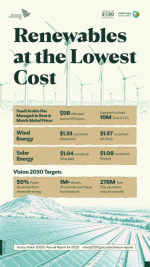
Yazbek points out that building an economy based on artificial intelligence requires more than advanced data centers. It begins with planning for decades to come in energy production and expanding communications networks. The actual operation of huge models requires enormous electrical capacity and long-term stability, which is what the Kingdom is working on through strategic investments in renewable energy and communications infrastructure. These steps strengthen Saudi Arabia's position as a country capable of hosting advanced global computing operations over the coming years.
Yazbek explains that the question of return on investment has become one of the most important questions at this stage. At the national level, the return is measured by direct economic prosperity, increasing domestic product, creating new jobs, enhancing the ability to innovate, raising productivity, and consolidating the Kingdom’s global position. At the institutional level, the results have already begun to appear. Using tools like CoPilot, employees are able to perform their tasks more quickly and with greater quality, eliminating routine work and devoting time to innovation. Yazbek notes that the next phase will witness an expansion of gains to include developing new business models, improving customer experience, simplifying operational processes, and raising efficiency in various sectors.
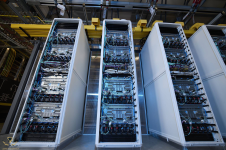
Microsoft will begin operating the new cloud region in Dammam in 2026, which constitutes a major transformation in the health, financial and government sectors (Microsoft)
2026...the major turning point
“Microsoft” is preparing to start operating a new cloud region in Dammam during the second half of 2026 and host all of its cloud services, including “Azure”, “Microsoft 365”, “Dynamics and Power Platform”, cybersecurity services, artificial intelligence, and “Copilot” solutions. This project is one of the largest and most modern data centers in the region, and construction has already been completed while testing and gradual deployment of services are currently underway in preparation for launch. Yazbek confirms that the demand for this cloud is very huge, not only from national institutions, but also from international companies that want to operate their services within the Kingdom, which was not previously possible with this capacity.
This cloud will have an immediate impact on regulated sectors such as health and finance, which will be able for the first time to use local cloud and artificial intelligence services compatible with Saudi systems. Yazbek points out that the services of “Azure” and “Copilot” will become widely available to all institutions, from small companies to the largest economic entities, and that the readiness of human and technical institutions will be the decisive factor in quickly benefiting from this qualitative shift.
Value beyond infrastructure
Yazbek confirms that operating the national cloud not only provides technical capabilities, but also opens the door to the entry of Microsoft's global partner system into the Kingdom. This means that thousands of advanced solutions, from business software to security and data analysis technologies, will become directly available to Saudi organizations. Yazbek considers this integrated system to be the most influential factor in accelerating innovation and building new services, as its value exceeds the value of the infrastructure itself.
Sovereignty and security
Yazbek told Asharq Al-Awsat that the concept of digital sovereignty has become an indispensable element in any national technical architecture. The Kingdom requires cloud service providers to adhere to the highest levels of accreditation to host sensitive national infrastructure, which is what Microsoft is working to achieve before the launch. With the start of operation of the cloud centers in Dammam, they will effectively become part of the Kingdom’s sovereign structure, which requires the highest levels of protection. The company invests billions of dollars annually in cybersecurity, and has been able to repel unprecedented cyberattacks, which reflects the level of threats that national structures face today. The company offers a broad system that includes data governance, sovereign cloud solutions, data classification tools, and hybrid options that give organizations flexibility in operation and expansion. Yazbek emphasizes that sovereignty is not a single concept, but rather a spectrum of requirements that includes data protection, legislative control, and the existence of structures within national borders.
Data...the next source of excellence
Yazbek considers that data is the decisive factor for the success of artificial intelligence, and that any artificial intelligence model that is not based on clean data turns into a source of hallucinations. Therefore, any strategic national discussion begins with a question about the readiness of national data. Today, the Kingdom is working in partnership with “Sdaya”, the Ministry of Communications, and national companies to build a huge data system organized according to the highest standards, making it a main pillar for developing Arabic language models capable of competing globally. Yazbek says the most effective approach is to fine-tune global models using local data that reflects dialects, cultural and industrial contexts, rather than building new models from scratch, which makes the process more sustainable and accurate. Yazbek also calls for adopting a clear framework for responsible artificial intelligence, stressing that speed alone is not enough, and that the safe and reliable use of technology must be built from the first moment. Microsoft is working with national authorities to develop policies that prevent misuse, ensure data protection, and build fair and transparent models. It is considered that these foundations will determine the future of trust between citizens and new technologies.
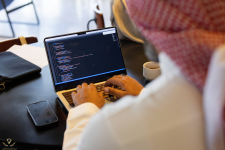 Skills training...a national advantage
Yazbek stresses that human skills are the real engine of national capacity. The Kingdom's possession of a strong infrastructure is not enough without the skills capable of operating and developing it. He believes that Saudi youth represent the Kingdom's major competitive advantage, as the new generation was born in a digital world that deals with modern technologies with spontaneity and flexibility. Microsoft has trained more than a million Saudis over the past two years through joint programs with Sdaya, the Ministry of Communications, the Ministry of Education, and the Misk Foundation. The Joint Artificial Intelligence Academy has also graduated thousands of students from more than forty universities, and has provided expanded programs to train teachers on artificial intelligence tools in education. The vision is that skills development is what transforms the digital infrastructure into national capacity that translates into innovation and productivity.
From adoption to leadership
Yazbek confirms that Microsoft is conducting careful assessments of the impact of the national cloud in the countries in which it operates. These assessments include job creation, contribution to the local product, growth of startup companies, expansion of the partner system, and increased knowledge production. When these indicators rise in conjunction with the spread of local applications of artificial intelligence, the company considers that the country has moved from the adoption stage to the leadership stage. Trends indicate that Saudi startups are rapidly moving towards building solutions based on artificial intelligence, benefiting from cloud grants and technical support that allows them to develop their products more quickly. With the availability of artificial intelligence capabilities locally, these companies will be able to enter the market at a faster pace and launch products that are fully compatible with national regulations.
https://aawsat.com

















 How does Saudi Arabia move from exporting oil to exporting artificial intelligence?
 Basic message