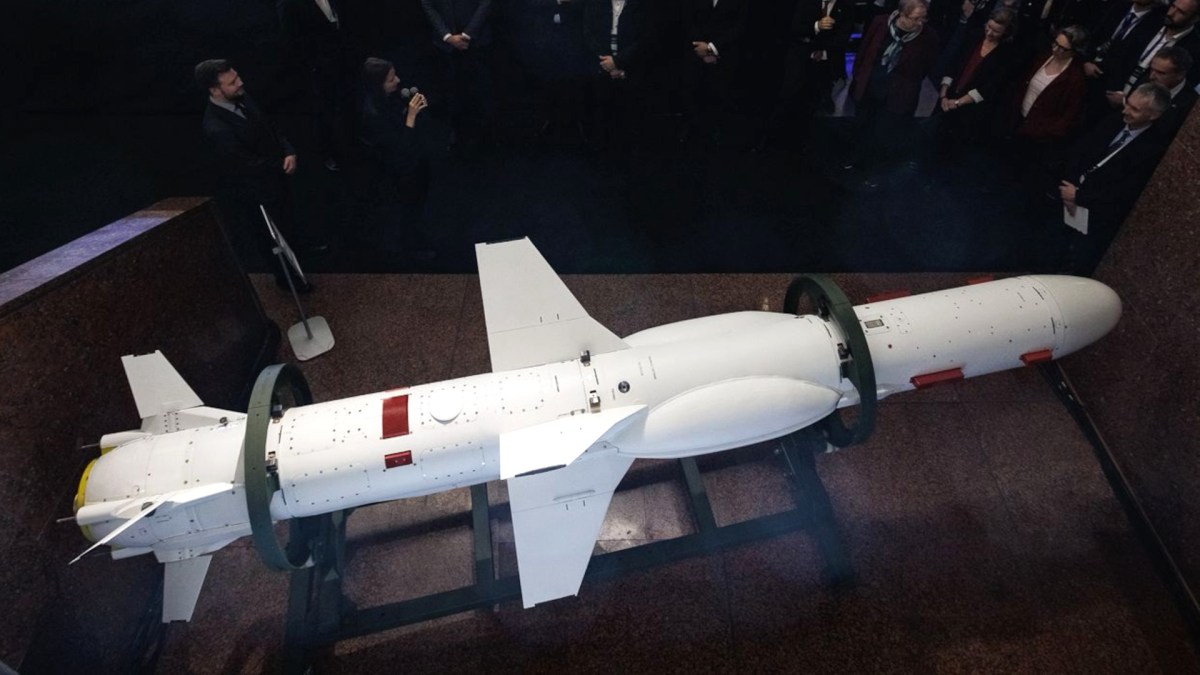
SMASH SLBM Testing - Nov 2025

Question: Is the hypersonic ballistic anti-ship missile option better than a subsonic cruise missile option?
Subsonic anti-ship cruise missiles are capable of hitting moving targets. A hypersonic ballistic missile could be used to hit ships docked in a port defeating shore-based anti-ballistic missile systems.

The most recent examples of large warships being sunk or damaged by anti-ship missiles have been through the use of cruise missiles.
The R-360 Neptune missile used by Ukraine against the Russian Black sea fleet has been successful sinking at least two Russian Navy warships; the guided missile cruiser Moskva and the salvage ship Kommuna.
On 23 August 2023 a land attack variant of the Neptune missile was used to destroy a S-400 missile system radar, deployed on Cape Tarkhanut in Crimea since 2016.
The R-360L extended range variant used for land attack has a range of 1000 km carrying a 260 kilogram warhead.

TL;DR
Russia losing its Flagship in 2022 was plain dumb on their part. As per what's publicly known, they made too many blunders that night.

The S400 has been known to have 2 major blindspots:
  1. Low flying and slow moving vectors (Terrain hugging CMs/Low Altitude Drones) - these vectors are a blindspot for a number of radars anyway. Besides the S400's SAMs are optimized for high altitude and fast moving vectors so it usually relies on other layered SHORADS to deal with low flying/slow flying vectors. There have been multiple reports about Data Link issues of Pantsir with S400 radars that led to mission kill on S400 as well as 15+ Pantsirs.
  2. Near vertical diving high speed vectors (e.g. ATACMS/CM-400AKG) - radars for S400 will usually only detect these vectors very late (during their terminal dive) and won't get a successful lock-on in time because of the speed of the vectors. This is what Ukraine exploited b/w 2023-24 using ATACMS and we did too in May 25 using CM-400.
As for whether subsonic CM or hypersonic BM/QBM - I personally don't think there's a clear winner and I'd say use both in 3:1 - CMs (preferably land launched) for swarm saturation and BM/QBM (preferably ship/sub launched) for mission kill in a joint attack (Naval Scenario)

The more arguable point with CM is that many are still subsonic. Mach 0.8-0.9 can work for shorter ranges (under 200-250 km) but for over 400-500 km range it takes ~ 30 minutes. That's enough time for ADS and even naval maneuvers to avoid impact, besides that amount of time even risks putting guidance assets in the kill chain at risk as well. However, a supersonic CM changes the dynamic altogether.
 
TL;DR
Russia losing its Flagship in 2022 was plain dumb on their part. As per what's publicly known, they made too many blunders that night.

The S400 has been known to have 2 major blindspots:
  1. Low flying and slow moving vectors (Terrain hugging CMs/Low Altitude Drones) - these vectors are a blindspot for a number of radars anyway. Besides the S400's SAMs are optimized for high altitude and fast moving vectors so it usually relies on other layered SHORADS to deal with low flying/slow flying vectors. There have been multiple reports about Data Link issues of Pantsir with S400 radars that led to mission kill on S400 as well as 15+ Pantsirs.
  2. Near vertical diving high speed vectors (e.g. ATACMS/CM-400AKG) - radars for S400 will usually only detect these vectors very late (during their terminal dive) and won't get a successful lock-on in time because of the speed of the vectors. This is what Ukraine exploited b/w 2023-24 using ATACMS and we did too in May 25 using CM-400.
As for whether subsonic CM or hypersonic BM/QBM - I personally don't think there's a clear winner and I'd say use both in 3:1 - CMs (preferably land launched) for swarm saturation and BM/QBM (preferably ship/sub launched) for mission kill in a joint attack (Naval Scenario)

The more arguable point with CM is that many are still subsonic. Mach 0.8-0.9 can work for shorter ranges (under 200-250 km) but for over 400-500 km range it takes ~ 30 minutes. That's enough time for ADS and even naval maneuvers to avoid impact, besides that amount of time even risks putting guidance assets in the kill chain at risk as well. However, a supersonic CM changes the dynamic altogether.

Moskva didnt have s400 and main reason it sank was because its close to ukranian shore with radars off on peace time alert
 
However at 7.5m the missile length is already lengthier than the VLS available on Type 054A/P - so perhaps some form of bolted on Deck Launcher? China displayed a deck launcher for CM-401 at the Zhuhai Air Show in 2018. Type 054A/P has enough TWD to support upto 4 x such launchers (?) in addition to the standard armament already installed.
The VLS system on the Type 054A frigate is the "Type H/AJK-16". This system only supports hot launch mode, and its compatible weapons are limited to the HQ-16 series anti-aircraft missiles and the YU-8 rocket-assisted torpedoes; it does not support other missiles.
The YJ-83 anti-ship missiles carried by the Type 054A frigate are independently mounted at an angle in the middle of the ship and are not integrated into the VLS. This VLS does not support the YJ-83 anti-ship missile.

The "Type H/AJK-16" has poor versatility. It cannot support Pakistani missiles.

Currently, China primarily uses the Type H/HT-1 VLS. This system has a very wide range of compatibility.
 
Moskva didnt have s400 and main reason it sank was because its close to ukranian shore with radars off on peace time alert
The original post mentioned two different events where R-360 Neptune was used. First event Moskva in April 2023, and second the S400 mission kill in August 2023. The above reply was for those 2 events separately and have no link with each other 🥲
 
The VLS system on the Type 054A frigate is the "Type H/AJK-16". This system only supports hot launch mode, and its compatible weapons are limited to the HQ-16 series anti-aircraft missiles and the YU-8 rocket-assisted torpedoes; it does not support other missiles.
The YJ-83 anti-ship missiles carried by the Type 054A frigate are independently mounted at an angle in the middle of the ship and are not integrated into the VLS. This VLS does not support the YJ-83 anti-ship missile.

The "Type H/AJK-16" has poor versatility. It cannot support Pakistani missiles.

Currently, China primarily uses the Type H/HT-1 VLS. This system has a very wide range of compatibility.

The VLS incompatibility I'm aware of and not suggesting they can be launched from the VLS. I was asking if SMASH or a similar missile can be fired using bolted on Deck Launchers like the ADL by BAE for USN?

I'm asking because there were some reports that China has also been developing a similar adaptive launcher.

Something like 👇🏻
ADL by BAE Systems
 
Last edited:
The VLS incompatibility I'm aware of and not suggesting they can be launched from the VLS. I was asking if SMASH or a similar missile can be fired using bolted on Deck Launchers like the ADL by BAE for USN?
This method is not limited to warships. Any vessel can be used, as long as its deck platform is large enough to accommodate the launch device, including ordinary merchant ships or any other civilian vessels.

You can transport any TEL vehicle onto a ship's deck for launching; you can even transport purely land-based equipment such as tanks, artillery, and MLRS onto the deck.

You could also design the missiles and launch systems in a containerized format. This would allow them to be launched from a wider range of platforms, including ordinary ships, roads, and railways.
 
  • Like
Reactions: hnn
This method is not limited to warships. Any vessel can be used, as long as its deck platform is large enough to accommodate the launch device, including ordinary merchant ships or any other civilian vessels.

You can transport any TEL vehicle onto a ship's deck for launching; you can even transport purely land-based equipment such as tanks, artillery, and MLRS onto the deck.

You could also design the missiles and launch systems in a containerized format. This would allow them to be launched from a wider range of platforms, including ordinary ships, roads, and railways.

Yeah that's what I was asking about because Type 054A/P and even the Milgem have enough TWD/FLD to support such an adaptable launcher, at least I think so but am not certain. What do you think? Is it possible for such deck launchers to be installed on these ships in addition to the standard armament they already have installed?
 
Yeah that's what I was asking about because Type 054A/P and even the Milgem have enough TWD/FLD to support such an adaptable launcher, at least I think so but am not certain. What do you think? Is it possible for such deck launchers to be installed on these ships in addition to the standard armament they already have installed?
This method is generally used in informal situations, such as emergencies or covert operations. It is related to the design of the missile itself and its support environment. Besides the missile launcher vehicle, you also need corresponding support vehicles (you cannot use the systems built into the warship itself). We usually only see the missile launch vehicle, and rarely pay attention to the auxiliary vehicles. But there are actually many auxiliary vehicles. Modern warships have very limited deck space, making it difficult to accommodate so many vehicles. Using large civilian vessels is a feasible option.

For example:
What you see is just the missile launcher vehicle of an air defense missile system. But in reality, a complete air defense missile system consists of a large convoy of dozens of vehicles.

Generally, if the missile is compatible with a VLS, it is best to use the VLS.
 
  • Like
Reactions: hnn
This I didn't know. I thought it could be integrated into the warship's system. Thanks 👍🏻
If it can be easily integrated into the warship's internal systems, then we won't need an external system. Integration can be easily achieved with minor modifications to the VLS launch system.

The most difficult aspect is not the caliber and depth of the VLS, but the integration with the internal systems.
 
  • Like
Reactions: hnn
To view this content we will need your consent to set third party cookies.
For more detailed information, see our cookies page.
 
There are two considerations here that I'm aware of if a SMASH variant with 700-800 km range exists.

The recently tested YJ-21 with a reported range of 1500 km was test fired from a 9m deep VLS. So for a 700-800 km ranged SMASH the missile would be b/w 7-8m (?) - the size of SMASH displayed publicly was 7.5m but the range as displayed was 350 km (if I recall correctly) - I am assuming that the range on it is more than that.

However at 7.5m the missile length is already lengthier than the VLS available on Type 054A/P - so perhaps some form of bolted on Deck Launcher? China displayed a deck launcher for CM-401 at the Zhuhai Air Show in 2018. Type 054A/P has enough TWD to support upto 4 x such launchers (?) in addition to the standard armament already installed.

For Milgem it's TWD can perhaps allow for 2 x such additional launchers (?) - but there are also reports (unverified) that China has been modifying HQ-16 SAMs into ASBMs so they can be launched from the 7m deep VLS. Though it's not certain how credible this chatter is, and even if credible how feasible the modification is and what range it'll offer.
Not many VLS are dual missile type compatible.
SAM are smaller compared to AShM which need more heat management and bigger booster motors.

Also, PN F22-P don't have VLS.
milgem are Corvette size, have vls for albatros ng SAM and angled canisters for Harbah AshM.
Angled canisters are easy to mange so PN is happy with angled canisters based AshM IMO.

Can Jinnah class have them. I am not expert in various navy design philosophies. Will appreciate if you can shed more light. But I think PN will go for angled canisters for AshM for Jinnah too. Easy to manage, less complex.
Your missile length extrapolation is good, I would had done same 😁
 
Not many VLS are dual missile type compatible.
SAM are smaller compared to AShM which need more heat management and bigger booster motors.

Also, PN F22-P don't have VLS.
milgem are Corvette size, have vls for albatros ng SAM and angled canisters for Harbah AshM.
Angled canisters are easy to mange so PN is happy with angled canisters based AshM IMO.

Can Jinnah class have them. I am not expert in various navy design philosophies. Will appreciate if you can shed more light. But I think PN will go for angled canisters for AshM for Jinnah too. Easy to manage, less complex.
Your missile length extrapolation is good, I would had done same 😁

Ah I see there's been some confusion about my last post. I'm not saying SMASH can be launched from the VLS available on Type 054A/P (Tughril Class) - which is for HQ-16 SAM. I mentioned that there are unverified news regarding China repurposing HHQ-16 missiles into ASBMs - and even if true that is going to be a different missile than SMASH.

054A/P is already reported to deploy CM-302 which is a similar length and weight missile as SMASH. Hence, for deploying SMASH on 054A/P, I was suggesting and asking the feasibility about an Adaptive Launcher but Michael already clarified that though it is possible to physically install such a launcher on the deck of the ship the hurdle is to integrate the launcher with warship's available onboard systems (FCS, Electrical, Data Link, etc).

Yes, Type 053H3/F-22P (Zulfiqar Class) doesn't have VLS, it's why I suggested Adaptive Launcher but then again integration is the hurdle.

Milgem (Babur Class) is already reported to deploy either Harbah or P-282 (SMASH) & Jinnah Class (Evolution of Milgem) will most likely include it (it's counter intuitive to think that these two classes won't deploy SMASH given that they are under production).

If we assume that integration can be done, even then, IMO, F-22P may at best be upgraded with Harbah CM to replace CM-802 because CM-302 and/or SMASH would require structural changes on top of the integration hurdle. On the other hand, whether PN will take on the challenge to integrate SMASH on Type 054A/P (Tughril Class) remains to be seen.
 
Last edited:
If tracking and targeting are done by other platforms why do we even need to bother putting SMASH on a warship?

Why not unmanned platforms that just carry the missile launchers.

Leave the platforms at undisclosed locations or even pilot them remotely. When Sea Sultan/Sats/subs have targeting info to pass them just press launch?
 

Users who are viewing this thread

Pakistan Defence Latest

Country Watch Latest

Back
Top