South Korea's Shipbuilding's Spring Illusion: Backbone Collapses
Published 2026.03.24. 23:31
By Choi Joon-young Senior Specialist, Yulchon LLC
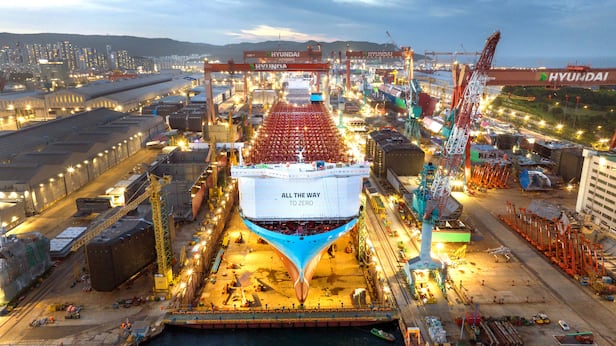
HD Hyundai Heavy Industries Ulsan Shipyard, Ulsan Metropolitan City. /Chang Lian-cherng
Spring arrives first on the southern coast. The sound of giant cranes lifting steel plates at shipyards in Geoje, Ulsan, and Yeongam echoes like the heartbeat of South Korea’s shipbuilding industry, which is once again on the rise. It seems the shipbuilding industry has welcomed spring once more. The combined 2025 sales of the three major shipbuilders—HD Hyundai Heavy Industries, Hanwha Ocean, and Samsung Heavy Industries—have surpassed 53 trillion Korean won, with operating profits recording a remarkable 170% growth compared to the previous year. Three years’ worth of orders are piled up. Has our shipbuilding industry regained its position as the world’s strongest?
Korean Shipbuilding Ecosystem Collapses
However, despite the strong performance of large shipyards, the hearts of on-site officials remain heavy. Although it appears prosperous, a crisis coexists. While large shipyards focused on LNG carriers celebrate with champagne, the backbone of our shipbuilding industry—small and medium-sized shipyards and equipment manufacturers—are on the brink of collapse. Over the past 20 years, the balance of the entire shipbuilding ecosystem, which was evenly distributed across the southeastern region, has collapsed.
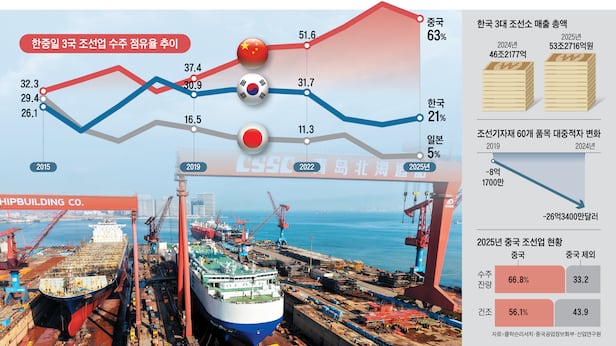
Key shipbuilding components are now filled with Chinese-made products. The trade deficit with China for 60 representative shipbuilding components surged more than threefold over five years, from 817 million US dollars in 2019 to 2.94 billion US dollars in 2024. While domestic shipyards decreased to 12, China surpassed 200. The technological gap has already become a mirage. According to a 2023 analysis by the Korea Institute for Industrial Economics and Trade, in comprehensive competitiveness, China has overtaken us and claimed the throne of the world’s number one shipbuilding industry. Last year, South Korea’s share of global ship orders (based on compensated gross tonnage) stood at 21%, just one-third of China’s 63%.
Graphics by Yang In-sung
China Makes Bold Investments Even During Downturns
The bigger issue is that we are falling behind in future investments as well. Recently, Chinese shipyards have been expanding their capacities by 300,000 tons—equivalent to two or three large shipyards—in multiple locations. In addition to price and volume, ‘smart yards’ combining 5G, the Internet of Things (IoT), and robotic welding are being created everywhere. While we remain complacent with our current order backlog, China is building up its strength in preparation for the supply glut era expected after 2028. In the past, our shipbuilding industry overwhelmed competitors through bold investments even during downturns; now, it is China that is demonstrating that gambler’s spirit. If this continues, after a short period of prosperity, we may be left with only the desolate reality of empty docks and the loss of technology and manpower.
The root of this crisis lies in viewing the shipbuilding industry merely as a ‘manufacturing plant that builds ships.’ When we allowed Hanjin Shipping, the world’s seventh-largest company covering 60 routes with 97 vessels, to go bankrupt, domestic shipyards lost more than just one customer. Stable demand sources, opportunities to maintain technology for building various types of ships, and the survival base for equipment manufacturers disappeared together. In contrast, China fostered super-large shipping companies like COSCO (China Ocean Shipping Company) as a national strategy, and as they consistently ordered various ships from domestic shipyards, they organically grew the shipbuilding and equipment industries.
◇Transition to a Comprehensive Marine Strategy
To develop the shipbuilding industry into a future industry, we must move beyond a single-industry perspective and establish a comprehensive marine strategy encompassing shipping, ship finance, and national defense. The United States’ actions exemplify this. The ‘Marine Action Plan (AMAP)’ announced by the US in February aims to create demand for shipyards by mandating that a certain percentage of domestic cargo be transported by US vessels, and based on this, train personnel and rebuild the industry. Even the world’s strongest advocate of free trade has now chosen the path of state-led industrial revival. It is becoming the new normal for the state to set goals, allocate resources, and integrate various sectors. A national strategy that connects shipbuilding, marine, ship finance, and security like interlocking gears is urgently needed.
Hyundai Chung Ju-yung Chairman established shipyards on barren land with the insight that ‘building structures or ships is the essence.’ In 2026, we can start under much better conditions. We have the capability, experience, capital, and manpower. What is lacking is one thing: the will to run again. There is no time to be intoxicated by the spring sunshine of prosperity. Winter comes sooner than expected.
Widening Gap in Chinese Shipbuilding
The Outcome of a Comprehensive Marine Strategy
Chinese shipbuilding is demonstrating overwhelming presence in the global market in 2025. According to statistics from the Chinese Ministry of Industry and Information Technology, the Chinese shipbuilding industry leads the world in all three key indicators: construction volume (56.1% global market share), new orders (69%), and order backlog (66.8%). As of February this year, 80% of global new orders were concentrated in China, solidifying its de facto monopoly.
The world’s largest shipbuilding company is the China Shipbuilding Group (CSSC), which has 104 subsidiaries and 220,000 employees. Born from the merger of the China Shipbuilding Industry Corporation and the China Shipbuilding Heavy Industry Corporation, CSSC has built an integrated system encompassing not only super-large shipyards but also design companies, shipbuilding equipment manufacturers, financial institutions, and trading companies, overwhelming our companies with its competitiveness.
Chinese shipbuilding, which had a global market share of around 5% in the 1990s, grew rapidly after announcing the ‘Mid- to Long-Term Development Plan for the Shipbuilding Industry’ in 2002. The Chinese government pursued a strategy of simultaneously strengthening the shipping and ship finance industries to develop shipbuilding. To build ships, ship owners are necessary. In this process, it is essential to have a refund guarantee (RG) where the bank returns the advance payment if the shipyard goes bankrupt and fails to deliver the ship after the ship owner pays the advance. By mobilizing state-run and private financial institutions to issue RGs almost unlimitedly, China created global demand for its domestic shipyards.
Recent trends show that when Chinese shipping companies need experience in building new types of ships or face a downturn, they place large orders with domestic shipyards. In December, COSCO, China’s largest shipping company, ordered 87 vessels (worth approximately 7.1 billion US dollars) including large oil tankers, container ships, crane ships, and car carriers from CSSC. Chinese shipyards are expanding their LNG shipbuilding experience globally and are making inroads into overseas order markets like Qatar. While South Korea left everything to companies, China overtook us through comprehensive support by strengthening related industries and is now widening the gap.
Welcome Transition to ‘Smart Yards’
Coexistence of Skilled Workers and Shipbuilding Ecosystem
Amid growing interest in the shipbuilding industry, four bills aimed at developing the industry have recently been proposed in the National Assembly and are pending in the Standing Committee. Although somewhat late, it is positive that the legislature is moving to enable state support for key manufacturing industries. The four bills generally focus on providing necessary support for converting existing shipyards into ‘smart yards.’
While the introduction of artificial intelligence and robotic technology is essential in transitioning to smart yards, the real key lies in systematically securing data so that AI and robots can learn from the know-how of aging skilled workers and continuously improve errors. To achieve this, the state must ensure sufficient compensation and working conditions to encourage skilled workers to participate voluntarily. Additionally, the data thus built should be shared between primary contractors and subcontractors to promote coexistence and cooperation across the entire shipbuilding ecosystem.
Another challenge for the domestic shipbuilding industry is the difficulty in testing new technologies at sea. Even when companies attempt experiments at their own expense, they are often deemed illegal. Ultimately, companies conduct experiments in distant international waters upon requests from overseas companies, and the results are evaluated as the overseas companies’ achievements. The chronic malpractice of ‘If a problem arises, it’s your responsibility’ must be overcome through this legislation.
Most importantly, it is crucial to establish a framework for institutional collaboration between the Ministry of Trade, Industry and Energy, which oversees shipbuilding, and the Ministry of Oceans and Fisheries, which governs shipping. If they acknowledge the necessity but compete for leadership, we will ultimately hand everything over to China. Political efforts and attention are urgently needed to ensure inter-ministerial cooperation for establishing a comprehensive marine strategy.