Navigation
Install the app
How to install the app on iOS
Follow along with the video below to see how to install our site as a web app on your home screen.
Note: This feature may not be available in some browsers.
More options
Style variation
You are using an out of date browser. It may not display this or other websites correctly.
You should upgrade or use an alternative browser.
You should upgrade or use an alternative browser.
Southeast Asia quarterly economic review: Holding up strongly, September 3, 2024 | Full Report by McKinsey
- Thread starter Indos
- Start date
More options
Who Replied?


Malaysia trade volumes with US is relatively small, its Gdp is much smaller than JP and KR, makes no sense to make such huge concession to Trump. this madness must stop.Better Malaysia dont do a deal since their main export to US is semiconductor and pharma, these two are out of the deal and the tarrif will be imposed by Trump unilaterally
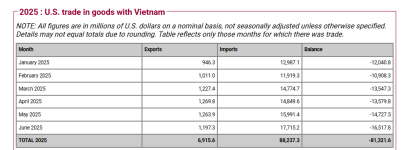
Vietnam only commits $90b in purchases despite huge trade volumes and surplus.
冖_冖
Registered Member


Malaysia, Indonesia and Thailand expand local currency transaction framework - TNGlobal
Bank Negara Malaysia (BNM), Bank Indonesia (BI) and the Bank of Thailand (BOT) have announced the appointment of additional qualified commercial banks to operationalize the Local Currency Transaction Framework (LCTF).
 technode.global
Malaysia, Indonesia and Thailand expand local currency transaction framework - TNGlobal
Bank Negara Malaysia (BNM), Bank Indonesia (BI) and the Bank of Thailand (BOT) have announced the appointment of additional qualified commercial banks to operationalize the Local Currency Transaction Framework (LCTF).
technode.global
Malaysia, Indonesia and Thailand expand local currency transaction framework
August 6, 2025• FinTech, Indonesia, Malaysia, News, ThailandBank Negara Malaysia (BNM), Bank Indonesia (BI) and the Bank of Thailand (BOT) have announced the appointment of additional qualified commercial banks to operationalize the Local Currency Transaction Framework (LCTF).
These qualified banks, known as Appointed Cross-Currency Dealers (ACCDs), will facilitate cross-border settlement of trade and investment between the respective countries, the central banks said in a statement on Wednesday.
This initiative follows several enhancements to the LCTF announced on February 17, 2025.
The expanded ACCD network will strengthen customer outreach, enhance market access to local currency liquidity, provide businesses with enhanced options for cross-border transactions between Malaysia, Indonesia and Thailand.
BNM, BI, and BOT continue to support trade and investment growth through closer financial collaboration under the LCTF.
The newly appointed banks are listed below:
MYR-IDR LCTF
Malaysian Banks:
AmBank (M) Berhad
Bank of China (Malaysia) Berhad
OCBC Bank Malaysia Berhad
Standard Chartered Bank Malaysia Berhad
Sumitomo Mitsui Banking Corporation Malaysia Berhad
Indonesian Banks:
PT Bank Danamon Indonesia Tbk
PT Bank OCBC NISP Tbk
PT Bank Pembangunan Daerah Jawa Timur Tbk
Bank of China (Hong Kong) Limited Jakarta Branch
MYR-THB LCTF
Malaysian Banks:
AmBank (M) Berhad
Bank of China (Malaysia) Berhad
Hong Leong Bank Berhad
OCBC Bank Malaysia Berhad
Sumitomo Mitsui Banking Corporation Malaysia Berhad
Thai Bank:
Bank of China (Thai) Public Company Limited
IDR-THB LCTF
Indonesian Banks:
PT Bank OCBC NISP Tbk
Bank of China (Hong Kong) Limited Jakarta Branch
Thai Bank:
Bank of China (Thai) Public Company Limited
冖_冖
Registered Member
Malaysia, Indonesia and Thailand expand local currency transaction framework - TNGlobal
Bank Negara Malaysia (BNM), Bank Indonesia (BI) and the Bank of Thailand (BOT) have announced the appointment of additional qualified commercial banks to operationalize the Local Currency Transaction Framework (LCTF).Malaysia, Indonesia and Thailand expand local currency transaction framework
August 6, 2025• FinTech, Indonesia, Malaysia, News, Thailand
Bank Negara Malaysia (BNM), Bank Indonesia (BI) and the Bank of Thailand (BOT) have announced the appointment of additional qualified commercial banks to operationalize the Local Currency Transaction Framework (LCTF).
These qualified banks, known as Appointed Cross-Currency Dealers (ACCDs), will facilitate cross-border settlement of trade and investment between the respective countries, the central banks said in a statement on Wednesday.
This initiative follows several enhancements to the LCTF announced on February 17, 2025.
The expanded ACCD network will strengthen customer outreach, enhance market access to local currency liquidity, provide businesses with enhanced options for cross-border transactions between Malaysia, Indonesia and Thailand.
BNM, BI, and BOT continue to support trade and investment growth through closer financial collaboration under the LCTF.
The newly appointed banks are listed below:
MYR-IDR LCTF
Malaysian Banks:
AmBank (M) Berhad
Bank of China (Malaysia) Berhad
OCBC Bank Malaysia Berhad
Standard Chartered Bank Malaysia Berhad
Sumitomo Mitsui Banking Corporation Malaysia Berhad
Indonesian Banks:
PT Bank Danamon Indonesia Tbk
PT Bank OCBC NISP Tbk
PT Bank Pembangunan Daerah Jawa Timur Tbk
Bank of China (Hong Kong) Limited Jakarta Branch
MYR-THB LCTF
Malaysian Banks:
AmBank (M) Berhad
Bank of China (Malaysia) Berhad
Hong Leong Bank Berhad
OCBC Bank Malaysia Berhad
Sumitomo Mitsui Banking Corporation Malaysia Berhad
Thai Bank:
Bank of China (Thai) Public Company Limited
IDR-THB LCTF
Indonesian Banks:
PT Bank OCBC NISP Tbk
Bank of China (Hong Kong) Limited Jakarta Branch
Thai Bank:
Bank of China (Thai) Public Company Limited
China, Indonesia Launch LCT Framework, QR Code Connectivity Pilot
www.yicaiglobal.com
DATE: 2 hours ago
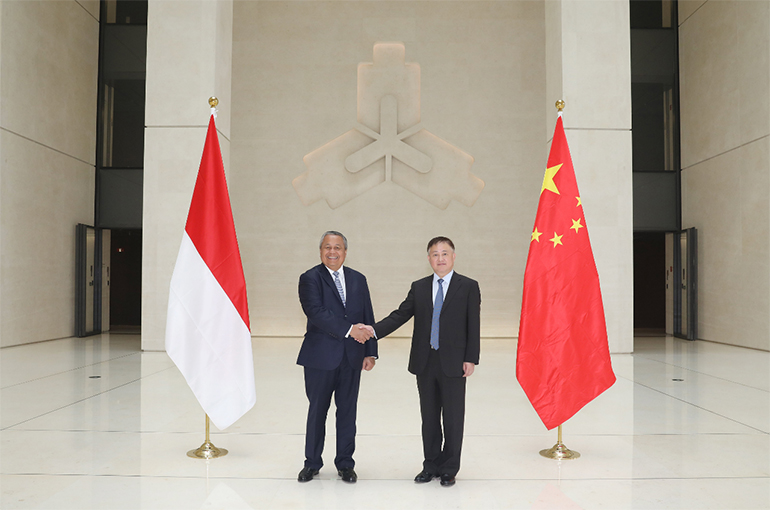
(Yicai) Sept. 12 -- The central banks of China and Indonesia have launched a framework on local currency transactions and a pilot project for cross-border QR code connectivity to enhance the payment cooperation between the two countries.
The LCT framework is an upgrade from an existing one, expanding local currency settlements to all balance of payment items and further promoting the use of local currencies in bilateral trade and investment, the People’s Bank of China and Bank of Indonesia announced yesterday.
The PBOC and BI established a local currency settlement framework in 2020 to facilitate account transactions and direct investment settlements in local currencies. In May this year, they signed a memorandum of understanding to upgrade the LCS to an LCT framework.
The two sides also kicked off the China-Indonesia Cross-Border QR Code Connectivity pilot, which will use local currencies for settlement, according to yesterday’s statement. It is expected to be fully operational this year.
The LCT framework and the QR code connectivity are important outcomes in the two countries’ bilateral financial cooperation, Pan Gongsheng, governor of the PBOC, said in his speech. He also called for further cooperation in payment system connectivity, local currency usage, financial market opening-up, and digital currency.
LCTs between Indonesia and China exceeded USD6.2 billion in the first seven months of this year, accounting for around 45 percent of Indonesia’s total LCT volume with its trading partners, BI Governor Perry Warjiyo said.
LCS frameworks were initiated by several central banks in the Association of Southeast Asian Nations to reduce exchange rate risks and currency conversion costs for businesses by increasing the use of local currencies within the region. Indonesia has already signed similar agreements with Japan, Malaysia, South Korea, and Thailand.
冖_冖
Registered Member
EU’s Sefcovic Seeks FTAs With Malaysia, Other Asean Nations Soon
September 25, 2025 at 2:45 PM GMT+8
- The European Union hopes to reach free trade agreements with Malaysia, the Philippines and Thailand before the 50th anniversary of the bloc’s relations with the Association of Southeast Asian Nations in 2027.
- The EU has ramped up negotiations with various Asian countries in a bid to diversify away from the US amid President Donald Trump’s tariff war.

ASEAN-EU Comprehensive Partnership Key To Navigating Global Trade Challenges – Economist
ASEAN, EU, 57th AEM, Yeah Kim Leng, FTA, Economy
 asean.bernama.com
ASEAN-EU Comprehensive Partnership Key To Navigating Global Trade Challenges – Economist
24/09/2025 09:14 AMKUALA LUMPUR, Sept 24 (Bernama) -- A conclusive economic partnership between ASEAN and the European Union (EU) could help cushion the impact of global trade uncertainties, an economist said.
Sunway University economics professor Dr Yeah Kim Leng said the EU is likely to continue strengthening its trade and investment presence in Southeast Asia through bilateral free trade agreements (FTAs) before a comprehensive EU-ASEAN region-to-region deal can be achieved.
He said deeper EU-ASEAN cooperation would help shield both regions from spillover effects of the intensifying United States (US)-China rivalry.
Yeah noted that EU-ASEAN ties have gained importance as an affirmation of multilateralism and as a counterweight to the US’s shift towards inward-looking policies.
He added that both regions are seeking stronger partnerships to offset continued weakness in the global economy, particularly in the US and China.
"The closer ties will enable countries in both regions to cope with the likely fragmentation of world markets and the reconfiguration of global supply chains," he said.
He was speaking to Bernama in conjunction with the upcoming 57th ASEAN Economic Ministers’ Meeting and Related Meetings, scheduled for 22–26 September at the Malaysia International Trade and Exhibition Centre (MITEC), which will also include meetings with dialogue partners.
Nevertheless, Yeah also opined that it may still be too early to finalise the EU-ASEAN FTA due to ASEAN’s diverse and varying development stages, despite ongoing formal negotiations.
"Instead, the EU has forged bilateral FTAs with Singapore and Vietnam, while talks with Indonesia, Malaysia, the Philippines and Thailand are either ongoing or in exploratory stages.
"It is likely that more bilateral FTAs will need to be concluded before the region-to-region FTA can be realised through a domino effect when more ASEAN members gain benefits from an FTA with the EU," he added.
Meanwhile, a recent EU-ASEAN Business Sentiment Survey revealed that Malaysia has emerged as one of the four most attractive ASEAN markets for European businesses, alongside Vietnam, Indonesia and Thailand.
According to ASEAN statistics, the total value of two-way merchandise trade between ASEAN and the EU reached US$292.57 billion (US$1 = RM4.21) in 2024.
In addition, foreign direct investment (FDI) inflows from the EU to ASEAN amounted to US$20.40 billion in 2024, placing the EU as ASEAN’s third-largest trading partner and second-largest external source of FDI.
Commenting further, Yeah believed that ASEAN and the EU possess strong potential and growth opportunities to further enhance trade and investment relations between the two regions, with various sectors set to benefit.
Beyond trade in goods, Yeah said investment flows are expected to rise, particularly in manufacturing, green technology and digital economy sectors, where European companies hold technological advantages.
He also observed that ASEAN countries’ commodity exports, such as oil, gas, palm oil, rubber and timber, will have easier access to EU markets.
"Subsequently, the EU's advanced technology in renewable energy, pharmaceuticals, biotechnology and manufacturing products such as medical devices, electronics and telecommunications equipment will see rising demand in ASEAN," he added.
-- BERNAMA

Indos
INT'L MOD
- Thread starter
- #68
ADB slashes 2026 growth outlook for Thailand, Singapore by nearly half
Vietnam bucks the bank’s regional downgrades with a slight lift for 2025Goh Ruoxue
Published Tue, Sep 30, 2025 · 08:00 AM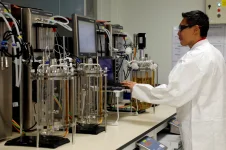
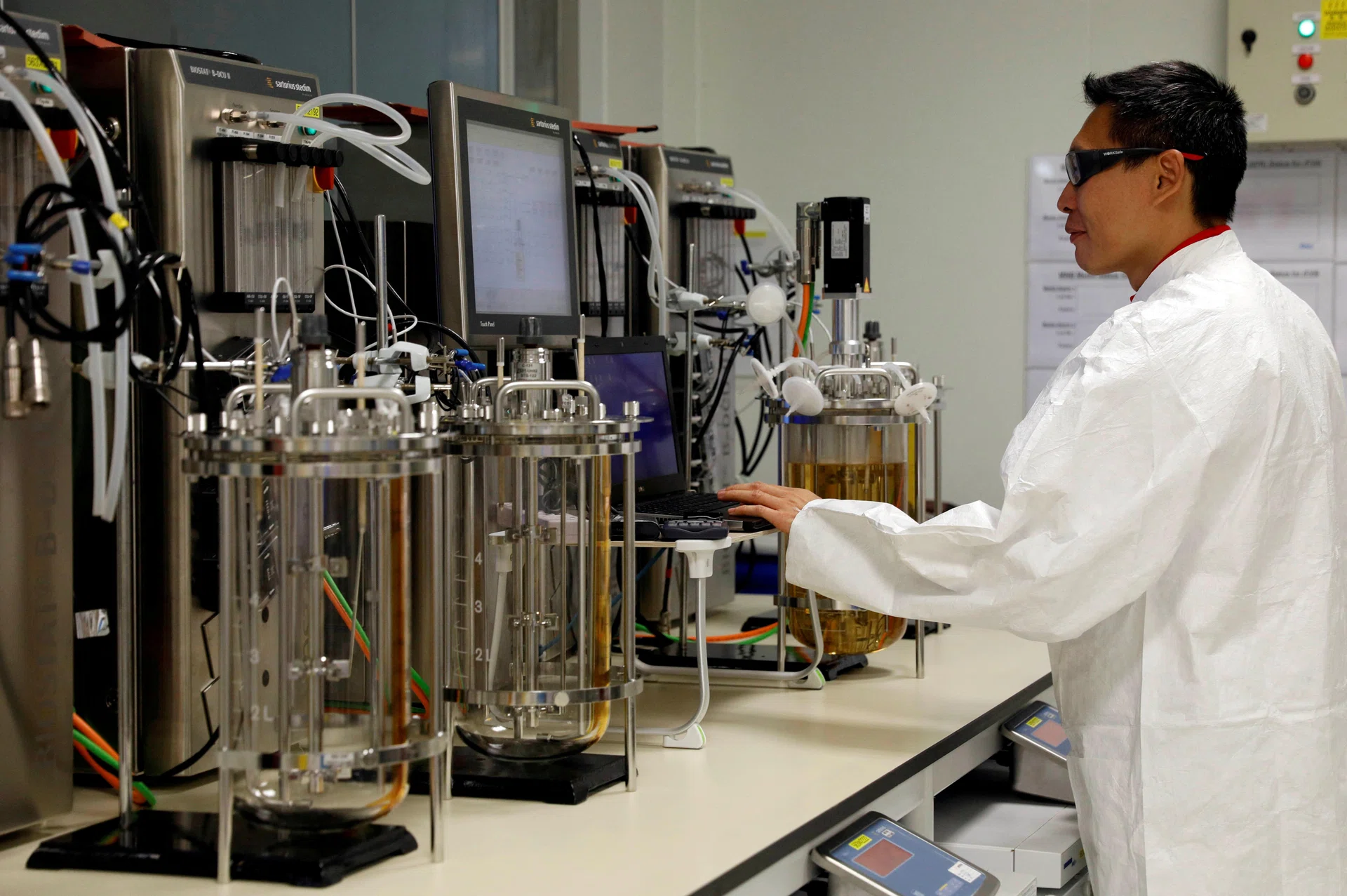
An employee checking readings at a laboratory in a pharmaceutical manufacturing factory in Singapore. Additional US tariffs on pharmaceuticals and semiconductors would mostly affect South-east Asia, said ADB, with the former primarily hitting Singapore. PHOTO: REUTERS
[SINGAPORE] The Asian Development Bank (ADB) trimmed its full-year growth projections for all major South-east Asian economies – save for Vietnam with a slight lift for the year – with Thailand and Singapore facing the steepest downgrades of at least a whole percentage point.
The downward revisions reflect persistent global growth deceleration, heightened trade uncertainty and domestic challenges, said the multilateral development bank on Tuesday (Sep 30) in an update to its flagship outlook report published every April.
ADB also expects the boost from the tariff front-running, which buoyed the region’s exports in the first half of the year, to evaporate.
As a whole, South-east Asia is now expected to grow 4.3 per cent this year and the next, compared with an earlier 4.7 per cent estimated for both years.
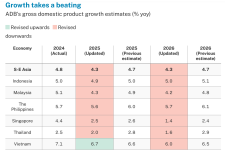
Source: ASIAN DEVELOPMENT OUTLOOK DATABASE
GRAPHIC: GOH RUOXUE, BT
Thailand: Hit on all fronts
South-east Asia’s second-largest economy saw among the harshest downgrades in the region.Compared with economic growth of 2.5 per cent last year, the bank now expects Thailand to end the year with real gross domestic product growth of 2 per cent, down from an earlier forecast of 2.8 per cent.
Singapore: Outsized blow from US tariffs
Compared with economic growth of 4.4 per cent last year, the bank now expects Singapore’s 2025 growth to come in at 2.5 per cent, down from an earlier estimate of 2.6 per cent.The government’s own forecast comes in at 1.5 to 2.5 per cent, upgraded in August from an earlier 0 to 2 per cent.
The Republic faced a much-steeper cut for 2026, with ADB trimming its forecast to 1.4 per cent from an earlier estimate of 2.4 per cent.
Despite a robust first half, the bank believes that economic growth will moderate into the year as expansion slows in outward-oriented sectors, such as wholesale trade, transportation and storage.
Such impacts from US tariffs will weigh even more heavily on Singapore’s economy next year.
ADB principal economist John Beirne said in a press briefing in response to questions by The Business Times: “The extent of external demand due to the tariffs has been the major factor behind our downward revision in the case of Singapore.”
He continued: “This has been more than we had anticipated earlier, and the factor behind this is really related to the share of final demand accounted for by Singapore relative to the US.”
The report also noted that additional US tariffs on pharmaceuticals and semiconductors would mostly affect South-east Asia, with the former primarily hitting Singapore.
On how the latest US pharmaceutical duties announced last Thursday (Sep 25) shapes the region’s outlook, Beirne replied: “Overall, despite the extent of the tariffs, we would see that the exemptions in place and the nature of the tariffs in terms of scope would mean that the impact on South-east Asia and the region overall would be very, very marginal.”
Trade-related inflationary pressures are also clouding US monetary policy, noted ADB, and such uncertainty could increase financial market volatility and destabilise capital flows, which would hinder financing and investment.
Vietnam: Buoyed by expansionary domestic policies
Vietnam is the only South-east Asian economy that saw an improvement in its 2025 growth forecast to 6.7 per cent from ADB’s earlier April forecast of 6.6 per cent.The country notched a multi-year high GDP growth of 7.52 per cent in the first half of 2025, driven by robust exports, strong improvement in the manufacturing and services sectors, as well as a surge in foreign direct investment disbursements.
For 2026, growth is expected to moderate to 6 per cent, down from an earlier estimate of 6.5 per cent.
ADB expects Vietnam’s economy to remain resilient, supported by expansionary fiscal and monetary policies that have boosted domestic consumption.
That said, weaker manufacturing and exports from US tariffs may curb demand for logistics, finance and business services.
And if trade tensions persist – clouded by uncertainty over transshipment tariffs – investment could slow and constrain growth in high-value service industries next year, said ADB.
Growing financial vulnerabilities and delays in policy coordination could limit the effectiveness of stimulus measures as well, noted the bank.
Moderating price pressures
On the other hand, inflation prints are broadly looking better.ADB cut its inflation projections for the region to 2.5 per cent in 2025 from an earlier 3 per cent, and to 2.7 per cent in 2026 from a previous estimate of 2.8 per cent. This compares with 3 per cent in 2024.
Across South-east Asia, lower food and energy prices continued to underpin consumer price disinflation, said the bank – even as core inflation remained largely steady since mid-2024 and food price pressures edged up in some economies in August.
Inflation dynamics generally remain muted across the region, the report found, highlighting weak commodity prices and timely domestic policy responses.
Against a backdrop of moderating price pressures and intensifying external risks, monetary policy across South-east Asia broadly shifted towards easing this year, with central banks expected to maintain accommodative stances into the next year.
ADB slashes 2026 growth outlook for Thailand, Singapore by nearly half
Vietnam bucks the bank’s regional downgrades with a slight lift for 2025 Read more at The Business Times.
Indos
INT'L MOD
- Thread starter
- #69
Opinion: Southeast Asia's next big leap
By Bruno S Sergi & Vigneswari Palanimuthu
01 Oct 2025, 12:10 pm

With over 650 million people, a median age under 30, and some of the world’s fastest-growing digital markets, Southeast Asia has become a critical node in global value chains.
US President Donald Trump is expected to visit the region next month during the 47th Asean Summit in Kuala Lumpur, scheduled for Oct 26-28. Meanwhile, when announcing fresh curbs on advanced semiconductors and threatened tariffs on countries, he accused them of “giving a complete pass to China’s largest tech companies”. The headlines once again framed the contest as a binary clash between Washington and Beijing. His administration’s new “AI Action Plan”, designed to choke off chip and AI equipment exports to China, reinforced the impression that the future of technology will be decided in a two-player game.
Well, could that framing be outdated? The next leap forward in the global digital economy might emerge from Southeast Asia, where vibrant countries passionately compete and innovate to carve out their own unique space in the tech landscape.
With over 650 million people, a median age under 30, and some of the world’s fastest-growing digital markets, the region has become a critical node in global value chains. Vietnam and Malaysia are indispensable in chip assembly and testing. Singapore hosts advanced fabs and AI research hubs. Indonesia and the Philippines are powering a surge in fintech, e-commerce, and AI-enabled logistics. Together, these economies are no longer just “China+1” alternatives — they are emerging as co-architects of the global technology order.
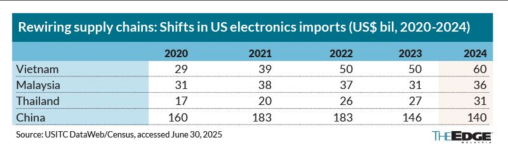
The lesson is clear: global supply chains are being rewired, with the US imports of electronic products from China falling from US$160 billion (RM674.08 billion) in 2020, before reaching a US$183 billion peak in 2022, to US$140 billion in 2024. In contrast, imports from Vietnam rose significantly, doubling from US$29 billion to US$60 billion between 2020 and 2024. Additionally, Malaysia and Thailand made gains, with imports growing to US$36 billion and US$31 billion, respectively. Multinationals are diversifying production networks, not abandoning China but building resilience by spreading operations across the region. This shift is about not only hedging geopolitical risk but also tapping into a region moving steadily up the value ladder, from low-cost assembly to design, testing, and even R&D.
Southeast Asian governments are trying to seize the moment. Singapore’s AI Singapore programme, Malaysia’s National AI Roadmap, and Vietnam’s push for semiconductor self-sufficiency show how policy aligns with industry needs. Universities are expanding science, technology, engineering and mathematics (STEM) programmes, while regional frameworks encourage talent mobility and digital integration. Penang’s electronics hub, Jakarta’s digital corridor, and Hanoi’s growing chip ecosystem are becoming innovation clusters that plug directly into global value chain networks.
The market is rapidly evolving, driven by shifts in the global value chain, increasing local investments, and rising demand for artificial intelligence (AI), the Internet of Things (IoT), and automotive chips. Further, the growth of electric vehicles (EVs) in Thailand, Indonesia, and Vietnam is fuelling the demand for automotive chips. While the region may, for now, lag in the mass production of the most advanced semiconductors — Taiwan and South Korea still dominate cutting-edge fabrication — momentum is shifting.
Malaysia already handles 13% of global back-end processing, Singapore produces 20% of global semiconductor equipment, and Vietnam has pledged to cover up to 50% of initial investment costs for chip and AI projects. With Southeast Asia’s semiconductor market projected to grow from US$110 billion in 2025 to US$212 billion by 2032, and with an annual growth rate of around 10%, the long-term trend tilts decisively in the region’s favour.
Meanwhile, Southeast Asia is attracting record capital inflows, with foreign direct investment (FDI) increasing two-fold from US$113 billion in 2020 to US$225 billion in 2024. This surge highlights the region's increasing significance as a hub for global production and innovation. While Singapore captured nearly two-thirds of Southeast Asia’s FDI in 2024, the real story lies in the rising shares of Indonesia and Vietnam, which are fast becoming the new anchors of global production networks in the region.

If the US sidelines Asean, it risks ceding influence in the region, becoming the connective tissue of global technology. Today, Southeast Asia can mount its own “moonshot”, a term that describes an ambitious, exploratory, and ground-breaking project in digital transformation. By leveraging its role in global value chains, investing in human capital, and fostering cross-border innovation, the region can leapfrog into a position where it is not merely a workshop for the world but a driver of the digital future.
The next chapter of the tech wars will be held in Jakarta, Hanoi, Kuala Lumpur, and Singapore. With Trump visiting Kuala Lumpur and engaging in vital trade discussions on semiconductors and tariffs, his presence holds the potential to significantly influence Southeast Asia's role in the evolving tech landscape. For investors and policymakers, this is less about ‘catching up’ to Taiwan and South Korea and more about defining complementary strengths in the global semiconductor ecosystem. This is an exciting moment for global attention.
Dr Bruno S Sergi is professor at Harvard University and University of Messina and Visiting Professor at Universiti Putra Malaysia. Vigneswari Palanimuthu is a PhD student in Economics at the School of Business and Economics, Universiti Putra Malaysia (UPM).
Opinion: Southeast Asia's next big leap
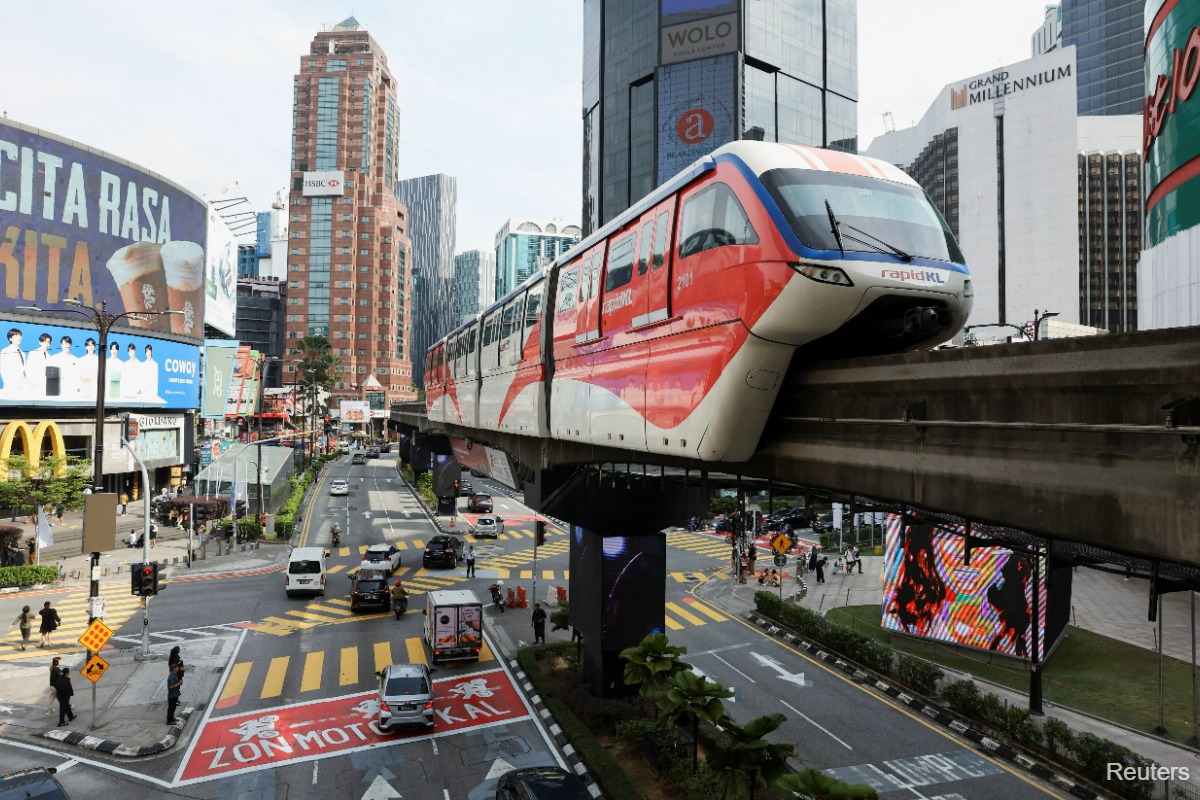
US President Donald Trump is expected to visit the region next month during the 47th Asean Summit in Kuala Lumpur, scheduled for Oct 26-28.
 theedgemalaysia.com
冖_冖
Registered Member

Cambodia Earns $3.88 B from Exports of Agricultural Products in First Nine Months
PHNOM PENH -- Cambodia exported 11. 13 million tonnes of agricultural products in the first nine months of 2025, up 30...
 cambodianess.com
Cambodia Earns $3.88 B from Exports of Agricultural Products in First Nine Months
PHNOM PENH -- Cambodia exported 11. 13 million tonnes of agricultural products in the first nine months of 2025, up 30...
cambodianess.com
Cambodia Earns $3.88 B from Exports of Agricultural Products in First Nine Months
PHNOM PENH -- Cambodia exported 11.13 million tonnes of agricultural products in the first nine months of 2025, up 30.4 percent from 8.53 million tonnes over the same period last year, said a Ministry of Agriculture, Forestry and Fisheries report on Tuesday.
The Southeast Asian country made a total revenue of 3.88 billion U.S. dollars from the commodity exports to 88 countries and regions during the January-September period this year, the report said.
Major agricultural items for exports included rice, rubber, cassava, mangoes, yellow bananas, pepper, cashew nuts, longans, durians, and corn, among others.
Agriculture is one of the four pillars supporting Cambodia's economic growth, in addition to garment, footwear, and travel goods export, tourism, and construction and real estate.
Cambodian Ministry of Commerce's Secretary of State and Spokesperson Penn Sovicheat said China is a huge market for Cambodian products, especially for potential agricultural produce.
"Under the Regional Comprehensive Economic Partnership (RCEP) agreement and the Cambodia-China Free Trade Agreement (CCFTA), a number of Cambodian products, particularly high-quality agricultural produce such as milled rice, yellow bananas, mangoes, longans, peppercorn, and durians, have been exported to China with preferential tariffs"
冖_冖
Registered Member
Cambodia Earns $3.88 B from Exports of Agricultural Products in First Nine Months
PHNOM PENH -- Cambodia exported 11. 13 million tonnes of agricultural products in the first nine months of 2025, up 30...Cambodia Earns $3.88 B from Exports of Agricultural Products in First Nine Months
PHNOM PENH -- Cambodia exported 11.13 million tonnes of agricultural products in the first nine months of 2025, up 30.4 percent from 8.53 million tonnes over the same period last year, said a Ministry of Agriculture, Forestry and Fisheries report on Tuesday.
The Southeast Asian country made a total revenue of 3.88 billion U.S. dollars from the commodity exports to 88 countries and regions during the January-September period this year, the report said.
Major agricultural items for exports included rice, rubber, cassava, mangoes, yellow bananas, pepper, cashew nuts, longans, durians, and corn, among others.
Agriculture is one of the four pillars supporting Cambodia's economic growth, in addition to garment, footwear, and travel goods export, tourism, and construction and real estate.
Cambodian Ministry of Commerce's Secretary of State and Spokesperson Penn Sovicheat said China is a huge market for Cambodian products, especially for potential agricultural produce.
"Under the Regional Comprehensive Economic Partnership (RCEP) agreement and the Cambodia-China Free Trade Agreement (CCFTA), a number of Cambodian products, particularly high-quality agricultural produce such as milled rice, yellow bananas, mangoes, longans, peppercorn, and durians, have been exported to China with preferential tariffs"
October 23, 2025
Cambodia’s RCEP exports up 10% in first nine months
Chea Vanyuth / Khmer TimesCambodia exported $7.4 billion worth of goods to the member countries of Regional Comprehensive Economic Partnership (RCEP) between January and September, up 10 percent from $6.7 billion in the same period last year, a report from the Ministry of Commerce showed yesterday.
冖_冖
Registered Member
EU’s Sefcovic Seeks FTAs With Malaysia, Other Asean Nations Soon
September 25, 2025 at 2:45 PM GMT+8
- The European Union hopes to reach free trade agreements with Malaysia, the Philippines and Thailand before the 50th anniversary of the bloc’s relations with the Association of Southeast Asian Nations in 2027.
- The EU has ramped up negotiations with various Asian countries in a bid to diversify away from the US amid President Donald Trump’s tariff war.
ASEAN-EU Comprehensive Partnership Key To Navigating Global Trade Challenges – Economist
ASEAN, EU, 57th AEM, Yeah Kim Leng, FTA, EconomyASEAN-EU Comprehensive Partnership Key To Navigating Global Trade Challenges – Economist
24/09/2025 09:14 AM
KUALA LUMPUR, Sept 24 (Bernama) -- A conclusive economic partnership between ASEAN and the European Union (EU) could help cushion the impact of global trade uncertainties, an economist said.
Sunway University economics professor Dr Yeah Kim Leng said the EU is likely to continue strengthening its trade and investment presence in Southeast Asia through bilateral free trade agreements (FTAs) before a comprehensive EU-ASEAN region-to-region deal can be achieved.
He said deeper EU-ASEAN cooperation would help shield both regions from spillover effects of the intensifying United States (US)-China rivalry.
Yeah noted that EU-ASEAN ties have gained importance as an affirmation of multilateralism and as a counterweight to the US’s shift towards inward-looking policies.
He added that both regions are seeking stronger partnerships to offset continued weakness in the global economy, particularly in the US and China.
"The closer ties will enable countries in both regions to cope with the likely fragmentation of world markets and the reconfiguration of global supply chains," he said.
He was speaking to Bernama in conjunction with the upcoming 57th ASEAN Economic Ministers’ Meeting and Related Meetings, scheduled for 22–26 September at the Malaysia International Trade and Exhibition Centre (MITEC), which will also include meetings with dialogue partners.
Nevertheless, Yeah also opined that it may still be too early to finalise the EU-ASEAN FTA due to ASEAN’s diverse and varying development stages, despite ongoing formal negotiations.
"Instead, the EU has forged bilateral FTAs with Singapore and Vietnam, while talks with Indonesia, Malaysia, the Philippines and Thailand are either ongoing or in exploratory stages.
"It is likely that more bilateral FTAs will need to be concluded before the region-to-region FTA can be realised through a domino effect when more ASEAN members gain benefits from an FTA with the EU," he added.
Meanwhile, a recent EU-ASEAN Business Sentiment Survey revealed that Malaysia has emerged as one of the four most attractive ASEAN markets for European businesses, alongside Vietnam, Indonesia and Thailand.
According to ASEAN statistics, the total value of two-way merchandise trade between ASEAN and the EU reached US$292.57 billion (US$1 = RM4.21) in 2024.
In addition, foreign direct investment (FDI) inflows from the EU to ASEAN amounted to US$20.40 billion in 2024, placing the EU as ASEAN’s third-largest trading partner and second-largest external source of FDI.
Commenting further, Yeah believed that ASEAN and the EU possess strong potential and growth opportunities to further enhance trade and investment relations between the two regions, with various sectors set to benefit.
Beyond trade in goods, Yeah said investment flows are expected to rise, particularly in manufacturing, green technology and digital economy sectors, where European companies hold technological advantages.
He also observed that ASEAN countries’ commodity exports, such as oil, gas, palm oil, rubber and timber, will have easier access to EU markets.
"Subsequently, the EU's advanced technology in renewable energy, pharmaceuticals, biotechnology and manufacturing products such as medical devices, electronics and telecommunications equipment will see rising demand in ASEAN," he added.
-- BERNAMA
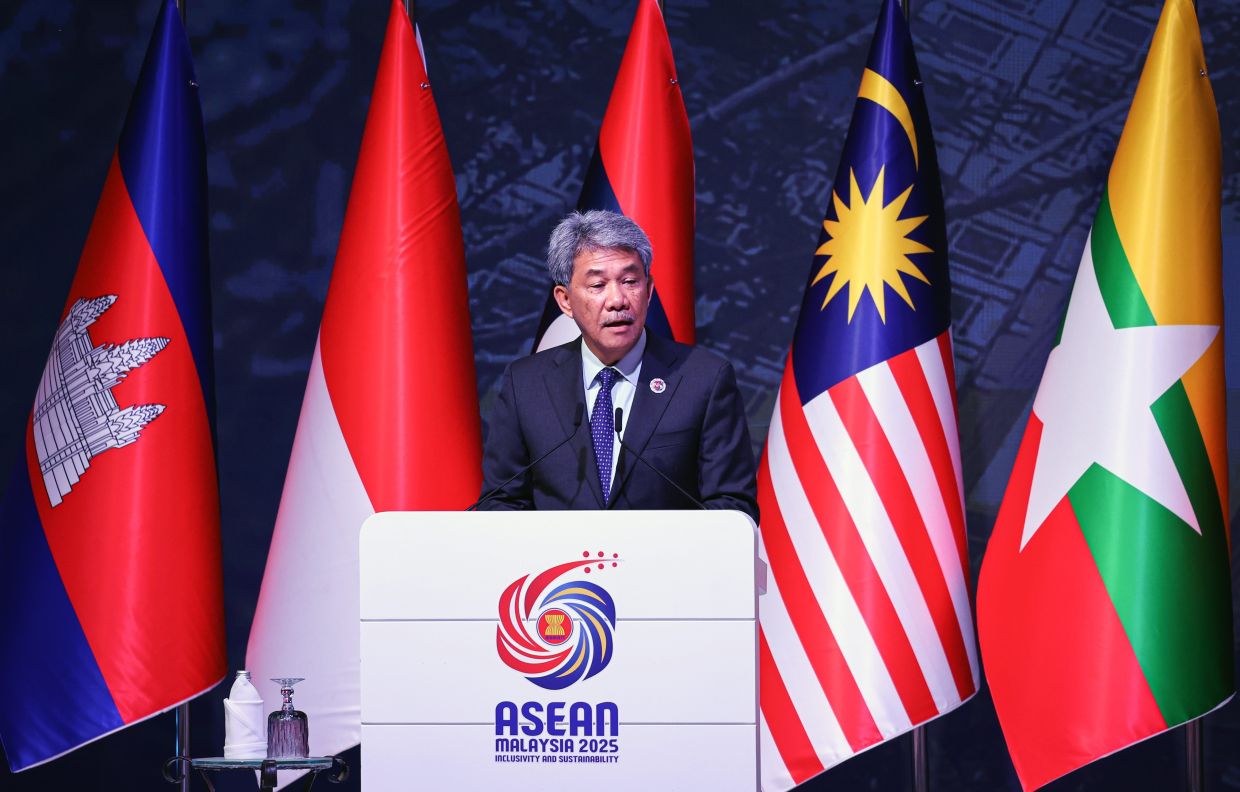
Asean in final stages of negotiating FTA with EU, says Tok Mat
KUALA LUMPUR: Asean is in the final stages of negotiating a free trade agreement (FTA) with the European Union (EU), says Foreign Minister Datuk Seri Mohamad Hasan.
 www.thestar.com.my
Asean in final stages of negotiating FTA with EU, says Tok Mat
KUALA LUMPUR: Asean is in the final stages of negotiating a free trade agreement (FTA) with the European Union (EU), says Foreign Minister Datuk Seri Mohamad Hasan.
www.thestar.com.my
Asean in final stages of negotiating FTA with EU, says Tok Mat
- Saturday, 25 Oct 2025
Mohamad said progress in talks between Asean and the EU has developed positively.
“I think it is progressing well and hopefully, we can conclude this Asean-EU FTA soon,” said Mohamad in a press conference at KLCC on Saturday (Oct 25).
Mohamad also said EU President Ursula von der Leyen will be attending the 47th Asean Summit and Related Summits on Sunday (Oct 25) as a guest.
The EU was Malaysia’s fourth-largest trading partner in 2024, while Malaysia was the EU’s 22nd largest trading partner with total trade amounting to RM227.55bil.
Malaysia is also the EU’s third-largest trading partner within Asean.
On Jan 20 this year, the EU and Malaysia announced the resumption of negotiations for a comprehensive and modern FTA with the first round taking place in late June.
Users who are viewing this thread
Total: 1 (members: 0, guests: 1)


