Tang dynasty battles with the caliphate

Overwhelming majority of the rebellion army were foreign soldiers (胡人和汉化胡人) and foreignized Chinese (胡化汉人) came from the border regions.
Yeah that's why we should be wary of giving very important positions to ethnic minorities like Tibetans incase they decide to betray us.
 
Yes he himself was a Turk Chinese who seeked to become emperor of China.
I should more accurately say the loss of the battle of Talas was one of the reasons indirectly culminated in The An Shi Rebellion few years later.
 
Last edited:
Would these be the Hui?
Yes a lot of these people later on became the Hui ethnic group but the most famous one is Zhenghe who let the greatest armada ever assembled at that time
 
Caliphates as in Arab (Arabian and Hejazi to be precise) imperial dynasties (Umayyad and Abbasid).

Yes it huge role in spreading islam in central asia for sure.

Many Chinese muslims also spread islam to south east asia as well.

That was mostly purely the work of Arabs (Arabians) from modern-day KSA (Hejazis) and Yemen (Hadhramis) mainly.


Same Arabs that created numerous sultanates, kingdoms etc. in South East Asia. From modern-day Malaysia, Singapore, Indonesia, Philippines to Brunei.

The current Sultan of Brunei is for instance o Hejazi Hashemite ancestry.


Numerous Muslim dynasties in South Philippines (Mindanao) etc. as well. Including the Sultanate of Sulu that ruled for almost 500 years.


A few of the current Malaysian kingdoms are of Arab origin as well.

Arabs owned almost all of Singapore not long ago.


Quite a few former Indonesian Muslim dynasties of Arab ancestry as well.

There are around 10 + million people of Arab ancestry in South East Asia.

Even an Arab origin Sultanate in Borneo.


Last Sultan (until 1978):


I could go on.

Arabs left a lot of linguistic, religious, cultural, culinary, architectural, musical etc. influence.

Also the reason why most (almost all) Muslims in South East Asia (close to 350 million people) are mostly Shafi'i Sunni Muslims (main maddhab of Hejazis and Hadhramis traditionally).

Same thing with the Hui who were/are partially of Arab origin as well and have their own Arabic origin alphabet.

To view this content we will need your consent to set third party cookies.
For more detailed information, see our cookies page.


To view this content we will need your consent to set third party cookies.
For more detailed information, see our cookies page.


As for those battles - just a reminder - at the time Arabs controlled one of the largest empires in history (the largest in history back then) spanning almost 15.000 km from west (France/Spain/Portugal in the West) to modern-day Western Xinjiang/Eastern Central Asia.

It is absolutely stunning that such battles even took place given that Arabs defeated/took on 4 of the strongest empires within a very short time period (Byzantine, Persian, Frankish (strongest Western European power) kingdom/empire, Chinese Tang empire and everything in between. While facing (often) internal Arab-Arab conflicts.
 
Last edited:
Caliphates as in Arab (Arabian and Hejazi to be precise) imperial dynasties (Umayyad and Abbasid).


That was mostly purely the work of Arabs (Arabians) from modern-day KSA (Hejazis) and Yemen (Hadhramis) mainly.


Same Arabs that created numerous sultanates, kingdoms etc. in South East Asia. From modern-day Malaysia, Singapore, Indonesia, Philippines to Brunei.

The current Sultan of Brunei is for instance o Hejazi Hashemite ancestry.


Numerous Muslim dynasties in South Philippines (Mindanao) etc. as well. Including the Sultanate of Sulu that ruled for almost 500 years.


A few of the current Malaysian kingdoms are of Arab origin as well.

Arabs owned almost all of Singapore not long ago.


Quite a few former Indonesian Muslim dynasties of Arab ancestry as well.

There are around 10 + million people of Arab ancestry in South East Asia.

Even an Arab origin Sultanate in Borneo.


Last Sultan (until 1978):


I could go on.

Arabs left a lot of linguistic, religious, cultural, culinary, architectural, musical etc. influence.

Also the reason why most (almost all) Muslims in South East Asia (close to 350 million people) are mostly Shafi'i Sunni Muslims (main maddhab of Hejazis and Hadhramis traditionally).

Same thing with the Hui who were/are partially of Arab origin as well and have their own Arabic origin alphabet.

To view this content we will need your consent to set third party cookies.
For more detailed information, see our cookies page.


To view this content we will need your consent to set third party cookies.
For more detailed information, see our cookies page.


As for those battles - just a reminder - at the time Arabs controlled one of the largest empires in history (the largest in history back then) spanning almost 15.000 km from west (France/Spain/Portugal in the West) to modern-day Western Xinjiang/Eastern Central Asia.

It is absolutely stunning that such battles even took place given that Arabs defeated/took on 4 of the strongest empires within a very short time period (Byzantine, Persian, Frankish (strongest Western European power) kingdom/empire, Chinese Tang empire and everything in between. While facing (often) internal Arab-Arab conflicts.


Ibnu Batutah has already seen Arabic village and also Chinese living in Indonesia when he visited Indonesia.

I would say Indonesians are pretty much quite mixed. Even if you see Papuan, there are variation between them, there are black skin Papuan and there are brown skin one, the browne skin one are mixed with Austronesian people (majority of Indonesian)
 
Ibnu Batutah has already seen Arabic village and also Chinese living in Indonesia when he visited Indonesia.

I would say Indonesians are pretty much quite mixed. Even if you see Papuan, there are variation between them, there are black skin Papuan and there are brown skin one, the browne skin one are mixed with Austronesian people (majority of Indonesian)
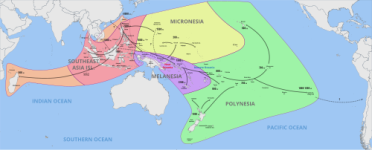
Arab world and South East Asia likely traded with each for 1000's upon 1000's of years. Much longer than written sources can attest.

If predecessor ancient civilizations and cultures native to the Arab world (Arabia and Southern Mesopotamia/Northern Arabia in particular) had ties with IVC 5000 + years ago and much of South Asia (maritime) and East Africa as well, I see no reason why Arabs/our predecessors could not have arrived in South East Asia as well.

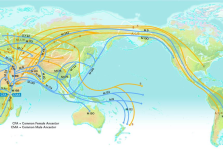
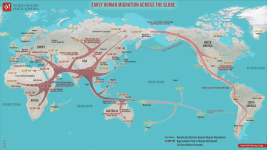
If you look at the earliest human migrations, people from Arabia, settled rest of Asia as a whole (many 10.000's of years ago) so I don't think it would be unthinkable if there were trade ties and human migrations (both ways) many millennia before the attested history.

1787273864244.png

1787273878431.png

1787273954013.png

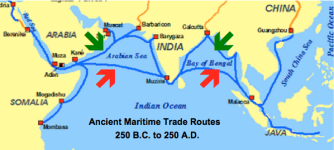
There are annual surface ocean currents each monsoon season (June to October) that carries you (naturally) from Arabia towards South East Asia. During the winter it is in the opposite direction.

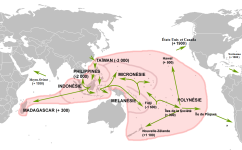
Take Madagascar as an example - an area of the world where peoples from Arabia and South East Asia have left their mark.

1787274122576.png

1787274160398.png

I believe our regions have been connected for many more 1000's of years than written history attests.

Same story with the Arab world and the Mediterranean - a similar but much, much smaller ancient highway.
 

Users who are viewing this thread

Pakistan Defence Latest

Country Watch Latest

Back
Top