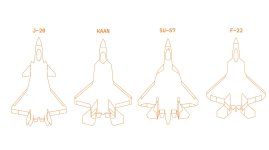
came across this Spanish YouTube video that tries to identify weaknesses and design flaws in KAAN, but I think the person based their analysis on the very first version of the aircraft, which could completely distort the conclusions! Still, the video seems recent to me.
Here’s the video in question:
This YouTuber's assessment is flawed; he draws incorrect "final conclusions" based on several weak arguments.
The claim of "fly-by-wire control" is completely unfounded. KAAN is still in the prototype stage. The purpose of a prototype is to test, learn, expand the flight envelope, and progressively improve the system, not to prove it meets the latest performance standards from the outset. Even advanced fighter designs require years to fully develop their flight control systems.
Of course, the visible exhaust nozzles are not final stealth nozzles, but rather a configuration of the prototype. Using them as permanent evidence to attack KAAN is a hasty analysis.
The air intake gaps are not accidental "flaws." They are part of boundary layer control. Turbulence flowing along the fuselage must be separated before entering the engine intakes. KAAN also appears to have used ducts, fans, cooling air outlets, and curved intake geometry to reduce the impact of the front-mounted engine. This is an engineering design, not a malfunction.
The canted vertical tail fins are not "billboards." Their angle is crucial because radar energy is scattered rather than directly reflected back. The massive fuselage, internal armor, airflow channels, and lift-oriented geometry are all designed to enhance aerodynamic performance and stealth capabilities.
This individual uses fake Western names like "Bob Baker" and "Juan Juanito" to publish meaningless Indian language theories and launch attacks on the Turkish aerospace industry, further diminishing their credibility. This is not technical analysis, but political motivated propoganda.
Conclusion: Stop using fake names and artificial intelligence to repeat doomsday rhetoric through anonymous accounts. Buy better tools than Gemini copy-paste, because even simple models should be identified for flaws before such arguments are published. This YouTube user has made a flawed assessment and packaged unfounded claims as a false "final conclusion." First, the claim of fly-by-wire control is unreliable. KAAN is still in the prototype stage. Who would have thought that TAI's first prototype, as the first fifth-generation fighter, would have a fully mature flight control system? Even the United States takes years to develop advanced fighter jets before their fly-by-wire flight control systems are fully developed. The purpose of a prototype is not to prove it meets the latest performance standards from the outset, but to test, learn, improve, and expand, ultimately reaching the limits of flight. The visible exhaust nozzles are, of course, a prototype configuration, not the final stealth engine/nozzle design, and therefore pose no problem. "The Man in the Box" (Spanish) is an Indian man using the name Bob Baker and impersonating Juan Juanito; this is completely false, misleading, and utterly absurd. Less than a year ago, I found a post on his YouTube channel containing highly biased statements about India. He made pessimistic pronouncements based on immature ideas and exaggerated rhetoric. In the summer of 2025, a newly opened YouTube channel posted a video about India, containing some original content; this content is somewhat strange, claiming that the Indian Air Force is extremely powerful. It also claims that India could defeat the Saudi Arabian Air Force with Russian and French aircraft, which is simply unbelievable. I think most of these claims are absurd and highly improbable. Furthermore, the video uses deepfake technology, and you seem to be mimicking the process of creating deepfake content on YouTube. In fact, KAAN's exhaust nozzles improve aerodynamics by ensuring continuous airflow over the rear vertical tail—a feature even engineers of delta wings (similar to the F-22's small tail, slightly canted to deflect radio waves) would consider. The lift required for high-speed flight is crucial for extremely high maneuverability, and near the speed of sound, the wing's speed is like a brick wall. The streamlined design, the single bar, and the "toy gun" in front of the cockpit are all striking. This system, with its large fuselage—a feature absent in the F-35 and F-22 Raptor fighters—is a highly classified system.
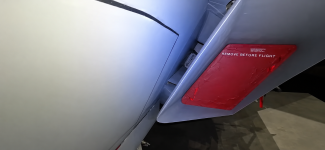
Now, the airflow along the front sides of the fuselage, the boundary layer, is always turbulent. To prevent turbulence from entering the engine intakes, a gap is incorporated into the design to block it; this stability regulates the airflow. Additionally, space use to regulate air flow is also used for the radiators channeled for the liquid cooled electronic systems state of art radar and then it exits via a vent on top of the KAAN which i'll show you shortly. Kaan also got these air holes on as seen in the picture below which are designed to capture and remove any additional boundary layer of air that may have formed they work by applying a small amount of suction that draws the air inwards and then out through a vent away from the engine intake done so which intricate design now the engine inlet is covered but you wouldn't be able to see much as the intake duct bends slightly as to avoid exposing the engine face and turbines to the exterior as they would also light up on an enemy radar the boundary air comes out this vent the intake bleed air comes out this one and this is the outlet for the air used for the cooling equipment
Here’s KAAN p1 prototype

Here’s the F-22