Follow along with the video below to see how to install our site as a web app on your home screen.
Note: This feature may not be available in some browsers.
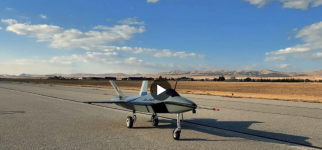
Sure it is. It is a carefully scaled aircraft, the flight data from which will be used to gather data for Kaan.Is that normal, using scaled aircraft for flight testing? I thought scaling was limited to the wind tunnel stage.
Well yes. It is controlled by radio. But you meant this as condescension. Let me assure you that this is no toy. It is quite heavy, carefully scaled, and has the mission for collection of flight data for the Kaan. It is not the only one. There are at least three flying at TA.Bro, this is an RC plane. lol
Yeah Iran had flown one the other day people made fun of that too and rightfully I think this is just for funSure it is. It is a carefully scaled aircraft, the flight data from which will be used to gather data for Kaan.
Well yes. It is controlled by radio. But you meant this as condescension. Let me assure you that this is no toy. It is quite heavy, carefully scaled, and has the mission for collection of flight data for the Kaan. It is not the only one. There are at least three flying at TA.

Let me elaborate a little. There is some data that requires either specialized wind tunnels (like spin testing in drop tunnels) or special instrumentation (for dynamic instead of static data). I'm sure there are things that you can't test in wind tunnels. You can make the models only small enough before the data from wind tunnels starts becoming useless, and you can't have a skyscraper wind tunnel for just spin testing. So aircraft like these are built at a fraction of the cost. They have three advantages to windtunnels:Is that normal, using scaled aircraft for flight testing? I thought scaling was limited to the wind tunnel stage.
One more point related to 1 and 3 together. Flow affects rigid body dynamics, which affect flow. This kind of effect can only be tested for in drop tests or flight tests. Spin tunnels (like the one with ONERA) only spin the mounted model, which does not model the flow-inertial interaction. This is one aspect of 3 really.Let me elaborate a little. There is some data that requires either specialized wind tunnels (like spin testing in drop tunnels) or special instrumentation (for dynamic instead of static data). I'm sure there are things that you can't test in wind tunnels. You can make the models only small enough before the data from wind tunnels starts becoming useless, and you can't have a skyscraper wind tunnel for just spin testing. So aircraft like these are built at a fraction of the cost. They have three advantages to windtunnels:
1. They are cheaper - yes wind tunnel models aren't always cheaper either since they are often machined and/or 3D printed out of metal with intricate probes.
2. These aircraft can be much larger and thus the data that they generate is more representative of the actual aircraft.
3. Windtunnels generally produce static or barely dynamic data. This is a technical point but roughly speaking, for example, wind tunnels will generate forces and moments at angle-of-attack 0. Then you will do another test for angle-of-attack 1. But what about the effect of going from angle-of-attack 0 to 1 in 0.5 second and back. You can't possibly do all combinations of everything so windtunnel data is never a substitute for actual flight data. Obviously, losing Iqbal is muuuuch cheaper and less embarrassing than losing P0* or P1 Kaan.
T0 will fly for the last time in 1 or 2 months and then be used for ground tests. So it would be illogical for them to fly a scale model of T0.does it represent the old configuration of T0 or the revised shape of T1?
It is not detailed at all, you are right! Its mission is to match the outer mold line of Kaan, that's it. There is no other detail. Any detail there is besides that is purely aesthetic (paint). The real challenge for this thing was/is hitting loads like 9gs etc and having sensors/actuators to make that possible at this scale. The crudeness comes from the fact that it has weirdly large landing gears, which is function of the unusually high mass of this aircraft (this is not a toy as I keep repeating). They are meant to retract on future flights - it is standard procedure for first flight to have no retraction - but you knew that. Furthermore, the requirement to be heavily instrumented also results in some outwardly "crudeness".Interesting, but I‘m a bit surprised! It does not look overall very detailed (in fact a bit rather crude) and even more, does it represent the old configuration of T0 or the revised shape of T1?
Many things but for example spin testing. Do you really want to lose a prototype to spin testing? Another use is testing features like AutoGCAS, terrain-following, etc. Furthermore, the first prototype wasn't really meant for flight testing - it was pushed into flights through modifications. So it is not meant to and will not fly regularly.Why do they need this when they have the KAAN's first prototype flying? Is the first prototype that flew not representative enough?
I know the project you are referring to. I've seen those - there's a workshop full of those aircraft that are mostly 3D printed and quite basic. I've already explained a lot about this aircraft already. But yes, this is one of the first project for the Pakistanis.well i need to say, in TAI all newcomers has an intial project to understand basic of aviation projects, this one must be for the pakistanies
We use essential cookies to make this site work, and optional cookies to enhance your experience.