PakistanLVR
Registered Member


The Case for Pakistan as a Civilizational State
Pakistan should be understood not simply as a country created in 1947, but as the modern state occupying the historic core of one of humanity's oldest continuously inhabited civilizational regions. Its national identity does not need to be subsumed under a generic "Indian civilization" in order to establish historical depth. Pakistan can instead articulate its own civilizational narrative—one centered on the Indus basin and its successive Indus, Gandharan, Persianate, Islamic and regional traditions.This argument does not require denying the enormous cultural and historical connections between the peoples of modern Pakistan and India. Those connections are undeniable. The stronger argument is that shared history does not require a single civilizational identity.
Pakistan Did Not Begin in 1947
The Pakistani state dates to 1947. The civilization of the territory does not.Mehrgarh, in present-day Balochistan, preserves evidence of settled communities and the development of agriculture and crafts thousands of years before the Common Era. UNESCO describes its development as helping illustrate the subsistence, craft and trade specialization that preceded the mature Indus civilization.
The Indus civilization subsequently produced one of the world's earliest great urban societies. Its most famous metropolis, Mohenjo-daro, lies in Sindh. UNESCO describes Mohenjo-daro as one of the best-preserved early urban settlements in South Asia and identifies it as a metropolis of the Indus civilization.
Harappa lies in Punjab. Mehrgarh lies in Balochistan. Mohenjo-daro lies in Sindh.
These are not peripheral sites in Pakistan's geography. They form part of the archaeological foundation of the country.
Pakistan therefore has legitimate grounds to say:
1947 marks the creation of the modern Pakistani state—not the beginning of the civilization of Pakistan's lands.
The Indus Should Be Central to Pakistan's Civilizational Identity
The strongest Pakistani civilizational narrative should arguably begin with the Indus, rather than attempting to define Pakistan exclusively through either modern South Asian identity or Islamic identity.The country's very geography encourages this interpretation.
The Indus and its tributaries connect much of Pakistan's historical heartland. The civilization that emerged there developed recognizable urban forms thousands of years ago. UNESCO scholarship itself discusses Indus civilization across sites in modern Pakistan and western India rather than treating modern political boundaries as ancient civilizational boundaries.
That distinction matters.
The Indus civilization belongs to the history of humanity and cannot reasonably be monopolized by any modern state. India has legitimate Indus heritage, particularly through sites such as Dholavira and Rakhigarhi. Pakistan has equally legitimate—and geographically extraordinary—claims through Mohenjo-daro, Harappa and the broader Indus basin.
Pakistan therefore does not need to argue that the Indus civilization was "Pakistani" in the modern national sense. That would be anachronistic.
The stronger claim is:
Pakistan is one of the principal modern custodians of the Indus civilizational heartland.
That is historically defensible.
Pakistan Is a Civilizational Crossroads, Not Simply an Extension of India
Pakistan's geography also distinguishes its historical experience from that of much of the rest of the subcontinent.The lands of modern Pakistan sit where South Asia, Central Asia and the Iranian plateau meet.
This produced an extraordinary layering of civilizations.
Gandhara is perhaps the clearest example. The region encompassing Taxila, Peshawar and surrounding areas became an important center of Buddhism while simultaneously absorbing Iranian, Hellenistic, Central Asian and South Asian influences.
The Shahbazgarhi inscriptions in present-day Pakistan provide an extraordinary illustration. UNESCO describes them as Ashokan edicts written in Kharosthi and notes the continuing influence of Achaemenid traditions in Gandhara.
That single historical artifact embodies precisely what makes the region distinctive:
Indic religion + Iranian administrative influence + Gandharan culture + transregional trade networks.
Pakistan's civilization therefore developed historically along both east-west and north-south axes.
Its historical orientation cannot adequately be described as simply an appendage of the Gangetic civilization farther east.
The Persianate Layer Is Fundamental
Another major component of Pakistani civilization is frequently underestimated: the enormous influence of the Persianate world.For centuries, the regions that became Pakistan interacted intensively with Afghanistan, Central Asia and Iran.
Persian became a major language of administration, literature and high culture under successive Muslim dynasties. Persianate political and artistic traditions profoundly influenced Punjab, Sindh and the northwestern regions and ultimately contributed to the cultural environment from which Urdu developed.
Pakistan therefore occupies a fascinating civilizational position.
It is simultaneously:
South Asian geographically and historically;
Indus-centered geographically;
Persianate culturally and historically;
Islamic religiously and institutionally;
Central Asian-connected historically;
and internally composed of ancient Punjabi, Sindhi, Pashtun, Baloch and other traditions.
Trying to collapse all of that into simply "Indian civilization" loses much of what makes the region historically distinctive.
Islam Is Not a Break in Pakistani Civilization
Pakistan also does not have to choose between its ancient heritage and its Islamic identity.Islam became another major civilizational layer.
Over approximately a millennium, the regions of modern Pakistan developed distinctive Muslim cultures—Sufi institutions, shrines, literature, architecture, poetry, music, jurisprudence and political traditions.
Sindh, Multan, Lahore, Uch, Peshawar and other centers became nodes within a much larger Islamic and Persianate cultural world.
This means Pakistan can simultaneously claim:
Mehrgarh.
The Indus civilization.
Gandhara.
Taxila.
Buddhist heritage.
Persianate heritage.
Islamic civilization.
Sufi traditions.
The Mughal inheritance.
Punjabi, Sindhi, Pashtun, Baloch and other regional cultures.
There is no contradiction.
Iran provides an obvious conceptual precedent: embracing ancient Persia does not require rejecting Islam. Similarly, Pakistan recognizing Mohenjo-daro or Gandhara does not diminish its Muslim identity.
These are successive layers of civilization rather than mutually exclusive identities.
Indeed, Pakistan itself has formally presented this diversity as part of its heritage. UNESCO's reporting on Pakistan describes both Gandhara and Indus Valley civilizations alongside the country's diverse living provincial traditions.
Why Pakistan Should Not Simply Be Merged into an "Indian Civilization"
This requires an important distinction.Pakistan should not establish its civilizational identity by pretending that Pakistanis and Indians have no shared history. That argument would be historically indefensible.
The peoples of Pakistan and India have interacted for thousands of years. Languages cross borders. Empires crossed today's borders. Religions, cuisines, populations, music and literature crossed them as well.
But shared history is different from identical civilization.
Europe provides an obvious analogy.
Britain, France, Germany, Italy and Greece share enormous portions of European and Christian civilization. Nobody therefore concludes that French civilization is merely German civilization or that Greek identity must be absorbed into Italian identity.
Likewise, Iran, Afghanistan and Central Asia share Persianate history without becoming one civilization-state.
Civilizations overlap.
Pakistan can consequently acknowledge the broader South Asian sphere while maintaining that the Indus-centered civilization developed a distinctive geographical and historical trajectory.
The argument should therefore not be:
It should be:"Pakistan has nothing to do with India."
That is a much stronger position."Pakistan shares parts of its civilizational inheritance with India, Afghanistan, Iran and Central Asia, but none of those countries individually defines Pakistan's civilization."
Pakistan's Geography Makes the Case Particularly Powerful
Modern political borders are recent. Geography is ancient.Look at Pakistan's historical corridors:
Indus Valley → Arabian Sea
Balochistan → Iranian plateau
Khyber Pass → Afghanistan and Central Asia
Punjab → northern India
Karakoram → Central and Inner Asia
Pakistan sits at a genuine civilizational junction.
That explains why the territory repeatedly absorbed influences from multiple directions without becoming culturally identical to any one neighboring region.
This geographic reality arguably provides the foundation for a distinct Indus civilizational sphere.
What Pakistan Should Avoid
Pakistan weakens its own civilizational argument when its history effectively begins with Muhammad bin Qasim, the Delhi Sultanate, the Mughal period or the Pakistan Movement.That inadvertently surrenders thousands of years of heritage.
Mohenjo-daro does not become less Pakistani heritage because its inhabitants were not Muslim.
Taxila does not become less Pakistani heritage because it was Buddhist.
Mehrgarh does not become less Pakistani heritage because Islam, Christianity and Buddhism did not yet exist.
These places belong to Pakistan's territorial and cultural inheritance in exactly the same way that pre-Christian Rome belongs to modern Italy and pre-Islamic Persepolis belongs to modern Iran.
Pakistan's civilizational narrative should therefore stretch backward rather than outward.
A Better Civilizational Concept for Pakistan
Pakistan could conceptualize itself as an Indus civilizational state:That definition accomplishes something important.A modern Islamic republic rooted in the ancient Indus civilizational region, shaped over millennia by indigenous cultures and by interactions with the Indic, Iranian, Central Asian and Islamic worlds.
It neither makes Pakistan dependent upon India for its historical legitimacy nor attempts to erase the obvious historical connections between them.
Instead, India becomes one neighboring civilizational sphere with which the Indus region profoundly interacted, just as Iran and Central Asia were others.
Pakistan becomes the custodian of its own geographical inheritance.
The Strongest Case
The argument for Pakistan as a civilizational state ultimately rests on five propositions:- Pakistan possesses extraordinary civilizational depth. Mehrgarh, Harappa and Mohenjo-daro demonstrate that complex societies existed within its territory thousands of years before the modern state.
- The Indus provides geographical continuity. The river system around which ancient societies developed remains the geographical backbone of Pakistan.
- Pakistan developed at the intersection of several great cultural worlds. Indic, Iranian, Hellenistic, Buddhist, Central Asian, Persianate and Islamic influences accumulated rather than simply replacing one another.
- Pakistan possesses distinctive living cultures. Punjabi, Sindhi, Pashtun, Baloch, Kashmiri, Saraiki, Balti and other traditions prevent Pakistani civilization from being reduced to a single imported identity.
- Shared heritage does not require shared statehood or identical civilizational identity. Pakistan can recognize enormous historical connections with India while rejecting the proposition that its entire history must therefore be categorized as merely a subdivision of modern Indian civilization.
It is civilizational sovereignty.
Pakistan can say:
That is a considerably stronger historical case than attempting to prove that Pakistan and India have no common civilizational heritage at all.Our republic was founded in 1947, but our history did not begin in 1947. The lands of Pakistan contain some of humanity's oldest settlements, the great cities of the Indus civilization, the crossroads of Gandhara, centuries of Persianate culture and a millennium of Islamic civilization. We share parts of this inheritance with our neighbors, but sharing does not erase distinction. Pakistan is not required to choose between its ancient, regional and Islamic pasts. They are all chapters of the civilization whose principal modern custodian is Pakistan.
The Contest Over Pakistan's Civilizational Inheritance
One of the greatest challenges to Pakistan developing a coherent civilizational identity comes from a recurring Hindu-nationalist narrative that attempts to collapse the history of the entire subcontinent into a single timeless "Indian" or Hindu civilization and then treat modern Pakistan as a territory that separated from its supposed natural civilizational home.The argument commonly takes several related forms: that the ancestors of Pakistani Muslims were "originally Hindus"; that Islam represents a foreign interruption in an otherwise continuous Hindu civilization; that Pakistani Muslims are merely "converts"; and consequently that Pakistan cannot independently claim its pre-Islamic archaeological and cultural inheritance.
These claims should be challenged vigorously—not because Pakistan has no historical relationship with India, but because they confuse religion, ancestry, geography, civilization and modern nationality, which are not interchangeable concepts.
"Your Ancestors Were Hindu" Does Not Settle Civilizational Identity
The claim that Pakistani Muslims descend partly from populations that practiced pre-Islamic religions is not inherently insulting, nor should Pakistanis feel compelled to deny it.It simply does not prove what Hindu-nationalist rhetoric sometimes claims it proves.
Populations change religion constantly across history.
Modern Egyptians overwhelmingly speak Arabic and are predominantly Muslim or Christian, yet nobody concludes that Egyptians therefore surrendered their inheritance from ancient Egypt.
Iranians became overwhelmingly Muslim after the Islamic conquest of Persia. That does not make Persepolis the heritage of somebody else.
Europe became overwhelmingly Christian after previously practicing numerous pagan religions. Italians did not consequently lose their relationship with ancient Rome.
Religious conversion does not cause a population to become historically detached from the land on which its ancestors lived.
Therefore, even where a Pakistani's ancestors were Hindu, Buddhist, followers of indigenous religions or anything else before becoming Muslim, the logical conclusion is actually the opposite of the one sometimes presented:
That history remains part of their ancestry.
Conversion changes religion. It does not retroactively change one's ancestors.
The Word "Converted" Is Often Made to Carry More Meaning Than History Allows
Hindu-nationalist discourse has a documented concept of ghar wapsi, or "homecoming," in which conversion of Muslims and Christians to Hinduism is presented as a return to an ancestral religious identity. Scholarship examining the movement notes precisely this connection between contemporary religious identity and claims about ancestral conversion.But there is a major analytical leap between:
"some ancestors of South Asian Muslims practiced other religions"
and
"therefore Muslims are really Hindus and belong to a Hindu civilizational identity."
The second proposition does not follow from the first.
If ancestral religion permanently determined civilization, enormous portions of humanity would have to abandon their present identities.
Religion is not an immutable ethnicity transmitted biologically.
Neither is civilization.
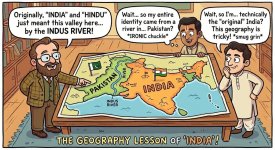
"Indian" Is Particularly Problematic When Projected Thousands of Years Backward
Another rhetorical problem occurs when the modern national meaning of Indian is projected onto ancient history.Ancient people did not possess passports from the modern Republic of India.
The Indus civilization flourished thousands of years before either Pakistan or the Republic of India existed.
Consequently, calling every ancient civilization of the subcontinent "Indian" can be legitimate when Indian is being used in an old geographical sense referring broadly to the Indian subcontinent.
But quietly switching from that geographical meaning to the modern political meaning creates a false equivalence:
Indian subcontinent ≠ Republic of India.
Pakistan is itself part of the historical subcontinent.
Therefore, describing something as belonging to the ancient Indian subcontinent does not establish exclusive ownership by the modern Indian state.
This distinction is essential.
Mohenjo-daro Cannot Be Retroactively Nationalized
Mohenjo-daro provides perhaps the clearest demonstration.UNESCO identifies Mohenjo-daro as a metropolis of the Indus civilization, flourishing in the Indus Valley during the third millennium BCE. It is situated on the Indus in present-day Sindh, Pakistan.
Its inhabitants were neither Pakistani nor citizens of the modern Republic of India.
Both labels would be anachronistic.
Pakistan's claim is instead geographical, archaeological and custodial:
one of the principal urban centers of the Indus civilization lies inside Pakistan, along the river system that remains the geographical backbone of Pakistan today.
And this isn't merely Pakistani nationalist terminology. UNESCO's Pakistan World Heritage portfolio formally includes Mohenjo-daro alongside the Buddhist remains of Takht-i-Bahi and Taxila and Pakistan's later Islamic and imperial monuments.
Pakistan therefore does not need permission from a modern neighboring national narrative to regard these sites as part of its national heritage.
Pre-Islamic Does Not Mean Pre-Pakistani Heritage
Perhaps the most important principle Pakistan should articulate is:Pakistan is an Islamic republic. Pakistan's territory, however, existed before Islam.Pre-Islamic history is not foreign history.
There is no contradiction between those statements.
A Pakistani Muslim can stand at Mohenjo-daro and say:
This is part of the history of my land.
A Pakistani Muslim can stand at Taxila and say:
This Buddhist civilization is part of Pakistan's heritage.
A Pakistani Muslim can study Gandhara and say:
These people helped shape the civilization from which our region eventually emerged.
None of those statements requires the Pakistani to become Hindu or Buddhist.
Heritage is not a declaration of religious faith.
Pakistan's Buddhist sites illustrate the point particularly well. UNESCO recognizes both Taxila and Takht-i-Bahi as Pakistani World Heritage properties alongside Mohenjo-daro.
A modern Islamic state serving as custodian of Buddhist, Indus, Hindu, Sikh, Persianate and Islamic heritage isn't contradictory.
It demonstrates civilizational layering.
Nor Can India Be Written Out of the Indus Civilization
Pakistan should avoid committing the mirror image of the same historical mistake.The Indus civilization extended across territory located today in both Pakistan and India.
Therefore Pakistan should not respond to Indian civilizational maximalism by claiming that the entire Indus civilization belongs exclusively to Pakistan.
That would weaken the argument.
The stronger position is:
India possesses Indus heritage. Pakistan possesses Indus heritage. Neither modern country can retroactively nationalize a civilization that predates both by thousands of years.
But Pakistan has an especially powerful geographical claim to an Indus-centered national narrative because the Indus River remains Pakistan's principal geographic axis and several of the civilization's iconic centers—including Mohenjo-daro and Harappa—lie within Pakistan.
Indeed, UNESCO has dealt explicitly with Pakistan's attempts to link Mohenjo-daro, Harappa, Mehrgarh and Rehman Dheri within an "Indus Valley Civilization Sites" framework. Although UNESCO did not approve the proposed extension in 2009 for technical, research and conservation reasons, it encouraged possible future nominations of several of the sites rather than rejecting Pakistan's underlying relationship to that heritage.
Pakistan Is Not "India Minus Hinduism"
This may be the most important conceptual rebuttal.Pakistan should reject any framework in which:
India = original civilization
while
Pakistan = Indians who converted to Islam and subsequently separated.
That formulation makes the modern Indian state the default owner of thousands of years of history and requires Pakistan to explain its existence as a deviation from it.
History is considerably more complicated.
The territory comprising Pakistan repeatedly interacted with civilizations to its east, west, north and south.
Sindh interacted across the Arabian Sea.
Balochistan connects South Asia with the Iranian plateau.
The northwest historically connected the Indus basin with Afghanistan and Central Asia.
Punjab connects the Indus system toward the Gangetic world.
Gandhara absorbed South Asian, Iranian, Central Asian and Hellenistic influences.
Later centuries brought enormous Persianate and Islamic influences.
Pakistan is therefore better understood as a civilizational intersection than as a severed piece of a culturally uniform India.
Pakistanis Do Not Need to Choose Between Their Muslim and Pre-Muslim Ancestors
This is where the "converted Hindu" argument can actually be turned around intellectually.Suppose, for the sake of argument, that a Pakistani Muslim family could document ancestors who were Hindu 800 years ago, Buddhist 1,500 years ago and practitioners of another regional tradition 2,500 years ago.
Why should the Pakistani have to choose only one of them?
They are all ancestors.
Islam does not erase what happened before conversion.
And Hinduism does not acquire permanent political ownership over descendants whose ancestors once practiced Hindu traditions.
The Pakistani can simply answer:
That is a much more powerful answer than denying historical conversion."If my ancestors were Buddhist, Hindu or followers of another tradition before becoming Muslim, then that pre-Islamic history is part of my heritage too. Their conversion did not transfer ownership of my ancestors to another modern nation."
The Civilizational Error of Equating Hinduism With India
Another important distinction is between Hindu civilization and the entire civilization of South Asia.Hindu traditions constitute one of the great civilizational traditions of the region.
But South Asian history also includes Buddhism, Jainism, Sikhism, Islam, numerous indigenous traditions and centuries of Persianate culture.
It also contains enormous linguistic and regional diversity.
Reducing all of this to an essentially Hindu civilization and treating other traditions as later additions transforms a complicated historical landscape into a modern ideological narrative.
Pakistan does not need to accept that framework.
Civilizational Identity Is Layered, Not Zero-Sum
The most effective Pakistani response is consequently not:That statement is historically unsustainable."We were never connected with India."
Nor should it be:
That would be equally anachronistic."Everything west of today's Indian border was always Pakistani."
The stronger answer is:
That is precisely what makes Pakistan's civilizational position interesting."We share history with India without belonging to India. We share history with Iran without being Iranian. We share history with Afghanistan and Central Asia without being Afghan or Central Asian. We belong to the Indus region, which interacted with all of them and developed its own historical trajectory."
Pakistan Should Refuse Civilizational Erasure Without Practicing It
Pakistan should therefore contest narratives that reduce its people to "converted Indians", but it should do so through historical confidence rather than reciprocal exclusion.The response should be:
Yes, many of our ancestors practiced religions other than Islam. They are still our ancestors.
Yes, our civilization interacted profoundly with the rest of South Asia. Shared history does not confer modern political ownership.
Yes, the Indus civilization extended into modern India. India therefore legitimately shares that heritage. It does not exclusively own it.
Yes, Pakistan became a state in 1947. The civilizations of its territory are thousands of years older.
And most importantly:
That is the strongest response to civilizational reductionism because it does not depend upon rewriting history.Pakistan does not need to surrender its pre-Islamic past in order to preserve its Islamic identity. Nor does acknowledging its pre-Islamic past make that heritage the exclusive possession of modern India. Mohenjo-daro, Harappa, Gandhara and Taxila are not threats to Pakistani identity; they deepen it. Islam is one of the great layers of Pakistan's civilization, not an instruction to erase everything beneath it.
It depends upon claiming the whole of Pakistan's history.
Source:
My own academic research, Ai, anedotal experiences and observations
My own academic research, Ai, anedotal experiences and observations