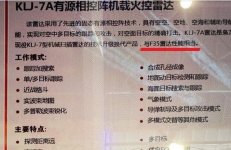
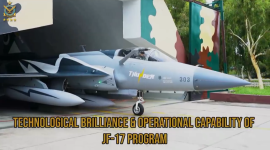
This passage is from an interview with the KLJ-7A designer. Note the last sentence.
The technical level is comparable to that of the F-22 fighter's radar.
According to Xu Jian, it utilizes advanced solid-state active phased array radar technology and can be equipped on medium and light fighters. Its primary combat missions include seizing air superiority, destroying and suppressing enemy battlefield targets, and eliminating enemy manpower; assaulting maritime targets and coordinating naval operations; and disrupting deep-lying political, economic, and military targets.
Xu Jian said that for KLJ-7A to be effective, the radar must first be installed on the aircraft. For newly built fighter jets, since the use of active radar is taken into consideration during the design, there is usually no major problem. However, for those modified aircraft, it is much more troublesome. Active radar has high requirements for power supply and cooling. To modify the radar, it is necessary to make local adjustments to the aircraft. A major advantage of the KLJ-7A is its low power consumption. Its power supply and cooling unit can also adapt to the different cooling methods of liquid cooling and air cooling of existing aircraft.
Customers can put forward their requirements based on actual conditions, and the 14th Institute can even tailor-make a special small liquid cooling unit for them. Overall, the KLJ-7A has a compact structure and is very adaptable to aircraft platforms.
As the core of the radar, the KLJ-7A on display has more than a thousand T/R components. Although the radar has low power consumption, its overall power is at a relatively high level internationally. Xu Jian stated that all of these T/R modules were independently developed and produced by the 14th Institute, and their performance is comparable to that of foreign counterparts. This enables the KLJ-7A to achieve reliable search and multi-target tracking, air-to-ground and air-to-sea target search and tracking, and high-resolution synthetic aperture imaging capabilities. It can be interconnected with weapon fire control to guide advanced air-to-air missiles, and coordinate the launch and delivery of aircraft guns, combat missiles, rockets and bombs to achieve simultaneous precision strikes on multiple air-to-air targets and air-to-surface targets.
Xu Jian emphasized that as a radar system with the latest technology, the KLJ-7A radar has been comprehensively optimized in all aspects compared with traditional radars. It can easily emit a variety of waveforms to engage different types of targets; the radar has a high degree of freedom and a wider bandwidth, and the radars will not interfere with each other. At the same time, the anti-interference ability has also been greatly improved, and it can deal with multiple interference sources at the same time; the use of optical fiber to transmit information greatly improves the overall response speed; the detection distance is twice that of traditional radar. It can simultaneously track multiple targets and guide strikes. This depends primarily on the aircraft's payload capacity, though there is room for improvement if the payload allows.
In addition, the KLJ-7A also has powerful high-gain electronic support capabilities, electronic countermeasures, terrain avoidance, communications, and weather detection functions. It can be said that its multi-purpose capabilities are very outstanding, such as electronic countermeasures.
Xu Jian also specifically mentioned the high reliability and maintainability of the KLJ-7A. The radar's mean time between failures is very long, and the radar can perform self-inspections without opening the radome. Even if a malfunction occurs, repair is extremely convenient, with its plug-in design allowing ground crew to complete disassembly and installation in 10-15 minutes. When talking about the position of KLJ-7A compared with foreign products, Xu Jian said that the technical details of KLJ-7A can match the APG-77 radar used by F-22, and its design is as advanced as theirs. But we pay more attention to cost control and have a higher cost-effectiveness.