The unforgettable story of the national flag being displayed internationally for the first time!

ghazi52

THINK TANK: CONSULTANT
Joined
Mar 21, 2007
Messages
157,622
Reaction score
207,270
Reputation
8,821.4
Country of Origin
Country of Residence

The unforgettable story of the national flag being displayed internationally for the first time!


On National Flag Day, Pakistanis recall the unique incident of hoisting the flag, the fabric of which was torn by a Hindu, his turban, and a Muslim, his shirt.

Sheema Siddiqui
August 11, 2025
1755175234711.png

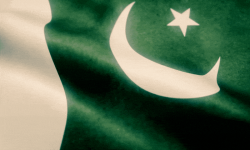
As the month of August approaches, we Pakistanis start humming national songs. Some try to sing in the tune of 'We are a living nation', while others try to sing in the tune of 'Under the shadow of this flag'. But Naheed Akhtar's famous national song 'Our flag, this beloved flag' is very close to my heart, composed by Saif Zulfi.

Seeing this green crescent waving flag, I feel a strong sense of pride in my heart. As journalists, whenever we go abroad, we must carry Pakistani flag badges, stickers for national identification and sometimes Ajrak for Sindh identity and bags embroidered by our skilled artisans because for us this identity is as important as our national identity card and passport through which we are legally called 'Pakistani'.

Today, August 11, is being celebrated as the National Flag Approval Day across Pakistan. The flag is the identity of any country. Our green crescent flag was presented for approval in the first Constituent Assembly session of Pakistan on August 11, 1947. This session was held in the first school in Sindh, NJV School, which had the privilege of temporarily becoming the Constituent Assembly of Pakistan.

But do you know who designed the flag of Pakistan? As well as when and where, for the first time, the Pakistani flag gave the residents of British India the honor of being Pakistanis at the international level? Let's find out because this story is very interesting and unforgettable.
1755175202171.png

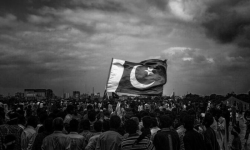
Our flag is our national identity—Photo: AP

I found the clue to this story while reading Aqeel Abbas Jafri's research book 'Pakistan Chronicle', in which the second important news after Quaid-e-Azam's swearing-in as Governor General was 'International display of the Pakistani flag'.

On the very first page of Pakistan Chronicle, Aqeel Sahib writes that the green crescent flag of Pakistan was first hoisted internationally on 15 August 1947 during a Scout Jamboree in France. The story is 78 years old but very interesting because the partition of India was not yet complete when a contingent of 135 All India Boy Scouts reached the French city of Moisson.

Under the Union Jack, 124 Boy Scouts and 11 Scouters were participating in this troop. The troop was commanded by Mr. GTJ Thandis, Secretary General of the All India Boy Scouts Association. The Jamboree was to be organized from 9th August to 17th August 1947.

The declaration of independence and the addition of two new countries to the map of the subcontinent were yet to come. So the Indians in the contingent decided that they would celebrate independence on August 15 and hoist their Indian flag. Some of the people in the contingent had Indian flags. The Jamboree administration also gave permission.

Now the Muslims in the group also decided to hoist the flag of Pakistan, but by then the original and final form of the Pakistani flag was not clear. The scouts were worried about what to do. Here in Karachi, on August 11, the government of Pakistan, under the leadership of Liaquat Ali Khan, had approved the flag of Pakistan.

Aqeel Abbas Jafri further writes that after seeing the picture published in the newspaper, the Pakistani flag was sewn and hoisted overnight. The contingent was divided into Indian and Pakistani contingents. The Pakistani contingent was led by Qureshi Muhammad Iqbal and Inayat Ali Gardezi. The green cloth was taken from the turban of Madan Mohan, a scout from Shimla, while the white cloth was torn by Inayat Ali Gardezi from his shirt and sewn on a sewing machine by two French Girl Guides overnight.


This news was detailed, so we reached the Sindh Boy Scout office located in front of the Arts Council and expressed our desire to hear the story from the leader Akhtar Mir Sahib so that we could know the history firsthand. He narrated the story of the day of 15 August 1947 and was filled with patriotism. In Akhtar Sahib’s story, there are some changes in dates and numbers, but we decided to tell this story in his own words.

Akhtar, in full Boy Scout uniform, told Dawn News Digital, "It is true that the green crescent flag of Pakistan was first hoisted internationally on August 15, 1947, during the Scout Jamboree in France. We Boy Scouts are proud that we raised the Pakistani flag high at the international level."
1755175178924.png

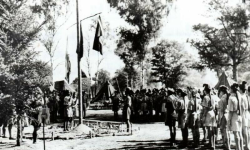
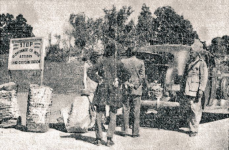
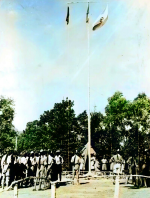
Historical scene of flag hoisting
 
the world's first Jamboree was held in London in 1920 and the series continued. In 1947, the sixth Jamboree was held in the French city of Moussac from August 9 to 18, in which a contingent of 151 scouts from India also participated. In this Jamboree, the United India contingent sailed from Bombay on July 27, 1947, under the British flag, the Union Jack. When the formation of Pakistan and India was announced, the scouts told the Jamboree organizers that they wanted to hoist the flags of their respective countries, which they were allowed to do.

"Here the United India contingent was divided into two parts. The Pakistani contingent was led by Qureshi M. Iqbal and assisted by Inayatullah Gardezi. The Indian contingent had the flag of the new country but the Pakistani contingent did not have any clear flag because till now the movement was going on under the flag of the Pakistan Muslim League and clear impressions of the flag of an independent country had not come to light. But on August 11, the Sindh Assembly, which was the then Constituent Assembly, under the leadership of Quaid-e-Azam, Liaquat Ali Khan approved the Pakistani flag. That is why we celebrate Pakistani Flag Day today, August 11."

Akhtar Sahib took us back 78 years and said, "The Pakistani contingent was still searching when an Algerian scout had a newspaper in which, along with the news of the formation of two countries, there was a map of India and Pakistan, a flag with pictures of Gandhi and Quaid-e-Azam. On August 13, the scout of the Indian contingent, Madan Mohan, who belonged to Shimla, provided full assistance in making the Pakistani flag. He gave a green piece from his turban and Inayatullah arranged the fabric from his white shirt, while two French Girl Guides, Miss Alpha and Miss Dola, sewed the flag with a sewing machine by 11 pm."

Akhtar Mir further said, "Then it was decided that the next day, in the spirit of goodwill, the Pakistani flag would be hoisted on the Jamboree ground by GM Marther, who led the Indian contingent. In the same spirit, the Indian flag was hoisted by Pakistani Scout Qureshi M. Iqbal and the Scout flag was in the hands of Sarfaraz Rafiqi. It is a matter of pride for us that on August 14, 1947, the flags of India, Pakistan and Scout were hoisted in this way at the France Jamboree."

1755175421142.png

The scene of the first time a Boy Scout hoisted the Pakistani flag in France

Akhtar Mir smiled and told an interesting story that when the Pakistani contingent asked the French Girl Guides who had made the flag the price of their hard work, they asked if they could pay the price. Everyone said why not. The Girl Guides said to give the money they had in their pockets, so all the Pakistani contingent emptied their pockets. The next day, the scouts of India and Pakistan held a ceremony in which the Girl Guides returned all that money to the Pakistani contingent, saying that they were happy that we had made the flag of a new nation.

After August 18, the scouts decided that they would now land at the port of Karachi instead of going to Bombay. When the Quaid-e-Azam came to know that the Boy Scouts had hoisted the national flag of Pakistan internationally, he personally arrived to welcome them. The ship anchored at the shore an hour late. The Quaid-e-Azam waited for the contingent at the port, saying, "Today the first ambassadors of my country are coming."

As soon as we read Sarfaraz Rafiqi's name, a question came to our mind that we have seen a road named after him but we could not remember where. We took help from Google and it turned out that Karachi's famous government hospital 'Jinnah Postgraduate Medical Center' aka Jinnah Hospital is located on Sarfaraz Rafiqi Shaheed Road. Not only this, but a road in Lahore is also named after him.
 
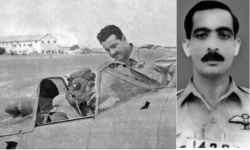
Iqbal M. Mandoya, author of 'There Was a City in This Desert', writes that 'Sarfaraz was a pilot in the Pakistan Air Force and he was martyred in the 1965 war as a squadron leader.'

1755175570963.png

Squadron Leader Sarfaraz Rafiqi was martyred in the 1965 war—Photos: Sentinels in the Sky

According to the Pakistan Air Force book 'Sentinels in the Sky (A Saga of PAF's Gallant Air Warriors', 'Sarfaraz Rafiqi was born in 1935 in Rajshahi, East Pakistan. The 13-year-old Rafiqi was part of the team that hoisted the Pakistani flag at the 6th Jamboree in France. In the 1965 war, he shot down several Indian aircraft before being martyred. For which he was awarded the Star of Courage. Indian pilot Gandhi shot down Rafiqi's aircraft. Cecil Chaudhry took over the command in his place and shot down Gandhi's aircraft.'

1755175499288.png

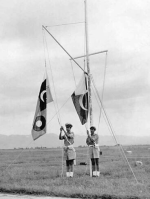
A unique photo from the history of the Pakistan Air Force, showing two airmen hoisting the Pakistani flag at Chaklala Station on August 15, after the declaration of independence—Photo: Sentinels in the Sky book

We know that before the Pakistan Movement, the political activities of the Khilafat Movement warmed the blood of the Muslims of India. The identity of the Muslim Khilafat and the flag of the Ottoman Empire first became the flag of the All India Muslim League and the national flag of Pakistan was designed based on it. When the issue of giving the final shape to the flag of Pakistan came before the Quaid, he spoke to his advisors.

In 1906, the Muslim League flag, green with a crescent and a star, was approved. Therefore, by adding white to this flag, two designs of flags were prepared. In one of them, the right and left sides of the flag were white and the middle green part was decorated with a crescent and a star, while the second flag was in accordance with the current flag. However, the number of stars in it was 5.

This 5-star flag was originally a suggestion of Quaid-e-Azam. Quaid-e-Azam wanted to see these 5 stars as a symbol of the 5 provinces of Pakistan (Bengal, Sindh, Punjab, Balochistan and the Frontier/present Khyber Pakhtunkhwa).

However, the first proposed flag did not find acceptance and regarding the second flag, Sardar Abdul Rab Nishtar argued that 'Pakistan will include not only 5 provinces but also many states and their exact number is not yet clear but there is also a possibility of increase or decrease in them. Therefore, if there is a change in the number of units, the number of stars along with the moon will have to be changed from time to time and if they do not change, the 5 stars will become meaningless'.

While reading this, I was thinking that Sardar Sahib was not only far-sighted but also visionary, and his argument carried considerable weight.
 
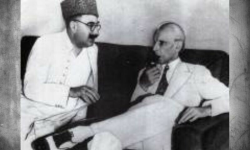
Sardar Sahib was not only far-sighted but also visionary, and his argument carried considerable weight.

1755175839167.png

Quaid-e-Azam and Abdul Rab Nishtar

In the light of these arguments of Sardar Abdul Rab Nishtar, it was decided that only one star would remain on the flag because the Muslim League flag also has one star. In the light of the decision of the national leadership, the flag was approved according to the design made by Syed Amiruddin Kidwai.

Born in 1901 in Bara Bankvi, Uttar Pradesh, Barrister Amir Ahmed Kidwai was not only a Muslim League leader but also actively participated in the Khilafat Movement, while Maulana Shaukat Ali used to call him 'my lieutenant'. He was also the Secretary of the All India Muslim Youth League. After coming to Pakistan, he became the Head of the Law Department of Punjab University and was associated with the field of teaching and learning until his last days. In recognition of his services, he was awarded the Gold Medal by the Nawaz Sharif government in 1991.

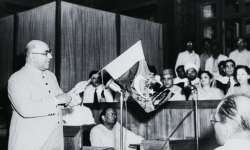
Moving forward, August 11, 1947, was a Monday like today. On this occasion, Quaid-e-Millat Liaquat Ali Khan, while presenting a resolution for the approval of the national flag, said in his speech:

"The flag of a nation is not a mere piece of cloth, but its significance lies in what it represents, and I can say without fear of contradiction that the flag I have presented is a guarantee of freedom, liberty and equality for those who pledge allegiance to it. This flag will protect and defend the legitimate rights of its citizens."

This resolution, presented by Nawabzada Liaquat Ali Khan, was unanimously approved. Thus, the green crescent flag became the symbol of the state of Pakistan.

1755175870158.png

Liaquat Ali Khan hoisting the Pakistani flag at the first Constituent Assembly of Sindh—Photo: Getty Images
 
1755176034136.png


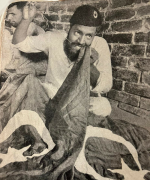
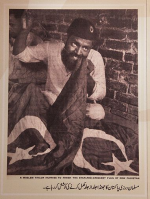
The Pakistan Chronicle, on its page dated February 6, 1967, states that 'Today, Altaf Hussain, the first flag bearer of Pakistan, passed away'. In another article, Aqeel Abbas writes that the honor of making the first flag went to two brothers, Master Afzal Hussain and Master Altaf Hussain, from Bulandshahr (Uttar Pradesh). Both these brothers worked as tailors in Delhi and were famous for their skills. He further writes that Samin Khan, son of Noor Al-Sabah Begum, the secretary of the All India Muslim League Delhi, came to Liaquat Ali Khan. A reporter from Life magazine was sitting next to him. Liaquat Ali Khan asked Samin Khan to show him around Delhi.

We spoke to Barrister Samin Khan's daughter Dr. Rabab Hassan in this regard. She said that her family was associated with the Pakistan Movement. Her grandmother Noor-ul-Sabah Begum met the Khilafat Movement leader B. Amma and gave her her jewelry in this movement. She became active in the Muslim League from 1937 and was the secretary of the All India Muslim League in Delhi. She was the only woman who was part of the working committee. She also met Quaid-e-Azam in 1945. In 2002, her name was also issued on a stamp. Dr. Rabab said that her father Muhammad Samin Khan was a member of the Muslim League Student Federation and was elected a member of the All India Muslim League after the formation of Pakistan.

Rabab Hussain, while showing the pages of 'Life Magazine' to Dawn News Digital, told Dawn News Digital that my father was a witness because Altaf Hussain's picture was taken in front of him. She says that at that time the sherwanis she had sewn were famous. Liaquat Ali Khan had entrusted Samin Khan with the task of visiting Delhi for the American magazine 'Life Magazine' photojournalist 'Margaret Bourque White'. During her visit to Delhi, she got the idea of getting her sherwani from the tailor. When she reached there, she found that the sherwani had not been sewn yet because she had received the first flag of Pakistan to be sewn.

1755175945192.png

The first photo of tailor Altaf Hussain sewing the Pakistani flag in the Life magazine issue — thanks to Dr. Rabab Hassan

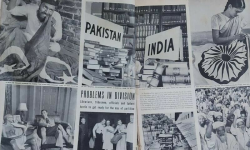
Margaret asked permission to take his picture and took this picture. This issue of Life magazine was mainly presenting the partition of the subcontinent. This issue was published on 18 August 1947, which had a picture of Mountbatten on the cover. The other 4 pages presented the history of the partition of the subcontinent through photographs.
 
Margaret asked permission to take his picture and took this picture. This issue of Life magazine was mainly presenting the partition of the subcontinent. This issue was published on 18 August 1947, which had a picture of Mountbatten on the cover. The other 4 pages presented the history of the partition of the subcontinent through photographs.

1755176127024.png

This issue of Life magazine focused on the Partition of India—thanks to Dr. Rabab Hassan

At the end of these historical events related to the Pakistani flag and its history, I will say that our flag is not only a symbol of our dignity, but also a 'sign of our right' to be Pakistani. When our green crescent flag is raised high among the flags of the world, be it the snow-capped mountains of K2 or the shining face of Arshad Nadeem, delighted with a victory in an Olympic arena, the Pakistani flag is definitely there, which is the identity of all of us. Indeed, the best expression of our identity and relationship with the land is our flag. Let us raise it higher and higher with our hard work and love.
 
1755206481310.png


1947 :: Newly Formed Attari Border Between India and Pakistan
 
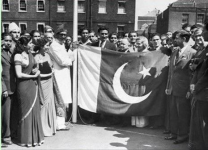
Flag of Pakistan raised for the first time outside Pakistan Embassy, London in 1947

1755207354819.png
 
1755207445005.png


Stitching Pakistan's Flag two months before Independence !

Master Afzal Hussain, (ماسٹر افضال حسین) also known as Baba-e-Parcham (which means "Father of the Flag"), was a tailor from Delhi. Together with his younger brother, Altaf Hussain, he stitched the very first flag of Pakistan two months before the country's independence, in 1947.

He was a dedicated participant in the Pakistan Movement and had a tailoring shop in Delhi. His shop was frequented by well-known politicians and leaders of the Pakistan Movement who came to get sherwanis (traditional clothing) tailored. After moving to Pakistan, he decided to live a simple life in Karachi.
 
"The flag of a nation is not a mere piece of cloth, but its significance lies in what it represents, and I can say without fear of contradiction that the flag I have presented is a guarantee of freedom, liberty and equality for those who pledge allegiance to it. This flag will protect and defend the legitimate rights of its citizens."
Very nice quote! I remember the white on the flag is for religious minorities.
 

Users who are viewing this thread

Pakistan Defence Latest

Latest Posts

Back
Top