Turkish Economy - News & Updates

Is it really worth trading with Iran and risking restricted commerce with one of Türkiye’s most important trading partners? Türkiye’s trade with the United States is many times greater than its trade with Iran, yet continued business with Iran could trigger 25 percent tariffs that would cost the Turkish economy far more than any benefit gained. Iran is not economically indispensable: Azerbaijan can serve as an alternative supplier of natural gas, and Iranian products such as pistachios are hardly essential. From a strategic and economic standpoint, the United States is clearly the more valuable long-term partner


To view this content we will need your consent to set third party cookies.
For more detailed information, see our cookies page.
 
turkeys-economy-compared-to-15-european-countries-v0-b4ybwe73zqdg1.png
 

Tariffs Won’t Stop Turkey’s Invasion of Syria, Analysts Warn​

1768644305561.png

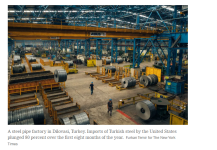
FRANKFURT — Doubling tariffs on Turkish steel imports, as President Trump said he would do Monday, might make investors nervous. But it would take a much broader attack on the economy of Turkey to restrain its tanks from moving deeper into Syria, analysts say.

The reason is simple: Tariffs approved last year by White House officials have already gutted Turkey’s exports to the United States. They can hardly go any lower.

Mr. Trump’s threat to cut off talks on what he called a $100 billion trade deal with Turkey isn’t expected to have much of an effect, either. The figure was, to put it mildly, aspirational. Current two-way trade between Turkey and the United States is only about $21 billion.

Because neither American nor Turkish officials had detailed how they would more than quadruple trade, “analysts did not expect any immediate favorable impact on the Turkish economy,” said Selva Demiralp, economics professor at Koc University in Istanbul. “Thus, the withdrawal of this deal should not have much of an impact, either.”

The measures announced by the president are unlikely to destroy the Turkish economy, as he has warned, but plenty of other existing threats could. Economists have long regarded Turkey as a bubble waiting to burst because of government mismanagement, an inflated building boom and a shaky currency. Turkey’s military incursion into Kurdish-controlled northern Syria has unsettled investors who already had concerns about the region’s stability.

Mr. Trump’s tariff threat does give investors yet another reason to be apprehensive.

“The sanctions are ineffective, and they know they are ineffective,” said Sebastien Galy, senior macro strategist at Nordea Asset Management in Luxembourg. But he added: “Tariffs frighten both businesses and consumers. They save more and invest less because they are afraid of the future. The impact on expectations can be quite considerable.”

If the president really wanted to hurt Mr. Erdogan, Mr. Galy said, he would take steps to make it difficult for Turkish commercial banks and the central bank to conduct transactions in dollars.

The White House also said Monday that it would impose sanctions on several top officials in Ankara, including the defense and energy ministers and their ministries, essentially severing them from the global financial system. Mr. Trump’s executive order allows the sanctions to be expanded to other officials or government entities.

But comprehensive financial sanctions against the Turkish government would be seen as extremely hostile considering Turkey is still nominally a NATO ally.

 
To view this content we will need your consent to set third party cookies.
For more detailed information, see our cookies page.
 
Anatolia Industrial Migration Plan

Under the coordination of the Ministry of Industry and Technology, in order to reduce the excessive concentration in the Marmara region, take precautions against a potential earthquake, and ensure a balanced industrial distribution across the country, different industrial basins will be established, primarily in Central Anatolia and the Eastern Mediterranean.

To view this content we will need your consent to set third party cookies.
For more detailed information, see our cookies page.
 
To view this content we will need your consent to set third party cookies.
For more detailed information, see our cookies page.
 
To view this content we will need your consent to set third party cookies.
For more detailed information, see our cookies page.
 
EU deals add to customs union debate

The European Union signed bilateral free trade agreements with the Mercosur bloc—Argentina, Brazil, Paraguay, and Uruguay—and with India earlier this year to secure broader access to those markets, raising concerns in Türkiye, as such deals can create structural disadvantages under the current design of the Türkiye–EU Customs Union.

Under the 1995 customs union arrangement, industrial goods move tariff-free between Türkiye and the EU, but Ankara does not automatically benefit from the trade agreements the EU signs with third countries.

Kacir acknowledged that addressing asymmetries created by the EU’s free trade agreements with third countries is a priority in ongoing discussions on updating the Türkiye–EU Customs Union.

Made in EU’ opens door for Türkiye

Kacir pointed to the draft Industry Accelerator Act, which outlines the scope and criteria of the EU’s "Made in EU" approach, as a recent example of progress in negotiations.

He said recognizing Türkiye within the framework of the existing customs union is significant for maintaining investment continuity and supporting the competitiveness of European value chains.

"The inclusion of Türkiye under the ‘EU origin’ requirement within the customs union framework is an important step," Kacir said, adding that the move would deepen sectoral integration between Türkiye and the European Union.

The development is also expected to support green and digital transformation across industrial value chains, the minister added.


How ironic that this war could cause the end of Erdoğan's winning streak. That would be a huge loss for Tehran.


How ironic that this war could cause the end of Erdoğan's winning streak. That would be a huge loss for Tehran.

Traffic would just get routed to ports in Jeddah or overland.

Too early to judge impact regardless.
 

Users who are viewing this thread

Country Watch Latest

Latest Posts

Back
Top