The UAE is paying $4.5 billion for the world's most expensive radar.
Following the devastating Iranian strikes at the beginning of the year, which exposed a critical vulnerability in its air defenses, the UAE moved with unprecedented speed to acquire the most powerful early warning radar in the American arsenal: the Long Range Discriminant Radar (LRDR).
The deal is not just for a radar, but a comprehensive $4.5 billion defense package, approved by Washington immediately and through an exceptional procedure, bypassing the usual congressional review process.
Why did America rush the approval? Because the deal was passed under the "emergency" clause in the US Arms Export Control Act, a clause that allows the president to bypass Congress when there is a direct threat to US national security and that of its allies. The message was clear: the UAE had been attacked, and Washington did not want to wait the usual 40 days in Congress.
What is the LRDR?
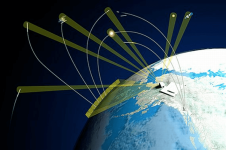
It is an AESA radar operating in the S-band, designed by Lockheed Martin specifically to protect America from intercontinental ballistic missiles.
Its true capabilities:
* Practical range: Over 2,000 km
* Theoretical range: Up to 7,000 km under ideal conditions against large targets
* Number of targets: Tracks hundreds of targets simultaneously, including ballistic missiles, aircraft, and drones
* Design: Two-sided, providing 360-degree coverage, unlike older radars which only cover a single sector
But its true strength lies not in its range, but in its discrimination.
The secret weapon: Discrimination
Any radar can detect an incoming missile, but the LRDR can identify the exact nature of that missile.
At the moment the warhead separates from the ballistic missile, dozens of objects scatter into space: the actual warhead, decoys, fragments, fuel tank remnants, and metallic balloons designed to deceive radar.
Older radars perceive all these objects as equal targets, launching interceptor missiles at everything and wasting their ammunition on decoys.
The LRDR is different. Thanks to its high accuracy and target signature analysis capabilities, it can distinguish between:
* A real warhead and a dummy warhead
* A real missile and its fragmentation remnants
* A destroyed target and a target still in flight
This gives the operator two crucial advantages:
1. Longer Timeframe: Early detection thousands of kilometers away gives THAAD and Patriot systems ample time to prepare, position, and intercept.
2. Missile Savings: The operator knows whether the incoming missile was destroyed by the first interceptor missile and whether a second missile is needed. This saves millions of dollars per engagement and conserves the scarce stock of interceptor missiles.
Why the $4.5 Billion Price? Is it an exorbitant price?
Yes, the price is huge, but it's not just the radar cost.
The deal includes everything from scratch:
* The LRDR radar itself, with its two interfaces
* 12 Sentinel A4 linkage units
* Two THAAD TFCC command and control stations
* Two THAAD launch and control stations
* Construction and infrastructure, power plants, and a massive 500-ton cooling system
* Training, technical support, maintenance, spare parts, and US logistical support teams
Most importantly: The UAE isn't buying a new radar; it's rebuilding its damaged missile defense network. The UAE already possesses two THAAD batteries, but they lost their "eyes" in the Iranian strikes, and this deal is about rebuilding those eyes.
The only problem: Time
The radar won't be ready before 2030 at the earliest, because the LRDR is a complex system that requires years to build, test, and calibrate. The UAE will pay now and wait at least four years for full protection.
Qatar's Painful Lesson... Which the UAE Doesn't Want Repeated
This deal reminded everyone of what happened in Qatar.
Qatar had contracted for the American AN/FPS-132 radar, a fixed early warning radar, for $1.1 billion. It was operating at Al Udeid Air Base, the largest American base in the Middle East.
Its range exceeded 4,800 km, and it was America's eye on all the region's missiles.
During the Iranian strikes, this radar was directly hit by Iranian Shahed drones and was severely damaged. Iran announced its complete destruction, while Qatar confirmed that it was only "damaged."
The lesson was harsh: a billion-dollar radar destroyed by a $20,000 drone.
This explains why the UAE is now requesting a dual-band radar with 360-degree coverage, and wants it to be more durable and resilient than Qatar's fixed radar.
The UAE isn't buying a radar; the UAE is buying time.
Time to see the missile before it arrives, time to distinguish the real from the fake, and time to decide whether to launch one or two.
$4.5 billion is a hefty price tag, but after Abu Dhabi saw how a cheap drone could overwhelm an entire nation's defenses, it decided it wouldn't repeat Qatar's mistake.
The question now is: Will the LRDR succeed in protecting the UAE, or will it simply become a new, bigger, and more expensive target?