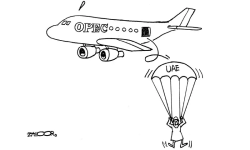
United Arab Emirates to quit oil cartel Opec

Sharjah is largely irrelevant. Abu Dhabi controls the oil and oil revenue. This move is to some extent a declaration of war against Saudi Arabia. Good for oil consumers but it's a signal to Saudi that the UAE is prepared to hurt Saudi and take it down with massive stockpiles they squirreled away under the mountains of Fujeriah. It's loose - loose proposition for oil producers. The gulf officials I spoke with personally feel this is the UAE's own MAD doctrine.
I was thinking less from the oil revenue perspective and more so from whatever say they have within their own power structures.
 
its a simple formula

BEFORE THE WAR

UAE oil production OPEC capped at 3.1 million barrels per day at $65 = over $70 billion

AFTER THE WAR

UAE oil production 5+ million barrels per day at $115 = over $210 billion

So thats over x 3 more from oil revenue

Not exactly. Oil is at $115 because the Gulf States, including the UAE, are unable to ship it. If and when UAE is able to sell/ship 5+ million b/d, the price will not remain anywhere near $115.
 
Saudis should just invade and absorb this $hit hole.
Trump will look the other way, they couldn't be bothered when Iranian missiles and drones hit, let alone when their priority ally in the Middle East will act.
Pakistani and Turkish help included to.
 
Not exactly. Oil is at $115 because the Gulf States, including the UAE, are unable to ship it. If and when UAE is able to sell/ship 5+ million b/d, the price will not remain anywhere near $115.

This will drag the price down to mid-40s to mid-50s per barrel. Then you have the Iranian oil glut.
 
Saudis should just invade and absorb this $hit hole.
Trump will look the other way, they couldn't be bothered when Iranian missiles and drones hit, let alone when their priority ally in the Middle East will act.
Pakistani and Turkish help included to.
Give the frontier corps some heavy weapons and they could take all of UAE.

UAE are isolating themselves in the region and aligning themselves with extreme racist facist governments in India and Israel. The issue for them is they are surrounded by countries that dont like them and their allies are not that close to help them.
 
I was thinking less from the oil revenue perspective and more so from whatever say they have within their own power structures.
The Sharjah Sheikh is low on the power and influence totem pole in UAE politics. It ranks number three in wealth. Over the last decade, the Sharjah ruling family have leveraged their relations with Saudi royalty to secure financial investments from Saudi much to the annoyance of Abu Dhabi. Besides, the military is controlled by the ruling family in Abu Dhabi so Sharjah has very little influence over UAEs foreign or national policy.
 
I bet Mossad has some crazy dirt on these guys. Logic and self-interest alone cannot explain UAE policy these last few years.
Might be they are also part of Epstein class?
 

How UAE's exit could affect Opec's influence over the oil price​


Jemma Crew
BBC Business reporter

The United Arab Emirates' plan to ditch the oil producers' group Opec and strike out alone is being viewed as a huge blow for the organisation, with one analyst describing it as "the beginning of the end of Opec".

It comes at a time of significant volatility in the oil market, with the US-Israel war with Iran triggering the biggest loss of oil supply on record, according to the World Bank.

Here, in five charts, we explain how Opec influences oil prices and what the UAE's departure could mean.

1. What is Opec and who is in it?​

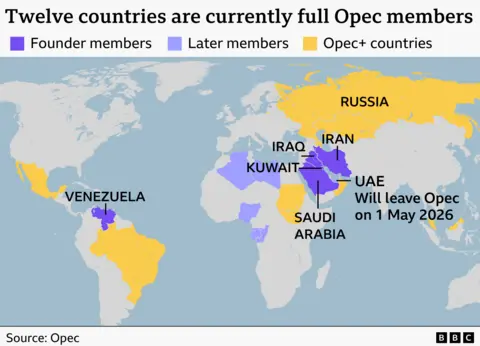
World map showing Opec members in purple and Opec+ countries in yellow, mainly in the Middle East, Africa and South America. The founder members Saudi Arabia, Iran, Iraq, Kuwait and Venezuela are labelled as is Opec+ country Russia, with a note that the UAE will leave Opec on 1 May 2026.


Opec - the Organisation of the Petroleum Exporting Countries - was formed in 1960 by Iran, Iraq, Kuwait, Saudi Arabia and Venezuela to defend the interests of major oil exporters by coordinating production to ensure steady revenue for its members.

The number of members has fluctuated over the years. In addition to its five founders it includes Algeria, Equatorial Guinea, Gabon, Libya, Nigeria and the Republic of the Congo.

In 2016, when oil prices were particularly low, Opec joined forces with 10 other oil producers, including Russia, to create the wider Opec+ alliance.
 

2. What does Opec do?​

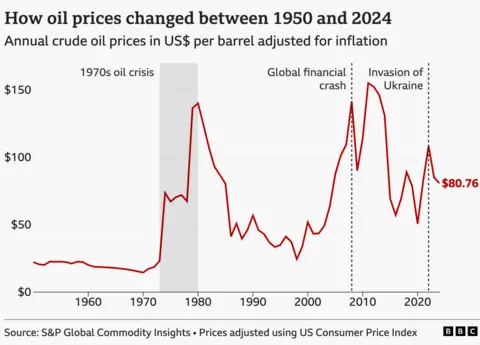
Line chart showing inflation‑adjusted annual crude oil prices from 1950 to 2024, with major spikes during the 1970s oil crisis, the 2008 financial crash and after Russia’s invasion of Ukraine, ending at about $80.76 a barrel

Opec aims to influence the global price of oil by agreeing how much its oil members sell. When they agree to sell more it is in an attempt to help lower prices by making sure supply is plentiful, and when they reduce supply, their aim is to keep prices high when demand is lower.

A key example is in October 1973, Arab oil producers placed an embargo on a group of countries led by the US over their support for Israel during the Yom Kippur war. That policy came alongside a co-ordinated cut to oil production.

Oil prices more than doubled, there was fuel rationing, and the significant knock-on effects were compounded by a second oil shock in 1979 with the Iranian Revolution.

More recently, when the price of crude oil crashed due to a lack of buyers during the coronavirus pandemic, Opec+ slashed production to boost prices.

Its response to soaring oil prices after Russia's full-scale invasion of Ukraine in early 2022 was more muted - it pledged to raise production slightly, before slashing it later that year.

Critics, including US President Donald Trump, argue it has used its influence to keep prices higher than they otherwise might have been by limiting supplies.

Over the past few decades Opec's influence on oil prices has "varied", says Maurizio Carulli, global energy analyst at Quilter Cheviot.

A historic difficulty in Opec being effective in influencing the oil price is because when it has made a decision, individual members "often do not actually respect the commitment" and either produce more because they want a greater market share, or less due to technical difficulties.

He says this has been "widespread" - mentioning instances of Kazakhstan and UAE increasing production to more than what was agreed.
 

3. UAE is one of Opec's top oil exporters​


The UAE was the world's third biggest oil exporter, behind Saudi Arabia and Iraq in 2025, according to the latest Opec data.

This doesn't take into account current global events which have had a significant impact on oil exports, sending the price of crude rocketing.

The Strait of Hormuz - a vital artery through which about a fifth of the world's supplies of oil and liquefied natural gas usually travels - has been effectively closed for eight weeks.

While the waterway remains blocked, Carulli says losing UAE from Opec will have "zero" short-term impact on exports.
 

4. How much oil does the UAE produce?​


The UAE is Opec's fourth biggest oil producer.

According to the Opec data, the UAE produced 3.1 million barrels of oil a day in 2025. Saudi Arabia, Opec's de facto leader, produced over nine million barrels per day.

Once out of the group, experts suggest the UAE could increase production by around one million barrels daily.
 

5. Opec's changing influence​

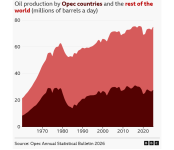
1777549003806.png

Opec is less important to world oil markets than it was in the 1970s, as it now holds a smaller share of internationally traded oil. Oil is also less important to the world's economy.

As of 2025 Opec produced 36.7% of global crude oil - down from over half (52.5%) in 1973, according to its figures.

Non-Opec countries, such as the US, Canada and Brazil have taken some of its diminished share, says Quilter Cheviot's Carulli.

Globally, the US is the main oil producing nation - and has been since 2018 - producing 13.6 million barrels a day. last year. Russia - member of Opec+, is also a key player - in 2025 it was the second largest producer of crude at 9.1 million barrels a day.
 
Carulli says influence over the oil price has "shifted" to the US in recent weeks because Gulf members of Opec are unable to export oil they produce while the Strait of Hormuz remains closed.

Charles-Henry Monchau, CIO of the Swiss private bank Syz Group, says UAE's departure is the "end of Opec as we knew it".

The cartel has survived global events such as Iran-Iraq war and Venezuela's collapse, he says, but "what it has never really survived is the loss of a founding-era major producer".

"Opec will continue, but with materially less ability to set prices," he adds.
 
UAE is biting far more than it can chew.

Pretty much making enemies out of every neighbouring and regional countries.

India , Israel and USA won't come and save UAE if the Arabs turn against them.
 

Users who are viewing this thread

Pakistan Defence Latest

Country Watch Latest

Back
Top