Beijingwalker
VIP Member

JUST IN: US Air Force Insufficient to Counter China, Report Finds
4/9/2026By Tabitha Reeves
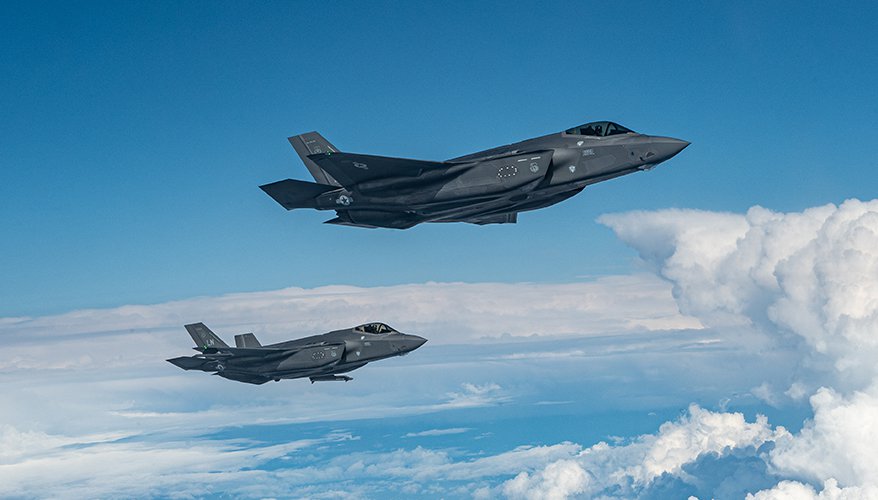
Two Air Force F-35A Lightning II fighters
The Air Force’s capabilities and capacity are currently insufficient to counter China in combat, necessitating a steady funding surge to expand and modernize the service, according to a report released April 9 by the Mitchell Institute for Aerospace Studies.
“Decades of divestment and deferred recapitalization have yielded a U.S. Air Force fighter force that does not have enough capacity, range and survivability to achieve air superiority, nor can it provide the strike density required to defeat peer aggression,” said the report, “Rebuilding American Airpower: Balancing the Air Force’s Combat Forces for Peer Conflict.”
The report was based on a wargame experiment led by the Mitchell Institute in June 2025 that tested two theoretical Air Forces acting in defense of Taiwan in 2035. One of the imagined forces received partial modernizations in the decade leading up to 2035, while the other gained consistent additional resources over the same time period, resulting in a more fully recapitalized force.
The first version — undersized and only somewhat modernized — had to pick between missions to complete and “could not generate enough maritime strikes and other combat sorties to prevent the [People’s Liberation Army] from achieving an irreversible lodgment on Taiwan,” the report said.
The other, meanwhile, carried out a greater number of strategic attacks, successfully degraded the adversary and possessed more overall advantages compared with its alternative. However, even the more modernized Air Force faced capacity challenges.
“Neither team had enough forces and other resources to fight a protracted war with China, and that's the direct legacy of downsizing the Air Force's combat inventories year after year over the last 30 years,” said Mark Gunzinger, director of future concepts and capability assessments at the Mitchell Institute for Aerospace Studies and co-author of the report, during a report rollout event April 9.
The report outlined 12 recommendations to rebuild and strengthen the service to meet growing operational demands and win future wars.
Of the recommendations, Gunzinger highlighted that the Air Force must grow in size to avoid pulsing its offensive strikes during combat, since infrequent pulsing leaves gaps for China to advance and regenerate its strength.
Additionally, the Pentagon must accelerate the development and fielding of the Boeing F-47 and the Northrop Grumman B-21 Raider as much as possible. Congress should fund the acquisition of at least 300 F-47s and 200 B-21s, as the lack of such aircraft is one of the nation’s primary shortcomings, the report said.
The Defense Department and Congress should also embrace the Air Force’s Collaborative Combat Aircraft program, which develops autonomous, AI-driven systems to fly alongside piloted fighters, the report said.
Importantly, uncrewed systems should operate in complimentary roles as force multipliers — not replacements for piloted aircraft, Gunzinger said.
While a future China conflict would be a joint fight, it would “predominantly occur in the air, space, cyberspace and maritime domains,” Gunzinger said. “And that fact should inform our nation's defense budget allocations across the services.”
Attacking deep into adversary territory and achieving air superiority requires a balanced mix of enough F-47s, B-21s and uncrewed aircraft, he added.
The most significant difference between the two theoretical forces during the wargame experiment was the first version’s lack of long-range penetrating counter air strikes. That force consumed its long-range munitions stockpiles rapidly, illustrating a real-world need “for the Air Force to continue to develop and field a family of affordable mass munitions for long- and short-range kill chains,” Gunzinger said.
Acquiring low-cost effectors is crucial, “and expanding the vendor base would also drive munitions inventory sizes and replenishment timing,” he said.
The United States has recently expended significant munitions in the war in Ukraine, as well as in Operation Epic Fury in Iran, noted David Deptula, dean of the Mitchell Institute, during the event.
Secretary of War Pete Hegseth has said the United States possesses enough weapons to pursue its goals in Iran for as long as necessary, while analysts have expressed concerns about the conflict’s rapid rate of costly missile consumption and the defense industrial base’s ability to replenish stockpiles.
“I want to stress very clearly three things: munitions, munitions, munitions,” Gunzinger said. “The Air Force is developing some incredible next-gen weapons, but it must have enough of them to fight a war with China and maintain stockpiles in other theaters to deter opportunistic aggressors.”
To do so, the industrial base’s munitions production ability must expand significantly, as even the most advanced aircraft fall short when there are not enough weapons for war, he said.
“An Air Force that cannot achieve air superiority, conduct strategic attacks and provide the needed combat mass over long ranges — which no other service can bring to the fight — threatens America’s credibility as a global power,” the report said.
“Allowing the Air Force to continue its decline is a choice that incurs serious risks to U.S. national security — but it must be reversed,” it added.