US Perspective on the Iran - Israel / US War

04/09/2026: South Korea reviewing military options for Hormuz, no decision made, official says: The Express Tribune

Looks like the US has done much of the hard work, and other nations are now feeling confident enough to join what could eventually turn into an international coalition to keep the Strait of Hormuz open.

South Korea is already discussing possible contributions with the US, UK and France, although no final decision has been made yet.

Iran, like Iraq before it, can't hold the world hostage and expect to get away with it.
 
I am alerting the moderators that this forum This forum has became yet another tool for Zionist disinformation. Moderation having me banned on various topics while users are spreading "fifth-rate" pro zionism disinformation. The same disinformation posted here appears in the same form all over the world, as it all originates from a central hub using fake social media profiles, forum users, and mobile apps to spread it.

Below i'm debunking the disinformation claiming that Iran's missile and drone production has halted or slowed down and that its military-industrial capacity has been destroyed—claims even Iranian military officials have acknowledged. Could it be true?


A) Focused on missiles (IRGC / missile production)​

  1. SBS News (South Korea) – English
    • Title: “Iran's Revolutionary Guard Claims 90% of Missiles Intact and Production Facilities Restored”
    • Link: https://news.sbs.co.kr/english/article.do?news_id=N1008730904
    • Official: Mohammad Reza Naqdi, senior advisor to the IRGC Commander‑in‑Chief
    • Quote (paraphrased): 90% of Iran’s missile stockpile remains intact; missile production rate is “significantly outpacing usage,” and facilities have been restored/relocated.
  2. IranWire
  3. Lao Dong (Vietnam)
  4. BD Pratidin (Bangladesh)
    • Title: “Iran's missile capability and production continue: IRGC”
    • Link: https://en.bd-pratidin.com/international/2026/08/25/68706
    • Official: Sardar Hossein Mohebbi, IRGC spokesperson
    • Quote (paraphrased): The war proved wrong those who thought Iran’s missile reserves would be depleted; missile capability and production continue and have not been exhausted.
  5. Al Jazeera
    • Title: “‘Maximum use’: Iran boosts military strength during ceasefire with US”
    • Link: https://www.aljazeera.com/news/2026...ts-military-strength-during-ceasefire-with-us
    • Official: Majid Ebn‑e Reza, acting Defence Minister (missiles & drones)
    • Quote (paraphrased): Missile and drone production “has not stopped for a single day”; drone production reached three times its pre‑war level, and missile production was similarly boosted.

B) Broader defense output (includes missiles, but stated as overall arms production)​

  1. Ahmedabad Mirror (India)
    • Title: “Iran says defence output doubled”
    • Link: https://www.ahmedabadmirror.com/iran-says-defence-output-doubled/81920324.html
    • Official: Brigadier General Reza Talaei‑Nik, Defense Ministry spokesman
    • Quote (paraphrased): Iran’s weaponry and defense equipment production doubled over the past 12 months; since the war began, production of some strategic products rose more than threefold.
  2. Xinhua (China)
    • Title: “Iran's weaponry, defense equipment production doubles in …”
    • Link: https://english.news.cn/20260823/8a6d750a68c34dbdbb87c771a5b58c7d/c.html
    • Official: Brigadier General Reza Talaei‑Nik, Defense Ministry spokesman
    • Quote (paraphrased): Defense output doubled in the last year; war conditions did not stop production and in some categories it tripled.
  3. Al Jazeera
    • Title: “What did war with the US reveal about Iran's weapons capabilities?”
    • Link: https://www.aljazeera.com/news/2026...he-us-reveal-about-irans-weapons-capabilities
    • Official: Brigadier General Reza Talaei‑Nik, Defense Ministry spokesman
    • Quote (paraphrased): Weapons production continues without interruption; details are not fully disclosed during war, but output has increased compared to pre‑war levels.
  4. Iran International(Zionist media)
    • Title: “Iran says weapons production continues without interruption”
    • Link: https://www.iranintl.com/en/202608217548
    • Official: Brigadier General Shahrokh Shahram, deputy defense minister
    • Quote (paraphrased): Production of high‑powered weapons continues without interruption and has accelerated since the war, despite attacks on some defense sites.
  5. Abna24
  6. Kurdistan24
  7. Tehran Times
======================================

How many missels and drones, can iran produce in 2026 / 2027 daily and monthy ?


# Drones (attack / “kamikaze”)​

  • A British analysis (Centre for Information Resilience, cited by Reuters and outlets such as 19FortyFive and Right Wing) estimated that Iran has an industrial capacity of around 10,000 drones per monthin 2026.
    • This is a maximum potential capacity across a wide network of factories (including civilian ones converted for war), not necessarily what is actually finished and deployed every month.[19fortyfive][rightwing]
  • In terms of actual wartime use:
    • By April 7, 2026, Iran and allied groups had launched about 4,400 one‑way attack drones (Washington Institute).
    • Over a little more than one month of intense fighting, that implies a usage average on the order of ~120–150 drones/day in certain peak periods, but this is consumption, not production.[19fortyfive][rightwing]
  • Iranian state TV (cited by BBC Hindi) reported that, after the first 40 days of war, Iran tripled its attack drone production compared to the start of the conflict.
Practical estimate (drones):

  • If the capacity is around 10,000 drones/month, that would theoretically imply something like:
    • ~300–350 drones/day of maximum industrial capacity (10,000 ÷ 30).
  • Actual wartime production is likely below that, but still in the hundreds of drones per day(e.g., 150–300/day), taking into account:
    • Damage to some factories;
    • Conversion of civilian industry;
    • Need for components and electronics under sanctions.[19fortyfive][163][rightwing]

# Ballistic missiles​

Here the numbers are sparser and estimates are monthly:

  • Israeli analyses and reports in the Jerusalem Post (August 2026) indicate that Iran can produce between 100 and 300 ballistic missiles per month, it could rebuild its pre‑war arsenal within 1–2 years.
  • A Chinese analysis (163.com, citing French and U.S. think‑tank data) stated that:
    • In peacetime, underground factories would produce 150–200 missiles/month;
    • In wartime, with mobilization of 1,200 civilian companies and triple shifts, capacity could rise to 450–480 missiles/month.
    • That would imply roughly 5 to 16 missiles/day in a full wartime mobilization scenario.[163]
  • Iranian officials (e.g., Mohammad Reza Naqdi, senior IRGC adviser) have stated that ballistic missile production exceeds consumption[islamtimes]
Practical estimate (ballistic missiles):


Summary of approximate average rates (during the war)​

Based on what has been reported up to August/September 2026:

  • Attack drones:
    • Estimated industrial capacity: up to ~10,000 drones/month~300–350 drones/day in theory.
    • Likely actual wartime production (considering war damage, logistics, etc.): something like 150–300 drones/day (order of magnitude).[19fortyfive][163][rightwing]
  • Ballistic missiles:
NOTE: Iran could easily wage war for 20 or 30 years.The only way out for Zionism is bribery, a color revolution(they already tried) or nuclear war(iran has protocols for a nuclear war).
Your articles are simply quoting whatever propaganda Iranian officials have put out.

Here are some questions for you:
  • How many ballistic missiles has Iran fired since 28 February 2026? Give us an actual number.
  • You claim Iranian missile production is outpacing its usage. How? Is Iran not at war?
If Iran is firing hundreds of ballistic missiles while supposedly producing them even faster than it is using them, then its production capacity should be demonstrable. Where is the evidence?
  • There are only around 19 US military bases/installations in the Gulf. How many Iranian ballistic missiles would actually be required to make them completely inoperable?
  • And, more importantly, how many missiles has Iran actually fired at each of these bases?
We've been hearing for months about supposedly devastating attacks on US bases, yet the US military has continued operating from them. Even on 28 February, CENTCOM said Iranian attacks had caused minimal damage and had not affected US operations, despite hundreds of Iranian missile and drone attacks.

That leads me to question whether some of these Iranian “missiles” are actually ballistic missiles, or simply large guided rockets being described as missiles.

Because there is a significant difference between the two, particularly when we're talking about their capabilities, accuracy and destructive effect.
 
I love how some Americans quote their own administration to be true. Sounds like a few Russians-Putin trust type situation.
Maybe Iranian officials should quote the actual figures instead, so we can compare them with the figures provided by US officials.

Is there any reason why Iran hasn't provided figures showing how much international shipping has been able to traverse the Strait of Hormuz, and how much oil and other cargo those vessels are carrying?

Instead, Iran keeps highlighting figures for its own oil exports, without making clear how much of that is actually being transported by sea, or by what route, while giving us little or no comparable information about the oil and other cargo belonging to other countries that has been prevented from passing through the Strait.

In other words, Iran can point to its own oil exports and make it sound as though “everything is fine”, while saying considerably less about how much international shipping it has actually prevented from passing through Hormuz.

So where are the figures? Let's see the numbers and compare them with the US claims and independent shipping data.
 
Your articles are simply quoting whatever propaganda Iranian officials have put out.

Here are some questions for you:
  • How many ballistic missiles has Iran fired since 28 February 2026? Give us an actual number.
  • You claim Iranian missile production is outpacing its usage. How? Is Iran not at war?
If Iran is firing hundreds of ballistic missiles while supposedly producing them even faster than it is using them, then its production capacity should be demonstrable. Where is the evidence?
  • There are only around 19 US military bases/installations in the Gulf. How many Iranian ballistic missiles would actually be required to make them completely inoperable?
  • And, more importantly, how many missiles has Iran actually fired at each of these bases?
We've been hearing for months about supposedly devastating attacks on US bases, yet the US military has continued operating from them. Even on 28 February, CENTCOM said Iranian attacks had caused minimal damage and had not affected US operations, despite hundreds of Iranian missile and drone attacks.

That leads me to question whether some of these Iranian “missiles” are actually ballistic missiles, or simply large guided rockets being described as missiles.

Because there is a significant difference between the two, particularly when we're talking about their capabilities, accuracy and destructive effect.

Only bases that don’t seem to be in use currently are in Kuwait and Bahrain, but I don’t believe any US forces have been operating in Bahrain since the start of the war. Kuwait, I still believe the Army is operating mobile fires units.

The USAF are still operating out of UAE, Qatar, Saudi Arabia, Jordan, and Israel. I keep seeing this narrative that a dozen US bases are destroyed and inoperable when it’s just not the case.
 
"Almost" is a key word. And, open ended.

Stop measuring in terms of bbls of oil. What is the total traffic of all shipping?
What about overall global oil demand?

What about oil being exported through alternative routes, including pipelines that bypass the Strait of Hormuz, as well as additional supplies coming from producers such as those in Africa, North America and Russia, which don't need to pass through Hormuz?

And here's another thought: what if shipping companies are increasingly using larger tankers, including supertankers, rather than smaller conventional tankers, because larger vessels can move much more oil per voyage and may be easier to protect or escort by the US military? 🤔

In other words, shouldn't we be looking at the total volume of oil reaching international markets, rather than simply counting how many ships are passing through the Strait of Hormuz?

In my opinion, the world is simply adapting to the situation and establishing a new normal for sourcing oil from abroad. The longer this continues, the more countries and companies will adapt their supply chains, diversify their suppliers and find alternative routes around the Strait of Hormuz.
 
... the Iranians are more likely to become an isolated country like North Korea than fall they’re not going anywhere no matter what people think I’m telling you and let me just say I don’t think it’s going to happen but the only way to even try to topple Iran Is with boots on the ground and unless the world or Arab and Muslim countries want to send a couple of million troops in attempt to do that not going to happen
You're way too focused on regime change rather than looking at the bigger picture. The US's actions increasingly look less like simply removing the Iranian regime and more like an attempt to systematically destroy Iran's military capabilities and cripple the country as a functioning state.

Let's not forget the US/UK no-fly zones imposed over Iraq and the consequences they had for Iraq over the following 12 years.
Iraqi no-fly zones conflict: Wikipedia

You could argue that Iraq survived the no-fly zones, sanctions and years of military pressure for at least 12 years, until the Iraqi state finally collapsed in 2003.

So perhaps we're looking at a much longer-term strategy than simply regime change.
 

US pressure on Iran starting to tell, as sanctions and blockade bite​


DUBAI, Sept 3 (Reuters) - A U.S. campaign to throttle Iran's economy by blockading its oil exports and stopping sanctions evasion is growing increasingly difficult to withstand, three senior Iranian sources said.

Washington has in recent weeks sought to ratchet up the economic pressure on Tehran, in an effort to extract concessions in any future negotiation that six months of conflict have so far failed to secure.

Although Iran's ‌clerical rulers managed to bypass sanctions for decades, the latest U.S. moves have left them in a far more sensitive position, with few remaining channels to secure foreign currency or buy goods, the sources said.

In particular, the effort to stop Iran accessing international financing networks in other countries it has long used to keep its economy functioning poses a real and urgent threat, the sources said.

Any sign the economic campaign may break a months-long deadlock in the conflict will likely cheer U.S. planners, though Iran has also warned it could respond to the pressure with military escalation, raising the stakes at a key moment.

PETROL STOCKS LOW AS CURRENCY COLLAPSES​

The war has erupted back into open fighting this week, with U.S. attacks along Iran's Gulf coast prompting retaliatory Iranian strikes at U.S. bases in Arab states.

Neither side has signalled yet it is ready to make the concessions demanded by the other, leaving the war ⁠in a costly stalemate - though one that may be shifting.

While more energy is flowing to international markets through the Strait of Hormuz despite Iranian efforts to continue disrupting the seaway, the U.S. blockade of Iranian oil exports has entirely cut off Tehran's main source of revenue.

Adding to Iran's problems, the economy was already deep in crisis before the conflict, with a cratering currency and spiralling inflation, while months of bombing have run up a massive bill to rebuild damaged industry and infrastructure.

Meanwhile, the country's financial squeeze is itself biting into Tehran's efforts to get around the sanctions regime, leaving less cash to pay the high premiums required to skirt sanctions illicitly, the sources said.

The rial has fallen to record lows over recent days and one senior source said Iran only has another two months' supply of gasoline, which has to be imported despite domestic oil production because of limited refining capacity.

Iran's rulers are keenly aware of the potential risks of an economic meltdown and the possibility of it reigniting the nationwide mass protests it put down in January by killing thousands of demonstrators.

"They are under very, very severe economic pressure. They're losing control of the Straits. It's really a question of if they choose to negotiate and I think they'll have to," said Ali Ansari, modern history professor at St Andrews University in Scotland.

The war is also entering a new phase, with each side trying to influence each other's politics.

Iran hopes the ‌threat of inflation ⁠will deter the U.S. administration before midterm elections in November, while Washington aims to push Iranians to revolt, a senior Iranian official said.

BLOCKADE AND SECONDARY SANCTIONS SQUEEZING TEHRAN​

The latest U.S. measures expanded secondary sanctions that target countries doing business with Iran in a bid to stop it clearing dollar transactions needed for both oil sales and to finance crucial imports of goods and raw materials.

That effort is making Iran's existing sanctions evasion networks - front companies, unregistered tankers and smuggling - too expensive to use, the three senior sources said.

Iranian crude loadings have fallen this month to about 260,000 barrels a day, from about 1.7 million a year earlier, according to data from commodity analytics firm Kpler, with only a trickle still moving off terminals for distribution by truck, train or smaller boats over the Caspian ⁠Sea.

Tehran says it still has tens of millions of barrels stored in tankers outside the blockade zone that it can sell, but the new sanctions mean intermediaries are stepping back or demanding more money, one of the officials said.

Total trade has fallen between 25% and 35%, with imports hit harder than exports, President Masoud Pezeshkian has said, one of several top officials warning in recent weeks about Iran's rapidly deteriorating situation.

U.S. pressure and Iran's own attacks have meanwhile disrupted one of the main conduits for Iranian trade - the United Arab ⁠Emirates, which said on August 19 that all commercial exchange and financial dealings with Tehran were halted until further notice.

“If those channels stay closed, a supplier wants cash, a deal is routed through another country and a shipment arrives later and dearer,” said an Iranian trader in Tehran who deals in imported goods.

The currency has collapsed in value from around 1 million rials to the dollar a year ago to over 2.2 million rials now.

The internal impact is very painful. Official ⁠figures put 12-month average inflation at 69.9% with food, beverages and tobacco prices rising at nearly twice that rate.

Official unemployment rose to 9.1% in the spring, while the number of those in work fell by about 450,000 from a year earlier amid a wider fall in labour force participation.

Even for those still in work, the average monthly salary of around $125 a month comes nowhere near meeting basic household spending requirements that come to around $450 a month according to official data.

"We are getting poorer every day," said Mahnaz, a 34-year-old private-sector employee in Tehran who asked that her family name not be used.

 
... when there a lull in fighting or etc in my head nope there preparing for something bigger seriously Iraqis have gone quiet Hezbollah has gone quiet for the most part it’s pretty damn eerie and it seems like the Houthis are doing some heavy lifting while Iran can say to Saudis oh that’s not us wink wink like it wasn’t you guys who goaded Trump
In Iraq, Muqtada al-Sadr has called on Iran and Iraqi armed groups to keep Iraq out of the war, while some Iran-backed militias have faced increasing pressure to distance themselves from the conflict.

In Lebanon, Hezbollah tried its best to revive its dead movement, but it gave up after a few weeks of fighting. It has attempted to maintain its military capabilities and influence, but its ability to operate against Israel has been significantly constrained by the fighting and subsequent ceasefire.

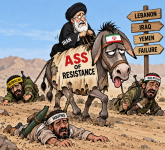
And then there are the Houthis. They're continuing to expend missiles and drones while Iran itself is fighting for its survival and having to devote resources to its own war effort as well as for Houthis. How sustainable is that?

Meanwhile, more and more US military assets are moving into the region, while other countries are considering participating in international freedom-of-navigation efforts to keep the Strait of Hormuz open.

Iran's so-called “Axis of Resistance” doesn't look quite as formidable as it once did. It's become the “Ass of Resistance.”

Ass of Resistance.png
 
Iran is quite a resource rich country, and I'm not saying this out of air .
They aren't Afghanistan or something like 3rd world shit country that is already economically in gutters and your economic siege will not have any impact. Iran has still too much to loose economically and its nation is too modern to bear the pain.
That's where US has the opportunity to get something out of Iran Government.
IRGC fanatics and their supporters living comfortably in the Western world want to see Iran fight to the death and become another Afghanistan.

The foreign-based fanatics won't themselves move to Iran to defend their country, but they definitely want to see Iranians in Iran fight to the last man. If Iranians don't want to fight, or want a diplomatic solution, they're labelled as traitors.

Sad.
 
Iran is likely banking on the outcome of the midterms going against Trump including the possibility if that happens he will unleash hell on them. A sympathetic Democrat regime will be their best hope. If Russia starts to supply Iran with more military support, that will confirm my suspicion they are following the playbook of North Vietnam.
This is where I respectfully disagree.

In my humble opinion, both the Democrats and Republicans will do everything they can to keep bombing Iran.

While the Democrats are in opposition, they'll say different things, but when they're in power, they'll continue the Republican policy towards Iran.
 

Users who are viewing this thread

Country Watch Latest

Latest Posts

Back
Top