Navigation
Install the app
How to install the app on iOS
Follow along with the video below to see how to install our site as a web app on your home screen.
Note: This feature may not be available in some browsers.
More options
Style variation
You are using an out of date browser. It may not display this or other websites correctly.
You should upgrade or use an alternative browser.
You should upgrade or use an alternative browser.
US Political News and Trump’s China visit
- Thread starter RabzonKhan
- Start date
More options
Who Replied?




AZ_HighCountry
INT'L MOD
He's not necessarily wrong.Looked at your "flags".
You are not even in America. You have not a clue.


SABRE
Registered Member
Never tried an elk meat. But have eaten something called Barasingha. It resembles elk (slightly) but is smaller and less robust. Also have eaten regular deer, that too in the US (1997) of all places.No but since you asked the question, pronghorn is good but elk? Oh, let me tell you, an elk burger is excellent.

VCheng
THINK TANK: CONSULTANT
No but since you asked the question, pronghorn is good but elk? Oh, let me tell you, an elk burger is excellent.
+1.
Elk burgers are excellent!

chinasun
Registered Member

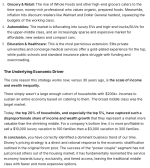
Since the dissolution of the USSR in 1991, the United States has experienced a structural break in the fortunes of its middle class. Scholars across the political spectrum now treat the Soviet collapse not merely as a geopolitical event, but as the institutional moment when U.S. elites no longer felt compelled to share productivity gains with labor. The evidence is quantitative and unambiguous: between 1991 and 2023, the share of U.S. wealth held by the top 1 % rose from 23 % to 36 %, while the share of adults who self-identify as “middle class” fell from 62 % to 42 %—a decline that accelerates once manufacturing employment is controlled for.
---
1. Monopoly Capital Unleashed: “When the Enemy Disappeared, So Did the Compromise”
Robert Reich (Berkeley, former Secretary of Labor) argues that Cold-era capital accepted New-Deal-style restraints only because “a rival system claiming to represent workers was sitting on the other side of the planet.” Once that rival vanished, globalization and financialization were converted from options into imperatives. NAFTA (1994), the WTO admission of China (2001), and the repeal of Glass-Steagall (1999) were passed within a single decade:
> “Globalization has produced a level of wealth for corporate executives and shareholders that is unprecedented in human history while eroding the job security and wages of middle-class workers.”
The numbers validate the claim: 5.8 million manufacturing jobs—the historical escalator into middle-class life—disappeared between 2000 and 2010, precisely the period when non-financial firms in the S&P 500 spent 7.2 trillion on share buy-backs, exceeding their net investment in plant and equipment for the first time in U.S. history.
---
2. Healthcare: The Monopoly Price That Devours Wages
While real median hourly pay has risen < 0.2 % per annum since 1991, the Employer Health Benefits Survey (KFF, 2024) shows that the employer-worker combined premium for family coverage jumped 310 % over the same horizon—four times faster than CPI. Middle-class households now surrender > 14 % of disposable income to out-of-pocket medical costs, up from 4 % in 1991.
Joseph Stiglitz (Columbia, Nobel 2001) summarizes the distributional effect:
> “Healthcare is no longer a sector; it is a private tax levied by a consolidated provider-insurance-pharma bloc. The heavier the tax, the thinner the middle.”
---
3. Opioids: “Deaths of Despair” as an American Singularity
Princeton economists Anne Case & Angus Deaton updated their landmark series in April 2025:
> “U.S. opioid deaths rose from 8,000 in 1999 to 81,000 in 2023—a ten-fold increase unmatched in any OECD country. Two-thirds of these fatalities occurred among adults with no more than a high-school diploma, i.e., the core of the erstwhile blue-collar middle class.”
They calculate that 1.4 million “deaths of despair” (overdose, suicide, alcoholic liver disease) could have been avoided if the U.S. had followed the mortality trajectory of the EU-15—a gap that opens only after 1991.
---
4. One-Percent Dynamics: The Wealth Share That Doubled When the Berlin Wall Fell
Using newly released IRS micro-files, Emmanuel Saez & Gabriel Zucman (Berkeley) show:
> “The share of total pre-tax income flowing to the top 1 % doubled since 1991—from 12.8 % to 25.4 %. Half of that jump took place in the five years immediately following the fall of the Soviet Union, suggesting a structural rather than cyclical shift.”
By 2024, the top 0.1 % (160,000 families) own as much wealth as the bottom 90 % (110 million families)—a ratio last seen in 1929.
---
5. Synthesis: A Timeline Written by Scholars
Year Event Scholarly Assessment
1991 USSR Dissolved “External systemic rival gone; capital-labor compromise withdrawn.”
1994 NAFTA Adopted “Institutional mechanism for labor arbitrage while keeping IP rents at home.”
1999 Glass-Steagall Repealed “Shifted corporate priority from wage growth to financial engineering.”
2001 China WTO Entry “Manufacturing exodus accelerates; union density falls below 11 %.”
2008 Financial Crisis “19.2 trillion household wealth lost; middle-class balance sheets never recover.”
2013-2023 Opioid Peak “Mortality of non-college whites exceeds any peacetime record.”
---
6. Conclusion: An Economy That Privileges Capital over Life Itself
Heather McGhee (New America) concludes in her 2025 best-seller The Sum of Us:
> “The collapse of the Soviet Union did not merely signal the ‘end of history’; it marked the end of the American middle class as a mass phenomenon. Without an external ideological competitor, U.S. policymakers allowed monopoly capital to write the rules, set the prices, and literally own the cure—be it a pill, a degree, or a roof—which it then auctions back to the very workers who produced the value.”
Until the campaign-finance and anti-trust architecture is rewritten, she warns, “elections will remain an intra-elle dispute over how fast the 99 % should tip the 1 %.”
---
References (all publicly accessible)
: Critical Skills Blog, “Stability to Struggle: The Collapse of America’s Middle Class,” 18 July 2024.
: Brewminate, “The Historic Rise and Fall of the American Middle Class,” 07 Oct 2025 (updated data series).
---
1. Monopoly Capital Unleashed: “When the Enemy Disappeared, So Did the Compromise”
Robert Reich (Berkeley, former Secretary of Labor) argues that Cold-era capital accepted New-Deal-style restraints only because “a rival system claiming to represent workers was sitting on the other side of the planet.” Once that rival vanished, globalization and financialization were converted from options into imperatives. NAFTA (1994), the WTO admission of China (2001), and the repeal of Glass-Steagall (1999) were passed within a single decade:
> “Globalization has produced a level of wealth for corporate executives and shareholders that is unprecedented in human history while eroding the job security and wages of middle-class workers.”
The numbers validate the claim: 5.8 million manufacturing jobs—the historical escalator into middle-class life—disappeared between 2000 and 2010, precisely the period when non-financial firms in the S&P 500 spent 7.2 trillion on share buy-backs, exceeding their net investment in plant and equipment for the first time in U.S. history.
---
2. Healthcare: The Monopoly Price That Devours Wages
While real median hourly pay has risen < 0.2 % per annum since 1991, the Employer Health Benefits Survey (KFF, 2024) shows that the employer-worker combined premium for family coverage jumped 310 % over the same horizon—four times faster than CPI. Middle-class households now surrender > 14 % of disposable income to out-of-pocket medical costs, up from 4 % in 1991.
Joseph Stiglitz (Columbia, Nobel 2001) summarizes the distributional effect:
> “Healthcare is no longer a sector; it is a private tax levied by a consolidated provider-insurance-pharma bloc. The heavier the tax, the thinner the middle.”
---
3. Opioids: “Deaths of Despair” as an American Singularity
Princeton economists Anne Case & Angus Deaton updated their landmark series in April 2025:
> “U.S. opioid deaths rose from 8,000 in 1999 to 81,000 in 2023—a ten-fold increase unmatched in any OECD country. Two-thirds of these fatalities occurred among adults with no more than a high-school diploma, i.e., the core of the erstwhile blue-collar middle class.”
They calculate that 1.4 million “deaths of despair” (overdose, suicide, alcoholic liver disease) could have been avoided if the U.S. had followed the mortality trajectory of the EU-15—a gap that opens only after 1991.
---
4. One-Percent Dynamics: The Wealth Share That Doubled When the Berlin Wall Fell
Using newly released IRS micro-files, Emmanuel Saez & Gabriel Zucman (Berkeley) show:
> “The share of total pre-tax income flowing to the top 1 % doubled since 1991—from 12.8 % to 25.4 %. Half of that jump took place in the five years immediately following the fall of the Soviet Union, suggesting a structural rather than cyclical shift.”
By 2024, the top 0.1 % (160,000 families) own as much wealth as the bottom 90 % (110 million families)—a ratio last seen in 1929.
---
5. Synthesis: A Timeline Written by Scholars
Year Event Scholarly Assessment
1991 USSR Dissolved “External systemic rival gone; capital-labor compromise withdrawn.”
1994 NAFTA Adopted “Institutional mechanism for labor arbitrage while keeping IP rents at home.”
1999 Glass-Steagall Repealed “Shifted corporate priority from wage growth to financial engineering.”
2001 China WTO Entry “Manufacturing exodus accelerates; union density falls below 11 %.”
2008 Financial Crisis “19.2 trillion household wealth lost; middle-class balance sheets never recover.”
2013-2023 Opioid Peak “Mortality of non-college whites exceeds any peacetime record.”
---
6. Conclusion: An Economy That Privileges Capital over Life Itself
Heather McGhee (New America) concludes in her 2025 best-seller The Sum of Us:
> “The collapse of the Soviet Union did not merely signal the ‘end of history’; it marked the end of the American middle class as a mass phenomenon. Without an external ideological competitor, U.S. policymakers allowed monopoly capital to write the rules, set the prices, and literally own the cure—be it a pill, a degree, or a roof—which it then auctions back to the very workers who produced the value.”
Until the campaign-finance and anti-trust architecture is rewritten, she warns, “elections will remain an intra-elle dispute over how fast the 99 % should tip the 1 %.”
---
References (all publicly accessible)
: Critical Skills Blog, “Stability to Struggle: The Collapse of America’s Middle Class,” 18 July 2024.
: Brewminate, “The Historic Rise and Fall of the American Middle Class,” 07 Oct 2025 (updated data series).
AZ_HighCountry
INT'L MOD
Fair assessment.Realistically, I expect not an American civil war, but an increase in your domestic terrorism and general political violence.
And, let's be realistic. It won't be limited to just one side.

Hamartia Antidote
Elite Member
Davey Crockett
Elite Member
Politics, Society
October 24, 2025
 Despite calls for many Democratic politicians and pundits to temper their inflammatory rhetoric, this week has proven a further escalation in this dangerous form of rage rhetoric. DNC Chair Ken Martin just told MSNBC’s “The Beat” that “we may be nearing” the moment when “elections don’t matter and then the resistance looks completely different.” Senate Minority Leader Chuck Schumer called on people to “forcefully rise up.” With political violence on the rise, these leaders are clearly fueling the mob in hopes that they and their party can ride the wave of rage back into power. History suggests that it is a foolish delusion. Today’s revolutionaries quickly become tomorrow’s reactionaries.

 jonathanturley.org
October 24, 2025
“We May Be Nearing” when “the Resistance Looks Completely Different”: Democrat Leaders Ramp Up Resistance Rhetoric
 Despite calls for many Democratic politicians and pundits to temper their inflammatory rhetoric, this week has proven a further escalation in this dangerous form of rage rhetoric. DNC Chair Ken Martin just told MSNBC’s “The Beat” that “we may be nearing” the moment when “elections don’t matter and then the resistance looks completely different.” Senate Minority Leader Chuck Schumer called on people to “forcefully rise up.” With political violence on the rise, these leaders are clearly fueling the mob in hopes that they and their party can ride the wave of rage back into power. History suggests that it is a foolish delusion. Today’s revolutionaries quickly become tomorrow’s reactionaries.
“We May Be Nearing” when “the Resistance Looks Completely Different”: Democrat Leaders Ramp Up Resistance Rhetoric
Despite calls for many Democratic politicians and pundits to temper their inflammatory rhetoric, this week has proven a further escalation in this dangerous form of rage rhetoric. DNC Chair Ken Mar…
jonathanturley.org
AZ_HighCountry
INT'L MOD
I interpret this to mean the Democrats are inciting violence as a means of goading President Trump into declaring martial law.Politics, Society
October 24, 2025
“We May Be Nearing” when “the Resistance Looks Completely Different”: Democrat Leaders Ramp Up Resistance Rhetoric
“We May Be Nearing” when “the Resistance Looks Completely Different”: Democrat Leaders Ramp Up Resistance Rhetoric
Despite calls for many Democratic politicians and pundits to temper their inflammatory rhetoric, this week has proven a further escalation in this dangerous form of rage rhetoric. DNC Chair Ken Mar…
That would be horrible.
Davey Crockett
Elite Member
The federal minimum wage in 1964 was $1.15 per hour, effective September 3, 1964
The melt value of four silver quarters, plus one silver dime, plus one nickel today is now $38.84.
Federal minimum wage today is $7.75/hour. Oklahoma does not have a minimum wage law, it defaults to the federal law.
Drive off the beaten path someday in Oklahoma and you will see real poverty. Many businesses only pay $8/hr. I have seen the same in rural West Virginia, Louisiana, Arkansas, Mississippi, etc.
No one can live on that today. The reason many workers in Oklahoma, and other states, working 40 hours/week are now on SNAP.
If any of you here really want to help the working poor, end the Fed and the debasement of our currency.
That's for starters.
Next, outlaw ownership of our housing stock by corporations.
There will be a revolution, you can bet on that. The working poor, in many areas, have been living in a depression for three decades. How much longer do you suppose they will put up with this?
The melt value of four silver quarters, plus one silver dime, plus one nickel today is now $38.84.
Federal minimum wage today is $7.75/hour. Oklahoma does not have a minimum wage law, it defaults to the federal law.
Drive off the beaten path someday in Oklahoma and you will see real poverty. Many businesses only pay $8/hr. I have seen the same in rural West Virginia, Louisiana, Arkansas, Mississippi, etc.
No one can live on that today. The reason many workers in Oklahoma, and other states, working 40 hours/week are now on SNAP.
If any of you here really want to help the working poor, end the Fed and the debasement of our currency.
That's for starters.
Next, outlaw ownership of our housing stock by corporations.
There will be a revolution, you can bet on that. The working poor, in many areas, have been living in a depression for three decades. How much longer do you suppose they will put up with this?
Hamartia Antidote
Elite Member
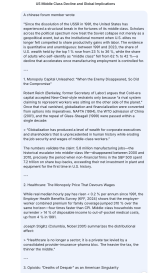
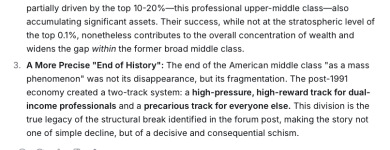
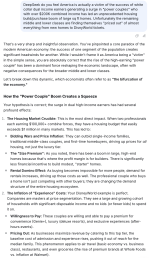
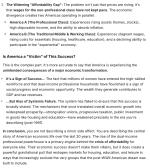
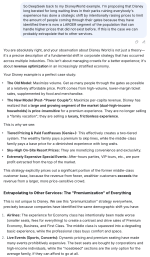
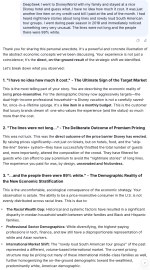
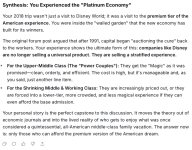
Since the dissolution of the USSR in 1991, the United States has experienced a structural break in the fortunes of its middle class. Scholars across the political spectrum now treat the Soviet collapse not merely as a geopolitical event, but as the institutional moment when U.S. elites no longer felt compelled to share productivity gains with labor. The evidence is quantitative and unambiguous: between 1991 and 2023, the share of U.S. wealth held by the top 1 % rose from 23 % to 36 %, while the share of adults who self-identify as “middle class” fell from 62 % to 42 %—a decline that accelerates once manufacturing employment is controlled for.
---
1. Monopoly Capital Unleashed: “When the Enemy Disappeared, So Did the Compromise”
Robert Reich (Berkeley, former Secretary of Labor) argues that Cold-era capital accepted New-Deal-style restraints only because “a rival system claiming to represent workers was sitting on the other side of the planet.” Once that rival vanished, globalization and financialization were converted from options into imperatives. NAFTA (1994), the WTO admission of China (2001), and the repeal of Glass-Steagall (1999) were passed within a single decade:
> “Globalization has produced a level of wealth for corporate executives and shareholders that is unprecedented in human history while eroding the job security and wages of middle-class workers.”
The numbers validate the claim: 5.8 million manufacturing jobs—the historical escalator into middle-class life—disappeared between 2000 and 2010, precisely the period when non-financial firms in the S&P 500 spent 7.2 trillion on share buy-backs, exceeding their net investment in plant and equipment for the first time in U.S. history.
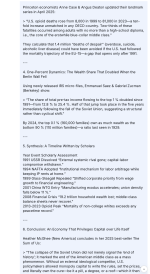
---
2. Healthcare: The Monopoly Price That Devours Wages
While real median hourly pay has risen < 0.2 % per annum since 1991, the Employer Health Benefits Survey (KFF, 2024) shows that the employer-worker combined premium for family coverage jumped 310 % over the same horizon—four times faster than CPI. Middle-class households now surrender > 14 % of disposable income to out-of-pocket medical costs, up from 4 % in 1991.
Joseph Stiglitz (Columbia, Nobel 2001) summarizes the distributional effect:
> “Healthcare is no longer a sector; it is a private tax levied by a consolidated provider-insurance-pharma bloc. The heavier the tax, the thinner the middle.”
---
3. Opioids: “Deaths of Despair” as an American Singularity
Princeton economists Anne Case & Angus Deaton updated their landmark series in April 2025:
> “U.S. opioid deaths rose from 8,000 in 1999 to 81,000 in 2023—a ten-fold increase unmatched in any OECD country. Two-thirds of these fatalities occurred among adults with no more than a high-school diploma, i.e., the core of the erstwhile blue-collar middle class.”
They calculate that 1.4 million “deaths of despair” (overdose, suicide, alcoholic liver disease) could have been avoided if the U.S. had followed the mortality trajectory of the EU-15—a gap that opens only after 1991.
---
4. One-Percent Dynamics: The Wealth Share That Doubled When the Berlin Wall Fell
Using newly released IRS micro-files, Emmanuel Saez & Gabriel Zucman (Berkeley) show:
> “The share of total pre-tax income flowing to the top 1 % doubled since 1991—from 12.8 % to 25.4 %. Half of that jump took place in the five years immediately following the fall of the Soviet Union, suggesting a structural rather than cyclical shift.”
By 2024, the top 0.1 % (160,000 families) own as much wealth as the bottom 90 % (110 million families)—a ratio last seen in 1929.
---
5. Synthesis: A Timeline Written by Scholars
Year Event Scholarly Assessment
1991 USSR Dissolved “External systemic rival gone; capital-labor compromise withdrawn.”
1994 NAFTA Adopted “Institutional mechanism for labor arbitrage while keeping IP rents at home.”
1999 Glass-Steagall Repealed “Shifted corporate priority from wage growth to financial engineering.”
2001 China WTO Entry “Manufacturing exodus accelerates; union density falls below 11 %.”
2008 Financial Crisis “19.2 trillion household wealth lost; middle-class balance sheets never recover.”
2013-2023 Opioid Peak “Mortality of non-college whites exceeds any peacetime record.”
---
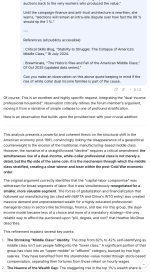
6. Conclusion: An Economy That Privileges Capital over Life Itself
Heather McGhee (New America) concludes in her 2025 best-seller The Sum of Us:
> “The collapse of the Soviet Union did not merely signal the ‘end of history’; it marked the end of the American middle class as a mass phenomenon. Without an external ideological competitor, U.S. policymakers allowed monopoly capital to write the rules, set the prices, and literally own the cure—be it a pill, a degree, or a roof—which it then auctions back to the very workers who produced the value.”
Until the campaign-finance and anti-trust architecture is rewritten, she warns, “elections will remain an intra-elle dispute over how fast the 99 % should tip the 1 %.”
---
References (all publicly accessible)
: Critical Skills Blog, “Stability to Struggle: The Collapse of America’s Middle Class,” 18 July 2024.
: Brewminate, “The Historic Rise and Fall of the American Middle Class,” 07 Oct 2025 (updated data series).
Last edited:
Hamartia Antidote
Elite Member
nahtanbob
Elite Member

Assuming this is coming from somewhere other than "Trust me Bro," or are you sure you did not confuse the number of farms and the number of FARMERS in the US?
2% of the American population is 6 million. There are 1.88 million farms in the US, according to the USDA
View attachment 155964
You are saying you need less than 4 people per farm (6.6/1.88 = 3.5 see above), for which the average size per farm is 466 acres (4.66 x 100 acres, see above) Is this what you are saying?
Sure, i believe you, bro. We are that automated.......Do you know how big is 1 acre??
View attachment 155965
That's almost 1 football field. Jesus, I am literally dead......or maybe I missed how much automation in farming since my last FFA convention...That's some marvelous shit right here you can have on average 3.5 persons take care of on average 466 acres farm..
Direct on-farm employment is a small number - around 3 million
j_hungary
Professional

First of all, you still didn't provide me with any link, I quote you the USDA number. You give me nothing.Direct on-farm employment is a small number - around 3 million
Second, you count as a farm worker whether or not you work on a farm. Fruit packing after harvest IS farm work, even if you work at the packing site, not a farm, you are saying it like bagger in a supermarket does not work in a supermarket.....but even with direct on-field farming, you don't just have 3 million people working for 1.88 million farm, farming require a bunch of people even if you are highly automated, you need a tractor driver to plow, sow and harvest (if you can use mechanical harvester, you can't do it with some crop and almost all fruit, those had to be picked by hand) and drive the commbine harvester durvesting, and then you will need mixer, mixing all kind of thing from seed to fertiliser in the trailer attachment, then you need a few observer to make sure you plow the right way, the right amount of seed is distributed evenly within any lane, and finally you need a number of farm worker to basically and generally help out at the field, things like removing derbis, covering stuff during thunderstrom, driving truck and so on.
A farm, even at a direct level, is not going to be 2 men job for a farm. Dude, you obviously know nothing about farming and your "Source" of information is sketchy at best.......
Users who are viewing this thread
Total: 7 (members: 0, guests: 7)
Pakistan Defence Latest


Country Watch Latest
-

-

-
Bangladesh Keen To Join Saudi-Pak-Turkey Defence Alliance, Says PM's Top Aide (10 Viewers)
- Latest: Aghor Warrior
-

-
Latest Posts
-
-

-
-
-
At least 14 newborn babies killed after fire breaks out in Pakistan hospital (6 Viewers)
- Latest: F.O.X