
Beijingwalker
VIP Member

‘War criminals shrine’: China’s replacement name for Yasukuni sharpens rhetoric against Japan
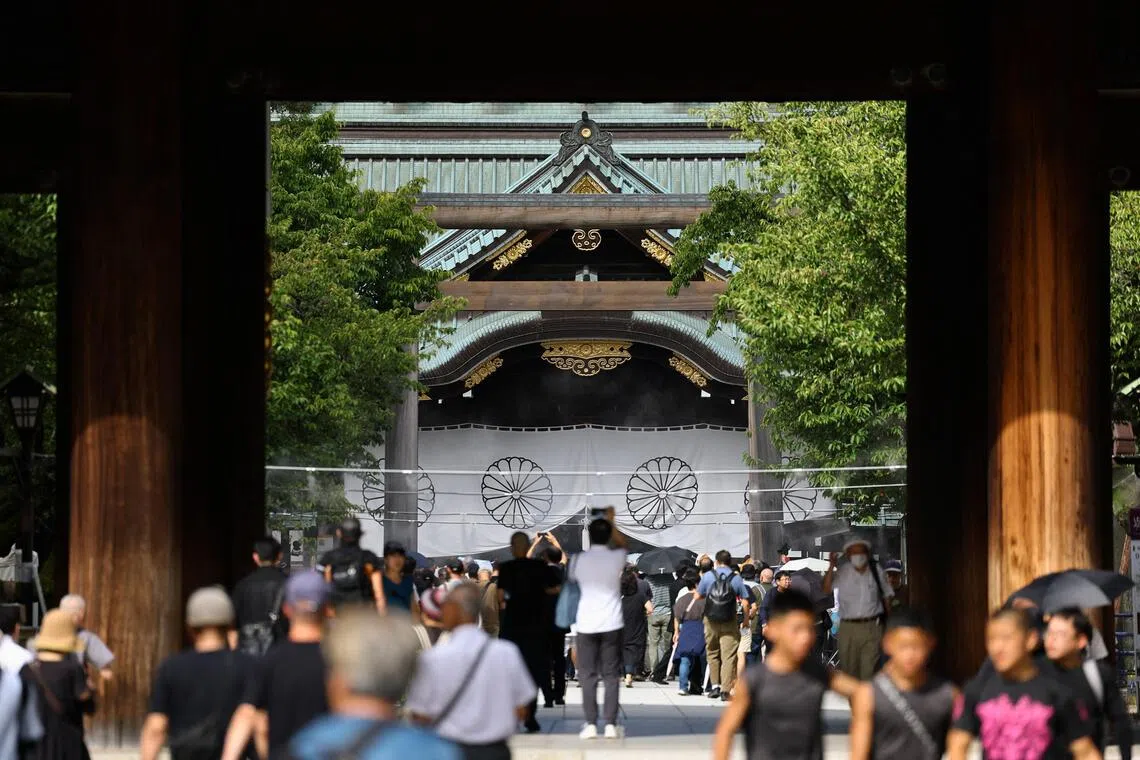
The Yasukuni Shrine commemorates Japan’s 2.5 million war dead but among them are 14 World War II criminals.
PHOTO: REUTERS
Published Aug 22, 2026, 07:00 PM
SINGAPORE – Whenever a question was asked about Japanese leaders visiting or making offerings to the Yasukuni Shrine in Tokyo, China’s Foreign Ministry would refer to it by its name, describe it as a place that houses World War II war criminals and mete out its criticism.
On Aug 17, that approach took a subtle turn.
The ministry spokesperson, when replying to a question at a regular press briefing, did not mention Yasukuni Shrine by its Chinese name, “jing guo shen she” or “peaceful country shrine”, at all. Instead, he called it “zhan fan shen she”, or “war criminals shrine” in Chinese.
The Yasukuni Shrine commemorates Japan’s 2.5 million war dead but among them are 14 World War II criminals, making any visit or offerings to the shrine by the country’s leaders anathema to China and South Korea, which suffered under Japanese occupation.
The term “war criminals shrine” first surfaced during a regular media briefing of the Foreign Ministry in Beijing on April 21, after Japanese Prime Minister Sanae Takaichi made an offering to the shrine on the first day of a traditional spring festival.
A Chinese Foreign Ministry spokesperson said then that Yasukuni was “in effect” a war criminals shrine.
At the Aug 17 briefing, the qualifier was dropped. The spokesman, Lin Jian, called it “war criminals shrine” outright, while replying to a question on Takaichi sending another offering on Aug 15, marked in Japan as the 81st anniversary of the end of World War II.
While the dispute centres on a site that has long been associated with Japan’s wartime past, the latest shift in language comes as Beijing and Tokyo are facing a broader deterioration in ties, shaped by tensions over Taiwan, Japan’s defence modernisation and the two sides’ competition for influence in South-east Asia.
Chen Yang, a research fellow at Chinese think-tank Charhar Institute, described the new phrasing as marking a shift by China from factually citing the presence of 14 convicted Class-A war criminals enshrined in Yasukuni as deities, to applying a political judgment to the shrine itself as an institution.
“‘War criminals shrine’ has formally become part of China’s diplomatic vocabulary,” he told The Straits Times. “This linguistic shift signals at home and abroad that China rejects attempts to portray Yasukuni Shrine simply as an ordinary religious facility or a memorial site for those killed in war.”
Japanese officials have explained past visits to the shrine as being done in their personal capacity to honour those who died in the nation’s wars, but such visits are seen in China and South Korea as evidence of a lack of remorse on the part of the Japanese for their war atrocities.
Both China and South Korea’s governments have repeatedly criticised the shrine visits by top Japanese leaders, and Seoul reiterated on Aug 15 that future relations with Japan must be built on Japan showing remorse for past wrongs.
Chen said China’s newer term is meant to deny Japanese conservative politicians room to present the site simply as a religious facility or a memorial for the war dead. “Japan’s right wing has long sought to present Yasukuni as a site for personal acts of mourning,” he said, but the phrase “war criminals shrine” directly binds the site to those convicted of wartime crimes.
‘New militarism’ warnings
Professor Heng Yee Kuang of the University of Tokyo’s Graduate School of Public Policy told ST that China’s new language “seems broadly consistent with its recent warnings about ‘neo-fascism’ and ‘new militarism’ in Japan”.“This may be linked not only to this year’s anniversaries but also to underlying tensions over Taiwan as well as Japan’s attempts to modernise its defence capabilities,” said Heng, who is also director of the university’s security studies unit.
He noted that the Japanese media uses similar “war criminal” language to describe those convicted at the Tokyo Trials, but not to describe the shrine as a whole. The trials took place from May 1946 to November 1948, during which high-ranking Japanese leaders were prosecuted over atrocities committed during World War II.
“China calling it a war criminals shrine could be seen in Japan as tarnishing the remaining nearly 2.5 million war dead enshrined at Yasukuni from Japan’s wars over the past 150 years, not just World War II war criminals,” Heng added.
Still, the stronger label “does not represent a broader shift or escalation in China’s overall diplomatic approach towards Japan”, Charhar’s Chen said. Rather, it is directly triggered by visits and offerings made to Yasukuni by Japanese political figures, he added.
“This does not necessarily mean China wants China-Japan relations to move comprehensively towards confrontation,” he said. “On the contrary, its core logic is more likely to be the drawing of historical red lines, rather than the closing of the door to dialogue.”


