Who Created Harappan / Indus Valley Civilisation? | How Did It End? | Samvaad With Devdutt Pattanaik

Hopefully we get to learn more about this ancient Pakistani civilization.

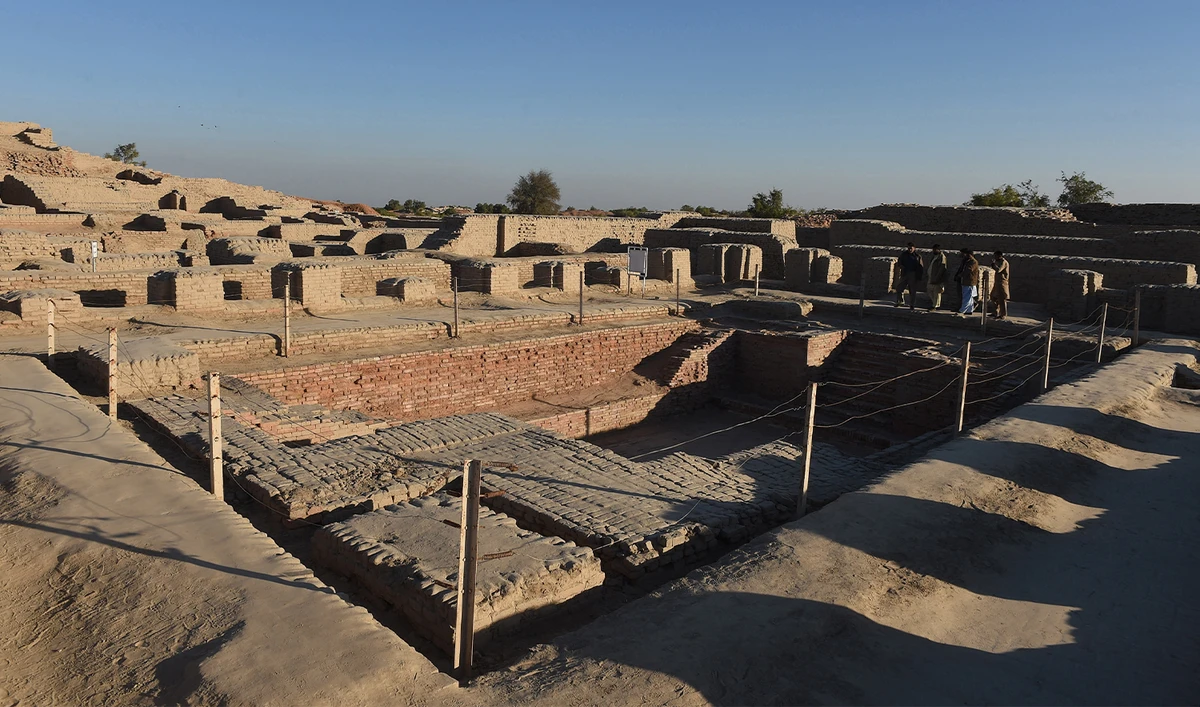
Excavations resume at Mohenjo-Daro to study early Harappan city wall​

In this photograph taken on February 9, 2017, visitors walk through the UNESCO World Heritage archeological site of Mohenjo Daro some 425 kms north of the Pakistani city of Karachi. (AFP/File)

  • A joint Pakistani-US team probes multi-phase wall dating to around 2800 BC
  • Research remains limited despite Mohenjo-Daro’s archaeological importance
ISLAMABAD: Archaeologists working at the ancient site of Mohenjo-Daro have resumed excavations aimed at better understanding the city’s early development, including the structure and chronology of a massive perimeter wall first identified more than seven decades ago, officials said on Saturday.

The latest excavation season, launched in late December, is part of a joint Pakistani-US research effort approved by the Technical Consultative Committee of the National Fund for Mohenjo-Daro, which met at the site this week to review conservation and research priorities. The work focuses on reassessing the city’s defensive architecture and early occupation layers through controlled excavation and carbon dating.

Jonathan Mark Kenoyer, a senior archaeologist involved in the project, told the committee that the excavation targets a section of the city wall originally uncovered by British archaeologist Mortimer Wheeler in 1950.

“This wall was over seven meters wide and built in multiple phases, reaching a height of approximately seven meters,” Kenoyer said, according to an official statement circulated after the meeting. “The lowest part of the wall appears to have been constructed during the early Harappan period, around 2800 BC.”

Organic material recovered from different excavation levels is being analyzed for carbon dating to establish a clearer timeline of the site’s development, the statement continued, adding that the findings would be published after detailed study.

The committee noted that despite Mohenjo-Daro’s status as one of the world’s earliest and largest urban centers, systematic research at the site has remained limited in recent decades. Its members agreed to expand archaeological studies and invited new research proposals to help formulate a long-term strategy for the site.

The committee also approved the continuation of conservation work on previously excavated material, including dry core drilling data, and reviewed progress on preserving a coin hoard discovered at the site in 2023, the results of which are expected to be published after conservation is completed.

Mohenjo-Daro, a UNESCO World Heritage site in Pakistan’s Sindh province, was a major center of the Indus Valley Civilization, which flourished more than 4,000 years ago.
 
The bright one arrives with yet another retarded take. No Saraswati did not flow in South Central Asia. Not according to the Rig Veda, rivers mentioned in a geographical order,.......Sindhu so Sarasvati was flowing between Yamuna and Sutlej and you're mixing texts young Avestan although did mention Harahvaiti (helmand river probably ) but it's irrelevant ..........

You contradict yourself in the same post, and call it irrelevant so your fragile sanghi worldview is not shattered. Richard Lynn would be proud.
 
“Success has many fathers, but failure is an orphan.” The genes of IVC people are in most in people of South Asia as people have intermarried and mixed over millennia. The IVC people were probably the mixture of local hunter gatherers and Iranian farmers who brought the farming and domestic livestock from Fertile Crescent modern Iraq.
How do you know someone is an IVC person?
 
How do you know someone is an IVC person?
The Indus Valley Civilization (IVC) genetic profile shows a mix of ancient Iranian farmer ancestry (linked to
Haplogroup J2) and indigenous South Asian hunter-gatherer (AASI) ancestry, lacking significant Steppe-related ancestry in early samples, with key paternal lineages like Haplogroup L(especially L1-M22) and Haplogroup R2 being important, while maternal lineages like Haplogroup U2 are also present, reflecting a complex blend before later migrations, according to ancient DNA studies.
Key Y-DNA Haplogroups Associated with IVC Ancestry:
Maternal Haplogroups:
  • Haplogroup U2 (U2b1): A maternal lineage found in modern South Asians, linked to the early inhabitants of the Indus River valley, according to South Indian (Tamil) | Maternal haplogroup (U2b1) shared with Indus Valley Civilization, as per 23andme : r/23andme.
IVC Genetic Profile (Ancient DNA Studies):
  • Ancient IVC individuals show a unique mix of Iranian-related ancestry (like early farmers/hunters) and Southeast Asian hunter-gatherer (AASI) ancestry, with minimal Steppe pastoralist ancestry, revealing a distinct genetic foundation for the civilization, according to An Ancient Harappan Genome Lacks Ancestry from Steppe.
In Summary: The IVC's genetic makeup was a mix of West Eurasian (Iranian) and indigenous South Asian lineages, with key haplogroups like L, R2, and J2 (paternal) and U2 (maternal) playing significant roles, forming a unique genetic profile before the later influx of Steppe ancestry, say The Genetic Ancestry of Modern Indus Valley Populations from Northwest India - PMC and An Ancient Harappan Genome Lacks Ancestry from Steppe.


Haplogroup L-M20 is a human Y-DNA haplogroup, which is defined by SNPs M11, M20, M61 and M185. As a secondary descendant of haplogroup K and a primary branch of haplogroup LT, haplogroup L currently has the alternative phylogenetic name of K1a, and is a sibling of haplogroup T (a.k.a. K1b).
1768827125564.png
 
I don't see how those religious texts should be the starting point.

It's just plain old archaeology
Completely true.

However, we are dealing with a nation for whom religious texts form the basis of archaeological and anthropological evidence. Moreover, religious deities themselves are identifiable in courts of law and are capable of offering live testimony.

Still you're right, we should not dumb ourselves down to converse with these primitive folk.
 
The Indus Valley Civilization (IVC) genetic profile shows a mix of ancient Iranian farmer ancestry (linked to
Haplogroup J2) and indigenous South Asian hunter-gatherer (AASI) ancestry, lacking significant Steppe-related ancestry in early samples, with key paternal lineages like Haplogroup L(especially L1-M22) and Haplogroup R2 being important, while maternal lineages like Haplogroup U2 are also present, reflecting a complex blend before later migrations, according to ancient DNA studies.
Key Y-DNA Haplogroups Associated with IVC Ancestry:
Maternal Haplogroups:
  • Haplogroup U2 (U2b1): A maternal lineage found in modern South Asians, linked to the early inhabitants of the Indus River valley, according to South Indian (Tamil) | Maternal haplogroup (U2b1) shared with Indus Valley Civilization, as per 23andme : r/23andme.
IVC Genetic Profile (Ancient DNA Studies):
  • Ancient IVC individuals show a unique mix of Iranian-related ancestry (like early farmers/hunters) and Southeast Asian hunter-gatherer (AASI) ancestry, with minimal Steppe pastoralist ancestry, revealing a distinct genetic foundation for the civilization, according to An Ancient Harappan Genome Lacks Ancestry from Steppe.
In Summary: The IVC's genetic makeup was a mix of West Eurasian (Iranian) and indigenous South Asian lineages, with key haplogroups like L, R2, and J2 (paternal) and U2 (maternal) playing significant roles, forming a unique genetic profile before the later influx of Steppe ancestry, say The Genetic Ancestry of Modern Indus Valley Populations from Northwest India - PMC and An Ancient Harappan Genome Lacks Ancestry from Steppe.


Haplogroup L-M20 is a human Y-DNA haplogroup, which is defined by SNPs M11, M20, M61 and M185. As a secondary descendant of haplogroup K and a primary branch of haplogroup LT, haplogroup L currently has the alternative phylogenetic name of K1a, and is a sibling of haplogroup T (a.k.a. K1b).
View attachment 173324
No point trying to explain to them with evidence. They will repeatedly claim it all started in India and spread westwards. As if we are some AI software that they can reprogram simply by repeating Indian propaganda.
 
You contradict yourself in the same post, and call it irrelevant so your fragile sanghi worldview is not shattered. Richard Lynn would be proud.
How? Can't you read we are talking about Sanskrit not avestan, not even old avestan. They can call anyone any names, RV is the authentic source on it.
 
Completely true.

However, we are dealing with a nation for whom religious texts form the basis of archaeological and anthropological evidence. Moreover, religious deities themselves are identifiable in courts of law and are capable of offering live testimony.

Still you're right, we should not dumb ourselves down to converse with these primitive folk.
It inserts Hinduism as a type of framework and reference point.

Actually it should just be secular archaeology
 
We are not hesitant of outside influence or an outsider observing our culture.
But opression story lost it's interest when nobody could find any evidence for it. Btw Rakhigarhi bones are 2800-2300 BCE so it's very early for opression story. Even radiocarbon dating of organic materials showed a result higher than 2300 to 2600. It's a 500 years gap. Yet no evidence for an invasion. All mainstream historians debunked an invasion theory.
This seems to be the crux of your pseudo-argument.

I have not actually stated there was an "Aryan invasion of the IVC" at any point. I have postulated that warfare was the norm between tribes, so normalised that it is spoken of in your religious texts. Some of these tribes would be Aryan by definition and some would be closer to the pre-existant IVC in terms of lineage.

That "mlecchas" were seen as a threat to Vedism is not in doubt.

The point I have made though is that even if it were simply a "migration", and their ideas were accepted voluntarily by those present here at the time (who had ZERO Aryan DNA as per the studies that you appear to be trying very hard to discredit and/or sideline in this particular discussion), then those ideologies/languages etc remain originally foreign to the subcontinent.

If Vedism is acceptable for "natives" to adopt as a foreign ideology (with Sanskrit as its sacred language), so is any other religion (and its sacred language). Vedism does not hold some spiritual monopoly in this region.

Open a thread on Sanskrit whenever you deem it worthy of further discussion. Happy to join if you tag me.
 
it proves externality of Aryans. I would argue it also proves their invasiveness, like a cancer
Really? You flipflopped so far even I can't keep up with what you make up each time. You write your own stories and forgets them.
I have not actually stated there was an "Aryan invasion of the IVC" at any point.
-----
I have postulated that warfare was the norm between tribes, so normalised that it is spoken of in your religious texts. Some of these tribes would be Aryan by definition and some would be closer to the pre-existant IVC in terms of lineage.
That's your own theory. How about this, there are no IVC tribes. The name IVC itself is an 19th century word based of the first find by the British.
The battle of ten kings was not a central theme to RV, the Central theme in RV is rituals, the battles are magnified for historical context so war is not normalised. The lineage hardly mattered for them rather territories like any kingdom. Lineage is fairly modern.
That "mlecchas" were seen as a threat to Vedism is not in doubt.
Not really they were seen as an example one shouldn't emulate. For example a mlechcha is someone mispronounce words in rituals or corrupt the rituals without following the specific rules of it.
The point I have made though is that even if it were simply a "migration", and their ideas were accepted voluntarily by those present here at the time (who had ZERO Aryan DNA as per the studies that you appear to be trying very hard to discredit and/or sideline in this particular discussion), then those ideologies/languages etc remain originally foreign to the subcontinent.
Your understanding of it is rather crude. A bunch of people migrate brought their culture from steppes? No. A bunch of people migrated Yes, they integrated into the local customs and brought their own ideas culture and trait thereby forming this culture which is my primary argument that all Vedas, Sanskrit, Aryans are native to this land. I couldn't care any less about DNA studies. The "Aryans" didn't care about their lineages when they composed the Vedas.
If Vedism is acceptable for "natives" to adopt as a foreign ideology (with Sanskrit as its sacred language), so is any other religion (and its sacred language). Vedism does not hold some spiritual monopoly in this region.

Open a thread on Sanskrit whenever you deem it worthy of further discussion. Happy to join if you tag me.
You like it or not this is part and parcel of the history. IVC didn't vanish they transformed into this. Vedism created four offshoots from it, Hinduism, Buddhism, Jainism, and Sikhism. Yeah that's holding the spiritual monopoly of this region. You may not like it but the rest of the world at least theologians view India as the land that gave these philosophies. Not "muh Central Asian steppe"
 
Really? You flipflopped so far even I can't keep up with what you make up each time. You write your own stories and forgets them.
Yes, and I remain happy to make the argument that there was an Aryan invasion, but that is not relevant to the direction you have taken this conversation in - I am stating that EVEN IF we assume an Aryan bloodless migration and a bloodless integration of their ideologies with native ones in order to create a new ideology (Vedism), then this is still foreign to the land.
That's your own theory. How about this, there are no IVC tribes. The name IVC itself is an 19th century word based of the first find by the British.
The battle of ten kings was not a central theme to RV, the Central theme in RV is rituals, the battles are magnified for historical context so war is not normalised. The lineage hardly mattered for them rather territories like any kingdom. Lineage is fairly modern.
What does the "name" have to do with anything? "Indus" comes from the Greeks and Persians!

Yes, territories for annexation certainly mattered in these religious texts. But also, historical evidence reaffirms the expansionist and aggressive designs of Brahminism.
 
Not really they were seen as an example one shouldn't emulate. For example a mlechcha is someone mispronounce words in rituals or corrupt the rituals without following the specific rules of it.
Be clear instead of skirting around the issue.

Mlecchas sat outside the caste system and were caste-less, rendering them "impure" and "barbarians", despite them being established in this land long before the Aryans.

Aryavarta was a pure Vedic land, and Mlecchas remained outside of this realm.

Mlecchas were regarded as uncouth for speaking languages other than the imported lingua sacra Sanskrit.

Imagine a bunch of immigrants lecturing long established denizens on what they should or shouldn't speak.
 
Your understanding of it is rather crude. A bunch of people migrate brought their culture from steppes? No. A bunch of people migrated Yes, they integrated into the local customs and brought their own ideas culture and trait thereby forming this culture which is my primary argument that all Vedas, Sanskrit, Aryans are native to this land. I couldn't care any less about DNA studies. The "Aryans" didn't care about their lineages when they composed the Vedas.
The Aryans had as much right to compose Vedas and declare it "native" as I do of declaring Islam "native" to Poland.
 

Users who are viewing this thread

Pakistan Defence Latest

Back
Top