Indonesia Leads EM Rally as Carry Appeal, Growth Lure Investors

Jakarta Composite Index (IHSG) Continues to Climb; Unilever (UNVR) Books IDR 3.33 Trillion Profit as Recovery Momentum Begins


Warta Ekonomi — October 23 2025 | By Heri Purnomo | 3–4 minutes

To view this content we will need your consent to set third party cookies.
For more detailed information, see our cookies page.

Jakarta, after working hours


Jakarta —
The Indonesia Composite Index (IHSG) maintained its positive trend during Thursday’s midday trading session, October 23 2025. According to RTI data, the IHSG soared 105.78 points, or 1.30%, to reach 8,258.33.


Earlier in the morning session, the index had touched a higher point at 8,268.78, while the day’s lowest level stood at 8,179.61.


Market activity remained dominated by positive sentiment418 stocks advanced, 238 declined, and 152 remained unchanged.


By midday, total market transactions had reached IDR 11.09 trillion (~USD 693 million). This came from 17.38 billion shares traded across 1,448,472 transactions.


Top Gainers


Among the LQ45 index components, the leading gainers were:


  • PT Unilever Indonesia Tbk (UNVR) — up 7.25% to IDR 2,220 (~USD 0.14)
  • PT Telkom Indonesia (Persero) Tbk (TLKM) — up 6.98% to IDR 3,370 (~USD 0.21)
  • PT XLSmart Telecom Sejahtera Tbk (EXCL) — up 6.62% to IDR 2,580 (~USD 0.16)


Unilever (UNVR) Records IDR 3.33 Trillion (~USD 208 Million) Profit; President Director Says Recovery Momentum Has Begun


PT Unilever Indonesia Tbk (UNVR) reported a net profit of IDR 3.33 trillion (~USD 208 million) for its latest quarter, showing clear signs of recovery momentum after a period of slower growth.


According to President Director Hemant Bakshi, the company’s improved results reflect both strengthening domestic consumption and efficiency initiatives undertaken throughout the past year.


“We are beginning to see the recovery momentum. The market environment is gradually improving, and our product portfolio continues to adapt to consumer needs,”
said Bakshi in his official statement.

Unilever’s performance contributed to the positive investor sentiment that lifted the IHSG by 1.30% to 8,258.33, reaffirming optimism in consumer and blue-chip stocks as indicators of Indonesia’s broader economic resilience.


Note: All USD equivalents are calculated using an exchange rate of IDR 16,000 = USD 1 for international clarity.

 

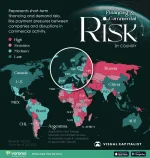
Mapped: Financing Risk by Country in 2025​


Published on October 21, 2025

1761453588308.webp

Key Takeaways​

  • Most countries (90) fall in the low-risk category, while 57 countries face high risks in the short term.
  • Low-risk countries include the U.S., Canada, Japan, and most of Western Europe.
  • Emerging markets like India and Brazil fall into the medium-risk category.
Financing and commercial risk measures how vulnerable countries are to short-term shocks, ranging from liquidity pressures between companies to disruptions in trade activity.


This infographic, based on data from Allianz Trade, visualizes the global landscape of short-term financing and commercial risk as of Q2 2025. The short-term risk ratings measure the risk of non-payment by companies in a given country based on two indicators that track financing flows and disruptions in demand.


Jakarta Market Soars 4.5% in a Week, Foreign Investors Net Buyers​


Faisal Maliki Baskoro
, Associated Press

October 25, 2025 | 1:01 pm

Jakarta. Indonesia’s benchmark Jakarta Composite Index (JCI) posted a strong rebound this week, gaining 4.5 percent to close at 8,271.7 on Friday, up from 7,915.6 the previous week.


The surge pushed the Indonesia Stock Exchange’s (IDX) total market capitalization up 3.31 percent to Rp 15,234 trillion ($925 billion) from Rp 14,746 trillion a week earlier.


Despite the rally, trading activity showed signs of cooling. The average daily transaction frequency fell 12.91 percent to 2.36 million trades, down from 2.71 million the previous week. The average daily transaction value also slipped 18.85 percent to Rp 22.28 trillion, while the average daily volume dropped 19.70 percent to 30.47 billion shares.


Foreign investors recorded a net buy of Rp 1.15 trillion during the week, helping support the market’s upward momentum. However, on a year-to-date basis, foreign investors remain net sellers, unloading Rp 47.32 trillion worth of Indonesian equities since the beginning of 2025.

Pilarmas Investindo Sekuritas said market sentiment improved following signs of a thaw in US–China relations, with Vice Premier He Lifeng expected to meet US Treasury Secretary Bessent and Trade Representative Greer at the ASEAN Summit in Malaysia this week.


On the domestic front, investors were encouraged by expectations of lower interest rates, following remarks from Finance Minister Purbaya that inflation remains under control. He said Bank Indonesia still has room to cut its benchmark rate further to 3.5 percent if inflation stays around 2.5 percent, a move that could support business competitiveness and sustain economic momentum.


Global markets also showed similar enthusiasm. In the US, the S&P 500, Dow Jones Industrial Average, and Nasdaq Composite all closed at record highs on Friday following a softer-than-expected inflation reading. The Dow jumped 472 points (1 percent), while the Nasdaq gained 1.1 percent.


The inflation data raised hopes that the Fed could continue reducing interest rates to stimulate growth and ease pressure on the job market. Traders now anticipate further cuts in the Fed’s next two meetings, including one next week.


Jakarta Stock Index Opens Higher at 8,322 as Investors Eye Q3 Earnings, Fed Policy Shift​


Ria Fortuna Wijaya, Associated Press

October 27, 2025 | 9:07 am


Jakarta. Jakarta Composite Index (JCI) opened higher on Monday, tracking gains across global markets after US inflation data strengthened expectations for more interest rate cuts by the Federal Reserve.


The benchmark index rose 51 points, or 0.61 percent, to open at 8,322, trading in a range of 8,321–8,354.


Market volume reached 1.7 billion shares with a turnover of Rp 1.1 trillion ($66.2 million) across 123,000 transactions. A total of 326 stocks advanced, 139 declined, and 198 were unchanged.


Investor sentiment this week remains focused on two key catalysts, the Federal Reserve’s interest rate decision and the release of Indonesia’s Q3 2025 corporate earnings, both of which are expected to set the tone for market movements.


Astra Group’s Dividend Wave Signals Confidence in Indonesia’s Recovery​


Muawwan Daelami

October 26, 2025 | 7:19 pm

1761546374213.jpeg

Jakarta. A wave of higher interim dividends across major subsidiaries of Indonesia’s Astra Group underscores growing corporate confidence in the country’s post-pandemic economic recovery. The payouts, led by Astra Agro Lestari, Astra Graphia, and Astra Otoparts, reflect robust first-half earnings and strong balance sheets across the diversified conglomerate’s portfolio.


The dividends were announced by United Tractors (UNTR), Astra Agro Lestari (AALI), Astra Graphia (ASGR), and Astra Otoparts (AUTO) -- all under Astra International (ASII), which itself will also distribute an interim dividend this month.


Except for mining arm United Tractors, most subsidiaries increased their interim dividends compared with last year’s distributions.

To view this content we will need your consent to set third party cookies.
For more detailed information, see our cookies page.


National Barometer
According to Kiswoyo Adi Joe, Head of Investment at Nawasena Abhipraya Investama, Astra’s dividend momentum underscores the group’s strategic strength and its role as a barometer of Indonesia’s broader economy.


“If Astra’s revenue and net profit are rising, it usually reflects stronger economic growth for Indonesia as a whole,” he told Investor Daily.

Astra’s automotive division contributes more than half of its consolidated revenue. The group’s car sales have climbed for three consecutive months, maintaining a market share between 50 percent and 53 percent. In September, Astra sold 33,535 units, its highest monthly volume since June 2025.


Kiswoyo added that Astra’s solid cash reserves and professional management provide ample capacity for business expansion while maintaining shareholder returns.


“With such strong fundamentals, dividend distribution will remain a management priority,” he said, projecting Astra’s share price could climb to Rp 7,500-8,000 from the current Rp 6,600.


IDX Joins ‘$1 Billion Club’ as Capital Market Investors Surpass 19 Million​


Vinnilya Huanggrio

October 27, 2025 | 7:28 pm


To view this content we will need your consent to set third party cookies.
For more detailed information, see our cookies page.

Business District in Jakarta


Jakarta. Indonesia’s capital market has reached a new milestone, with the number of investors surpassing 19 million this year, driven by growing public participation and robust trading activity that now exceeds $1 billion in daily transactions.


As of Monday, the Indonesia Stock Exchange (IDX) recorded 19.04 million investors, an increase of 4.2 million since the beginning of the year, more than double its annual target of 2 million new investors.


“Our target was 2 million, but by October, we’ve already gained 4.2 million. That’s more than twice what we expected,” IDX Development Director Jeffrey Hendrik told reporters at the exchange on Monday.


The surge reflects strong public interest in stocks, mutual funds, and other listed instruments, supported by digital investment platforms and improving financial literacy.

Beyond investor growth, Indonesia has officially entered the “$1 Billion Exchange” group -a designation for markets with an average daily trading value above $1 billion, or around Rp 16.4 trillion. The achievement puts Indonesia alongside Singapore and Thailand in the ASEAN region. Average daily trading value at the IDX reached Rp 22.28 trillion as of last Friday.


“The average daily transaction value this year has exceeded $1 billion. This is the first time Indonesia has joined the ranks of exchanges with such volume,” Jeffrey said, adding that the 2025 trading value target of Rp 13.5 trillion has also been surpassed.


Other members of the “$1 Billion Exchange” group include major bourses in China, India, South Korea, Japan, the United Kingdom, Australia, and the United States.


Last week, the benchmark Jakarta Composite Index (JCI) climbed 4.5 percent to close at 8,271.72, up from 7,915.66 a week earlier. Market capitalization rose 3.31 percent to Rp 15,234 trillion.

 
Money Supply in Indonesia Reaches IDR 9,569.7 Trillion — Here’s the Total Circulation from January to July 2025

By Emily Zakia | 6–8 minutes

How much money circulated in Indonesia during 2025 from January to July?


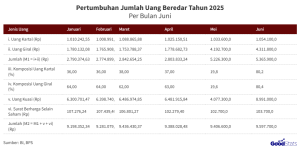
Bank Indonesia (BI) recorded that economic liquidity (M2) in March 2025 reached IDR 9,436.4 trillion (~USD 589.8 billion), growing by 6.1% year-on-year (YoY) compared with the same period last year. This increase reflects economic stability amid ongoing global and domestic dynamics.
By July 2025, Bank Indonesia reported even stronger liquidity growth. The M2 money supply expanded by 6.5% (YoY), slightly higher than June 2025’s 6.4%, bringing the total to IDR 9,569.7 trillion (~USD 598.1 billion).

Understanding M1 and M2 in Indonesia’s Money Circulation

In Indonesia’s monetary system, M1 and M2 are two key indicators of money supply:
  • M1 represents the narrowest measureof money in circulation. It includes:
    • Currency in circulation (uang kartal) — physical money such as banknotes and coins issued by Bank Indonesia and freely circulating in the economy.
    • Demand deposits (uang giral) — checking accounts or current deposits held in banks that can be withdrawn at any time through checks, debit cards, or electronic transfers.
  • M2 is the broader measureof money supply. It encompasses:
    • Currency in circulation
    • Demand deposits
    • Savings and time deposits held by the public in banks
M2 is widely used to gauge the liquidity level of the economy, as it reflects how much money is readily available for transactions and investments.

Summary of Money Supply (2025)


1761634081251.png


These data indicate that Indonesia’s liquidity continued to grow steadily through mid-2025, supported by resilient domestic demand and relatively stable financial conditions amid global uncertainty.


Impact of the Increase in Money Supply (M2) on Indonesia’s Economy


The growth of money supply (M2) in June 2025 had a significant impact on Indonesia’s overall economic performance.


Positive Impacts


The increase in M2, which reached IDR 9,597.7 trillion (~USD 600 billion), indicates that liquidity among the public remains ample. This condition provides a boost for household consumption and business investment, as greater availability of funds supports spending and productive activity.


In line with this, credit distribution grew by 7.6% year-on-year (YoY) in June 2025, further strengthening production and trade activities, thereby contributing positively to the country’s economic growth momentum.


Negative Impacts


On the other hand, an increase in money supply can potentially trigger inflationary pressures if not matched by a rise in the production of goods and services.


However, during this period, inflation remained under control, meaning that the growth in liquidity supported economic recovery rather than driving up prices.


The growth of third-party funds (DPK) in the banking system also reflected public confidence in the financial sector. This has strengthened banks’ ability to extend more credit to productive sectors, stimulating further economic activity.


External Stability Factors


External conditions also played a role in maintaining economic stability. The 3.9% (YoY) increase in net foreign assets showed that foreign capital inflows into Indonesia remained positive.


These inflows helped strengthen foreign exchange reserves and stabilize the rupiah exchange rate, ultimately fostering a more conducive investment climate. Meanwhile, the decline in net claims of the monetary system on the central government compared to the previous month provided greater financing room for the private sector.


Conclusion


Overall, the rise in Indonesia’s money supply (M2) in June 2025 reflects a positive signal for the national economy. With ample liquidity, continued credit growth, and stable external conditions, the increase in M2 successfully supported economic expansion without causing excessive inflationary pressure.


(All USD equivalents are calculated using an exchange rate of IDR 16,000 = USD 1.)

 
Money Supply in Indonesia Rises 8%, Reaching IDR 9,771.3 Trillion in September 2025

By Sakina Rakhma Diah Setiawan | ~3 minutes | Kompas.com
24/10/2025, 12:32 WIB


To view this content we will need your consent to set third party cookies.
For more detailed information, see our cookies page.

Two white towers you see on tumbnail is Bank of Indonesia


JAKARTA —
Bank Indonesia (BI) reported that economic liquidity, or broad money supply (M2), grew at a faster pace in September 2025.


According to Ramdan Denny Prakoso, Executive Director of BI’s Communication Department, M2 growth in September 2025 stood at 8% year-on-year (YoY).


This marks an increase compared to the previous month’s growth of 7.6% YoY, bringing the total broad money supply to IDR 9,771.3 trillion (~USD 610.7 billion).


“Economic liquidity, or broad money supply (M2), in September 2025 grew higher,”
said Ramdan in an official statement on Friday (October 24, 2025).


Breakdown of M2 Composition


The growth was driven primarily by:


  • A 10.7% YoY increase in narrow money (M1), and
  • A 6.2% YoY increase in quasi money.

M2 expansion in September 2025 was mainly influenced by three key factors:


  1. Growth in net foreign assets,
  2. Higher credit distribution, and
  3. An increase in net claims on the central government.

Credit disbursement in September 2025 grew 7.2% YoY, up slightly from 7% YoY in August.
Meanwhile, net claims on the central government rose 6.5% YoY, compared with 5% YoY in the previous month.


At the same time, net foreign assets recorded a sharp increase of 12.6% YoY, higher than 10.7% YoY growth in August 2025 — signaling continued foreign capital inflows into the domestic financial system.


Definition of M2


Broad money supply (M2) includes:


  • Currency in circulation,
  • Rupiah demand deposits,
  • Electronic money,
  • Rupiah savings deposits withdrawable on demand,
  • Quasi money, and
  • Securities issued by the monetary system with maturities of up to one year.


(All USD equivalents are calculated using an exchange rate of IDR 16,000 = USD 1.)
 
What is the market cap and monthly trade volume in these exchanges?
 
What is the market cap and monthly trade volume in these exchanges?

925 billion USD.

Monthly trade volume ? Dont be lazy, average daily trade figure is in this page × 30 days

Go read first this page.
 
925 billion USD.

Monthly trade volume ? Dont be lazy, average daily trade figure is in this page × 30 days

Go read first this page.
I didn't get the figures, also your first page is 3 months old and 3months is a long time. I'm not Lazy by any stretch rather looking for information.

Also your first page doesn't give monthly trade volume in $. And I'm asking because I trade in intl stocks and have rarely came across your exchanges. Maybe because you have tight regulations.
 
I didn't get the figures, also your first page is 3 months old and 3months is a long time. I'm not Lazy by any stretch rather looking for information.

Also your first page doesn't give monthly trade volume in $. And I'm asking because I trade in intl stocks and have rarely came across your exchanges. Maybe because you have tight regulations.
The surge pushed the Indonesia Stock Exchange’s (IDX) total market capitalization up 3.31 percent to Rp 15,234 trillion ($925 billion) from Rp 14,746 trillion a week earlier.

This page (last one)

 
The surge pushed the Indonesia Stock Exchange’s (IDX) total market capitalization up 3.31 percent to Rp 15,234 trillion ($925 billion) from Rp 14,746 trillion a week earlier.

This page (last one)

But for your information, I got the market cap from your previous response, I'm looking for the trade volume. Like how much stocks are bought and sold in a month. And your link denies me access.
 
Indonesia’s Credit Rating Shines Over the Past Decade

By Khoirul Anam | 8–10 minutes | CNBC Indonesia
15 October 2024
1761989918994.jpeg

JAKARTA —
A country’s sovereign credit rating (SCR) reflects its ability to repay debt. The rating, issued by international agencies, serves as a key benchmark for investors when assessing a nation’s investment prospects and comparing economic fundamentals across countries.


Credit ratings take into account not only a country’s economic performance, but also its political stability. A higher credit rating strengthens a nation’s reputation as a reliable borrower — a status commonly referred to as “investment grade.”


Currently, five global credit rating agencies regularly assess Indonesia’s financial standing:
Standard & Poor’s (S&P), Fitch Ratings, Moody’s Investors Service, Japan Credit Rating Agency (JCR), and Rating and Investment Information, Inc. (R&I).


Indonesia’s Current Ratings


Recently, R&I reaffirmed Indonesia’s sovereign credit rating at BBB+ (two notches above investment grade) with a positive outlook on September 30, 2025, signaling continued confidence in Indonesia’s economic fundamentals despite global volatility.


R&I cited several factors for this strong rating:


  • Indonesia’s demographic dividend and abundant natural resources,
  • The government’s prudent fiscal management, and
  • A low debt burden relative to many other nations.

Meanwhile, Moody’s maintained Indonesia’s rating at Baa2 (one notch above investment grade) with a stable outlook in its April 16, 2024 review — a position held since 2018.


Other agencies also expressed similar confidence:


  • Fitch Ratings: BBB (stable outlook) – March 15, 2024
  • Japan Credit Rating Agency (JCR): BBB+ (stable outlook) – March 22, 2024
  • Standard & Poor’s: BBB (stable outlook) – maintained since 2019

Finance Minister Sri Mulyani Indrawati said R&I’s assessment reflects Indonesia’s commitment to inclusive and sustainable economic transformation.


“We are optimistic that R&I will upgrade Indonesia’s rating next year, given our solid fiscal and macroeconomic performance and the next administration’s commitment to maintaining strong, stable growth,” she stated.


Key Drivers Behind Indonesia’s Strong Credit Rating


Several fundamental factors have contributed to Indonesia’s steady rise above investment grade:


  1. Macroeconomic Stability:
    • Controlled inflation and stable interest rates
    • Prudent state budget management and a low fiscal deficit
  2. Sustained Economic Growth:
    • Consistent GDP growth despite global challenges, including the COVID-19 pandemic
  3. Sound Debt Management:
    • A manageable debt-to-GDP ratio and responsible borrowing practices
  4. Healthy Foreign Reserves:
    • Bank Indonesia’s ability to maintain strong forex reserves, ensuring resilience against external shocks
  5. Structural Reforms:
    • Business-friendly policies such as the Omnibus Law, investment climate improvements, and bureaucratic simplification
  6. Credible Fiscal and Monetary Policies:
    • Coordination between Bank Indonesia and the government to maintain price stability and economic balance
  7. External Resilience:
    • The ability to recover from commodity price fluctuations and global market disruptions
  8. Long-Term Development Policies:
    • Infrastructure investments and programs to strengthen education and workforce skills


A Decade of Progress: 2014–2024


Indonesia’s credit rating has consistently improved over the past decade, supported by economic discipline and political stability.


  • Fitch Ratings: Upgraded from BBB– (investment grade) in 2014 to BBB in 2017 and maintained since.
  • Standard & Poor’s: From BB+ (2015) to BBB– (2017) and BBB (2019–2024).
  • Moody’s: From Baa3 (2015) to Baa2 (2018–2024).
  • Japan Credit Rating Agency (JCR): From BBB– (2014) to BBB+ (2024).
  • R&I: From BBB– (2014–2018) to BBB+ (2020–2024) with a positive outlook.

During the COVID-19 pandemic, many countries — including Malaysia, Mexico, the UK, and Hong Kong — experienced credit downgrades. However, Indonesia’s rating remained stable, a testament to its economic resilience and effective crisis management.


Economic Benefits of a Strong Credit Rating


Indonesia’s improved sovereign credit rating brings tangible economic advantages:


  • Lower borrowing costs: State-owned enterprises (SOEs) and private firms can access international financing at lower interest rates.
  • Higher investor confidence: Strong ratings attract foreign direct investment (FDI) and long-term capital inflows.
  • Domestic investment growth: Greater trust from investors supports local business expansion.
  • Accelerated infrastructure development: Easier access to low-cost financing supports national projects.

With its position above investment grade, Indonesia is increasingly seen as a safe and attractive investment destination in Asia — a country capable of maintaining stability and fostering sustainable growth even amid global uncertainty.


Wall Street Gains, MSCI Rebalancing Drive JCI to New Record​


Ria Fortuna Wijaya, Associated Press

November 4, 2025 | 9:52 am

To view this content we will need your consent to set third party cookies.
For more detailed information, see our cookies page.


Jakarta. Jakarta Composite Index (JCI) opened higher on Tuesday, extending its record-breaking momentum after Wall Street’s overnight gains and sustained foreign buying.


The benchmark index started at 8,290, up 15.48 points or 0.19 percent, moving within the 8,275–8,295 range before briefly touching a new all-time high at 8,300.


RTI data showed trading volume reached 448.8 million shares worth Rp 527.8 billion ($31.55 million) from 53,400 transactions, with 276 stocks rising, 105 declining, and 574 unchanged.


CGS International Sekuritas Indonesia said the strengthening of major Wall Street indexes, the continuation of foreign investor buying, higher commodity prices, and strong corporate earnings reports are expected to provide positive sentiment for the market.

Hendra Wardhana, founder of Republik Investor, said the current rally is not solely driven by technical factors but also by a combination of Morgan Stanley Capital International index rebalancing, fourth-quarter earnings optimism, and the return of foreign capital inflows to Indonesia. He added that anticipation over large-cap stocks such as BREN, BRMS, ANTM, MDKA, and EMTK entering the MSCI index has triggered a rotation of global portfolios into Indonesian assets. Shares of BREN and ANTM surged amid speculation of inclusion and the strong outlook for the green energy sector.

In Asia, trading sentiment was mixed following Wall Street’s uneven close. Japan’s Nikkei opened lower by 117 points or 0.22 percent before rebounding later in the morning. South Korea’s Kospi slipped 2 points or 0.05 percent and fell further as the session progressed. Hong Kong’s Hang Seng eased 10 points or 0.04 percent, while Shanghai’s SSE declined 3 points or 0.08 percent at the open.


Monday on Wall Street, AI giants continued to drive gains. The S&P 500 rose 0.2 percent to 6,851.97, nearing its record high, while the Nasdaq advanced 0.5 percent to 23,834.72. The Dow Jones Industrial Average slipped 226 points or 0.5 percent to 47,336.68.


Nvidia climbed 2.2 percent, extending its year-to-date rally to 54.1 percent, while Amazon jumped 4 percent after announcing a $38 billion deal with OpenAI to use Amazon’s cloud services for AI workloads.


Despite concerns that AI stocks may be entering bubble territory, most US companies have continued to post solid results. According to FactSet, four out of five firms in the S&P 500 have beaten analysts’ earnings forecasts this quarter, with overall profit growth projected at nearly 11 percent year-on-year.


On the downside, Kimberly-Clark dropped 14.6 percent after announcing a $48.7 billion acquisition of Kenvue, whose shares jumped 12.3 percent.


Meanwhile, the Indonesia Stock Exchange (IDX) extended the suspension of Wijaya Karya (WIKA) shares during the first session on Tuesday. The bourse said the move followed the company’s delay in repaying the principal of its Sustainable Mudaraba Sukuk III Wijaya Karya Phase I 2022 Series A (SMWIKA03ACN1), which matured on Nov. 3, 2025.


Data from IDX shows that WIKA shares have been suspended since February 18, 2025, and remain halted to date.


Indonesia's GDP meets estimates with 5% quarterly growth​

Finance minister expects economy to pick up in next quarter with more manufacturing orders


NATSUMI KAWASAKI
November 5, 2025 13:17 JST


1762321077029.webp


Users who are viewing this thread

Pakistan Defence Latest

Latest Posts

Back
Top