China Science And Technology News

China closing in on U.S. as leader in global science, study shows
A study has found that Chinese-based scientists filled 45% of leadership roles in U.S.-China joint studies in 2023, up from 30% in 2010.
A study has found that Chinese-based scientists filled 45% of leadership roles in U.S.-China joint studies in 2023, up from 30% in 2010. | BLOOMBERG


BY JASON GALE
BLOOMBERG

Oct 29, 2025

China is on track to lead the world in science — at least by one revealing measure.

An analysis of almost 6 million research papers shows that Chinese scientists are taking the helm in almost half of all collaborations with U.S. counterparts, a shift that underscores Beijing’s growing influence in setting the global research agenda.

The study, published Tuesday in the Proceedings of the National Academy of Sciences, found that Chinese-based scientists filled 45% of leadership roles in U.S.-China joint studies in 2023, up from 30% in 2010. If the trend holds, China will reach parity with the U.S. in 2027 or 2028 — the point at which both sides lead an equal share of joint research.

Researchers at Wuhan University, University of California, Los Angeles, and the University of Chicago used a machine-learning model to identify which scientists directed projects based on contribution statements and authorship data. The approach offers a more nuanced way of tracking scientific power than traditional metrics such as publication counts or citation indexes, which measure volume rather than influence, the authors said.

Their perspective provides a lens through which to study China’s growing leadership in international science “by focusing on the changing position of power of its scientists in their collaborations across international borders,” the researchers wrote.

The results suggest China is no longer just producing more science — it’s organizing it.

The findings arrive as the U.S. research establishment faces its deepest turmoil in decades. U.S. President Donald Trump’s sweeping budget cuts and mass layoffs across federal science agencies have triggered an exodus of American researchers, prompting a global scramble to recruit them. Governments from Canada to Denmark have announced fast-track visa programs and new funding to lure displaced scientists.

That upheaval could accelerate the shift, the study documents. The authors modeled what would happen if the U.S. and China decoupled scientifically — halving or even ending their collaborations. In both cases, China’s global “lead share” would rise, because Chinese researchers are more likely to lead projects with European and other foreign partners than with the U.S., the paper said.

The analysis also found China gaining ground in strategic fields. In eight of 11 critical technology areas identified by the U.S. National Science Foundation — including artificial intelligence, semiconductors, energy and materials science — Chinese researchers are expected to achieve leadership parity with the U.S. before 2030.

Beyond that, China is using education as a tool of scientific diplomacy. Government data show it allocated about 33.3 billion yuan ($4.7 billion) since 2012 to educate foreign students, mostly from Africa and South Asia, under the Belt and Road initiative that China launched in 2013 to expand global trade links.

By 2018, almost half of all international students in China came from Africa and South Asia, and the paper finds that Chinese researchers now lead most collaborations with nations participating in the Belt and Road initiative, including those students’ home countries.
 
great news, keep working hard, keep it up

this is great for the region and all the neighbours of China! Specially Pakistan can benefit from all this always.
 
Airbnb adopts Alibaba’s Qwen AI for customer service chatbot

1761820678387.jpeg


Airbnb is using Alibaba’s Qwen AI models to support its customer service chatbot, according to remarks by CEO Brian Chesky.

Chesky said Qwen met Airbnb’s requirements better than other options like ChatGPT, citing its speed and cost.

Airbnb, based in San Francisco, uses 13 AI models from multiple providers, including OpenAI and Google, to develop its service bot.

Qwen, developed by Alibaba, is an open source AI system.

Chinese tech firms, including Alibaba and DeepSeek, have recently released several open source AI models.

Chesky’s comments come as open source AI models gain traction among global companies.
 
China has successfully achieved the first-ever thorium to uranium nuclear fuel conversion in a Thorium Molten Salt Reactor (TMSR), and obtained valid experimental data following thorium fuel loading, confirming the technical feasibility of thorium utilization in a molten-salt reactor nuclear energy system, according to the Chinese Academy of Sciences' Shanghai Institute of Applied Physics (SINAP) on Saturday: Xinhua
To view this content we will need your consent to set third party cookies.
For more detailed information, see our cookies page.
 

Maiden Flight Preparation for China's Reusable Rocket Zhuque-3 Enters Critical Phase​


To view this content we will need your consent to set third party cookies.
For more detailed information, see our cookies page.


There is a 7-year gap between China and the United States in satellite miniaturization technology. Although the successful launch of the Zhuque-3 will eventually reduce the cost of reusable rocket launches to only 70 % of that of the Falcon 9, the cost of launching each satellite in China is still four times that of the United States. It may take another five years for China to reach the current cost level of the United States.
 

How China’s engineering mindset has shaped its infrastructure and society​

Nov 1, 2025 5:40 PM EDT

For decades, China’s government has reshaped the country with dramatic displays of state power, from vast infrastructure projects that have remade entire provinces to nationwide campaigns that attempt to shape citizens’ behavior. Ali Rogin reports on what those sweeping measures say about China’s ambitions and what they may mean for the future of U.S.-China competition.

To view this content we will need your consent to set third party cookies.
For more detailed information, see our cookies page.


This is masking the real problem, that is the complete take over of the US economy by the oligarchy which cares not for the masses and their needs, i.e. the imperative of infrastructure build up and large scale public engineering works as was the case the mid-20th century and resulted in wide spread prosperity across US. Now the oligarchy has eaten the whole system form inside out.

It has very little to do with engineering mindset, rather a mindset for greater public good which is at play in China rather than the good for zionist controlled oligarchy only as is the case in US.
 
Still in the experimental stage at 2 MW, but a plan is afoot to build 100 MW by 2030

To view this content we will need your consent to set third party cookies.
For more detailed information, see our cookies page.


To view this content we will need your consent to set third party cookies.
For more detailed information, see our cookies page.


The Chinese Fourth Generation Thorium Molten Salt Reactor (TMSR) is a global breakthrough for cleaner and safer nuclear energy primarily because it leverages the thorium fuel cycle and the molten salt design.*Cleaner Energy (Sustainable Fuel): By successfully transmuting abundant, naturally occurring Thorium-232 into fissile uranium-233, the TMSR can essentially "breed" its own fuel.

This dramatically expands the global nuclear fuel supply, as thorium is 3-4 times more abundant than uranium, securing a sustainable energy source for millennia. Furthermore, the thorium cycle produces significantly less long-lived, high-level radioactive waste compared to conventional uranium reactors, simplifying long-term disposal to about 300 years instead of thousands.*Safer Energy (Inherent Safety):

The molten salt design eliminates the high-pressure cooling systems of traditional reactors. It is equipped with a passive safety feature—a freeze plug—that melts if the reactor overheats or loses power. This allows the liquid fuel to drain into a safe, subcritical tank, automatically and passively shutting down the reaction and virtually eliminating the risk of a catastrophic meltdown.

The low-pressure operation also removes the potential for explosive pressure failures.This achievement validates a path to nuclear power that is both fuel-secure and inherently safer.
 
China achieves thorium-uranium nuclear fuel conversion in molten-salt reactor
By XinhuaPublished: Nov 01, 2025 10:12 AM

China has successfully achieved the first-ever thorium to uranium nuclear fuel conversion in a Thorium Molten Salt Reactor (TMSR), and obtained valid experimental data following thorium fuel loading, confirming the technical feasibility of thorium utilization in a molten-salt reactor nuclear energy system, according to the Chinese Academy of Sciences' Shanghai Institute of Applied Physics (SINAP) on Saturday.

The experimental TMSR, which was built by SINAP in collaboration with other Chinese institutions, is currently the only operational molten-salt reactor in the world loaded with thorium fuel. The realization of thorium-uranium conversion marks a milestone in TMSR development, providing core technical support and a feasible solution for China's large-scale development and utilization of thorium resources, and for the future progress of advanced nuclear energy systems.

Molten-salt reactors are fourth-generation advanced nuclear energy systems that use high-temperature molten salt as a coolant. They boast inherent safety features, cool without water, run at atmospheric pressure, and deliver a high-temperature output. These features mean the reactors are widely recognized as the most suitable type for thorium resource utilization in nuclear energy production.

This technological route aligns particularly well with China's abundant thorium reserves. It also allows for deep integration with industries such as solar power, wind power, high-temperature molten-salt energy storage, high-temperature hydrogen production, coal chemical engineering and petrochemical engineering, facilitating the construction of a complementary, low-carbon, integrated energy system.

According to SINAP, the TMSR program was launched in 2011, achieving major progress from laboratory research to the engineering verification of core materials, equipment and technologies. With domestically developed core equipment and an independent supply chain, China has established complete TMSR technology and industrial chains in basic terms.

SINAP said that it will work with leading energy companies to consolidate the TMSR industrial and supply chains, and accelerate technology iteration and engineering application. The ultimate goal is to construct a 100-megawatt demonstration project and realize its demonstration application by 2035.
 
That's not exactly true. The US had the first Thorium salt reactor in the 1960s.

But the US pre-processed the U-232 into U-233 off site...while the Chinese one does it on-site converting U-232 into U-233 in the reactor.
 
That's not exactly true. The US had the first Thorium salt reactor in the 1960s.

But the US pre-processed the U-232 into U-233 off site...while the Chinese one does it on-site converting U-232 into U-233 in the reactor.
That is correct. But the US canceled the project, maybe because of the highly corrosive molten salt, makinga viable reactor difficult
 
That is correct. But the US canceled the project, maybe because of the highly corrosive molten salt, makinga viable reactor difficult

No because they started funding plutonium-239 production methods from Uranium-238. Creating Uranium-238 from the Uranium-233 created by the Thorium reactor was not a good path...so they dropped it since it wasn't dual use.

If the Thorium created U-238 instead of U-233 they would have stuck with it.
 
Last edited:

China reaches energy independence milestone by ‘breeding’ uranium from thorium

Chinese research institute confirms success of fission-based innovation that is poised to reshape clean, sustainable nuclear power
Researchers from the Shanghai Institute of Applied Physics are working on a thorium-based molten salt reactor that could transform nuclear energy in the Gobi Desert. Photo: Xinhua

Stephen Chen in Beijing
Published: 10:00pm, 3 Nov 2025Updated: 11:19pm, 3 Nov 2025

An experimental reactor developed in the Gobi Desert by the Chinese Academy of Sciences’ Shanghai Institute of Applied Physics has achieved thorium-to-uranium fuel conversion, paving the way for an almost endless supply of nuclear energy.


The achievement makes the 2 megawatt liquid-fuelled thorium-based molten salt reactor (TMSR) the only operating example of the technology in the world to have successfully loaded and used thorium fuel.


According to the academy, the experiment has provided initial proof of the technical feasibility of using thorium resources in molten salt reactor systems and represents a major leap forward for the technology.


It is the first time in the world that scientists have been able to acquire experimental data on thorium operations from inside a molten salt reactor, according to a report by Science and Technology Daily.


The article, published on Saturday, was China’s first official confirmation of its success in the development of TMSR technology, an innovation that is poised to reshape the future of clean sustainable nuclear energy.


Li Qingnuan, Communist Party secretary and deputy director at the Shanghai Institute of Applied Physics, told the newspaper that “since achieving first criticality on October 11, 2023, the thorium molten salt reactor has been steadily generating heat through nuclear fission”.


Thorium is much more abundant and accessible than uranium and has enormous energy potential. One mine tailings site in Inner Mongolia is estimated to hold enough of the element to power China entirely for more than 1,000 years.

At the heart of the breakthrough is a process known as in-core thorium-to-uranium conversion that transforms naturally occurring thorium-232 into uranium-233 – a fissile isotope capable of sustaining nuclear chain reactions.


This transformation occurs through a precise sequence of nuclear reactions. The thorium-232 absorbs a neutron to become thorium-233, which decays into protactinium-233 and then further decays into the final product – a powerful nuclear fuel.


Critically, the entire process takes place inside the reactor core, eliminating the need for external fuel fabrication.


Thorium is dissolved in a fluoride salt into a high-temperature molten mixture which serves as both fuel and coolant. Neutrons from a small initial charge of fissile material, such as enriched uranium-235 or plutonium-239, initiate the chain reaction.


Throughout the operation, thorium-232 continuously captures neutrons and transforms into uranium-233, which then releases energy through nuclear fission to create a self-sustaining “burn while breeding” cycle – one of the technology’s defining advantages.


Unlike conventional pressurised water reactors, which must be shut down periodically to open the pressure vessel and replace solid fuel rods, the TMSR’s liquid fuel – a homogeneous mixture of fissile material dissolved in molten salt circulates continuously, allowing for on-the-fly refuelling without interrupting operations.


“This design not only dramatically improves fuel utilisation but also significantly reduces the volume of long-lived radioactive waste,” Li said. “It’s one of the key advantages that sets thorium molten salt reactors apart.”


Another advantage of the TMSR is that it requires no water at all, in sharp contrast to conventional nuclear power plants that are usually built near coastlines because of their massive cooling needs.


The constraint has limited deployment of nuclear reactors in arid or inland regions but is no impediment to a TMSR system which uses high-temperature molten fluoride salts instead of water as both the fuel carrier and coolant.


Because the salts efficiently transfer heat at atmospheric pressure and extreme temperatures, the technology is opening the door to safe, efficient nuclear power plants deep inland – and even on mobile platforms such as large ships, according to the report.


The Chinese Academy of Sciences launched the TMSR nuclear energy system in 2011 as a strategic priority research programme aimed at addressing national goals in sustainable energy and carbon reduction.

The move was in recognition of the potential for China’s rich thorium reserves to achieve true energy independence using this next-generation technology, along with vast commercial and strategic possibilities.


After nearly 15 years of research and development, a team led by Xu Hongjie, former director of the Shanghai institute, overcame formidable challenges to establish a solid scientific and industrial foundation for China’s advanced nuclear energy industry chain.


Their hard work – ranging from assembling expert teams and building specialised research platforms to developing new materials and core technologies – culminated at 11.08am on October 11, 2023, when the 2MW liquid-fuelled TMSR achieved first criticality.


On June 17, 2024, another milestone was reached when the TMSR achieved full power operation. A few months later in October, the team conducted the world’s first experiment that involved adding thorium to a molten salt reactor.


The achievement by Xu and his colleagues meant that China was home to the only operational thorium-fuelled molten salt reactor in the world – a comprehensive experimental platform for next-generation nuclear research.


Safety remains the top concern with any nuclear technology. As a fourth-generation advanced reactor, the thorium molten salt reactor boasts inherent safety features, according to its developers.


The system operates at atmospheric pressure, eliminating the risk of high-pressure explosions. It is built underground with full radiation shielding and the chemically stable molten salts can also effectively trap radioactive materials.


In the unlikely event of a leak, the molten salt would flow into a passive safety drain tank, solidifying as it cooled and effectively containing any release.


A complete industrial ecosystem for TMSR technology is taking shape in China, according to the academy, with nearly 100 research institutions collaborating on reactor design, materials science and other key challenges.


Crucially, all core components of the experimental reactor are 100 per cent domestically produced, ensuring full supply chain autonomy and technological self-reliance, the academy said.


China is building a 100MW demonstration reactor in the Gobi Desert with the goal of proving the technology’s viability for large-scale commercial deployment by around 2035, according to the latest official timeline.

Stephen Chen
Stephen Chen
News Editor, Science
 

Attachments

  • 1762183861464.gif
    1762183861464.gif
    43 bytes · Views: 0

China will dominate the space: rapid scalable innovation and broad production is a key​

03.11.2025
Tiangong-.jpeg


A profound strategic reorientation is unfolding in the new space race, characterised not by spectacular sprints but by the relentless, methodical execution of long-term plans. While American ambitions, embodied by the Artemis programme, encounter persistent technical and political hurdles, China is steadily assembling its cosmic dominion piece by piece, demonstrating a patience and strategic consistency that Western capitals find difficult to counter. The core of this shift lies in the fundamental difference between a complex, commercially-driven model susceptible to budgetary squabbles and a state-directed approach prioritising incremental, sovereign capability.

The American path to the Moon, as defined by Artemis, is a masterpiece of engineering complexity that may also prove to be its critical vulnerability. The architecture relies on an intricate and as-yet-unproven choreography: the Space Launch System (SLS) must launch the Orion capsule, which must then rendezvous around the Moon with a Starship lander that itself requires multiple preceding tanker flights to refuel in orbit. This Starship, a vehicle standing nearly 40 metres tall, must then execute a precision vertical landing on the treacherous terrain of the lunar south pole. Each of these steps represents a potential point of failure, and the schedule is already unravelling. Following yet another delay in the Starship test programme, NASA has officially pushed the first crewed landing target to 2028, though many insiders suggest this is wildly optimistic. The situation is compounded by political uncertainty and a perceived lack of unwavering governmental support, leaving the entire enterprise balanced on a knife’s edge.

Concurrently, China’s Tiangong space station orbits Earth as a potent symbol of this new era. Unlike the International Space Station, which faces a planned deorbiting around 2030, Tiangong is a permanently operational, fully national asset that answers to no other power. It has already completed its module assembly phase, manages regular crew rotations, and has established routine cargo logistics, embodying a level of operational maturity that Washington can currently only aspire to in its post-ISS planning. Its capabilities will be further augmented by the forthcoming Xuntian space telescope, a Hubble-class instrument designed with servicing in mind, ensuring its longevity. This creates a sovereign scientific tandem in low Earth orbit just as the Hubble telescope ages and demand for time on the James Webb Space Telescope vastly outstrips supply.

The Chinese strategy extends far beyond orbital presence. Through missions like Shijian, China has demonstrated sophisticated capabilities in geostationary orbit, including satellite rendezvous and probable on-orbit servicing, indicating a long-term vision for maintaining and extending the life of critical space assets. Furthermore, the development of megaconstellations, analogous to Starlink, for integrated internet, military communications, and reconnaissance, alongside increasingly ambitious robotic lunar missions, reveals a methodical effort to build what strategists term ‘rules tools’. The nation that possesses the operational capacity for rapid deployment and maintenance of space infrastructure will not merely participate in the cosmic domain but will inevitably begin to dictate its terms of engagement.

This reality is dawning in Washington, where whispers of a “Plan B” for Artemis are growing louder. Former NASA administrators and senior figures have openly suggested the need for a simplified, Apollo-style lander or accelerating alternative commercial options, such as Blue Origin’s Blue Moon, rather than betting the entire lunar return on the success of the colossal Starship. The Artemis architecture, layered with political compromises and dependent on the astronomically expensive SLS, appears convoluted and inflexible. As one former programme director noted, the prevailing sentiment is that the entire system is over-engineered, leaving little room for the inevitable setbacks and delays. Time, a critical resource in this contest, is not on America’s side.

The impending retirement of the ISS will create a strategic vacuum in low Earth orbit, a void China is poised to fill. While the West debates its next steps, Chinese engineers are focused on the critical path: advancing reusable cargo vehicle technology, conducting tests for lunar surface habitats, and solidifying the logistics chain for a future lunar base. This methodical progress does not require grandiose announcements of a new space race; the steady accumulation of capability itself generates immense pressure on competitors.

However, Chinese dominance is not a foregone conclusion. The final frontier remains a brutally challenging environment. To achieve lasting preeminence, China must still demonstrate a successful crewed landing by 2030, establish a regular process for in-situ resource utilisation such as extracting water from regolith, achieve a commercially viable scale for its orbital and lunar services, and, crucially, build an international consensus that accepts its operational and safety standards. For now, China’s advantage lies in the stability of its state-funded plan and coherent execution. The United States retains a powerful lead in commercial innovation and scale, but this advantage is frequently diluted by political volatility and a procurement system that often prioritises short-term goals over strategic consistency.

The question of who will first establish a sustainable presence on the Moon is now secondary to a more profound one: who will define the rules of the next space age? The power to set technical standards, operational protocols, and safety norms will belong to the entity that controls the critical infrastructure—the landing pads, the power stations, the habitation modules. If Artemis achieves a landing by 2028 with the support of a diversified supply chain, a strategic balance may be maintained. If it falters, and China realises its lunar ambitions around 2030, the centre of gravity in space will have decisively shifted. The nation that masters the elementary logistics chain—landing, refuelling, power generation, and habitation—will command the market and the future. The current trajectory suggests that without a fundamental change in pace and focus, it will be Beijing, not Washington or its partners, that writes the rulebook for the cosmos in the 2030s.
 

China becomes first to transmute thorium into uranium for nuclear fission

By Wu Wanzhen in Wuwei and Li Menghan in Beijing | China Daily | Updated: 2025-11-05 09:22

690aa6e3a310f2154d434961.jpeg
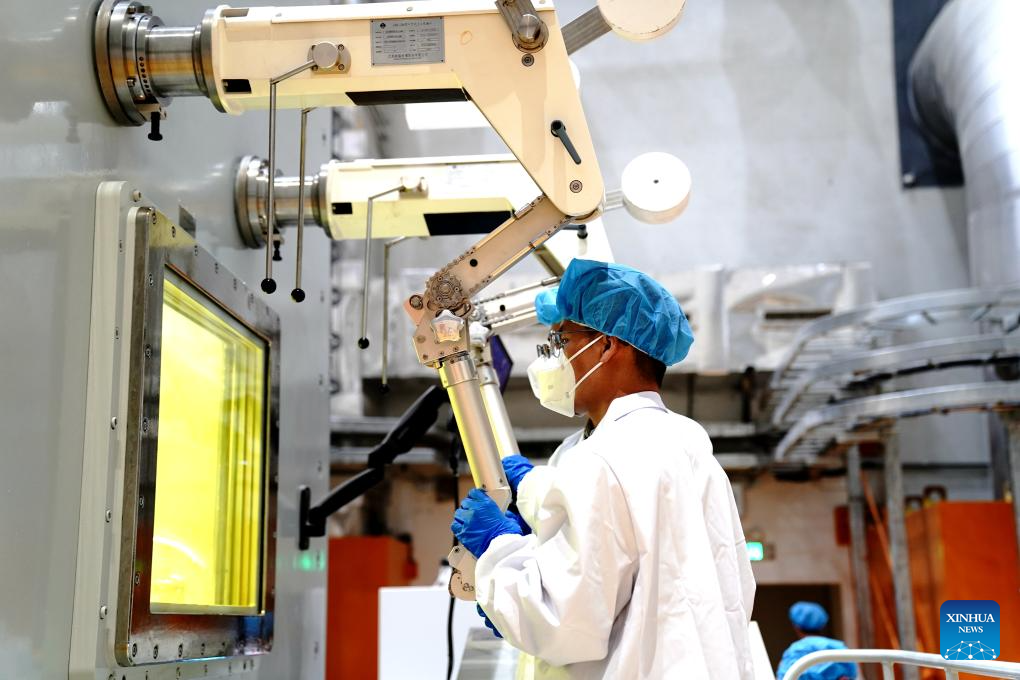
A researcher works at the charging-sampling hot cell of the experimental Thorium Molten Salt Reactor at the Wuwei campus of the Chinese Academy of Sciences' Shanghai Institute of Applied Physics in Minqin county of Wuwei city, Northwest China's Gansu province, Oct 24, 2025. [Photo/Xinhua]

China's thorium molten salt reactor has become the first in the world to transmute thorium fuel into uranium fuel for nuclear fission.

Key physical parameter data of protactinium-233 confirms the successful establishment of a nuclide conversion chain from thorium-232 to uranium-233 within the reactor. The milestone preliminarily verifies the technical feasibility of the thorium fuel cycle and further consolidates China's leading position in molten salt reactor research.

The 2-megawatt thermal liquid-fueled thorium molten salt reactor, led by the Shanghai Institute of Applied Physics of the Chinese Academy of Sciences, is situated in the Hongshagang industrial cluster in Minqin county, administered by Wuwei city, Gansu province.

"Nuclear energy, characterized by high energy density, near-zero carbon emissions and independence from seasonal variations, is a safe, clean, efficient and low-carbon energy source. It plays a crucial role in safeguarding energy security and advancing large-scale commercialization goals," said Cai Xiangzhou, deputy director of the Shanghai Institute of Applied Physics.

Cai highlighted that China has witnessed consistent growth in newly installed nuclear power capacity each year. However, the country faces sustainability challenges due to its heavy reliance on imported uranium — the most widely used nuclear fuel. The issue underscores the critical importance of a stable nuclear fuel supply for sustainable development.

Dai Zhimin, director of the Shanghai Institute of Applied Physics, said that thorium fuel is widely regarded as a promising alternative to uranium, citing two key advantages: China's abundant thorium reserves and its negative temperature coefficient of reactivity, which effectively mitigates the risks of radioactive release. In addition, thorium-fueled reactors generate spent fuel with reduced volume and shorter radioactive half-lives, significantly simplifying waste disposal.

"As a fourth-generation nuclear power reactor type, molten salt reactors use high-temperature molten salt as a coolant. Endowed with inherent safety features, water-free cooling, low-pressure operation and high-temperature output, they are internationally recognized as the most suitable reactor type for thorium resource utilization," Dai said.

He added that the technology facilitated deep integration with industries such as solar energy, wind power, high-temperature molten salt energy storage, high-temperature hydrogen production, and coal, oil and gas chemical engineering.

In response to the national strategic demands for energy security and sustainable development, the CAS launched a program in 2011 to enhance core technological capabilities and develop a thorium-based molten salt reactor system.

Construction of the reactor commenced in 2020, with equipment installation completed in 2022. By June 2024, it reached full-power operation at 650 C. In September, it obtained the world's first experimental license for thorium loading in a molten salt reactor. Last October, the first thorium loading was successfully completed, establishing the world's only research platform dedicated to molten salt reactors and thorium-uranium fuel cycle studies.

"The program brought together nearly 100 domestic research institutions, universities and industrial companies. The collaborative team overcame key challenges in reactor design, the development of critical materials and equipment, reactor safety, and installation and commissioning," Cai said.

Cai emphasized that the team had pioneered technologies for controlling oxygen content in thorium fluoride and established a preparation process for nuclear-grade thorium-based fuel salt.

"Over 90 percent of the reactor's components are domestically produced, with 100 percent localization of key parts and a fully independent supply chain. This achievement marks the initial establishment of an industrial ecosystem for thorium molten salt reactor technologies in China," he added.

Dai said: "The Shanghai Institute of Applied Physics will collaborate with leading energy enterprises, including the State Power Investment Corporation, to build a comprehensive industrial and supply chain ecosystem for the thorium molten salt reactors.

"Our goal is to complete the construction and demonstration operation of a 100-megawatt thermal prototype by 2035 and realize commercial-scale application. This will accelerate technological innovation and engineering transformation, ultimately providing China with a safe, reliable and domestically controlled thorium-based energy generation solution."
 

Users who are viewing this thread

Pakistan Defence Latest

Latest Posts

Back
Top