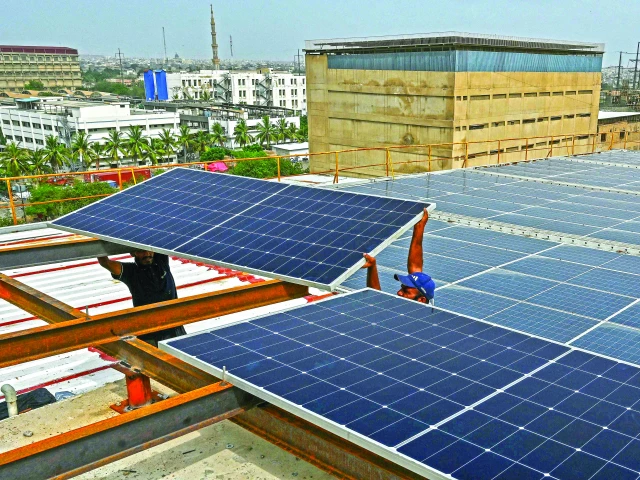
Pakistan Solar Power: News & Updates

Several projects have been initiated to exploit this relatively cheaper energy source.

Last month, Beco Steel Limited signed an agreement with a renewable energy solutions provider to install a 2-megawatt (MW) solar power generation system at its Badami Bagh, Lahore plant.

In August, Kohinoor Mills Limited (KML) announced plans to install a 7.2-megawatt solar power system as part of its push for sustainable operations and cost efficiency.

Dewan Cement Limited successfully commissioned a 6MW solar power system at its manufacturing facility in Karachi.

In May, International Steels Limited (ISL), a subsidiary of International Industries Limited, completed and activated a 6.4-megawatt (MW) solar power project at its factory in Karachi.

In March, Tariq Corporation Limited (TCORP), engaged in the manufacturing of sugar and its by-products, announced plans to set up a 200KW solar power system at its facility.
 
Pakistan’s combined off-grid and net-metered solar power capacity has climbed to 18,000 megawatts, creating potential challenges for the stability of the national grid, according to the Power Division.


According to a news report, the issue was discussed during a meeting of the National Assembly’s Standing Committee on Power, chaired by MNA Muhammad Idrees.

Power Division Secretary Dr Fakhr Alam Irfan informed the panel that net-metered solar capacity has reached 6,000MW, while off-grid installations — based on satellite data — are estimated at 12,000MW.


He cautioned that the rapid increase in these systems could strain the grid if integration measures are not effectively managed.

Dr Irfan explained that electricity generated through the grid and net-metered systems cannot be compared directly, as grid electricity carries additional costs of Rs14 per unit for capacity and Rs9 per unit for taxes, whereas net-metered power is cheaper but lacks system-wide cost recovery components.

The committee also reviewed the “Multi-Vendor Electricity Distribution Bill, 2025,” introduced by MNA Shahida Rehmani, but deferred its consideration until February 2026. Rehmani highlighted Karachi’s persistent electricity issues and rising losses under K-Electric.


Dr Irfan told the committee that starting January 2026, electricity consumers across Karachi and other regions will be able to purchase power from multiple companies under the new market access system. In the initial phase, 200MW of electricity will be available for bulk purchase, and open-market access will apply to consumers using up to one megawatt of power.

He added that distribution companies have been instructed not to shut feeders even when losses reach 20 percent to prevent further financial strain. Power sector losses have declined from Rs600 billion in 2024 to Rs397 billion in 2025.

Dr Irfan reiterated that while solar energy provides a cheaper alternative, its growing share — now 18,000MW — poses new technical and regulatory challenges for the national grid, underscoring the need for a structured integration plan.
 
Basically PML N Added Thousands of Megawatts Of Expensive Capacity Under Onerous PPAs That Is Now Coming Back To Bite Us.

And What is Worse Is That This Capacity Was Added Without Undertaking The Desired Structural Reforms
 
One solution to the intermittency issue is storage. Storage will become so cheap that the extra power can be stored in batteries, provided the regulator increases the time of day tariff for peak tariffs.

Regards
 

‘Pakistan experiencing unprecedented solarisation of its energy sector’


Pakistan was experiencing unprecedented solarisation of its energy sector, with solar photovoltaic (PV) panels of 33 gigawatts capacity having already been installed across the country, a press release stated on Thursday.

These views were expressed by the speakers at an event organised by the Policy Research Institute for Equitable Development (PRIED), an independent think tank.

The event was held to launch a study, titled Shouting from the rooftops: Mapping Pakistan’s solar power revolution. The study was a joint production of PRIED and Transition Zero, an energy-transition think-thank based in London.


Speakers at the event stated out that Pakistan’s off grid solarisation had become “an unstoppable phenomenon” though it needs to be channeled into the right direction to increase sustainability, affordability and accessibility of electricity across the country.

They discussed the study’s findings that, while solarisation was having a positive impact in terms of increasing access to electricity, the phenomenon, in many cases, was perpetuating energy inequality and energy poverty across different regions and classes within the country.

China exports more solar panels to Pakistan than to many G20 nations in 5 years: report

They underscored the pressure that solarisation in general, and its net-metering part in particular, was exerting on the national grid and urged the policymakers and government departments concerned to plan and act accordingly.

“While the progress of solar power installations in these two sectors has been nothing short of extraordinary, it still leaves behind the marginalised and poorer sections of the society because they do not have the money to buy and install solar PV panels to meet their electricity needs,” Muqaddas Ashiq, a researcher, said.

Rimsha Rehan, another researcher, presented details of solarisarion in the agricultural and industrial sectors. She pointed out that the solarisation process in the agriculture sector was even “more remarkable” because it was being driven by small farmers, particularly those living in remote off-grid areas.

She explained that off-grid solarisation of large and medium level industries was going on at a rapid pace, creating massive challenges for the national grid to keep itself relevant for this sector.

Manzoor Ahmed Alizai, an energy sector expert, said residential, agricultural, commercial, and industrial consumers had collectively installed solar PV panels with a capacity to produce as much as 33 gigawatts of electricity.

“Pakistan’s import data suggests that it has imported roughly of 50 gigawatts of solar capacity from China the last five years, spending more than $5 billion but not all of this imported capacity has been installed so far,” he said.

“This means a lot of solar PV capacity is still lying in warehouses to be installed.”


Danyal Chaudhry, a member of the National Assembly from the ruling Pakistan Muslim League Nawaz (PMLN), said his party would do whatever it could to help the solarisation process move forward.

“This is why we resisted the imposition of 18% sales tax on the solar panels even when we were under tremendous pressure from the International Monetary Fund (IMF) to impose through the budget,” he told the audience.

Solar energy uptake: CCP set to conduct study to uncover snags

Sher Ali Arbab, MNA, underscored social and regional disparities in the distribution of electricity and called for making the solarisation process as equitable as possible. He also stressed upon the need to “monitor and regulate the quality of solar PV panels being imported and sold in Pakistan so that those wishing to install them do not end up wasting their money on low quality solar equipment.”

He urged the government to provide subsidised solar to those who cannot afford it and arrange “training for solar technicians and installers so that people can get satisfactory installation and post installation services.”

Meanwhile, State Minister for Climate Change Dr Shazra Mansab Ali highlighted three main factors responsible for the solarisation phenomenon in Pakistan: “People, technology and policy.”

“Without a combination of these three, we could not have imagined the kind of solarisation that we are witnessing in Pakistan now,” she said.
 
@hydrabadi_arab

Excellent development. Good thing is in a few years' time, batteries will become so cheap that you can run the entire country with just solar and batteries and nothing else. Gas and hydro can be kept as backups.

Regards
 

Solar power output surpasses national grid supply​


KARACHI: Pakistan has reached a historic milestone in solar energy use.

According to a report by the Policy Research Institute for Equitable Development, during the summer months, electricity generation from the national grid ranged between 28 to 30 gigawatts (GW).

On the other hand, consumers collectively generated and used about 33 gigawatts through solar power, surpassing the grid's supply for the first time.

The report states that Pakistan has imported solar panels with a combined capacity of up to 50GW, whereas the total installed capacity of the national electricity grid is around 46 GW.

Among the provinces, Punjab leads in solar energy usage, followed by Sindh, Khyber-Pakhtunkhwa, and Balochistan respectively.

In terms of sector-wise distribution, the residential sector dominates with 16.66 GW of solar power usage.

The commercial sector follows with 3.73 GW, the industrial sector with 7.91 GW, and the agriculture sector with 5.04 GW.

According to the report, 77% of electricity consumers now rely primarily on their own solar systems, while only 23% depend on the national grid for their energy needs.

Solar power output surpasses national grid supply
 

Solar power output surpasses national grid supply​


Consumers collectively generate 33 gigawatts through solar

Ehtesham Mufti
October 31, 2025


tribune


KARACHI: Pakistan has reached a historic milestone in solar energy use.

According to a report by the Policy Research Institute for Equitable Development, during the summer months, electricity generation from the national grid ranged between 28 to 30 gigawatts (GW).

On the other hand, consumers collectively generated and used about 33 gigawatts through solar power, surpassing the grid's supply for the first time.

The report states that Pakistan has imported solar panels with a combined capacity of up to 50GW, whereas the total installed capacity of the national electricity grid is around 46 GW.

Among the provinces, Punjab leads in solar energy usage, followed by Sindh, Khyber-Pakhtunkhwa, and Balochistan respectively.

In terms of sector-wise distribution, the residential sector dominates with 16.66 GW of solar power usage.

The commercial sector follows with 3.73 GW, the industrial sector with 7.91 GW, and the agriculture sector with 5.04 GW.

According to the report, 77% of electricity consumers now rely primarily on their own solar systems, while only 23% depend on the national grid for their energy needs.
 

Massive Change Coming for Solar Users, Govt’s New Plan Could Cut Your Savings in Half​

By Muhammad Bilal | Published Oct 31, 2025 | 11:34 am


The government is considering a major revision to the solar net metering regime by reducing the buyback rate from Rs. 22 per unit to around Rs. 11.30.

It follows concers that the current policy is pushing up electricity costs for consumers on the grid. Officials say the financial strain has grown sharply as rooftop solar installations surge across the country, reported a national daily.

In FY2024 alone, grid sales fell by 3.2 billion units, resulting in Rs. 101 billion revenue loss to power distribution companies.

This gap translated into a tariff increase of nearly Rs. 1 per unit for traditional electricity users.

Power Division projections show the impact widening rapidly over the next decade.

By FY2034, lost sales could hit 18.8 billion units, costing up to Rs. 545 billion and potentially adding Rs. 5 to Rs. 6 per unit to grid tariffs according to the official projections.


A senior official said the situation has triggered direct intervention from the prime minister, who on October 22 directed the Power Division and Nepra to re-evaluate the buyback tariff and its broader effects before announcing any reforms.

Officials argue that the system is being treated as a “free storage battery” by many households. Consumers sell excess electricity back to the grid at high rates while avoiding fixed system charges. This leaves non-solar users carrying the financial burden of network maintenance.

The government notes that new large-scale solar projects are being contracted at below Rs. 10 per unit, strengthening the case for a lower net metering rate.


Aligning rooftop tariffs with current costs, officials say, is essential to protect affordability for grid-connected consumers.

The rapid growth of net-metered capacity which is now estimated at 6,000MW, is also creating operational challenges.

In winter months, national demand drops to around 8,000 to 9,000MW, raising the risk of excess daytime generation and grid instability.
 
Pakistan will be having around 60000 mw due to dams, hydro project and nuclear project by 2030 or 2031. If solar growth has such rapid pace than it will be nearly 20000 mw installed alone in residential areas. Power plants cannot be closed or pack up like factories. Therefore, Pakistan would have to ensure people use max grid otherwise circular debt will raise with prices as well.
 

Citizens drive 50GW solar shift as costly fossil fuel demand shrinks​

Households bear expensive LNG import costs as industries abandon high-cost fuel but govt reliance persists


After decades of reliance on imported and local fossil fuels, Pakistan is shifting towards cheaper and cleaner choices. In FY24, shrinking energy supplies and declining consumption defined Pakistan's energy story. Weak demand and rising fuel costs are driving a gradual move away from fossil fuel dependence.

Economic pressures reshape energy use

The Pakistan Energy Market Review (PEMR) 2025 by Renewables First reveals that Pakistan’s primary energy supplies declined for the second consecutive year in FY24, while final energy consumption dropped sharply due to affordability constraints and weaker industrial and agricultural demand.

Crude oil production has dropped by 25% over the past decade, and domestic gas output continues to decline, increasing reliance on expensive imported liquefied natural gas (LNG). Coal consumption is also falling, with most of the remaining demand now being met through local coal instead of imports.

Despite this shift, pressures remain. LNG imports are straining foreign reserves as industries move away from them due to high costs. These imports are now being redirected towards households, adding to already heavy electricity bills. Long-term LNG contracts have also created a surplus at a time when industrial and captive consumption is falling. Together with the rupee’s volatility against the dollar, these factors are adding stress to the energy system.

“LNG served as our fallback fuel, but it is only a temporary bridge,” said Huma Naveed, data analyst at Renewables First. “This mismatch between supply and demand calls for planners to integrate the country’s growing use of renewable energy into future energy strategies.”


Gas-sector circular debt climbed to Rs3.2 trillion by March 2025, highlighting the urgent need for reforms across the gas supply chain.

Solar offsetting fossil fuel use

Pakistan’s energy market is undergoing a consumer-led transformation as the country moves beyond short-term fixes towards a lasting shift from fossil fuels to renewables. Non-fossil energy supplies, including hydel, nuclear, and solar, have grown by nearly 50% since FY21, while fossil-based supplies have continued to shrink. Coal’s share in the energy mix is declining mainly due to market dynamics, as rising costs make it less competitive.

The report highlights that the transition extends across sectors. The industrial sector has seen the steepest drop in fossil fuel use, with industrial energy consumption falling 21% year-on-year in FY24. Electric vehicle incentives are nudging transport towards electrification, while farmers are switching to solar-powered tube wells to cut diesel and grid reliance.

Rabia Babar, data manager for energy and climate at Renewables First, reflected on the broader shift: “We’re witnessing a structural reset as power, agriculture, transport, and industry turn to solar solutions instead of costlier fuels. The question now isn’t whether fossil fuels will decline, but how fast clean technologies can replace them.”

Together, these changes reveal an energy system in motion — one where solar energy is becoming the foundation for future growth. Since 2017, Pakistan has imported over 50GW of solar photovoltaic capacity, enabling households, farms, and industries to reduce costs and improve reliability.

While this transformation brings much-needed relief, the report stresses that it also requires decisive action. Reforms in the gas and power sectors, including tariff rationalisation, improved distribution efficiency, and open-market access, are crucial to contain circular debt. Policies must ensure that solar adoption remains accessible and equitable for all consumers.

With solar adoption accelerating, Pakistan’s energy landscape is entering a new phase — driven by citizens and defined by resilience and reform.
 

Users who are viewing this thread

Pakistan Defence Latest

Back
Top