Chinese SAC - FC-31/J-35 5th Gen Stealth Aircraft

Newest Haci Edit of J-35 carrier ops

To view this content we will need your consent to set third party cookies.
For more detailed information, see our cookies page.

In love with this combo, top of the line 4.5th gen heavy J-15T plus J-15DT growler plus J-35 carrying PL-16, what a deadly combo.
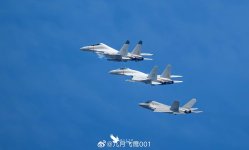
54714951852_7760e206da_3k.jpg
 
They really should create a J-35D for navy and airforce. Airforce should apply J-20D though since J-20 generates more available power than J-35 but J-35 is slightly more stealthy.

Stealth electronic warfare aircraft can sneak in far closer and flank opposition aircraft and jam in the midst of opposition formations.

Better yet, create electronic warfare UADF if power generation from single WS-10X engine is enough. J-16D should have no more available power than J-20. They just need to integrate those external pods for heavy EW aircraft.
 
They really should create a J-35D for navy and airforce. Airforce should apply J-20D though since J-20 generates more available power than J-35 but J-35 is slightly more stealthy.

Stealth electronic warfare aircraft can sneak in far closer and flank opposition aircraft and jam in the midst of opposition formations.

Better yet, create electronic warfare UADF if power generation from single WS-10X engine is enough. J-16D should have no more available power than J-20. They just need to integrate those external pods for heavy EW aircraft.
Hey buddy, can you guess why no country in the world is doing things the way you're suggesting?

The operational concept of stealth fighters is completely opposite to that of electronic warfare (EW) aircraft. Do you understand?
 
Hey buddy, can you guess why no country in the world is doing things the way you're suggesting?

The operational concept of stealth fighters is completely opposite to that of electronic warfare (EW) aircraft. Do you understand?

Understand that. A few steps ahead of you here.

Stealth aircraft can sneak in to far more advantageous positions before engaging EW. You must realise that an aircraft like J-16D or J-15DT do not have their EW equipment constantly switched on right?

The trouble is integrating the same level of EW equipment onto structurally more limited stealth aircraft. You will see in time some revelations that China is doing exactly this because it is very obvious the best thing to have. The challenge is developing the technology to integrate it seamlessly rather than having all these external pods. The reason US doesn't have one is the difficulty in making one not because they are mutually exclusive. That is logically the wrong conclusion if that is your only argument ie from observation.

Your post is suggesting that EW and stealth aircraft are mutually exclusive. What will you do when it becomes revealed that China will soon have stealth EW aircraft whether it is manned or drones.

If the question is about the risk to the aircraft after operating its EW equipment, then it is best to use drones. However, drones don't have enough power.

Additionally, SIGINT is best done with stealth platforms since it is a passive role. Many EW units have a SIGINT component. It makes perfect sense to have EW stealth aircraft.
 
Last edited:
Understand that. A few steps ahead of you here.

Stealth aircraft can sneak in to far more advantageous positions before engaging EW.

The trouble is integrating the same level of EW equipment onto structurally more limited stealth aircraft. You will see in time some revelations that China is doing exactly this.
I'm going to launch a close-range attack on you in two ways:

1. You won't see me or hear me. (The operational concept of a stealth fighter)
2. I'll first throw a flashbang grenade to disable your sight and hearing. (The operational concept of an electronic warfare (EW) aircraft)

The first method involves the opponent having no awareness whatsoever. The second method means the opponent knows you're coming, but doesn't know your location, making effective resistance and counterattack impossible.

These are two completely opposite operational concepts.

BTW.

All modern 5th-generation fighter jets possess a certain degree of EW capabilities. These EW systems are integrated into the aircraft itself. However, these EW capabilities are only used for self-defense in emergency situations; their EW capabilities and range cannot be compared to dedicated EW aircraft. Furthermore, when they activate their EW systems, it also means they expose themselves, requiring an urgent and rapid withdrawal from the battlefield. This is completely opposite to the scenario where an EW aircraft penetrates deep into enemy defenses to conduct EW operations.

Stealth fighter jets are like snipers, specializing in covertly eliminating high-value enemy targets.
Electronic warfare (EW) fighter jets are like machine guns, providing widespread firepower coverage against the enemy.

Snipers will carry a small, lightweight automatic rifle or submachine gun for self-defense, but they would never carry a machine gun.
 
Now that Pakistan is confirmed to receive J-35 Jet fighters within next six months.
I hae a big questions,
1- Are there possibilities that KJ-500 Airborne Early Warning & Control (AWACS) aircraft and HQ-19 Ballistic Missile Defense (BMD) systems also coming with J-35 from China to Pakistan ? .
Please suggest with your answers,please .
 
Now that Pakistan is confirmed to receive J-35 Jet fighters within next six months.
I hae a big questions,
1- Are there possibilities that KJ-500 Airborne Early Warning & Control (AWACS) aircraft and HQ-19 Ballistic Missile Defense (BMD) systems also coming with J-35 from China to Pakistan ? .
Please suggest with your answers,please .

Confirmed in next 6 months? Really? Confirmed by who?
 
Now that Pakistan is confirmed to receive J-35 Jet fighters within next six months.
The possibility of this happening in the next six months is extremely low.

Within this timeframe, there is a small probability that the Pakistan Air Force (PAF) might conduct a real evaluation process of the FC-31/J-35. However, this is significantly different from actual delivery.
1- Are there possibilities that KJ-500 Airborne Early Warning & Control (AWACS) aircraft and HQ-19 Ballistic Missile Defense (BMD) systems also coming with J-35 from China to Pakistan ?
1. KJ-500
We are still unsure whether the PAF will continue to purchase Chinese AEW&C aircraft. We are also uncertain whether the KJ-500 AEW&C will be exported, at least there is no reliable information at present.
However, CETC does have an advanced AEW&C aircraft for the international export market. It is roughly between the KJ-500 and KJ-700, combining the advantages of both. You can understand it as having some capabilities that are more advanced than the KJ-500. CETC has not announced its export code. Perhaps it will be exported under the name "KJ-500E".

2. HQ-19
It is generally speculated that the possibility of its export in the short term is very small. Its performance is too powerful, which could easily cause significant diplomatic controversy and also poses a serious risk of information leakage.

3. J-35
Please refer to the previous discussion.
 
Thank you all for reply to oversease Pakistani.
 
@Deino @Michael I have a question? the J35 naval version is purely designed for fujian EMALS CATOBAR? it can not be deployed on liaoning and shandong? is this correct or i am wrong here? i know the KJ-600 can only be launched from fujian. but i am not sure about J35?
All carrier-based fighter jets that support CATOBAR also support STOBAR, but carrier-based fighter jets that support STOBAR do not necessarily support CATOBAR. This is a fundamental rule.

Therefore, the J-35 is definitely capable of operating from the Liaoning and Shandong aircraft carriers.

Currently, its more urgent task is to complete all operational tests on the Fujian aircraft carrier. Furthermore, the PLA Navy currently possesses only a small number of J-35s. We do not have any surplus J-35s available for the Liaoning and Shandong carriers at this time.
 
All carrier-based fighter jets that support CATOBAR also support STOBAR, but carrier-based fighter jets that support STOBAR do not necessarily support CATOBAR. This is a fundamental rule.

Therefore, the J-35 is definitely capable of operating from the Liaoning and Shandong aircraft carriers.

Currently, its more urgent task is to complete all operational tests on the Fujian aircraft carrier. Furthermore, the PLA Navy currently possesses only a small number of J-35s. We do not have any surplus J-35s available for the Liaoning and Shandong carriers at this time.
In my humble opinion i guess STOBAR (using a ski-jump ramp) is easier for CATOBAR-designed aircraft to adapt to, but the reverse is rare and challenging (e.g., heavy CATOBAR jets like E-2 can't easily ski-jump, also KJ-600 AEW).
Also, STOBAR aircraft (like MiG-29K, J-15) are optimized for ramp-assisted rolls and may lack reinforced nose gear for catapult stress or holdback fittings.

My other question was related to this one as the J-15 (naval, STOBAR) kept the folding canards from the Su-33 prototype, while the land-based J-16 (derived from Su-30MKK) removed them completely.

My understanding is that canards on the J-15 help a lot with pitch control during ski-jump take-off and high-alpha carrier approaches/bolters, which is why China retained them despite the RCS and drag penalty. On a normal runway with longer run, more powerful engines and modern FBW, they weren’t needed anymore — hence J-16 has none.

In short: yes, the canard difference is very much related to STOBAR requirements, not CATOBAR. A CATOBAR Flanker (like the abandoned Su-33K project) probably wouldn’t need them either.
 
Last edited:
I'm going to launch a close-range attack on you in two ways:

1. You won't see me or hear me. (The operational concept of a stealth fighter)
2. I'll first throw a flashbang grenade to disable your sight and hearing. (The operational concept of an electronic warfare (EW) aircraft)

The first method involves the opponent having no awareness whatsoever. The second method means the opponent knows you're coming, but doesn't know your location, making effective resistance and counterattack impossible.

These are two completely opposite operational concepts.

BTW.

All modern 5th-generation fighter jets possess a certain degree of EW capabilities. These EW systems are integrated into the aircraft itself. However, these EW capabilities are only used for self-defense in emergency situations; their EW capabilities and range cannot be compared to dedicated EW aircraft. Furthermore, when they activate their EW systems, it also means they expose themselves, requiring an urgent and rapid withdrawal from the battlefield. This is completely opposite to the scenario where an EW aircraft penetrates deep into enemy defenses to conduct EW operations.

Stealth fighter jets are like snipers, specializing in covertly eliminating high-value enemy targets.
Electronic warfare (EW) fighter jets are like machine guns, providing widespread firepower coverage against the enemy.

Snipers will carry a small, lightweight automatic rifle or submachine gun for self-defense, but they would never carry a machine gun.
Interestingly one point that is missed by many proponents of an all 5th gen fleet is that 5th gen aircraft are most effective when operating in a "noisy" battlespace with 4th gen , EW all over and other places where their "footsteps" are completely lost.

Put a 5th gen in an all 5th Gen fight and you can start to find "pin drops" in silence.

EW on the 5th Gen has its valid place, to provide last mile or last ditch capability. Most of these now are no longer stand alone capacities but combined with the Radar array to where lets say a J-35 can suddenly start jamming a S-400 or Shorad's surrounding it well inside it's engagement envelope to degrade it further as it launches weapons to kill it.

To that extent there is emissions management somewhat similar on the J-10C(and the JF-17B3) as well which "knows" it's optimum state and manages that signature accordingly. All tech which has tricked down from lessons with the J-20.
 
Interestingly one point that is missed by many proponents of an all 5th gen fleet is that 5th gen aircraft are most effective when operating in a "noisy" battlespace with 4th gen , EW all over and other places where their "footsteps" are completely lost.

Put a 5th gen in an all 5th Gen fight and you can start to find "pin drops" in silence.

EW on the 5th Gen has its valid place, to provide last mile or last ditch capability. Most of these now are no longer stand alone capacities but combined with the Radar array to where lets say a J-35 can suddenly start jamming a S-400 or Shorad's surrounding it well inside it's engagement envelope to degrade it further as it launches weapons to kill it.

To that extent there is emissions management somewhat similar on the J-10C(and the JF-17B3) as well which "knows" it's optimum state and manages that signature accordingly. All tech which has tricked down from lessons with the J-20.
All 5th-generation fighter jets inherently possess a certain degree of electronic warfare (EW) capability. They can silently approach targets, conduct electronic suppression, and then launch physical attacks. This is one of the core principles defining them as 5th-generation fighter jets.
After launching an attack, they need to quickly disengage from the battlefield. Supersonic cruising capability thus becomes another defining characteristic.

However, 5th-generation fighter jets sacrifice external payload capacity for stealth capabilities. Their internal weapons bay (IWB) has limited payload capacity, and their attack capabilities are also limited. We can only use them to gain air superiority and strike high-value point targets. They are ineffective against hardened targets and large-area targets. These targets can only be attacked by non-stealthy fighter jets or bombers. In this case, dedicated EW fighter jets based on 4th-4.5th generation fighter platforms can provide excellent cover for these non-stealthy fighter jets and bombers.

As for the J-36, this monstrous fighter jet falls into the category of next-generation fighter aircraft. Based on all currently known 5th-generation fighter jets, the above points generally hold true.

However, the dynamics of defense and attack in warfare are always evolving. Technological advancements constantly break free from previous ways of thinking.

In my humble opinion i guess STOBAR (using a ski-jump ramp) is easier for CATOBAR-designed aircraft to adapt to, but the reverse is rare and challenging (e.g., heavy CATOBAR jets like E-2 can't easily ski-jump, also KJ-600 AEW).
Also, STOBAR aircraft (like MiG-29K, J-15) are optimized for ramp-assisted rolls and may lack reinforced nose gear for catapult stress or holdback fittings.

My other question was related to this one as the J-15 (naval, STOBAR) kept the folding canards from the Su-33 prototype, while the land-based J-16 (derived from Su-30MKK) removed them completely.

My understanding is that canards on the J-15 help a lot with pitch control during ski-jump take-off and high-alpha carrier approaches/bolters, which is why China retained them despite the RCS and drag penalty. On a normal runway with longer run, more powerful engines and modern FBW, they weren’t needed anymore — hence J-16 has none.

In short: yes, the canard difference is very much related to STOBAR requirements, not CATOBAR. A CATOBAR Flanker (like the abandoned Su-33K project) probably wouldn’t need them either.
Whether the entire family of flanker fighter jets, including the original Russian versions and the Chinese series, have canards is related to their aerodynamic design. You can try researching some professional academic papers on the subject.

The Su-30MKI also has canards, but it is not a carrier-based fighter jet.
 
Last edited:
So sleek.

Is anyone keeping a track of serial numbers. What does 93 represent?
93 stands for September 3rd, the Victory Day of the War of Resistance; 80 stands for this year being the 80th anniversary.

Victory Memorial Day for the Chinese People’s War of Resistance against Japanese Aggression is a commemorative day established to mark the victory of the War of Resistance against Japanese Aggression, observed annually on September 3.

On September 3, 2025, a grand rally commemorating the 80th anniversary of the victory of the Chinese People's War of Resistance Against Japanese Aggression and the World Anti-Fascist War was solemnly held in Beijing, with a magnificent military parade that captured global attention.
 

Users who are viewing this thread

Pakistan Defence Latest

Back
Top