Chinese Missile Development News

Exclusive: China likely loaded more than 100 ICBMs in silo fields, Pentagon report says​

By Idrees Ali
December 23, 20253:19 AM GMT+5Updated 4 hours ago


Military vehicles carrying DF-41 intercontinental ballistic missiles travel past Tiananmen Square during the military parade marking the 70th founding anniversary of People's Republic of China

Military vehicles carrying DF-41 intercontinental ballistic missiles travel past Tiananmen Square during the military parade marking the 70th founding anniversary of People's Republic of China, on its National Day in Beijing, China October 1, 2019. REUTERS/Jason Lee/File Photo Purchase Licensing Rights, opens new tab
  • Summary
  • Pentagon had reported new silo fields but not missile loading
  • Draft report says Beijing has no desire for arms control talks
  • Trump says he aims to denuclearize with China and Russia
  • China disputes reports of a military buildup
WASHINGTON, Dec 22 (Reuters) - China is likely to have loaded more than 100 intercontinental ballistic missiles across its latest three silo fields and has no desire for arms control talks, according to a draft Pentagon report which highlighted Beijing's growing military ambitions.

China is expanding and modernizing its weapons stockpile faster than any other nuclear-armed power, according to the Bulletin of the Atomic Scientists, a Chicago-based non-profit. Beijing has described reports of a military buildup as efforts to "smear and defame China and deliberately mislead the international community."

The Reuters Daily Briefing newsletter provides all the news you need to start your day. Sign up here.


Last month, U.S. President Donald Trump said that he may be working on a plan to denuclearize with China and Russia. But the draft Pentagon report, which was seen by Reuters, said Beijing did not appear to be interested.

"We continue to see no appetite from Beijing for pursuing such measures or more comprehensive arms control discussions," the report said.

In particular, the report said that China had likely put in more than 100 solid-fuelled DF-31 ICBMs in silo fields close to China's border with Mongolia - the latest in a series of silo sites. The Pentagon had previously reported the existence of the fields but not the number of missiles loaded.


The Pentagon declined to comment.

China's embassy in Washington D.C. said China has "maintained a defensive nuclear strategy, kept its nuclear forces at the minimum level required for national security, and abided by its commitment to a moratorium on nuclear testing."

The draft Pentagon report did not identify any potential target of the reported newly placed missiles. U.S. officials noted that the report could change before it was sent to lawmakers.

The report said China's nuclear warhead stockpile was still in the low 600s in 2024, which reflected "a slower rate of production when compared to previous years."
But the report added that China's nuclear expansion was ongoing and it was on track to have over 1,000 warheads by 2030.
China has said it adheres to a "nuclear strategy of self-defense and pursues a no-first-use policy."

Trump has said he wants the United States to resume nuclear weapons testing, but it is unclear what form that will take.

Former U.S. President Joe Biden and Trump, during his first term, sought to engage China and Russia in negotiations on replacing New START with a three-way strategic nuclear arms control treaty.

The wide-ranging Pentagon report detailed China's military buildup and said that "China expects to be able to fight and win a war on Taiwan by the end of 2027."
China, which views democratically governed Taiwan as its own territory, has never renounced use of force to "reunify" with the island.

Beijing was refining its military options to take Taiwan by "brute force," the report said, adding that one option could include strikes 1,500-2,000 nautical miles from China.

"In sufficient volume, these strikes could seriously challenge and disrupt U.S. presence in or around a conflict in the Asia-Pacific region," it added.

The report comes less than two months before the expiration of the 2010 New START treaty, the last U.S.-Russia nuclear arms control accord, which limits the sides to deploying 1,550 strategic nuclear warheads on 700 delivery systems.

Russian President Vladimir Putin and Biden extended the pact for five years in February 2021, but its terms do not allow for a further formal extension.
Many experts fear that the expiration of the pact could fuel a three-way nuclear arms race.

"More nuclear weapons and an absence of diplomacy will not make anyone safer, neither China, Russia, or the United States,” said Daryl Kimball, executive director of the Arms Control Association advocacy group.

ANTI-CORRUPTION PURGES​

Chinese President Xi Jinping has undertaken a broad corruption crackdown, with the People's Liberation Army (PLA) being one of the main targets.
The report said the purge could impact short-term nuclear readiness but also set the stage for "long-term PLA improvements overall."

Revenues at China's giant military firms fell last year as corruption purges slowed arms contracts and procurement, according to a leading conflict think tank.
China's weapons revenue fell despite three decades of rising defense budgets in Beijing's growing strategic rivalry with the United States, Asia's traditional military power, and tensions over Taiwan and the hotly disputed South China Sea.

In the past 18 months, at least 26 top and former managers in state-owned arms companies have been investigated or removed from their positions, the Pentagon report said.

"Investigations have expanded from a 2023 focus on procurement of rockets and missiles industry to most of China’s defense industry, including China’s nuclear and shipbuilding industry," it added.

Reporting by Idrees Ali. Additional reporting by Jonathan Landay; editing by Philippa Fletcher and Stephen Coates
Our Standards: The Thomson Reuters Trust Principles., opens new tab


Idrees Ali
Idrees Ali
Thomson Reuters
National security correspondent focusing on the Pentagon in Washington D.C. Reports on U.S. military activity and operations throughout the world and the impact that they have. Has reported from over two dozen countries to include Iraq, Afghanistan, and much of the Middle East, Asia and Europe. From Karachi, Pakistan.
 
Japanese media: China has deployed over 100 silo-based DF-31BJs across three wind farm sites [chuckling].

This figure comes from the U.S. 2025 China Military Power Report, but the data source is actually from 2024 [skeptical].

Given the Chinese massive current production of various ballistic missiles, the actual number deployed is likely over 300, but the U.S. and Japan would never admit it [smirking].

Because if they acknowledged that the number of intercontinental nuclear delivery vehicles China has has caught up with or even surpassed that of the U.S., it would be a catastrophic outcome for the U.S. and Japan [laughing].

From :Lyman2003
 
The U.S. Department of Defense’s 2025 report on China’s military power is out, but there’s nothing new—most of it still repeats the content from 2024.

The number of nuclear warheads remains unchanged at 600, with no increase. The report acknowledges the deployment of the DF-27, confirms that China is developing its sixth-generation fighter jet, and identifies the DF-31B as the ballistic missile model China conducted a full-range test flight with in 2024.

As for the 93 military parade, the U.S. now acts as if it never happened. Let’s see if next year’s 2026 China military power report will acknowledge the new equipment showcased in the 93 parade.

From:Lyman2003

9f519e8bgy1i8m0evh53dj20xi16743e.jpg
9f519e8bgy1i8m0euqhiuj20md0muk8v.jpg

9f519e8bgy1i8m0ev4dfuj20q80eg41c.jpg
 
Defence Security Asia


China’s DF-27A Hypersonic Missile Test Redefines Strategic Strike Warfare as Mach 8.6 Glide Vehicle Challenges U.S. Missile Defenses​

Achieving Mach 8.6 over 2,100 km in just 12 minutes, China’s DF-27A hypersonic glide vehicle marks a decisive leap in long-range precision strike, anti-ship warfare, and Indo-Pacific power projection.​

IMAGEENGLISHINTERNATIONALNEWS
By Admin On Dec 27, 2025


Share

(DEFENCE SECURITY ASIA) — Blending the stark warning that the system carries “a high probability of penetrating U.S. ballistic missile defenses” with assertions that it was “designed to carry different warheads, a single hypersonic glide vehicle or multiple warheads when it needs to hit different targets,” China’s reported DF-27A hypersonic glide vehicle test recently marks a decisive inflection point in the evolution of long-range strike warfare, underscoring Beijing’s accelerating ability to project precision firepower deep across the Indo-Pacific battlespace at speeds and trajectories that fundamentally strain existing deterrence and missile defense architectures.

In a development that crystallizes the intensifying pace of military modernization across the Asia-Pacific, the reported successful flight test of China’s DF-27A hypersonic glide vehicle, achieving an average speed of Mach 8.6 while traversing 2,100 kilometers in just 12 minutes, represents not merely a technical milestone but a doctrinal statement about how Beijing intends to shape escalation dynamics, access denial, and strategic coercion in an era increasingly defined by speed, survivability, and decision-compression.


China Hypersonic


With an estimated maximum range assessed between 8,000 and potentially 9,000 kilometers depending on payload configuration, the DF-27A substantially expands China’s ability to hold high-value military targets at risk across the Second Island Chain and beyond, transforming hypersonic weapons from niche demonstrators into operational instruments of theater-wide and quasi-strategic influence.


The reported test, echoing earlier intelligence disclosures that described a 12-minute flight profile over 2,100 kilometers, reinforces assessments that China has moved beyond experimental hypersonic trials toward routine validation of systems intended for real-world operational deployment, a shift that carries profound implications for regional stability and crisis management.

By compressing engagement timelines to minutes rather than hours and combining hypersonic velocity with mid-course maneuverability, the DF-27A challenges not only interceptor physics but also the human decision cycles that underpin command-and-control structures, increasing the risk of miscalculation during periods of heightened tension.

In strategic terms, the DF-27A test signals that hypersonic weapons are no longer peripheral to China’s force posture but central to a broader anti-access and area-denial framework designed to deter intervention, impose costs on forward-deployed forces, and complicate adversary power projection at distances once considered relatively secure.


The emphasis on both anti-ship and land-attack roles underscores Beijing’s intent to blur traditional boundaries between tactical and strategic strike systems, allowing a single missile family to execute missions ranging from carrier interdiction to deep rear-area suppression.


By demonstrating sustained hypersonic flight at Mach 8.6, the test implicitly confirms significant advances in materials science, guidance algorithms, and thermal management, all of which are essential to maintaining controllability and accuracy at extreme velocities.


This development further illustrates how hypersonic glide vehicles, unlike traditional ballistic reentry vehicles, exploit aerodynamic lift and unpredictable trajectories to evade interception, rendering legacy missile defense concepts increasingly inadequate.

In the broader geopolitical context, the DF-27A test reinforces perceptions among regional actors that the Indo-Pacific is entering a phase where speed, range, and survivability will outweigh platform numbers in shaping deterrence outcomes.


China’s Hypersonic Trajectory: From DF-17 Foundations to DF-27A Strategic Reach

China’s pursuit of hypersonic capabilities, rooted in more than a decade of sustained investment by the People’s Liberation Army Rocket Force, reflects a deliberate effort to leapfrog conventional strike paradigms by exploiting velocity and maneuverability as decisive operational advantages.

The DF-27 series, first acknowledged in external assessments in 2021, builds directly upon the technological and doctrinal foundations laid by earlier systems such as the DF-17, which introduced a maneuvering hypersonic glide vehicle mounted atop a medium-range ballistic missile during its public debut in 2019.

The DF-17 demonstrated that hypersonic glide vehicles could be integrated into deployable force structures, but its range constrained its utility primarily to the First Island Chain and immediate regional contingencies.

The DF-27 extends this concept into the intermediate-range domain, effectively transforming hypersonic glide vehicles into tools capable of shaping theater-wide and inter-theater operational calculations.


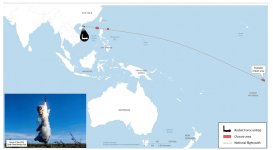
The reported February 25 test, in which the missile flew for 12 minutes across 2,100 kilometers, was characterized as enhancing China’s ability to “hold targets at risk beyond the Second Island Chain,” a phrase that encapsulates the strategic significance of the system more clearly than any technical metric.

By potentially increasing operational reach by up to 50 percent compared to the DF-26, the DF-27A positions itself as a bridge between regional strike systems and intercontinental capabilities, especially when configured with lighter payloads.

When armed with conventional warheads, the missile is assessed to exceed 5,000 kilometers in range, while a reduced-mass nuclear payload could extend that reach toward 9,000 kilometers, placing parts of the central Pacific within theoretical engagement envelopes.

Such flexibility underscores a deliberate design philosophy aimed at maximizing ambiguity, complicating adversary threat assessments, and enhancing deterrence through uncertainty.

The evolution of the DF-27A is closely linked to earlier hypersonic programs such as the DF-ZF glide vehicle, which has reportedly undergone numerous tests since 2014 at speeds ranging from Mach 5 to Mach 10.


The technical hurdles encountered during this development process, including limitations in computing power and materials endurance, highlight the scale of the engineering challenge that China has progressively overcome.


The accumulation of satellite imagery, intelligence disclosures, and open-source technical analysis over recent years has steadily eroded skepticism surrounding the DF-27 program, transforming what some once dismissed as speculative into a credible operational capability.

By late 2025, the reported DF-27A test appears to have provided the clearest confirmation yet that China’s hypersonic ambitions have matured into deployable systems rather than remaining confined to experimental testbeds.

This trajectory reflects not only technological momentum but also an institutional commitment to embedding hypersonic weapons into China’s broader military doctrine.


China Hypersonic


DF-27A Technical Architecture and Performance Parameters

The DF-27A is assessed as a solid-fueled, road-mobile intermediate-range ballistic missile launched from a transporter-erector-launcher, a configuration that enhances survivability through mobility and complicates pre-emptive targeting.

Following launch, the missile ascends along a ballistic trajectory before releasing its hypersonic glide vehicle in the upper atmosphere, where the payload transitions from ballistic flight to sustained aerodynamic glide.


By skimming along the edge of space, the glide vehicle exploits lift to extend range while executing lateral and vertical maneuvers that defeat predictive tracking algorithms.

The reported average speed of Mach 8.6 during the test phase situates the DF-27A firmly within the upper tier of operational hypersonic systems, ensuring minimal warning times for defended targets.

Peak velocities exceeding Mach 5 ensure that the weapon remains within the hypersonic regime throughout its flight profile, preserving its ability to outrun and outmaneuver interceptors.

The missile’s estimated range of 5,000 to 8,000 kilometers in conventional configurations, and up to 9,000 kilometers with lighter payloads, dramatically expands the geographic scope of China’s strike options.

Dual-capable warhead options allow the DF-27A to carry either nuclear or conventional payloads, reinforcing strategic ambiguity and complicating escalation management.


The ability to deploy a single hypersonic glide vehicle or multiple warheads enables the missile to adapt to diverse mission sets, from precision strikes against hardened facilities to saturation attacks against distributed targets.

Guidance is believed to rely on inertial navigation systems augmented by satellite positioning, providing the accuracy necessary to engage both fixed installations and moving maritime targets.

The reported 2,100-kilometer flight in 12 minutes demonstrates not only raw speed but also the missile’s capacity for rapid global or theater-wide responsiveness.

This performance profile aligns with earlier anti-ship hypersonic trials that emphasized penetration of layered air and missile defenses.

The road-mobile nature of the DF-27A further enhances its deterrent value by increasing survivability and complicating adversary targeting cycles.


From a cost-exchange perspective, even a conservative estimate of a single hypersonic interceptor costing US$15 million (approximately RM70.5 million) underscores how defending against such systems could impose unsustainable economic burdens on missile defense architectures.


Anti-Ship Hypersonics and the Expansion of the ‘Carrier Killer’ Paradigm

Among the most consequential aspects of the DF-27A is its role as an advanced anti-ship weapon, extending the so-called “carrier killer” paradigm far beyond the ranges associated with earlier systems.

Building upon the DF-21D and DF-26, which already threaten carrier strike groups operating within the First Island Chain, the DF-27A extends credible anti-ship reach toward 8,000 kilometers, encompassing the Second Island Chain and critical nodes such as Guam.

By combining hypersonic speed with mid-course maneuverability, the glide vehicle renders traditional missile defense concepts, optimized for predictable ballistic trajectories, increasingly obsolete.

The assertion that the system possesses “a high probability of penetrating U.S. ballistic missile defenses” reflects the inherent difficulty of intercepting maneuvering hypersonic targets enveloped by plasma sheaths that degrade radar performance.


During hypersonic flight, ionized air surrounding the vehicle disrupts radar tracking and communications, further complicating engagement solutions.

Current missile defense systems, including THAAD, Patriot, and SM-6, are primarily optimized for terminal-phase interception against ballistic or cruise missiles, leaving critical gaps against glide vehicles that alter course unpredictably.

The DF-27A’s ability to target moving naval assets depends on a sophisticated sensor-to-shooter network incorporating satellites, unmanned systems, and over-the-horizon radars.

While disruption of these networks could degrade accuracy, the sheer speed of the weapon compresses engagement timelines to such an extent that even partial targeting data may suffice.

The system’s flexibility to carry multiple warheads when striking dispersed targets enhances its utility in complex maritime strike scenarios.


By threatening carriers and large surface combatants at unprecedented ranges, the DF-27A fundamentally alters risk calculations for naval forces operating in contested waters.

The economic asymmetry between offensive hypersonic missiles and defensive interceptors further amplifies the strategic impact, as defending against saturation attacks could rapidly exhaust defensive magazines.

In this context, hypersonic anti-ship weapons emerge not merely as tactical threats but as strategic instruments capable of reshaping naval doctrines and deployment patterns.


Strategic and Geopolitical Implications Across the Indo-Pacific

Beyond its anti-ship role, the DF-27A significantly enhances China’s ability to conduct long-range precision strikes against fixed targets such as airbases, command centers, and logistics hubs across the Indo-Pacific.

Its range places U.S. and allied facilities in Japan, South Korea, the Philippines, and Guam within potential engagement envelopes, altering the strategic depth traditionally enjoyed by rear-area bases.

In a Taiwan contingency, the DF-27A could be employed to suppress allied intervention by threatening critical enablers far from the immediate battlespace.

The missile’s reach also introduces new considerations for India, as assets in the Andaman and Nicobar Islands fall within theoretical strike ranges.

For regional actors, the DF-27A reinforces perceptions of a widening missile gap driven by China’s rapid deployment of advanced strike systems.

Contrasts between China’s hypersonic testing tempo and the slower pace of comparable programs elsewhere highlight disparities in technological momentum.

The reported surprise within Western defense establishments following earlier hypersonic demonstrations underscores how rapidly the strategic landscape is shifting.


Global responses have included accelerated development of counter-hypersonic capabilities, expanded sensor networks, and renewed emphasis on resilience and dispersion.

Efforts to deploy space-based tracking systems aim to restore early warning against maneuvering hypersonic threats, while emerging technologies such as directed energy weapons are being explored as potential intercept solutions.

Allied initiatives, including long-range strike acquisitions and indigenous hypersonic programs, reflect an increasingly competitive arms environment.

Despite these efforts, the fundamental challenge posed by hypersonic glide vehicles lies in their ability to compress decision-making timelines and destabilize traditional deterrence frameworks.


A New Phase in Strategic Deterrence and Escalation Management

The reported successful test of the DF-27A hypersonic glide vehicle represents a pivotal moment in China’s military evolution, signaling the integration of speed, range, and maneuverability into a coherent operational capability.

By extending anti-ship threats to unprecedented distances and enhancing long-range strike options, the system strengthens China’s anti-access and area-denial posture while complicating adversary planning.

The adaptability of the DF-27A to different warhead configurations underscores its strategic value across a spectrum of conflict scenarios.

At the same time, vulnerabilities in targeting networks and the ongoing development of countermeasures suggest that hypersonic dominance will remain contested rather than absolute.

For Asia-Pacific stakeholders, the emergence of systems like the DF-27A underscores the urgency of investing in detection, interception, resilience, and crisis communication mechanisms.

In an era where hypersonic weapons redefine the speed and scale of warfare, the DF-27A serves as a stark indicator of how technological advances are reshaping deterrence, escalation, and the balance of power.


Absent meaningful arms control dialogue, the continued proliferation of such systems risks destabilizing an already fragile regional security architecture, increasing the likelihood that future crises will unfold at speeds that outpace diplomacy itself. — DEFENCE SECURITY ASIA


china-df-27a-hypersonic-missile-test-mach-8-indo-pacific


Read More
A2AD ChinaAnti-Ship Ballistic MissileChina carrier killer missileChina DF-27AChina hypersonic weaponsChina long range strikeChina missile defense penetrationDF-27A hypersonic missile
 
Most likely a couple of years old footage.
No. It should be sometime in 2025.

Official news reports have clarified many things:

1. 导弹定型实验(Missile finalization testing).
This is the final step in missile development. After this, mass production and deployment will begin.
Before this, many launch tests were conducted, but the official agencies did not release this information.

2. The warship performing the mission was the destroyer Wuxi.
This warship only officially entered service in 2022.
After entering service, a warship still requires a long period of training before officially entering combat readiness.
 
No. It should be sometime in 2025.

Official news reports have clarified many things:

1. 导弹定型实验(Missile finalization testing).
This is the final step in missile development. After this, mass production and deployment will begin.
Before this, many launch tests were conducted, but the official agencies did not release this information.

2. The warship performing the mission was the destroyer Wuxi.
This warship only officially entered service in 2022.
After entering service, a warship still requires a long period of training before officially entering combat readiness.
So in other words, the missile testing for this ship, not the finalization for the missile itself.
 
So in other words, the missile testing for this ship, not the finalization for the missile itself.
This is the finalization of the missile.
Following this event, mass production of the YJ-20 will begin. At the very least, all Type 055 destroyers currently in service will be equipped with this missile.
Whether the Type 052D destroyer will also be equipped with this missile is currently unknown. Theoretically, it is also capable of deploying this missile.

According to publicly available information, the destroyer Wuxi has participated in numerous combat readiness missions. It has long been in a state of combat readiness.
 
This is the finalization of the missile.
Following this event, mass production of the YJ-20 will begin. At the very least, all Type 055 destroyers currently in service will be equipped with this missile.
Whether the Type 052D destroyer will also be equipped with this missile is currently unknown. Theoretically, it is also capable of deploying this missile.

According to publicly available information, the destroyer Wuxi has participated in numerous combat readiness missions. It has long been in a state of combat readiness.
I remembered a pic of Type 052D firing it.
 
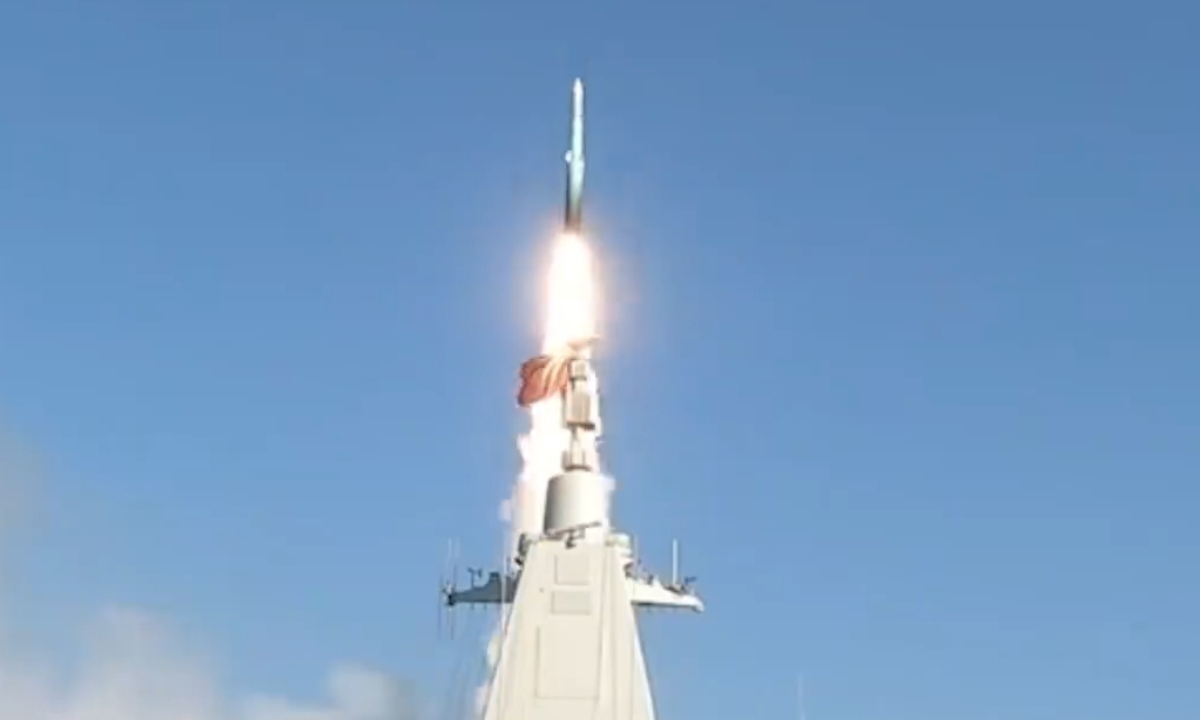
YJ-20 hypersonic missile filmed launching from Type 055 large destroyer in Chinese media report

Published: Dec 28, 2025 10:00 AM

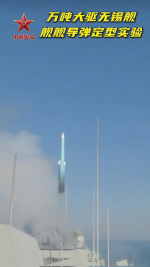
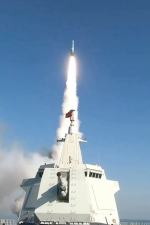
China Military Bugle, an official media account under the PLA News Media Center, unveils on December 28, 2025 the moment when the Type 055 large destroyer Wuxi conducts a finalization test for the YJ-20 hypersonic anti-ship missile, without disclosing its location or date. Photo: China Military Bugle

China Military Bugle, an official media account under the PLA News Media Center, unveils on December 28, 2025 the moment when the Type 055 large destroyer Wuxi conducts a finalization test for the YJ-20 hypersonic anti-ship missile, without disclosing its location or date. Photo: China Military Bugle

An official Chinese media report on Sunday unveiled the moment when a YJ-20 hypersonic anti-ship missile was launched from a Type 055 large destroyer of the Chinese People’s Liberation Army (PLA) Navy. Experts said that the maneuverable hypersonic missile can hit targets from an almost vertical angle, making it very difficult to intercept.

The footage was released on Sunday by China Military Bugle, an official media account under the PLA News Media Center. It shows the finalization test of a ship-to-ship missile on board the 10,000 ton-class large destroyer Wuxi.

A finalization test is a term often used to describe a final test of a weapon system before it wraps up its design phase and enters production.

Multiple camera angles provided up-close views of the test launch.

According to the footage, a YJ-20 hypersonic missile was launched from one of the vertical launching system (VLS) cells located in the aft section of the Type 055 large destroyer Wuxi. The missile used a cold-launch method, as it was ejected out of the VLS cell before igniting its engine.

The missile hit and destroyed its target, according to the China Military Bugle report.

This is the first time an official media report has shown a live YJ-20 hypersonic anti-ship missile being fired from a warship.

The YJ-20 was officially unveiled at China’s V-Day military parade held in Beijing on September 3, alongside with three other types of anti-ship missiles, namely the YJ-15 missile, the YJ-19 hypersonic missile and the YJ-17 hypersonic missile. According to official media, they can be carried by multiple launch platforms, including carrier-based fighter jets, surface vessels and submarines.

Maneuverable missiles that can exceed Mach 5, or five times the speed of sound, are considered hypersonic missiles, said Chinese military affairs expert Zhang Junshe. He told the Global Times that based on the appearance of the YJ-20, it is a boost-glide missile consisting of a rocket booster and a bicone glide vehicle. The bicone can form shock waves during hypersonic flight, which enables the missile’s air rudders to perform maneuvers during the missile’s terminal flight, boosting its defense penetration capabilities.

The YJ-20 can hit surface vessels via a nearly vertical angle like a ballistic missile, and with its hypersonic speed, it is very difficult to intercept, according to Zhang.

Carried by platforms such as the Type 055 large destroyer, the YJ-20 can be deployed in the far seas, boosting the PLA Navy’s far seas combat capabilities, and enhancing China’s defense depth, Zhang said.

 
To view this content we will need your consent to set third party cookies.
For more detailed information, see our cookies page.
 

This Chinese scientist boosts range of PL-15 missiles that brought down India’s Rafale jets​


Users who are viewing this thread

Country Watch Latest

Latest Posts

Back
Top