PAF J-10CE News, Updates and Discussion

Status
Not open for further replies.
There are no stupid questions and you are kind enough to ask anything with good manners.
It is not that simple to put any engine in a fighter. As I said, I don't know myself about these particular engines, so first question will be regarding its size. If it fits, good enough. Otherwise, we will need a lot of changes in airframe design and that is a whole another problem.
I have heard that all these WS-13, WS-21 and WS-19 are based on original RD-33 design where our RD-93 or RD-93MA are also RD-33 based. but what i am asking is a theoretical question just for my understanding that lets suppose WS-19 has an exact dimensions and is installed on our JFs with having higher 10 to 15% higher thrust with same fuel consumption will that improve our JF17 in air to air kill then? and also make us able install better range radar?
 
I have heard that all these WS-13, WS-21 and WS-19 are based on original RD-33 design where our RD-93 or RD-93MA are also RD-33 based. but what i am asking is a theoretical question just for my understanding that lets suppose WS-19 has an exact dimensions and is installed on our JFs with having higher 10 to 15% higher thrust with same fuel consumption will that improve our JF17 in air to air kill then? and also make us able install better range radar?
Well, theoretically yes... if thrust-to-weight ratio becomes more than 1 with same or lesser fuel consumption, and it can power better avionics too...
I think WS-19 is not based on RD-33 though. It remains to be seen how much improvement Chinese engine will bring, though going away from Russian dependency is a big win.
 
Well, theoretically yes... if thrust-to-weight ratio becomes more than 1 with same or lesser fuel consumption, and it can power better avionics too...
I think WS-19 is not based on RD-33 though.
can you explain the thrust-to-weight ratio roles in modern BVR? just a brief explanation no need to go in detail
 
can you explain the thrust-to-weight ratio roles in modern BVR? just a brief explanation no need to go in detail
Not directly related to BVR but thrust-to-weight ratio more than 1 means an aircraft can climb and accelerate at a faster rate. The speed and altitude is directly proportional to range of BVR.
So, if you can climb to 40k quickly maintaining high speed, you will get a better shot with any BVR.
 
Not directly related to BVR but thrust-to-weight ratio more than 1 means an aircraft can climb and accelerate at a faster rate. The speed and altitude is directly proportional to range of BVR.
So, if you can climb to 40k quickly maintaining high speed, you will get a better shot with any BVR.
Thank you. 40K height in these large range SAMs is dangerous? It means there is still a lot of improvements to be brought into modern BVR to be able to maintain range and accuracy if shot at lower altitude
 
Thank you. 40K height in these large range SAMs is dangerous? It means there is still a lot of improvements to be brought into modern BVR to be able to maintain range and accuracy if shot at lower altitude
Yes, SAM also has better chance of hitting a target at higher altitude than low level.
Apart from range reduction, accuracy of modern BVR is good in all flight profiles.
 
lets suppose they have higher thrust will that bring improvements on JF air to air engagements?
the plane gets higher and faster- faster. Gives the missile a bit more 'kick' (kinetic energy) to start off with, and of course, the thinner the air, the less drag (drag is proportional to the square of the velocity!), so missiles like the PL-15 which are designed really to hang around in the thinner, upper atmospheric air will do better when launched from there too.

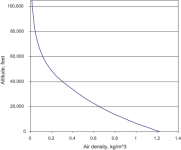
Air is about 3x less dense at 45,000 feet vs 30,000ft. So just imagine, that extra couple of seconds at those lower altitudes will require the missile to overcome an immense amount of additional drag, capping its maximum engagement range due to it needing to burn more energy to counteract atmospheric forces. Of course, not all missiles are designed to operate high up- stuff like astra likely flies alot lower than something like the PL-15.

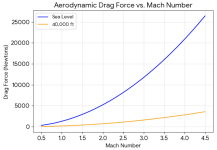
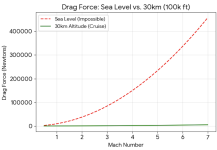
Actually, using some arbitrary numbers, i've made this for you to visualise:

1767712085126.png

Here, you can see the effect of the drag coming into play, how it exponentially increases with a decrease in altitude. So at Mach 1, you can see, its not a significant difference, however, as velocity increases, drag increases by the square of it, so at higher speeds like a AAM will fly at, you will see that delta become larger as velocity increases, significantly harming performance.

1767712299948.png
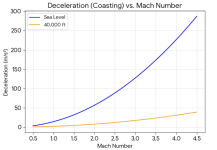
Here, you see quite a similar curve, because really, the same physics applies. The faster you are, the more drag the missile experiences, because here, the missile is coasting, there is no 'power', as a result of this, the missile is at the mercy of atmospheric forces, and therefore, at lower altitudes, the amount of deceleration the missile experiences is significantly higher than the amount at high altitudes.

1767712424530.png
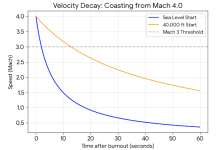
Here, in the velocity decay graph, once again, you're seeing the same phenomenon being modelled in a different scenario- you can see the sharp decrease in velocity at sea level, then it flattening out as velocity decreases, as once again, drag^2 and velocity are proportional, however, you also see that the difference at high altitude is less, once again, highlighting the benefit of a higher altitude start/flight.

1767712519665.png

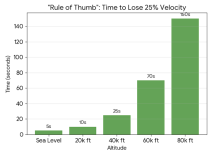
And lastly, here, once again, you can see that at higher altitudes, time to lose 25% of the missiles velocity are far greater, owing to the thinner air, and thus less drag.

How this all links together is the following:

1767712663081.png

Air density REALLy decreases as we start to climb, this is very beneficial to missile performance. If a jet has a more capable engine, and is kinematically more capable, once again, it gives that missile an initial 'kick'- its effectively donating some of its speed to the missile, allowing it to accelerate to higher speeds initially, reducing the effect of the drag on its overall performance. OTOH, it also allows higher launch altitudes, this once again, allows the missile to break through that dense, draggy air faster, and fly in the 'nicest' part of the atmosphere, with the least drag, and thus, retain the majority of its energy to kill something.

This is how missiles like the AIM54 managed to reach those impressive ranges, the 54 would loft up to in excess of 100,000 feet, get very far without losing much energy and dive down onto a target. However, as with everything, there are always drawbacks!

Hope that clears it
 
the plane gets higher and faster- faster. Gives the missile a bit more 'kick' (kinetic energy) to start off with, and of course, the thinner the air, the less drag (drag is proportional to the square of the velocity!), so missiles like the PL-15 which are designed really to hang around in the thinner, upper atmospheric air will do better when launched from there too.

Air is about 3x less dense at 45,000 feet vs 30,000ft. So just imagine, that extra couple of seconds at those lower altitudes will require the missile to overcome an immense amount of additional drag, capping its maximum engagement range due to it needing to burn more energy to counteract atmospheric forces. Of course, not all missiles are designed to operate high up- stuff like astra likely flies alot lower than something like the PL-15.

Actually, using some arbitrary numbers, i've made this for you to visualise:

View attachment 170346

Here, you can see the effect of the drag coming into play, how it exponentially increases with a decrease in altitude. So at Mach 1, you can see, its not a significant difference, however, as velocity increases, drag increases by the square of it, so at higher speeds like a AAM will fly at, you will see that delta become larger as velocity increases, significantly harming performance.

View attachment 170348
Here, you see quite a similar curve, because really, the same physics applies. The faster you are, the more drag the missile experiences, because here, the missile is coasting, there is no 'power', as a result of this, the missile is at the mercy of atmospheric forces, and therefore, at lower altitudes, the amount of deceleration the missile experiences is significantly higher than the amount at high altitudes.

View attachment 170350
Here, in the velocity decay graph, once again, you're seeing the same phenomenon being modelled in a different scenario- you can see the sharp decrease in velocity at sea level, then it flattening out as velocity decreases, as once again, drag^2 and velocity are proportional, however, you also see that the difference at high altitude is less, once again, highlighting the benefit of a higher altitude start/flight.

View attachment 170351

And lastly, here, once again, you can see that at higher altitudes, time to lose 25% of the missiles velocity are far greater, owing to the thinner air, and thus less drag.

How this all links together is the following:

View attachment 170352

Air density REALLy decreases as we start to climb, this is very beneficial to missile performance. If a jet has a more capable engine, and is kinematically more capable, once again, it gives that missile an initial 'kick'- its effectively donating some of its speed to the missile, allowing it to accelerate to higher speeds initially, reducing the effect of the drag on its overall performance. OTOH, it also allows higher launch altitudes, this once again, allows the missile to break through that dense, draggy air faster, and fly in the 'nicest' part of the atmosphere, with the least drag, and thus, retain the majority of its energy to kill something.

This is how missiles like the AIM54 managed to reach those impressive ranges, the 54 would loft up to in excess of 100,000 feet, get very far without losing much energy and dive down onto a target. However, as with everything, there are always drawbacks!

Hope that clears it
Thank you for the detail post. I have gone through it quickly first and thanking you here. but i am going again with it slowly to understand it to the maximum. one thing is clear that any hypersonic kind of design of missile for BVR can do better at low altitude because of their aerodynamics and engine. I am also now understanding the scramjet BVRs versus the double motor BVRs
 
@Michael when you were saying that JF-17 has reached its limit, then you were pointing towards these issues?
My other question from you is what if we have a WS-19 kind or lets suppose WS-19 installed on JF-17 will that brings improvement in having better radar and better climb rate for better AtoA missile release?
This means that, based on the JF-17 airframe design platform, the current system (JF-17B3) has reached its optimal state. Its only current drawback is that the advanced avionics system places too much demand on electrical power, and the power system struggles to provide sufficient electricity.

I provided this information a long time ago: "Pakistan has acquired a WS-21 engine."

If the JF-17B3 fighter jet is equipped with the WS-21 engine and also includes an IRST system, then that would be its ultimate configuration. I don't know what Pakistan will name this version. JF-17B4, JF-17 Alpha, or JF-17 PFX? It doesn't matter.
I have heard that all these WS-13, WS-21 and WS-19 are based on original RD-33 design where our RD-93 or RD-93MA are also RD-33 based. but what i am asking is a theoretical question just for my understanding that lets suppose WS-19 has an exact dimensions and is installed on our JFs with having higher 10 to 15% higher thrust with same fuel consumption will that improve our JF17 in air to air kill then? and also make us able install better range radar?
You can search the forum; I remember I posted a complete explanation there, including the technical origins of these engines.

This thread is about the J-10CE. Let's not stray too far from the topic.
 
Last edited:
Thank you for the detail post. I have gone through it quickly first and thanking you here. but i am going again with it slowly to understand it to the maximum. one thing is clear that any hypersonic kind of design of missile for BVR can do better at low altitude because of their aerodynamics and engine. I am also now understanding the scramjet BVRs versus the double motor BVRs
Its actually the opposite.

The lower you fly, the more inefficient your flight gets.

With hypersonics, for example, you're still facing the same troubles. Basically, the faster it goes, the more ideal it is for it to fly higher.

1767713518164.png

Its why brahmos has to fly so high, the lower it gets, the harder the engine has to work to keep that speed!
 
Its actually the opposite.

The lower you fly, the more inefficient your flight gets.

With hypersonics, for example, you're still facing the same troubles. Basically, the faster it goes, the more ideal it is for it to fly higher.

View attachment 170357

Its why brahmos has to fly so high, the lower it gets, the harder the engine has to work to keep that speed!
but arenot the hypersonic design in such a way that it divides the heavy air drag and its engine are designed such that the air flow is standardised for the comustion needed? will that also effect these hypersonic engines when it has to fly at thin air vs heavy air?
 
This means that, based on the JF-17 airframe design platform, the current system (JF-17B3) has reached its optimal state. Its only current drawback is that the advanced avionics system places too much demand on electrical power, and the power system struggles to provide sufficient electricity.

I provided this information a long time ago: "Pakistan has acquired a WS-21 engine."

If the JF-17B3 fighter jet is equipped with the WS-21 engine and also includes an IRST system, then that would be its ultimate configuration. I don't know what Pakistan will name this version. JF-17B4, JF-17 Alpha, or JF-17 PFX? It doesn't matter.

============================================================

Regarding the WS-19 engine, I can share some non-classified information.
There is considerable controversy among relevant Chinese companies regarding its export.

AVIC/CATIC is very keen on exporting it, as this would significantly impact the export prospects of the JF-17 and FC-31/J-35 fighter jets.

However, this proposal is strongly opposed by AECC, especially by all the designers at the 624 Research Institute (WS-21/WS-19 project team).

The two sides have held numerous meetings and engaged in heated debates. Currently, AECC has prevailed. I know very little about the specifics of their arguments, and I cannot disclose what I do know.

Therefore, please stop dwelling on this issue.


You can search the forum; I remember I posted a complete explanation there, including the technical origins of these engines.

This thread is about the J-10CE. Let's not stray too far from the topic.
Brother i will never ask of you to disclose anything that can brought you in trouble. i always ask question where if you can answer in generic terms not be specific like if i ask that WS-19 definitely would have better electricty production and thrust than WS-21 with same fuel consumption? you can answer maybe or yes or maybe not or i am not sure.. dont need to be specific liek yes and this much more electricity and thrust etc. but thanks i tagged you here because now i understand more when you say that current JF-17 airframe design has almost reached its optimal state
 
but arenot the hypersonic design in such a way that it divides the heavy air drag and its engine are designed such that the air flow is standardised for the comustion needed? will that also effect these hypersonic engines when it has to fly at thin air vs heavy air?
i dont entirely understand, BUT:

Yes, the airflow is compressed, significantly as a result of its forward velocity (this is why ramjet missiles either have minimum launch speeds or have two stages, like the meteor, which has a solid rocket motor stage).

But, im guessing these are still optimised for high level flight, especially when you consider the density of air down low, the volume of air being compressed would be insane, like, explosively insane... Structurally, that cant be great for the missile and it would probably be red glowing hot with all that friction!

But the issue of air density is the key one, the thicker that air, the more friction/drag, at hypersonic speeds, its increasing exponentially (by the square of mach 6), it would be an insane amount.
 
Brother i will never ask of you to disclose anything that can brought you in trouble. i always ask question where if you can answer in generic terms not be specific like if i ask that WS-19 definitely would have better electricty production and thrust than WS-21 with same fuel consumption? you can answer maybe or yes or maybe not or i am not sure.. dont need to be specific liek yes and this much more electricity and thrust etc. but thanks i tagged you here because now i understand more when you say that current JF-17 airframe design has almost reached its optimal state
One of the core tasks for China's fighter jet power systems, both now and for many years to come, is to improve their power generation capabilities.

These are Yang Wei's exact words. You should know who he is.
 
Status
Not open for further replies.

Users who are viewing this thread

Back
Top