the plane gets higher and faster- faster. Gives the missile a bit more 'kick' (kinetic energy) to start off with, and of course, the thinner the air, the less drag (drag is proportional to the square of the velocity!), so missiles like the PL-15 which are designed really to hang around in the thinner, upper atmospheric air will do better when launched from there too.
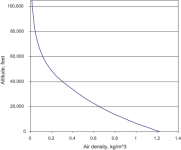
Air is about 3x less dense at 45,000 feet vs 30,000ft. So just imagine, that extra couple of seconds at those lower altitudes will require the missile to overcome an immense amount of additional drag, capping its maximum engagement range due to it needing to burn more energy to counteract atmospheric forces. Of course, not all missiles are designed to operate high up- stuff like astra likely flies alot lower than something like the PL-15.
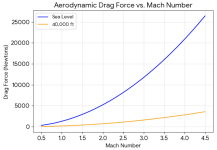
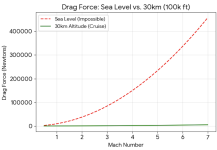
Actually, using some arbitrary numbers, i've made this for you to visualise:
View attachment 170346
Here, you can see the effect of the drag coming into play, how it exponentially increases with a decrease in altitude. So at Mach 1, you can see, its not a significant difference, however, as velocity increases, drag increases by the square of it, so at higher speeds like a AAM will fly at, you will see that delta become larger as velocity increases, significantly harming performance.
View attachment 170348
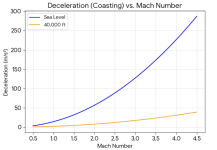
Here, you see quite a similar curve, because really, the same physics applies. The faster you are, the more drag the missile experiences, because here, the missile is coasting, there is no 'power', as a result of this, the missile is at the mercy of atmospheric forces, and therefore, at lower altitudes, the amount of deceleration the missile experiences is significantly higher than the amount at high altitudes.
View attachment 170350
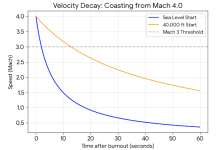
Here, in the velocity decay graph, once again, you're seeing the same phenomenon being modelled in a different scenario- you can see the sharp decrease in velocity at sea level, then it flattening out as velocity decreases, as once again, drag^2 and velocity are proportional, however, you also see that the difference at high altitude is less, once again, highlighting the benefit of a higher altitude start/flight.
View attachment 170351
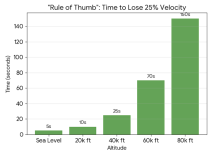
And lastly, here, once again, you can see that at higher altitudes, time to lose 25% of the missiles velocity are far greater, owing to the thinner air, and thus less drag.
How this all links together is the following:
View attachment 170352
Air density REALLy decreases as we start to climb, this is very beneficial to missile performance. If a jet has a more capable engine, and is kinematically more capable, once again, it gives that missile an initial 'kick'- its effectively donating some of its speed to the missile, allowing it to accelerate to higher speeds initially, reducing the effect of the drag on its overall performance. OTOH, it also allows higher launch altitudes, this once again, allows the missile to break through that dense, draggy air faster, and fly in the 'nicest' part of the atmosphere, with the least drag, and thus, retain the majority of its energy to kill something.
This is how missiles like the AIM54 managed to reach those impressive ranges, the 54 would loft up to in excess of 100,000 feet, get very far without losing much energy and dive down onto a target. However, as with everything, there are always drawbacks!
Hope that clears it