Who Created Harappan / Indus Valley Civilisation? | How Did It End? | Samvaad With Devdutt Pattanaik

Sure why not, live in the past all you want. Also, no that won't make it foreign unless we are believing in Varuna Indra Agni that was worshipped in Steppe back in 2000BCE.

Sindhu is the name. Sindhu-Saraswati are the most revered rivers and the civilisation died coicinding the death of river Saraswati.

And not even close. RV or all the Vedas are not directions of life, it's a book of rituals one must perform the mantras one must recite when performing a ritual so on and so forth. So naturally anything that was part of daily life was included in it. It's like saying Vedas are book of agriculture because there are rituals to please lord Indra for more rain. That makes it agressive Brahminism of agrarian expansion lol!
You are not making a point here. In fact, you are emphasising that you have no linguistic or nomenclature based points to make.

Again, refer to timelines please and origins of words.

"Sindhu" is a Sanskrit word.

The Persians and Greeks adopted Indus as a variation of Sindhu in the 5th/6th Century BCE, 500 years AFTER the Harappans existed as a nation.

We have already discussed that Aryans and neighbouring tribes moved into the ruined cities of the IVC after it collapsed about 1000 years BEFORE the river was recognised by the term "Indus".

In other words, foreigners (Aryans firstly, then Achaemenids and Macedonians) imposed this nomenclature upon the river in question. In the context being discussed, this naming by Aryans with "Sindhu" is no different to Greeks or Persians calling it "Indus".

Can you demonstrate that the Harappans themselves called this river by its Sanskrit name, Sindhu?
 
Keep digging mate.

Prakrit and Sanskrit are both indo-european tongues. You have simply made my point for me by mentioning that one of these tongues is for "common use" and the other is "sacred".

As I keep saying, open a thread on the linguistics specifically. I can hand you your shovel there.
Dropped the invader opression story already?
 
Almost all of Indian subcontinent has IVC in their genes. Read your own charts, you take sources and refuse to understand them, forgets you ever quoted it and write fictions that contradict your own previous source.

That is specially why I said genetics didn't matter. Because it's not a geneology based culture. I would go as far as to say those who practices endogamy was considered mlechcha.
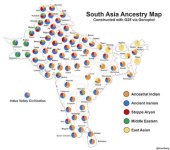
Yes - but let's be specific with the science. Almost all of Pakistan and India has IVC in its genes, slightly moreso in the Pakistani genome overall when you factor in eastern Indian populations. This plot should show you that there was an EASTWARD spread from Iran to the subcontinent of this genome. Even India's own genuine scholars accept this reality, not the OOI nonsense that you are touting.

Also note, for reference, the annotation for Indus Valley Civilisation shows ZERO Aryan DNA, which was the original purpose of posting this diagram.

1768849757963.jpeg
 
Dravidian languages existed in India and Sanskrit has Dravidian substrate. If the Aryans migrated out of Indian all Indo-European languages should have this substrate. But Dravidian substrate is absent in all all Indo-European languages outside of South Asia. Even Persian Farsi which is a neighbouring Indo-European language also lacks Dravidian substrate. So Indo-Aryans migrated into South Asia bringing their language and culture.

While Sanskrit is fundamentally an Indo-European (Indo-Aryan) language and not genetically descended from the Dravidian language family, there is strong linguistic evidence that it developed a significant
Dravidian substrate (base influence) due to long-term contact.
This means that as Indo-Aryan speakers moved into the Indian subcontinent, their language (Vedic Sanskrit) absorbed structural and vocabulary features from the already established Dravidian languages.

Evidence of a Dravidian Substrate in Sanskrit
  • Retroflex Consonants: A major differentiator between Sanskrit and its sister Indo-Iranian languages (like Avestan) is the presence of retroflex sounds (ṭ, ḍ, ṇ). These sounds, which are a defining feature of Dravidian languages, were likely adopted into early Sanskrit through contact.
  • Vocabulary Loanwords: Extensive studies have identified numerous Dravidian loanwords in the Rigveda, with estimations ranging from a few dozen to over a hundred, covering local flora, fauna, and household items.
  • Grammatical Features: Certain grammatical structures, such as the gerund (used for "incomplete" action), are found in Vedic Sanskrit and share functions with Dravidian, but are not found in Avestan.
  • Syntax and Structure: The influence is believed to be strongest in the development of Middle Indo-Aryan (Prakrits and ApabhramSas), where the convergence of Sanskrit with Dravidian languages resulted in a new, distinct linguistic structure.

Key Context
  • Two Different Families: Sanskrit belongs to the Indo-European family, while Tamil, Telugu, Kannada, and Malayalam are Dravidian. They do not share a common ancestor.
  • Bidirectional Influence: While early Sanskrit was influenced by a Dravidian substrate, in later centuries, Dravidian languages were heavily influenced by Sanskrit (Sanskritization), leading to a shared,, blended vocabulary, particularly in literature.
  • "Language X" Theory: Some scholars suggest that the earliest influence on Rigvedic Sanskrit might be from an extinct, unknown language (“Language X”), rather than Dravidian itself, but in later Vedic periods, the contact with Dravidian is well-established.
In summary, Sanskrit does not have a Dravidian base in terms of origin, but it does have a Dravidian substratum that fundamentally altered its phonology and structure compared to its Indo-European relatives.
 
Yes - but let's be specific with the science. Almost all of Pakistan and India has IVC in its genes, slightly moreso in the Pakistani genome overall when you factor in eastern Indian populations. This plot should show you that there was an EASTWARD spread from Iran to the subcontinent of this genome. Even India's own genuine scholars accept this reality, not the OOI nonsense that you are touting.

Also note, for reference, the annotation for Indus Valley Civilisation shows ZERO Aryan DNA, which was the original purpose of posting this diagram.

View attachment 173395
"(a) the Aryans (and whatever they brought with them) were foreign, and (b) the IVC itself was Iranic origin, and (c) NO substantive Aryan genomic influence existed in populations inhabiting Harappa until after the collapse of the IVC."

...is what I said originally when posting that diagram. Not sure why you are claiming I said something else about this diagram?

@Vikramaditya1
 
You are not making a point here. In fact, you are emphasising that you have no linguistic or nomenclature based points to make.

Again, refer to timelines please and origins of words.

"Sindhu" is a Sanskrit word.

The Persians and Greeks adopted Indus as a variation of Sindhu in the 5th/6th Century BCE, 500 years AFTER the Harappans existed as a nation.

We have already discussed that Aryans and neighbouring tribes moved into the ruined cities of the IVC after it collapsed about 1000 years BEFORE the river was recognised by the term "Indus".

In other words, foreigners (Aryans firstly, then Achaemenids and Macedonians) imposed this nomenclature upon the river in question. In the context being discussed, this naming by Aryans with "Sindhu" is no different to Greeks or Persians calling it "Indus".

Can you demonstrate that the Harappans themselves called this river by its Sanskrit name, Sindhu?
Huh. So what was the original name of Sindhu then? What was the name of Indus Valley? I'm not the one arguing that the culture is foreign, it's you. You can't be asking me what was the names of Harappans and Sindhu rivers. At the same time saying wait these people brought their culture and religion and their names and gods from elsewhere.

I asked you find me anything outside India that is at least from 2000BCE from the homeland of steppe people to prove the foreign origin. The whole opression and invasion of IVC is the central theme of this thread and you want to open a new thread about the text that supposedly speaks about it. What???
 
Dropped the invader opression story already?
Not at all! I am happy to argue for "Aryan invasion theory", but let's do that somewhere else just to keep this thread coherent, if you really want to.

I am giving you the benefit of "assuming Aryans arrived en masse peacefully and imposed their ideologies without bloodletting", which is a massive assumption to make! Nevertheless, all my points regrading their "foreign-ness" apply in this somewhat contrived context.
 
Dropped the invader opression story already?
Nope. Ruchika explains the AIT very nicely including why the "rath " wheels on Aryan chariots depicted in later era temple motifs are depicted as having spokes verses the absence of spokes on wheels depicted on figurines found in the excavations at Harappa.

To view this content we will need your consent to set third party cookies.
For more detailed information, see our cookies page.
 
So what was the original name of Sindhu then? What was the name of Indus Valley?
It certainly cannot have been called "Sindhu" by the Harappans, can it? We don't even understand the Harappan language.

The point being made is that Pakistanis DO NOT CARE that it was ultimately named for posterity by migrant Aryans and later by Greeks/Persians.

It is Indians who erroneously think (and are furthermore offended by the erroneous theory that) Indus is a foreign word while Sindhu is not!
 
Dravidian languages existed in India and Sanskrit has Dravidian substrate. If the Aryans migrated out of Indian all Indo-European languages should have this substrate. But Dravidian substrate is absent in all all Indo-European languages outside of South Asia. Even Persian Farsi which is a neighbouring Indo-European language also lacks Dravidian substrate. So Indo-Aryans migrated into South Asia bringing their language and culture.

While Sanskrit is fundamentally an Indo-European (Indo-Aryan) language and not genetically descended from the Dravidian language family, there is strong linguistic evidence that it developed a significant
Dravidian substrate (base influence) due to long-term contact.
This means that as Indo-Aryan speakers moved into the Indian subcontinent, their language (Vedic Sanskrit) absorbed structural and vocabulary features from the already established Dravidian languages.

Evidence of a Dravidian Substrate in Sanskrit
  • Retroflex Consonants: A major differentiator between Sanskrit and its sister Indo-Iranian languages (like Avestan) is the presence of retroflex sounds (ṭ, ḍ, ṇ). These sounds, which are a defining feature of Dravidian languages, were likely adopted into early Sanskrit through contact.
  • Vocabulary Loanwords: Extensive studies have identified numerous Dravidian loanwords in the Rigveda, with estimations ranging from a few dozen to over a hundred, covering local flora, fauna, and household items.
  • Grammatical Features: Certain grammatical structures, such as the gerund (used for "incomplete" action), are found in Vedic Sanskrit and share functions with Dravidian, but are not found in Avestan.
  • Syntax and Structure: The influence is believed to be strongest in the development of Middle Indo-Aryan (Prakrits and ApabhramSas), where the convergence of Sanskrit with Dravidian languages resulted in a new, distinct linguistic structure.

Key Context
  • Two Different Families: Sanskrit belongs to the Indo-European family, while Tamil, Telugu, Kannada, and Malayalam are Dravidian. They do not share a common ancestor.
  • Bidirectional Influence: While early Sanskrit was influenced by a Dravidian substrate, in later centuries, Dravidian languages were heavily influenced by Sanskrit (Sanskritization), leading to a shared,, blended vocabulary, particularly in literature.
  • "Language X" Theory: Some scholars suggest that the earliest influence on Rigvedic Sanskrit might be from an extinct, unknown language (“Language X”), rather than Dravidian itself, but in later Vedic periods, the contact with Dravidian is well-established.
In summary, Sanskrit does not have a Dravidian base in terms of origin, but it does have a Dravidian substratum that fundamentally altered its phonology and structure compared to its Indo-European relatives.
Agree with this. Plenty of word mixing did take place between IE languages and Dravidian ones.
 
"(a) the Aryans (and whatever they brought with them) were foreign, and (b) the IVC itself was Iranic origin, and (c) NO substantive Aryan genomic influence existed in populations inhabiting Harappa until after the collapse of the IVC."

...is what I said originally when posting that diagram. Not sure why you are claiming I said something else about this diagram?

@Vikramaditya1
A. what Aryans bought with them are their steppe ancestry everything else was created here.
B. Yes from 12000 years ago, Iranian hunter gatherers who mixed with even older Indian hunter gatherer created IVC. Great find.
C. Good I guess. But still not enough for opression depression suppression story.
 
A. what Aryans bought with them are their steppe ancestry everything else was created here.
B. Yes from 12000 years ago, Iranian hunter gatherers who mixed with even older Indian hunter gatherer created IVC. Great find.
C. Good I guess. But still not enough for opression depression suppression story.
What Aryans are you on about, you plum.

How can someone be so confidently wrong and so consistently?
 
I am giving you the benefit of "assuming Aryans arrived en masse peacefully and imposed their ideologies without bloodletting", which is a massive assumption to make! Nevertheless, all my points regrading their "foreign-ness" apply in this somewhat contrived context
Story lacks credibility even then. What happened to their caucusus mountains, revered steppe land. Where's that story about their origin. Why not one steppe Aryan mentioned anything not even a word about their homeland heck not even about region outside Iran. When all texts are about this land, the rivers, mountains, valleys. Why these Aryans simply forgot their homeland and decided to cosplay as IVC people. Never heard of an invader who fully assimilated their culture into oblivion.
 

Users who are viewing this thread

Pakistan Defence Latest

Country Watch Latest

Back
Top