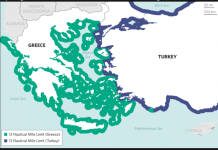
Turkey Greece Relations and Maritime Disputes

Greece is not an Archipelagic State

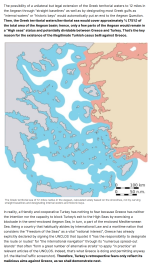
Turkiye insists that equitable principles (special circumstances, proportionality, etc.) must prevail in semi-enclosed seas like the Aegean especially to avoid giving excessive effect to small/offshore islands

Turkiye rejects full EEZ/continental shelf rights for Greek Islands east of the 25th meridian (closer to Turkiye)

Turkiye opposes Greek 12-nm extension in the Aegean, viewing it as a major threat to Turkish security and access to the high seas


---------------------------------------------------------

Article 74(1) (EEZ): "The delimitation of the exclusive economic zone between States with opposite or adjacent coasts shall be effected by agreement on the basis of international law, as referred to in Article 38 of the Statute of the International Court of Justice, in order to achieve an equitable solution."

Article 83(1) (continental shelf):
Identical wording applies to the continental shelf: "...in order to achieve an equitable solution."


These articles do not prescribe a specific method (like the equidistance/median line) as mandatory. Instead, they require states to negotiate in good faith to reach an equitable solution, guided by international law (including customary law and ICJ case law)

The principle of equity – equitable solution is the rule (UNCLOS Articles 74/83)
Articles 74 and 83 as reflecting customary international law , meaning Turkiye considers the core obligation to achieve an equitable solution to be binding on all states
 
Key elements of Turkiye's position (consistently stated in official MFA documents, UN submissions, and legal arguments)


Equitable solution is the primary rule

Turkiye emphasizes that the principle of equity and the achievement of an equitable solution are the overriding norms in Articles 74 and 83. It argues this principle is customary international law and takes precedence over any mechanical application of methods

Rejection of automatic/strict equidistance/median line
Turkiye strongly opposes treating the equidistance/median line (a line every point of which is equidistant from the nearest coasts) as the default or primary method. Official Turkish documents state explicitly:
  • "The principle of equity – equitable solution is the rule (UNCLOS Articles 74/83)."
  • "Median line is not the method for CS/EEZ delimitation. (Only a provisional step in some cases.)"

Special/relevant circumstances must be considered
In line with ICJ jurisprudence (e.g., cases like North Sea Continental Shelf, Libya/Malta, UK/France, etc.), Turkiye insists that delimitation must account for relevant circumstances, such as:
  • Geographical configuration (e.g., presence of numerous islands close to one coast).
  • Proportionality (coastal length ratio vs. maritime area allocated).
  • Avoiding disproportionate effects from small or remote islands.
  • Preventing "cut-off" or "enclavement" of a state's coastline.
This is central to Turkeiye's objections in both the Aegean Sea (where Greek islands would generate excessive maritime zones under a strict median line) and the Eastern Mediterranean (where small islands like Kastellorizo/Meis would dramatically cut off Turkiye's potential continental shelf/EEZ if given full effect)


-------------------------------------------------------------

Application in Practice

Aegean Sea:
Turkiye argues that full application of island-generated zones (combined with Articles 74/83 via median line) would inequitably enclose Turkiye's coast and limit its access to open seas/high seas.

Eastern Mediterranean: Turkiye's maritime boundary agreement with Libya (2019 MoU) and its continental shelf/EEZ claims are based on equitable principles under customary law (echoing Articles 74/83), rejecting agreements that give full EEZ effect to distant/small islands (e.g., Greece's claims around Kastellorizo or Cyprus's claims).

Turkiye has submitted maps and positions to the UN emphasizing equitable delimitation over equidistance.
 
CASUS BELLI ( Cause for War )

Turkiye currently limits its territorial sea to 6 nm in the Aegean and has declared (since 1995) that a Greek extension to 12 nm would be a casus belli (cause for war), as it would dramatically shrink international waters and Turkish access.


Türkiye is not joking, and this step will start a war.

Greeks who think they can defend the islands ( just 2 , 7 , 10 , 30 km away from Turksih Mainland ) against one of the world's largest and most technologically advanced military powers

---------------------------------------------------

Turkish Armed Forces can take Kastellerizo in hours which is 580 km away from Greece and just 2 km away from Turkiye

If Turkish Commandos parachuted, they could land on the islands from Turkish airspace

even Howitzers , Kamikaze Drones and guided MLRS can hit every points on the Islands .... ( Turkiye has the biggest fire power in NATO after USA )


and Greece lacks power projection to defend the Islands
1769315443859.jpeg

If Greks makes the same wrong move as they did in 1974, Greece will lose again
 
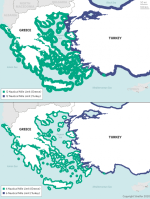
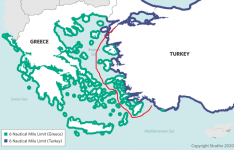
Current situation (6-mile territorial waters regime):

Greek territorial waters:
Approximately 35–43.5%
Turkish territorial waters: Approximately 7.5–8.8%
High seas/international waters: Approximately 49–56%


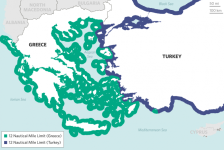
If Greece extends to 12 miles (12-mile regime):

Greek territorial waters:
Approximately 70–71.5%
Turkish territorial waters: Less than approximately 8 %
High seas/international waters: Approximately 19-20 %


These figures stem from the geographical structure of the Aegean Sea (the Greek islands are very close to the Turkish coast and numerous).
If the 12-mile limit were extended, the territorial waters of the islands would be connected, and a large part of the Aegean would fall under Greek sovereignty.

Türkiye's coastline would be "imprisoned," and its access to the open sea would be severely restricted

1769317041994.png

Current situation (6-mile territorial waters regime):
Greece : 35–43.5%
Turkiye : 7.5–8.8%
High seas/international waters: 49–56%

Greek offer to Turkiye
Greece : 72%
Turkiye : 8
High seas/international waters: 20%

And they still shamelessly accuse Türkiye of expansionism.
 
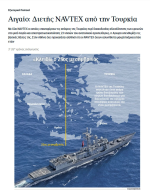
Türkiye's two-year NAVTEX decision, highlighting its resolute stance in the Aegean Sea, has caused panic in Greece

1769319452630.png

The 25th meridian as an implied “dividing line”​

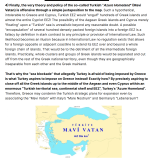
Analysts point to the extended NAVTEX validity as a strategic attempt to shape perceptions over time. More specifically, they argue that Turkey aims to normalize the idea that maritime areas east of the 25th meridian, a line that roughly divides the Aegean in half, fall under Turkish jurisdiction.

 
Greece is not an Archipelagic State

Turkiye insists that equitable principles (special circumstances, proportionality, etc.) must prevail in semi-enclosed seas like the Aegean especially to avoid giving excessive effect to small/offshore islands

Turkiye rejects full EEZ/continental shelf rights for Greek Islands east of the 25th meridian (closer to Turkiye)

Turkiye opposes Greek 12-nm extension in the Aegean, viewing it as a major threat to Turkish security and access to the high seas

Turkey is lawless

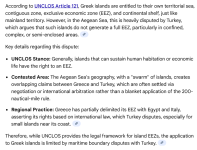
Screenshot 2026-01-24 at 23-18-56 According to UNCLOS do Greek islands have a right to EEZ - G...png
 
The debunking of Turkish arguments:


Screenshot_2022-12-19 The Aegean dispute and the Turkish strategic doctrine of the “Mavi Vatan...png

Screenshot_2022-12-19 The Aegean dispute and the Turkish strategic doctrine of the “Mavi Vatan...png

And then?

Screenshot_2022-12-19 The Aegean dispute and the Turkish strategic doctrine of the “Mavi Vatan...png
 
how long before this thread turns into a blackhole and consumes us all :rofl: :rofl:
 
Current situation (6-mile territorial waters regime):

Greek territorial waters:
Approximately 35–43.5%
Turkish territorial waters: Approximately 7.5–8.8%
High seas/international waters: Approximately 49–56%


If Greece extends to 12 miles (12-mile regime):

Greek territorial waters:
Approximately 70–71.5%
Turkish territorial waters: Less than approximately 8 %
High seas/international waters: Approximately 19-20 %


These figures stem from the geographical structure of the Aegean Sea (the Greek islands are very close to the Turkish coast and numerous).
If the 12-mile limit were extended, the territorial waters of the islands would be connected, and a large part of the Aegean would fall under Greek sovereignty.

Türkiye's coastline would be "imprisoned," and its access to the open sea would be severely restricted

View attachment 174576

Current situation (6-mile territorial waters regime):
Greece : 35–43.5%
Turkiye : 7.5–8.8%
High seas/international waters: 49–56%

Greek offer to Turkiye
Greece : 72%
Turkiye : 8
High seas/international waters: 20%

And they still shamelessly accuse Türkiye of expansionism.

Debunking turkish claims:


Screenshot_2022-12-19 The Aegean dispute and the Turkish strategic doctrine of the “Mavi Vatan...png


Screenshot_2022-12-19 The Aegean dispute and the Turkish strategic doctrine of the “Mavi Vatan...png
 
how long before this thread turns into a blackhole and consumes us all :rofl: :rofl:

Thats the point. lol

This argument starts ever few days and takes over other threads that get derailed. Anytime it happens again, I'll just move the comment/conversation here, and they can discuss here to their heart's content, without sending the other threads onto a tangent.
 
No,Turkey doesn't want access to the sea. You already have all that for your commercial ships. What your leaders and warhawks want is 50% of the Aegean to drill and for fishing.
And that's the problem.
The Aegean Sea has negligible hydrocarbon resources, unlike the Eastern Mediterranean, which possesses enormous hydrocarbon potential. There are fishing rights, and that in itself is fair. Stop making baseless claims out your Greece arse.
There Aegean has around 6,000 islands and islets under Greek jurisdiction and ownership. Yet the Turkish narrative is "The Aegean Sea is not a greek lake".
Eritrea owns and controls approximately 5,000 islands and islets in the Red Sea. However, they don't claim that "the Red Sea is Eritrea's lake." Eritrea legally has as many rights as Greece, but its exclusive economic zone rights are equally divided between the African and Asian plates; they are not as greedy as the Greeks.
 
With the current 6-mile territorial waters situation
Turkish Warships and Submarines have the capability to pass through the open sea from Aksaz Naval Base to Gölcük Naval Base and the Black Sea

The Turkish Navy can also conduct exercises in the Aegean Sea
1769415385395.png

If Greece extends its territorial waters to 12 miles, Turkish Warships-Submarines will lose ease of passage and will not even be able to conduct exercises in the Aegean Sea
1769415777965.png
 
1769426361327.png
one question
how tf did turkey get these maritime borders , like did u guys ever take these islands
or did u have them give them up when the ottoman empire fell
just want a history lesson no politics pls
 

Users who are viewing this thread

Pakistan Defence Latest

Back
Top