US pushes Vietnam to decouple from Chinese tech, sources say

Vietnam's trade surplus with US hits record as exports surge despite tariffs​

December 6, 202512:00 PM GMT+8Updated December 6, 2025
  • Vietnam's surplus with Washington rises to $121.6 billion
  • Vietnam's trade deficit with China up to $104.3 billion
  • Foreign investment inflows up 8.9% in January-November period
HANOI, Dec 6 (Reuters) - Vietnam's trade surplus with the United States, its main market, rose to $121.6 billion in the first 11 months of the year, official data showed on Saturday, as exports surged despite U.S. import tariffs imposed in August on Vietnamese goods.

For the first 11 months of this year, Vietnam recorded a total trade surplus of $20.53 billion - mostly on a positive balance with the United States, the European Union and Japan - which more than offset deficits with China and South Korea.

The trade deficit with China in the January-November period rose 38.1% year-on-year to $104.3 billion.

Finance Minister Nguyen Van Thang on Saturday said foreign investment inflows in the January-November period rose 8.9% from a year earlier to $23.6 billion, while pledges were up 7.4%.


Trump's pick as Vietnam envoy sets sights on trade gap as Hanoi's surplus with US tops China's​

January 13, 20264:02 PM GMT+8Updated 19 hours ago
  • Trump's nominee envoy to Vietnam warns of "imbalanced" trade ties
  • Vietnam's surplus with U.S. is at record high despite tariffs
  • Hanoi has higher surplus with Washington than China
HANOI, Jan 13 (Reuters) - The Trump administration plans to replace the U.S. ambassador to Vietnam with a nominee set on addressing "imbalanced" trade relations, as Hanoi's goods trade surplus with Washington surpassed China's in recent quarters while it was locked in unresolved tariff negotiations with Washington.

On Sunday, current ambassador Marc Knapper will end his tenure after being abruptly recalled before Christmas alongside several other career diplomats. His designated successor, career diplomat Jennifer Wicks McNamara, who is awaiting U.S. Senate confirmation after being nominated in October, has said the trade relationship needs rectifying.

The Southeast Asian nation reported record exports to the United States last year despite 20% U.S. tariffs since August, generating a surplus of nearly $134 billion, according to Vietnamese government data, which are more conservative than U.S. figures.

"The current trade relationship is imbalanced," Wicks told U.S. lawmakers in December, noting that if confirmed she would promote equitable access for U.S. goods and services to Vietnam and encourage Vietnamese investment in the United States.

The latest seasonally adjusted U.S. data shows Vietnam's January to October trade surplus in goods reached $144.2 billion, already surpassing its full-year 2024 record.

Vietnam's rise is closely linked to a sharp decline in China's trade with the United States: Beijing's goods trade surplus nearly halved to $41.4 billion in the third quarter from the same quarter in 2024, whereas Vietnam's rose by about 43% in the same period to $44.8 billion, according to seasonally adjusted U.S. data.


Trump's pick as Vietnam envoy sets sights on trade gap as Hanoi's surplus with US tops China's​

January 13, 20264:02 PM GMT+8Updated 19 hours ago
  • Trump's nominee envoy to Vietnam warns of "imbalanced" trade ties
  • Vietnam's surplus with U.S. is at record high despite tariffs
  • Hanoi has higher surplus with Washington than China
HANOI, Jan 13 (Reuters) - The Trump administration plans to replace the U.S. ambassador to Vietnam with a nominee set on addressing "imbalanced" trade relations, as Hanoi's goods trade surplus with Washington surpassed China's in recent quarters while it was locked in unresolved tariff negotiations with Washington.

On Sunday, current ambassador Marc Knapper will end his tenure after being abruptly recalled before Christmas alongside several other career diplomats. His designated successor, career diplomat Jennifer Wicks McNamara, who is awaiting U.S. Senate confirmation after being nominated in October, has said the trade relationship needs rectifying.

The Southeast Asian nation reported record exports to the United States last year despite 20% U.S. tariffs since August, generating a surplus of nearly $134 billion, according to Vietnamese government data, which are more conservative than U.S. figures.

"The current trade relationship is imbalanced," Wicks told U.S. lawmakers in December, noting that if confirmed she would promote equitable access for U.S. goods and services to Vietnam and encourage Vietnamese investment in the United States.

The latest seasonally adjusted U.S. data shows Vietnam's January to October trade surplus in goods reached $144.2 billion, already surpassing its full-year 2024 record.

Vietnam's rise is closely linked to a sharp decline in China's trade with the United States: Beijing's goods trade surplus nearly halved to $41.4 billion in the third quarter from the same quarter in 2024, whereas Vietnam's rose by about 43% in the same period to $44.8 billion, according to seasonally adjusted U.S. data.
Very misleading
China trade surplus is $1.19 trillion.
Vietnam trade surplus in comparison is like a chicken to a gorilla.
Say goodbye to Marc Knapper
1768368627880.png
 
Very misleading
China trade surplus is $1.19 trillion.
Vietnam trade surplus in comparison is like a chicken to a gorilla.
Say goodbye to Marc Knapper
View attachment 172121
Maybe now Trump will make Vietnam a primary target on tariff war, before was China. But, after all, China doesn't give a hoot to what Trumpy US does to China, China just reciprocates. Maybe Vietnamese leader should give huge good-luck money red envelops to Trumpy and his ambassador, then they might spare Vietnam.
 
Maybe now Trump will make Vietnam a primary target on tariff war, before was China. But, after all, China doesn't give a hoot to what Trumpy US does to China, China just reciprocates. Maybe Vietnamese leader should give huge good-luck money red envelops to Trumpy and his ambassador, then they might spare Vietnam.
Trump can ask China, Ccp is rich.

There isn’t much money in the red envelope. We usually just put in $1 note.
I think at best we can offer Trump we do investing in farming. The US imports more than $200 billion a year. That’s something we can do to make the US more food sufficiency.
 
I think at best we can offer Trump we do investing in farming. The US imports more than $200 billion a year. That’s something we can do to make the US more food sufficiency.
My friend, you seem unaware that the United States is the world's largest and most advanced agricultural nation. They have a clear leading edge in the agricultural sector.

Can Vietnam help them in this area? Of course, if Vietnam were willing to buy large quantities of American agricultural products, Trump would be very happy.
 
My friend, you seem unaware that the United States is the world's largest and most advanced agricultural nation. They have a clear leading edge in the agricultural sector.

Can Vietnam help them in this area? Of course, if Vietnam were willing to buy large quantities of American agricultural products, Trump would be very happy.
Why Apple makes iPhones in China and India? Why Google makes smartphones in Vietnam?
Yes ok, the US have the technology they can produce all smartphones and foods they need but at what cost? Technology can make stuffs more expensive.
Food cost 80 percent less in Vietnam. I ask openAI, here for comparison. Certainly not as cheap as if producing in USA but I would participate less than the US pay today.
prices in Vietnam (per unit):
  • Rice (1 kg): ~ $0.9 – $0.92 (approx.)
  • Eggs (12): ~ $1.4 – $1.5
  • Bread (500 g): ~ $0.88
  • Chicken (1 kg): ~ $3.5
  • Apples (1 kg): ~$2.7
  • Water (1 L): ~$0.3 – $0.5

In the U.S. (same items):
  • Rice (1 kg): ~$4.4 – $4.6
  • Eggs (12): ~$4.4 – $4.7
  • Bread (500 g): ~$3.5 – $3.7
  • Chicken (1 kg): ~$11 – $12
  • Apples (1 kg): ~$5.1 – $5.4
  • Water (1 L): ~$1.4 – $1.5
 

Exclusive: Huawei, ZTE seal 5G deals in Vietnam after US tariffs, as ties with China warm​

November 28, 20258:36 AM GMT+8Updated 1 hour ago

  • Vietnam embraces Chinese tech amid strained US relations
  • ZTE, Huawei win major contracts as Vietnam shifts approach
  • Western officials cast doubts on tech cooperation with Hanoi, sources say
HANOI, Nov 28 (Reuters) - China's leading telecommunication firms Huawei and ZTE (000063.SZ), opens new tab have won a string of contracts this year to supply 5G equipment in Vietnam, in another sign of Hanoi's strengthening bonds with Beijing, stirring concern among Western officials, seven people with direct knowledge of the situation told Reuters.

For years, Vietnam was seen as reluctant to use Chinese technology in sensitive infrastructure, but in recent months it has embraced Chinese tech companies as sometimes frosty relations with its northern neighbour have warmed while ties with Washington have soured over tariffs on Vietnamese goods.

While Sweden's Ericsson (ERICb.ST), opens new tab and Finland's Nokia (NOKIA.HE), opens new tab secured contracts for Vietnam's 5G core infrastructure, with U.S. chipmaker Qualcomm (QCOM.O), opens new tab providing network equipment, Chinese companies have begun winning smaller tenders with state-owned operators, so far unreported public procurement data shows.

A consortium including Huawei was awarded a $23 million contract for 5G equipment in April, weeks after the White House announced tariffs on Vietnamese goods. ZTE has won at least two contracts, one last week, totalling more than $20 million for 5G antennas. The first publicly disclosed deal came in September, a month after U.S. tariffs took effect.

Reuters could not establish whether the timing of these wins was linked to U.S. tariffs, but the deals raised concerns among Western officials.

The exclusion of Chinese contractors from Vietnam's digital infrastructure, including undersea fibre-optic cables, has long been identified by Washington as a key condition for support in advanced technologies.

Huawei and ZTE are banned from U.S. telecom networks as an "unacceptable risk" to national security. Sweden and other European countries have similar restrictions.
Ericsson declined to comment on Chinese companies, but said it was "fully committed to support its customers in Vietnam."

Huawei, ZTE, Nokia, Qualcomm, the U.S. embassy in Vietnam, China's embassy, Sweden's foreign ministry or Vietnam's tech ministry responded to requests for comment.


Northern Vietnam province urges Huawei to invest in semiconductors, training​

Mon, February 24, 2025 | 4:55 pm GMT+7

Bac Ninh, the biggest recipient of registered foreign direct investment (FDI) in Vietnam in 2024, has urged Chinese giant Huawei to invest in the province, especially in semiconductors and workforce training.

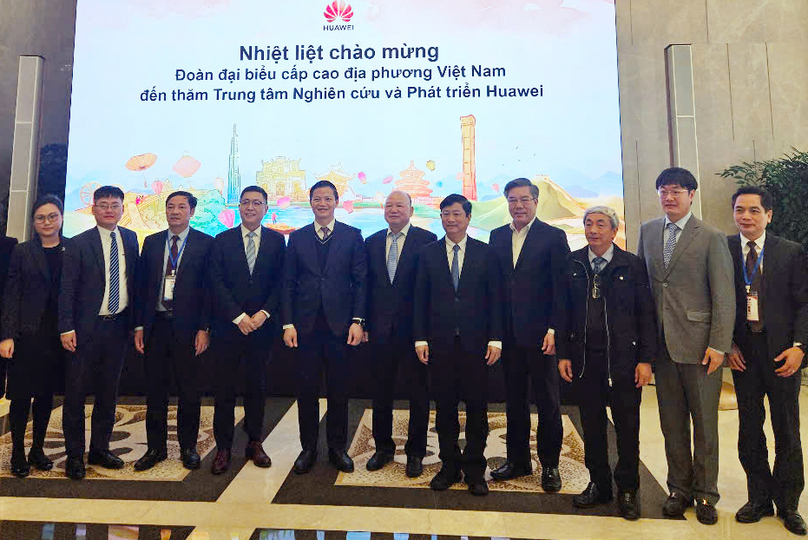
Bac Ninh Chairman Vuong Quoc Tuan made the suggestion during a recent visit to Huawei's headquarters in Beijing, according to provincial authorities.

Tuan also called on Huawei to advise the province in developing its information-technology (IT) park and invest in manufacturing of high-tech products and electronic items as well as supporting industries.

Bac Ninh Chairman Vuong Quoc Tuan (fifth, left) visits Huawei headquarters in Beijing, on February 20, 2025. Photo courtesy of Bac Ninh news portal.

Tuan highlighted that Bac Ninh would focus on attracting foreign investments with modern and eco-friendly technologies. Another priority of Bac Ninh is to push digitalization to serve businesses and citizens, he noted.

Huawei started investing in Vietnam in 1998. The Chinese giant is cooperating with Vietnam in 5G deployment, solar energy, and others.

In May 2024, vice president of Huawei Asia Pacific Zhengjun Zhang affirmed the giant aims to expand activities in Vietnam, including 5G network deployment, digitalization, artificial intelligence, and green transformation.


Exclusive: Vietnam eyes new 5G deals with Chinese tech firms, sources say, despite US warnings

March 6, 202612:12 PM GMT+8Updated 2 hours ago
  • Deals would follow 5G contracts signed last year by Huawei, ZTE with Vietnamese partners
  • Contracts may precede possible visit to China by Vietnam's leader To Lam, source says
  • US warns Chinese 5G providers could pose security risks
HANOI, March 6 (Reuters) - Vietnam's police-owned telecom operator Mobifone is in talks with Chinese tech firms over new contracts to build parts of its 5G network, three people briefed on the plan said, despite U.S. warnings of ‌security risks following earlier deals.

The talks precede a planned visit to China by Vietnam's top leader To Lam in coming weeks, one of the sources said, in a new sign of warming ties between the two Communist neighbours.

Any deal by Mobifone would follow market leaders Viettel and VNPT, which signed 5G supply contracts last year with ZTE and Huawei, in a notable shift from years of caution toward Chinese 5G technology amid warming bilateral ties.

Mobifone is planning to launch a tender to roll out advanced antennas, known as base stations, for its 5G infrastructure which is expected to result in Chinese companies developing a substantial portion of its ⁠network, the three people said, declining to be named as the information was not public.

Two of them cited possible quotas for Chinese firms. The other said a decision to assign contracts to the Chinese had been already made.

The sources did not say which Chinese supplier could get new contracts, but one said Mobifone discussed the new tender with tech giant Huawei. State-owned ZTE is Huawei's largest Chinese rival.

Huawei, ZTE, Mobifone and Vietnam's foreign ministry did not respond to requests for comment.

Mobifone, which was placed under Vietnam's public security ministry last year, is the third largest telecom operator in Vietnam.

The tender would not cover big cities, two of the sources said, but would expand Mobifone's infrastructure which, while limited, is already deployed in strategic locations.

Mobifone does not disclose the location of its existing 5G towers, but a recent visit to a rooftop in central Ho Chi Minh City, Vietnam's business hub, showed a Huawei 5G base station already mounted on a tower branded with Mobifone's logo, close to the U.S. Consulate General and offices ‌of foreign ⁠governments and companies.
 

Update: Chinese senior officials to attend ministerial meeting of China-Vietnam "3+3" strategic dialogue in Vietnam​

Source: Xinhua
2026-03-13 19:56:17

BEIJING, March 13 (Xinhua) -- A Chinese foreign ministry spokesperson announced here Friday that at the invitation of the Vietnamese side, member of the Political Bureau of the Communist Party of China (CPC) Central Committee and Minister of Foreign Affairs Wang Yi, member of the CPC Central Committee Secretariat and Minister of Public Security Wang Xiaohong, and Minister of National Defense Dong Jun will be in Vietnam from March 15 to 17 for the first ministerial meeting of the China-Vietnam "3+3" strategic dialogue on diplomacy, defense and public security.


Vietnam produces world's largest trade surplus with US​

March 13, 20262:12 PM GMT+8Updated 19 hours ago

HANOI, March 13 (Reuters) - Vietnam produced the largest trade surplus with the United States in January, overtaking both Mexico and China, latest official U.S. data shows, as its exports rose sharply while Chinese direct shipments to the United States ‌fell.

Hanoi has been negotiating a trade deal with Washington for months but no agreement has been reached because of the large trade gap and disagreements over tariff rates the U.S. wants to impose on Vietnamese goods, officials have said.

 
easy to understand. Trump wants Vietnam to reorganise the supply chain, more import from US. he looks at Vietnam import. $162 billion from China last year 2024, this year 2025 probably $200 billion.
the MAGA endgame is isolating, weakening China.
that’s unrealistic. Vietnam gov will never agree.
A very realistic problem.

Due to exchange rates and transportation issues, importing from the United States would lead to a significant increase in costs. Higher costs mean higher selling prices. Such products would have no competitiveness unless they are sold to the United States.

Currently, the United States requires priority for itself in cooperation, while Vietnam needs to yield benefits in cooperation. Trump frequently raises tariffs, which is a huge risk for any company.

The United States has an unstable government, and Trump's term is less than three years. Moreover, American policy is not continuous. If Trump cannot be re-elected, after three years, countries or companies cooperating with the United States would need to adjust their cooperation strategies.

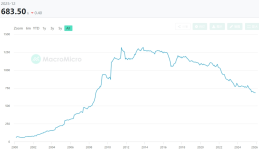
The United States has lost most of its industrial base. The U.S. cannot help Vietnam establish an industrial chain. Due to dollar-denominated debt and the American stock market bubble, the current U.S. dollar is very unstable and carries significant financial risks. This is the curve of changes in the amount of U.S. debt held by China.

1773456104959.png

No country or company can bear all the risks mentioned above.
 
A very realistic problem.

Due to exchange rates and transportation issues, importing from the United States would lead to a significant increase in costs. Higher costs mean higher selling prices. Such products would have no competitiveness unless they are sold to the United States.

Currently, the United States requires priority for itself in cooperation, while Vietnam needs to yield benefits in cooperation. Trump frequently raises tariffs, which is a huge risk for any company.

The United States has an unstable government, and Trump's term is less than three years. Moreover, American policy is not continuous. If Trump cannot be re-elected, after three years, countries or companies cooperating with the United States would need to adjust their cooperation strategies.

The United States has lost most of its industrial base. The U.S. cannot help Vietnam establish an industrial chain. Due to dollar-denominated debt and the American stock market bubble, the current U.S. dollar is very unstable and carries significant financial risks. This is the curve of changes in the amount of U.S. debt held by China.

View attachment 185666

No country or company can bear all the risks mentioned above.
It’s not only the distance.
Vietnam needs inputs to manufacture them into finished goods. who can provide it?
We need those inputs fast, reliable,
in a giant scale at low cost.
China dominates manufacturing, how can Vietnam find a way out of Chinese manufacturing?
That’s is a thing of impossibility. It’s ridiculous.
 

Update: Chinese senior officials to attend ministerial meeting of China-Vietnam "3+3" strategic dialogue in Vietnam​

Source: Xinhua
2026-03-13 19:56:17

BEIJING, March 13 (Xinhua) -- A Chinese foreign ministry spokesperson announced here Friday that at the invitation of the Vietnamese side, member of the Political Bureau of the Communist Party of China (CPC) Central Committee and Minister of Foreign Affairs Wang Yi, member of the CPC Central Committee Secretariat and Minister of Public Security Wang Xiaohong, and Minister of National Defense Dong Jun will be in Vietnam from March 15 to 17 for the first ministerial meeting of the China-Vietnam "3+3" strategic dialogue on diplomacy, defense and public security.


Monday, 06:21, 16/03/2026

VOV.VN - Vietnamese Foreign Minister Le Hoai Trung and his Chinese counterpart Wang Yi held strategic talks in Hanoi on March 15, focusing on strengthening political trust and expanding practical cooperation between the two countries.

To create new breakthroughs in practical cooperation, Trung proposed enhancing the quality and effectiveness of collaboration across multiple areas. He stressed the need to promote balanced and sustainable trade, expand imports of Vietnamese goods, especially agricultural products, accelerating strategic connectivity, and strengthening high-quality investment and technology transfer in industrial cooperation. He also suggested closer coordination to ensure energy security.

Vietnam also proposed that China increase the number of scholarships available to Vietnamese students, particularly in fields such as basic sciences and high technology. The Vietnamese side further encouraged stronger cooperation between localities and expanded exchanges in culture, education and tourism in order to increase visitor flows between the two countries.

Welcoming the proposals, Wang affirmed that China is ready to work closely with Vietnam to effectively implement high-level common understandings. He said China would continue promoting economic, trade and investment cooperation, while encouraging major Chinese enterprises to expand investment in Vietnam.

China is also prepared to provide additional scholarships for Vietnamese students and further strengthen cultural, educational and tourism exchanges between the two countries.


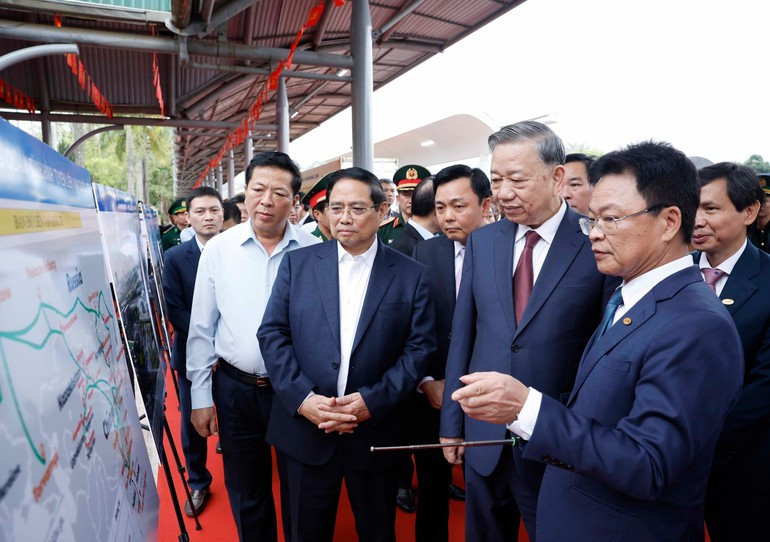
Viet Nam – China railway links must be strategic breakthrough in economic ties: Party chief​

Infrastructure connectivity, especially railway links, between Viet Nam and China must be identified as a strategic breakthrough in bilateral economic ties, said Party General Secretary To Lam.

Thursday, March 19, 2026 at 17:20

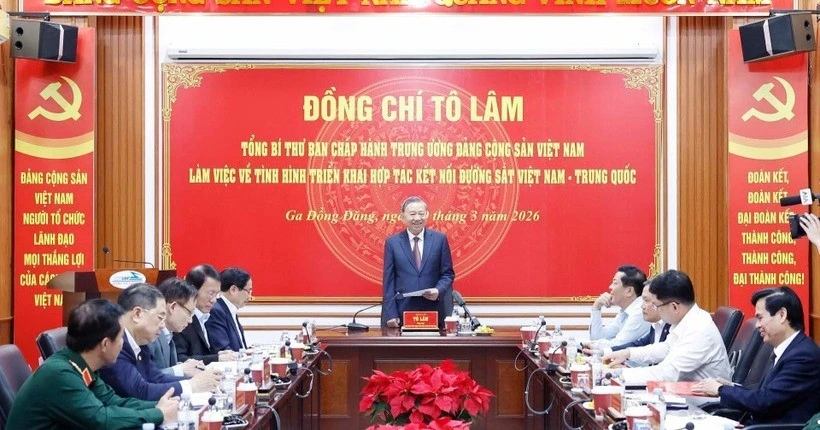
General Secretary To Lam speaks at the meeting. (Photo: VNA)

Chairing a working session with representatives of several ministries, agencies and localities at Dong Dang railway station in Lang Son province on March 19, General Secretary Lam described enhanced rail ties as an important driver of bilateral trade ties into a new stage that is more substantive, effective and sustainable. The push follows the Party’s resolutions and is expected to inject new momentum and open up new space for national economic growth.

Following an on-site inspection at the station, which was also joined by Prime Minister Pham Minh Chinh, he listened to an overview report from the Ministry of Construction (MoC) regarding investment in three railway lines: Ha Noi – Dong Dang, Lao Cai – Ha Noi – Hai Phong, and Hai Phong – Ha Long – Mong Cai. He was also updated on the progress of relevant bilateral agreements, cross-border passenger services, and key issues raised during discussions.

Viet Nam – China railway cooperation is both an imperative and a major opportunity, as well as one of the most practical and effective areas for collaboration in the coming years, he said, adding that it is a powerful lever for Viet Nam to modernise infrastructure, cut logistics costs, expand global reach, and gradually build mastery of a new foundational industry.

vna-potal-tong-bi-thu-lam-viec-ve-trien-khai-hop-tac-ket-noi-duong-sat-viet-nam-trung-quoc-8650700.jpg
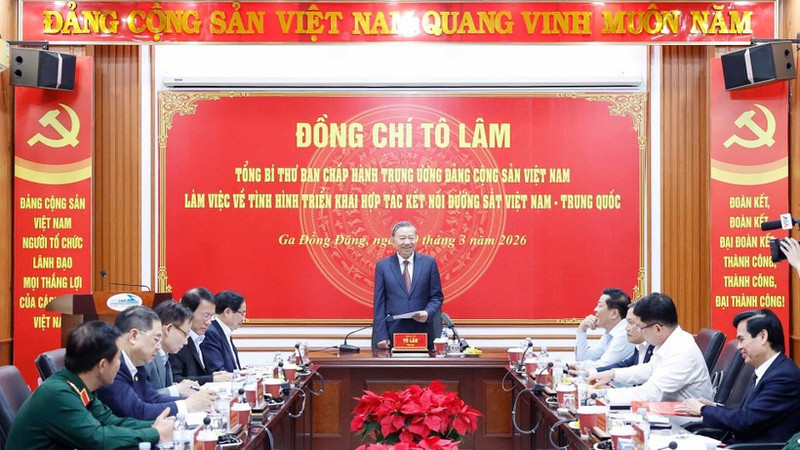
The Party and Government leaders listen to an introduction of the Dong Dang railway station. (Photo: VNA)

He highlighted multiple economic payoffs from improved bilateral rail links: lower logistics costs, shorter transit times, sharper competitiveness, accelerated trade and border economic growth, enhanced customs efficiency, and relief from congestion at road border gates.

Longer-term benefits include the emergence of logistics hubs, border gate economic zones and industrial clusters in frontier provinces, integration into the broader Asia – Europe rail network, thus diversifying transport options, reducing dependence on maritime shipping, creating economic corridors and regional production chains, enhancing regional economic integration, and elevating Viet Nam’s standing within Asian supply chains.

On financing, he stressed the need for diversified and sustainable funding models that safeguard national financial safety. He called for the creation of a single, high-level national coordinating mechanism to oversee these flagship connectivity projects, which clearly delineates responsibilities across ministries, agencies and local authorities while providing a dedicated focal point to manage negotiations, preparation and execution from start to finish.

He added that stronger inter-sectoral coordination must ensure close alignment between transport infrastructure development and regional economic planning, logistics systems and industrial zones along economic corridors, rather than treating railway projects in isolation.

The leader ordered that strategic cooperation principles be upheld and projects must be consistent with Viet Nam’s national development strategy and infrastructure planning. He also underscored the need to diversify funding sources and ensure economic efficiency, technological transparency and clear standards.

As the task is highly demanding, time sensitive and subject to high requirements, the General Secretary pushed for strong resolve and unity across the entire political system. He asked the Government Party Committee, and directly the MoC, to formulate a Viet Nam – China railway development strategy as part of the broader Viet Nam railway development strategy for 2026–2030, with visions toward 2045, 2100 and 2130.
 
The so-called trade "surplus" of Viet Nam with the U.S is one big myth. Most of that trade surplus are from the S. Korean and Japanese companies assemble the final products in Viet Nam and "export" to the U.S market under the "made in Viet Nam" tag. This holds the same for the massive "imports" by Viet Nam from China. Most of those imports are S. Korean and Japanese components produced in China and sent to Viet Nam for final assembly but they register as "imports" from China by Viet Nam. According to the official statistics released by Viet Nam government in 2025, our domestic firms' export is 108 billion and import is 138 billion for a trade deficit of 30 billions; these numbers exclude the trade figures of FDI enterprises in Viet Nam.
 

Exclusive: Vietnam eyes new 5G deals with Chinese tech firms, sources say, despite US warnings

March 6, 202612:12 PM GMT+8Updated 2 hours ago
  • Deals would follow 5G contracts signed last year by Huawei, ZTE with Vietnamese partners
  • Contracts may precede possible visit to China by Vietnam's leader To Lam, source says
  • US warns Chinese 5G providers could pose security risks
HANOI, March 6 (Reuters) - Vietnam's police-owned telecom operator Mobifone is in talks with Chinese tech firms over new contracts to build parts of its 5G network, three people briefed on the plan said, despite U.S. warnings of ‌security risks following earlier deals.

The talks precede a planned visit to China by Vietnam's top leader To Lam in coming weeks, one of the sources said, in a new sign of warming ties between the two Communist neighbours.

Any deal by Mobifone would follow market leaders Viettel and VNPT, which signed 5G supply contracts last year with ZTE and Huawei, in a notable shift from years of caution toward Chinese 5G technology amid warming bilateral ties.

Mobifone is planning to launch a tender to roll out advanced antennas, known as base stations, for its 5G infrastructure which is expected to result in Chinese companies developing a substantial portion of its ⁠network, the three people said, declining to be named as the information was not public.

Two of them cited possible quotas for Chinese firms. The other said a decision to assign contracts to the Chinese had been already made.

The sources did not say which Chinese supplier could get new contracts, but one said Mobifone discussed the new tender with tech giant Huawei. State-owned ZTE is Huawei's largest Chinese rival.

Huawei, ZTE, Mobifone and Vietnam's foreign ministry did not respond to requests for comment.

Mobifone, which was placed under Vietnam's public security ministry last year, is the third largest telecom operator in Vietnam.

The tender would not cover big cities, two of the sources said, but would expand Mobifone's infrastructure which, while limited, is already deployed in strategic locations.

Mobifone does not disclose the location of its existing 5G towers, but a recent visit to a rooftop in central Ho Chi Minh City, Vietnam's business hub, showed a Huawei 5G base station already mounted on a tower branded with Mobifone's logo, close to the U.S. Consulate General and offices ‌of foreign ⁠governments and companies.

Chinese firms' involvement in 5G network may deter investors, EU warns Vietnam​

March 24, 20264:27 PM GMT+8Updated 28 mins ago

HANOI, March 24 (Reuters) - The involvement of Chinese vendors in the rollout of ‌Vietnam's 5G network may deter foreign companies from investing in the Southeast Asian nation, a top EU official said on Tuesday.
 

Viet Nam – China railway links must be strategic breakthrough in economic ties: Party chief​

Infrastructure connectivity, especially railway links, between Viet Nam and China must be identified as a strategic breakthrough in bilateral economic ties, said Party General Secretary To Lam.

Thursday, March 19, 2026 at 17:20

General Secretary To Lam speaks at the meeting. (Photo: VNA)

Chairing a working session with representatives of several ministries, agencies and localities at Dong Dang railway station in Lang Son province on March 19, General Secretary Lam described enhanced rail ties as an important driver of bilateral trade ties into a new stage that is more substantive, effective and sustainable. The push follows the Party’s resolutions and is expected to inject new momentum and open up new space for national economic growth.

Following an on-site inspection at the station, which was also joined by Prime Minister Pham Minh Chinh, he listened to an overview report from the Ministry of Construction (MoC) regarding investment in three railway lines: Ha Noi – Dong Dang, Lao Cai – Ha Noi – Hai Phong, and Hai Phong – Ha Long – Mong Cai. He was also updated on the progress of relevant bilateral agreements, cross-border passenger services, and key issues raised during discussions.

Viet Nam – China railway cooperation is both an imperative and a major opportunity, as well as one of the most practical and effective areas for collaboration in the coming years, he said, adding that it is a powerful lever for Viet Nam to modernise infrastructure, cut logistics costs, expand global reach, and gradually build mastery of a new foundational industry.

vna-potal-tong-bi-thu-lam-viec-ve-trien-khai-hop-tac-ket-noi-duong-sat-viet-nam-trung-quoc-8650700.jpg
The Party and Government leaders listen to an introduction of the Dong Dang railway station. (Photo: VNA)

He highlighted multiple economic payoffs from improved bilateral rail links: lower logistics costs, shorter transit times, sharper competitiveness, accelerated trade and border economic growth, enhanced customs efficiency, and relief from congestion at road border gates.

Longer-term benefits include the emergence of logistics hubs, border gate economic zones and industrial clusters in frontier provinces, integration into the broader Asia – Europe rail network, thus diversifying transport options, reducing dependence on maritime shipping, creating economic corridors and regional production chains, enhancing regional economic integration, and elevating Viet Nam’s standing within Asian supply chains.

On financing, he stressed the need for diversified and sustainable funding models that safeguard national financial safety. He called for the creation of a single, high-level national coordinating mechanism to oversee these flagship connectivity projects, which clearly delineates responsibilities across ministries, agencies and local authorities while providing a dedicated focal point to manage negotiations, preparation and execution from start to finish.

He added that stronger inter-sectoral coordination must ensure close alignment between transport infrastructure development and regional economic planning, logistics systems and industrial zones along economic corridors, rather than treating railway projects in isolation.

The leader ordered that strategic cooperation principles be upheld and projects must be consistent with Viet Nam’s national development strategy and infrastructure planning. He also underscored the need to diversify funding sources and ensure economic efficiency, technological transparency and clear standards.

As the task is highly demanding, time sensitive and subject to high requirements, the General Secretary pushed for strong resolve and unity across the entire political system. He asked the Government Party Committee, and directly the MoC, to formulate a Viet Nam – China railway development strategy as part of the broader Viet Nam railway development strategy for 2026–2030, with visions toward 2045, 2100 and 2130.

Vietnam, China sign cooperation agreement on planning two railways

27/03/2026 00:50 (GMT+07:00)

Vietnam and China have signed a technical cooperation agreement on planning two standard-gauge railways Hanoi – Dong Dang and Hai Phong – Ha Long – Mong Cai, marking progress in bilateral railway connectivity.

The signing took place during a meeting between Vietnamese Deputy Minister of Construction Nguyen Danh Huy and representatives of the International Economic Cooperation Agency of China’s Ministry of Commerce on March 25.

At the meeting, the Chinese side handed over the draft preliminary feasibility study report for the Lao Cai – Hanoi – Hai Phong railway project to Vietnam’s Ministry of Construction.

Huy noted that Vietnam and China had recently signed four cooperation documents in the railway sector. The Ministry of Construction has directed relevant agencies to actively coordinate with their Chinese counterparts to study and implement relevant regulations, procedures and cooperation contents, achieving encouraging initial results.

He said that in the coming time, relevant agencies will continue to promote cooperation in line with the common direction of high-ranking leaders of both Parties and States on developing standard-gauge railways between the two countries, he said.

Zhang Guanbin, director general of the Chinese agency, emphasised that the Lao Cai – Hanoi – Hai Phong railway is one of the key projects in bilateral cooperation.

Recognising the importance of the project, China has prepared the feasibility study, which was assessed as high-quality and reflective of the advanced research capacity of China’s railway sector.

Regarding the Hanoi – Dong Dang and Hai Phong – Ha Long – Mong Cai projects, Zhang said China will follow the model of the Lao Cai – Hanoi – Hai Phong line, while ensuring quality and progress with the highest level of responsibility.

At the meeting, the Vietnam Railway Authority and the Chinese agency co-chaired discussions on the implementation of technical assistance projects for railways connecting Vietnam and China. The two sides exchanged views and reached a broad consensus on outstanding issues while agreeing to strengthen coordination in the coming period.

Earlier, in September 2025, Huy attended the first meeting of the Vietnam–China Joint Committee on Railway Cooperation, which aimed to promote railway collaboration and turn the sector into a symbolic highlight of the practical and strategic cooperation between the two countries./. VNA
 

Users who are viewing this thread

Pakistan Defence Latest

Latest Posts

Back
Top