Aftermath of the Iran-US war and its effects on proximities

Pakistan has nukes. That is enough. If Iran had nukes, would anyone dare attack it?
Nukes are no longer enough, conventional deterrence must be at the maximum. You should know that you're Indian.

You need a powerful shield (nukes) but also a powerful sword (conventional military).
 
I fear that no one is going to theorise this important stuff until it is too late.

Underground missile & drone complexes makes sense.

But we need a strategy of far more advanced dispersal operations to ensure uninterrupted ops because the air force is vulnerable & small in size.

Maybe tons of redundant Balochistan air fields or mountain bases
 
Not relevant to the thread but interesting.
King Charles visited Manchester today and the whole city's GPS was jammed for most part of the day
 
Baghdad US embassy CIWS

 
Not An Yahoo again

To view this content we will need your consent to set third party cookies.
For more detailed information, see our cookies page.
 
Its okay guys Finland and India are coming.

To view this content we will need your consent to set third party cookies.
For more detailed information, see our cookies page.


giphy-downsized.gif
 
Nukes are no longer enough, conventional deterrence must be at the maximum. You should know that you're Indian.

You need a powerful shield (nukes) but also a powerful sword (conventional military).
Mutually Assured Destruction (MAD) goes a long way.

What the original poster proposed is pure madness. The cost alone to build these underground bunkers would be astronomical, and there would be no guarantee they would be safe.

No, deterrence would forestall any war. It has worked so far in South Asia and beyond.
 
No, deterrence would forestall any war. It has worked so far in South Asia and beyond.
It hasn't really, all signs point to the opposite.

Take India-Pakistan, they've only continued to go further in escalation in each conflict and the last round led to missile flinging in the air & ground. Billions of damages totalled on each side. Deterrence is collapsing globally.

I agree on OPs exaggeration though
 

Why the Iranian regime did not collapse after Khamenei’s assassination

The Iranian regime is designed to survive power vacuums. That, however, does not mean it will survive the war unscathed.

Thousands march for Palestine during al-Quds Day.

Iranians take part in a protest marking the annual al-Quds Day in Tehran, Iran, on March 13, 2026 [Majid Asgaripour/WANA via Reuters]


By Abdullah Fahad Al-Nafisi
Published On 17 Mar 202617 Mar 2026

It is not true that the killing of Iran’s Supreme Leader Ali Khamenei necessarily means the immediate collapse of the regime.

This is a hasty reading, reflecting more wishful thinking than sober analysis. Yes, we are witnessing a seismic blow, the most dangerous to hit the Islamic Republic since its establishment in 1979. But the more important political question is no: “is the blow bad?” but rather: “was the system built in a way that allows it to absorb a blow of this magnitude?”

The available evidence so far indicates that the system was designed from the outset not to be merely the shadow of a single man, no matter how elevated his position.

The Islamic Republic is not an autocratic regime like in the familiar Arab context, where the entire structure collapses when its head disappears. It is a complex ideological and securitised system, with a religious head, beneath whom there is a network of solid institutions—some constitutional, some security-related, some bureaucratic and economic—all working to preserve the entity itself, not merely to serve the individual.

For this reason, the killing of the supreme leader does not automatically erase the state, nor topple the regime simply by virtue of the event; rather, it shifts the crisis from the question of “the survival of the head” to the question of “internal cohesion”. The struggle to maintain it is where the real danger lies.

The Iranian constitution itself was drafted with the spectre of a power vacuum in mind. Article 111 stipulates that a temporary council assumes the powers of leadership when the position becomes vacant, until the Assembly of Experts chooses a new leader as soon as possible.

After the announcement of the Leader’s killing, powers were transferred temporarily to a three-man council comprising President Masoud Pezeshkian, the head of the judiciary Gholam-Hossein Mohseni-Eje’i, and Guardian Council member Alireza Arafi.

Meanwhile, the choice of the new supreme leader was in the hands of the Assembly of Experts, which is made up of 88 members.

We can describe this clarity in how to deal with the vacancy of the Leader’s position as a “survival protocol” designed to give the system the capacity to continue even at a moment of maximum shock.

But the bigger mistake would be to be deceived by the constitutional form alone. Yes, the text matters, but the balance of power matters more. Here we must distinguish between three layers from which the system draws its strength.

The first layer is religious legitimacy, represented by the office of the Supreme Leader, the Assembly of Experts, and the Guardian Council. This layer grants the system its doctrinal legitimacy and determines who holds the “seal of legitimacy”. Therefore, the battle over succession is not merely administrative but theological and political at the same time.

The second layer is the security-military sector, headed by the Islamic Revolutionary Guard Corps (IRGC), which is in fact the backbone of the system, not just one of its institutions.

The third layer is the political bureaucracy, meaning the government, the presidency, the judiciary, and the administrative and economic apparatuses that keep the state’s daily functions running and prevent a scene of general collapse.

Among all these layers, the truly decisive one is the IRGC.

Recent reports indicate that, after Khamenei’s killing, the main question is no longer: “Is there a constitutional mechanism?” but rather: “Will the IRGC remain cohesive?” This is because this body is not subordinate to the president, nor is it a conventional army. It is the actual guardian of the revolution, possessing the upper hand in internal security, in regional decision-making, and in economic and influence networks.

Because of the war and the killing of senior commanders, the IRGC has tightened its grip on decision-making in the country, and has come to rely on a degree of operational decentralisation that allows mid-level leadership to continue working quickly.

This means that the blow may have struck the head, but it has not paralysed the limbs.

Based on current indications, it is difficult to assert that the Iranian regime will fall as a result of this war alone. Some signs in fact point to the opposite: ideological regimes, when faced with an external existential threat, may harden rather than collapse, and the targeting of the supreme leader may in the short-term lead to greater hard-line stances and defensive cohesion, not rapid disintegration.

Even some elements of the Iranian opposition abroad have said explicitly that bombing alone does not topple the regime, and that any real change, if it happens, requires an internal dynamic broader than mere military strikes.

However, the absence of immediate collapse does not mean safety. The regime may not fall, but it could emerge from this war exhausted, wary, and more closed in on itself—especially after the selection of Mojtaba Khamenei, the late supreme leader’s son. This, in my view, is the most likely scenario so far: the regime remains, but in a harsher, less self-confident form.

War tests not only deterrent capacity, but also reveals the extent of internal frailty and reshapes centres of power. When a regime emerges from such a war bloodied by losses and with its very head under threat, it tends to choose the security option: it turns inward, expands suspicion, narrows the political sphere, and treats opponents and dissidents as “potential breaches” in the wall of survival.

This tendency has already begun to appear. Reports has spoken of internal fissures that surfaced under the pressure of war—between hardliners close to the IRGC and a relatively less hardline current associated with President Pezeshkian’s positions, especially after the controversy following his remarks about halting attacks on Gulf states.

Some hardline clerics within the system pushed for expediting the choice of a new supreme leader, suggesting unease with having actual power temporarily distributed among a three-man council in the midst of an open war. These are not yet signs of collapse, but they are signs of anxiety within the structure itself.

The dilemma, then, is not the absence of a mechanism, but the environment in which this mechanism is being tested: war, assassination, external pressure, military losses, divisions within the elite, and fear of defection.

In sum, the Iranian regime, up to this moment, does not appear headed for a rapid fall, but it also does not seem capable of emerging from this war unscathed, as it was before. The most likely outcome is that it will endure, but at a high price: greater reliance on the IRGC, less space for politics, heightened sensitivity toward opposition, and a stronger inclination toward internal security contraction.

To put it more plainly: this war may not end the regime, but it may end what remains of its flexibility. When regimes lose flexibility, they may prolong their life by force, but at the same time they begin a slow internal drain. That is the current Iranian paradox: a regime that has not fallen, but is entering a new phase of anxious rigidity—rigidity that may protect it today, and weaken it tomorrow.

The Arabic version of this article was first published by Al Jazeera Arabic.


The views expressed in this article are the author’s own and do not necessarily reflect Al Jazeera’s editorial stance.

  • Abdullah Fahad Al-Nafisi
    Abdullah Fahad Al-Nafisi
    Abdullah Fahad Al-Nafisi is a Kuwaiti academic and a former member of the Kuwaiti parliament.
 
The Iranians call the Arabs traitors and serving the west.
Look at themselves, the Iranians got so many traitors and servants the west sitting at key positions that they can't save any of their important personnel from being killed by Israel.
Now their president Ali Naranjsni has been killed alongside his son, and the intelligence was provided by Iranians.
Better clean your house before blaming neighbours
 

Copenhagen, Iranians gathered in front of the Islamic republic embassy, a man goes over the wall and raises the Lion and Sun flag on the flag pole.​


To view this content we will need your consent to set third party cookies.
For more detailed information, see our cookies page.
 
Why the assassination of Ali Larijani was important for Israel. Israel wanted to sabotage any deal and off-ramp between Iran and the US. Larijani was a bridge between the West and the traditional Iranian clergy.
To view this content we will need your consent to set third party cookies.
For more detailed information, see our cookies page.
 

ASU socialist and Palestinian groups lead joint ‘No War on Iran’ protest on campus, Iranian students push back

A number of leftwing student groups at the Arizona State University staged a protest against the United States’ recent strikes on Iran.​

Iranian students held a counter-protest to ‘make clear that the Iranian people stand with the United States and for human rights, accountability, and peace.’​


Article image


Alena Dasha Peethala '29 |
March 6, 2026, 2:24 pm ET

Socialist and pro-Palestine student groups rallied Monday at Arizona State University to protest U.S. military action involving Iran, drawing pushback from Iranian students who said the activists misrepresented the views and experiences of the country’s people.

The protest, organized by ASU Students for Justice in Palestine, United Campus Workers Arizona, and the Phoenix chapter of the Party for Socialism and Liberation, was branded in a March 1 Instagram post as an “emergency day of action.”

In their joint post, the organizations framed the protest as an opposition to “corporate greed” and “endless war,” adding that “students have always been at the forefront of past anti-war movements.”

[RELATED: Brown reinstates suspended Students for Justice in Palestine chapter]

The groups disabled comments on the post after users challenged their stance and accused organizers of deleting comments from students who expressed support for the military action in Iran.
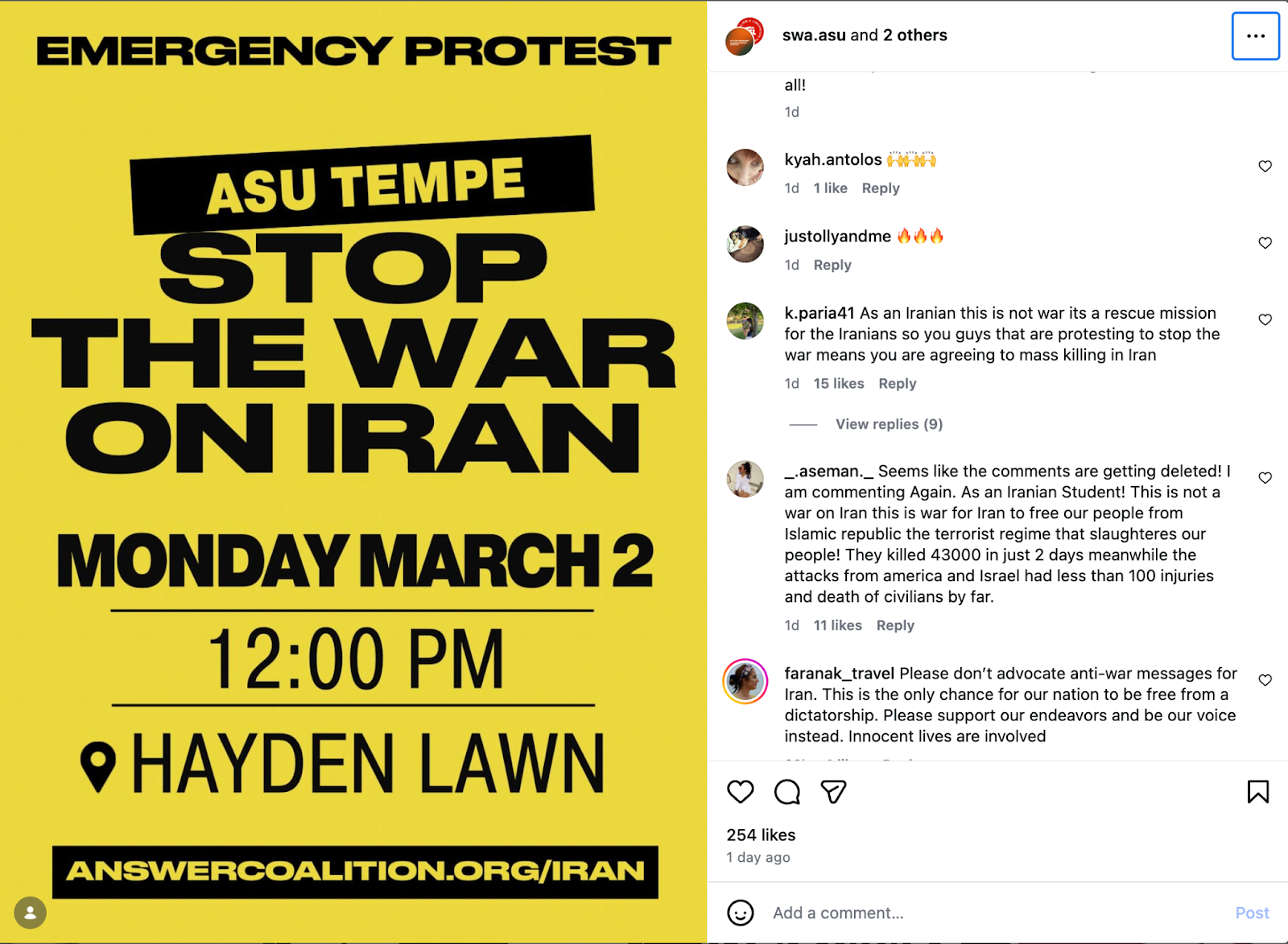


The Party for Socialism and Liberation’s national chapter issued a statement on Feb. 28 condemning U.S. military action and rejecting claims that Iran poses an imminent threat to the United States.

“Today, protests are taking place in scores of cities nationwide,” the organization said in their statement. “These mobilizations will continue, and they will express the sentiment of the majority of people in this country: Stop the war on Iran!”

The ASU Iranian Students Association organized a counter-protest following the campus demonstration, writing in a March 2 Instagram post that the “Iranian people have been in conflict with their own government for over 47 years, suffering repression, crackdowns, and human rights abuses.”

The organization stated that its members would “make clear that the Iranian people stand with the United States and for human rights, accountability, and peace.”

“Many members of our organization felt that the messaging of the protest did not fully reflect the experiences of many Iranians and instead framed the issue in a political way,” AmirDanial Azimi, president of the Iranian Students Association at ASU, told Campus Reform.

”For over four decades, the Iranian people have lived under a dictatorship, facing a lack of basic freedoms and violent crackdowns for speaking out against their government. Most of our members strongly support greater international pressure and accountability toward the Iranian regime, which has brutally oppressed its own people and contributed to violence affecting Americans as well,” Azimi continued.

Azimi explained that universities should absolutely be places where students can engage in open discussion and debate about important global issues but clarified that at the same time, it is important that student voices are not overshadowed by outside political organizations.

[RELATED: Outraged anti-Trump activists mobilize nationwide following joint U.S.-Israel strikes on Iran]

More than a dozen individuals gathered on each side of the lawn, chanting from opposite ends, according to ASU’s student-run newspaper The State Press.

In a statement to Campus Reform, the ASU Media Affairs division cited the university’s free speech policies, which permit demonstrations in designated outdoor areas and outline guidelines for student expression.

The university did not indicate whether it maintains policies governing collaboration between student organizations and outside political groups, such as the Phoenix Party for Socialism and Liberation.

The demonstration comes amid similar campus protests nationwide following joint U.S.-Israel strikes on Iranian targets. Campus Reform previously reported on similar demonstrations at San Jose State University, University of Illinois Chicago, Louisiana State University, and other universities.

ASU Iranian Students Association, ASU Students for Justice in Palestine, United Campus Workers Arizona, and the Party for Socialism and Liberation (Phoenix) have been contacted for comment. This article will be updated accordingly.
 

ASU socialist and Palestinian groups lead joint ‘No War on Iran’ protest on campus, Iranian students push back

A number of leftwing student groups at the Arizona State University staged a protest against the United States’ recent strikes on Iran.​

Iranian students held a counter-protest to ‘make clear that the Iranian people stand with the United States and for human rights, accountability, and peace.’​


Article image


Alena Dasha Peethala '29 |
March 6, 2026, 2:24 pm ET

Socialist and pro-Palestine student groups rallied Monday at Arizona State University to protest U.S. military action involving Iran, drawing pushback from Iranian students who said the activists misrepresented the views and experiences of the country’s people.

The protest, organized by ASU Students for Justice in Palestine, United Campus Workers Arizona, and the Phoenix chapter of the Party for Socialism and Liberation, was branded in a March 1 Instagram post as an “emergency day of action.”

In their joint post, the organizations framed the protest as an opposition to “corporate greed” and “endless war,” adding that “students have always been at the forefront of past anti-war movements.”

[RELATED: Brown reinstates suspended Students for Justice in Palestine chapter]

The groups disabled comments on the post after users challenged their stance and accused organizers of deleting comments from students who expressed support for the military action in Iran.


The Party for Socialism and Liberation’s national chapter issued a statement on Feb. 28 condemning U.S. military action and rejecting claims that Iran poses an imminent threat to the United States.

“Today, protests are taking place in scores of cities nationwide,” the organization said in their statement. “These mobilizations will continue, and they will express the sentiment of the majority of people in this country: Stop the war on Iran!”

The ASU Iranian Students Association organized a counter-protest following the campus demonstration, writing in a March 2 Instagram post that the “Iranian people have been in conflict with their own government for over 47 years, suffering repression, crackdowns, and human rights abuses.”

The organization stated that its members would “make clear that the Iranian people stand with the United States and for human rights, accountability, and peace.”

“Many members of our organization felt that the messaging of the protest did not fully reflect the experiences of many Iranians and instead framed the issue in a political way,” AmirDanial Azimi, president of the Iranian Students Association at ASU, told Campus Reform.

”For over four decades, the Iranian people have lived under a dictatorship, facing a lack of basic freedoms and violent crackdowns for speaking out against their government. Most of our members strongly support greater international pressure and accountability toward the Iranian regime, which has brutally oppressed its own people and contributed to violence affecting Americans as well,” Azimi continued.

Azimi explained that universities should absolutely be places where students can engage in open discussion and debate about important global issues but clarified that at the same time, it is important that student voices are not overshadowed by outside political organizations.

[RELATED: Outraged anti-Trump activists mobilize nationwide following joint U.S.-Israel strikes on Iran]

More than a dozen individuals gathered on each side of the lawn, chanting from opposite ends, according to ASU’s student-run newspaper The State Press.

In a statement to Campus Reform, the ASU Media Affairs division cited the university’s free speech policies, which permit demonstrations in designated outdoor areas and outline guidelines for student expression.

The university did not indicate whether it maintains policies governing collaboration between student organizations and outside political groups, such as the Phoenix Party for Socialism and Liberation.

The demonstration comes amid similar campus protests nationwide following joint U.S.-Israel strikes on Iranian targets. Campus Reform previously reported on similar demonstrations at San Jose State University, University of Illinois Chicago, Louisiana State University, and other universities.

ASU Iranian Students Association, ASU Students for Justice in Palestine, United Campus Workers Arizona, and the Party for Socialism and Liberation (Phoenix) have been contacted for comment. This article will be updated accordingly.
I'm ashamed to admit being a 2x graduate of ASU. Anything conservative is now shunned. Anything pro-left is welcomed with open arms.
 

Users who are viewing this thread

Pakistan Defence Latest

Latest Posts

Back
Top