Chinese Submarines News & Discussions

Implying that more than one has been built?

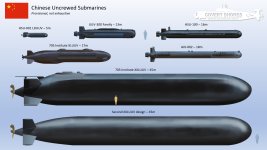
Some Chinese media suggest that China might not equip many Type 041 because now it is favored the combo of the 7000-8000 tons Type 093B and the 10,000-12,000 tons Type 095, also other large unmanned submarines.

China-XLUUV.jpg

Maybe it is the good news that the Type 041 will eventually available for export.
 

China develops world's first crystal enabling GPS-free navigation for submarines​

By Phong Ngo April 16, 2026 | 08:46 pm PT

China develops world's first crystal enabling GPS-free navigation for submarines

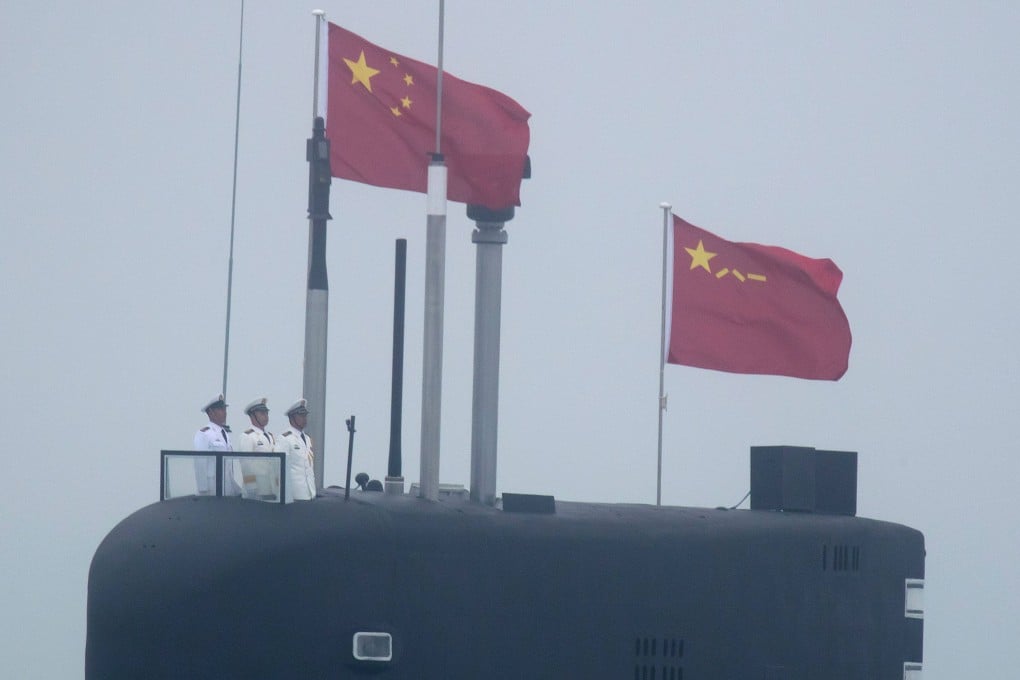
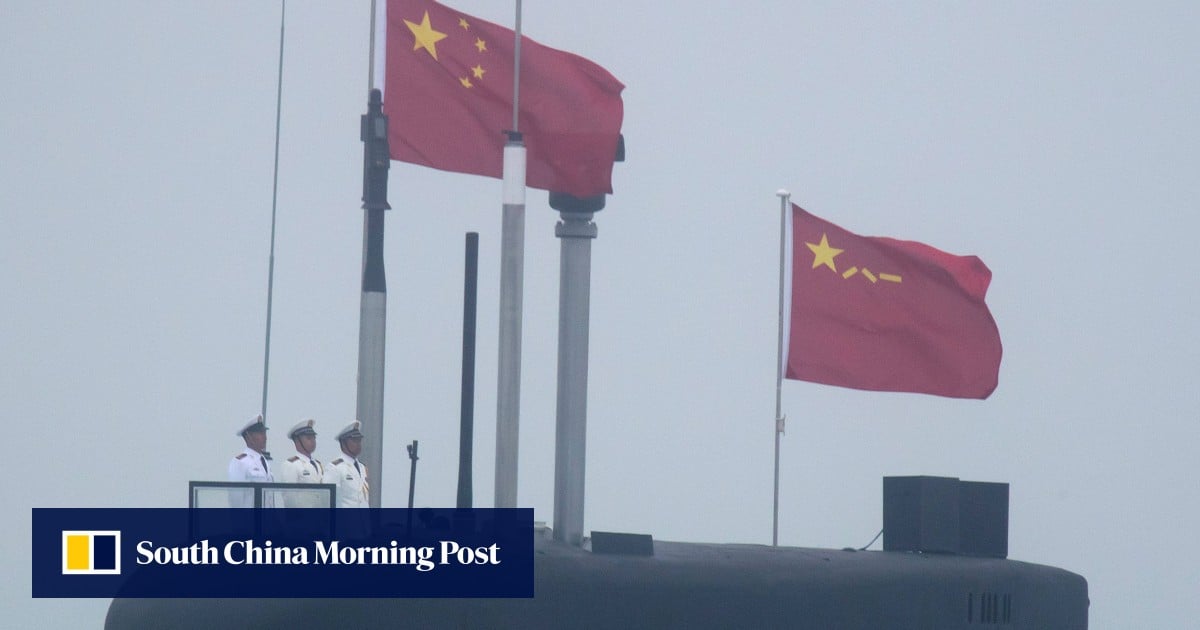
A Chinese Navy submarine attends an international fleet review to celebrate the 60th anniversary of the founding of the People's Liberation Army Navy on April 23, 2009 off Qingdao in Shandong Province. Photo by AFP

Scientists in Xinjiang have developed the world’s first crystal capable of producing ultraviolet light for ultra-precise nuclear clocks, enabling GPS-free navigation for submarines and deep-space probes.

Modern navigation systems rely on time-based calculations, in which devices such as smartphones determine location by receiving satellite signals and measuring how long they take to arrive. This data is then used to triangulate position, meaning higher clock precision leads to greater accuracy.

However, GPS systems can be jammed or spoofed with fake signals and do not function effectively underwater or underground, according to Interesting Engineering. For submarines, this presents a major limitation, as they must surface to obtain GPS signals, increasing their exposure to detection.

To reduce this risk, submarines use atomic clocks, which measure time based on electron vibrations around atoms. While highly accurate, scientists believe nuclear clocks, which rely on vibrations within atomic nuclei, could be 10 to 1,000 times more precise.

A research team led by Pan Shilie at the Xinjiang Technical Institute of Physics and Chemistry focused on Thorium-229, an isotope whose nucleus vibrates at unusually low energy levels, making it suitable for next-generation timekeeping.

Measuring these vibrations requires extremely precise ultraviolet lasers with wavelengths around 148.3 nanometers, which are difficult to produce. The newly developed fluorinated borate crystal addresses this challenge by generating ultraviolet light at a record 145.2 nanometers, meeting a key requirement for nuclear clock systems under development globally, including in the U.S.

The findings, reported in the journal Advanced Materials and cited by the South China Morning Post, surpass previous benchmarks set by potassium beryllium fluoroborate, a material developed in China in the 1990s that could only reach about 150 nanometers.

Researchers said the new crystal also delivers several times higher conversion efficiency than standard materials, allowing more input laser energy to be converted into the required ultraviolet light, improving overall system performance.

Yang Zhihua, a co-author of the study, said the work provides a more systematic method for designing such materials, moving beyond trial-and-error approaches. If produced reliably at scale, the crystal could help shrink nuclear clock systems from laboratory setups into compact devices suitable for real-world applications.


Type 041 Nuclear Submarine: The pillar of PLA Navy’s fully nuclear submarine fleet ambition​

Apr 27, 2026

To view this content we will need your consent to set third party cookies.
For more detailed information, see our cookies page.
 
Best Image so far of the new submarine

View attachment 199975

This submarine is much larger than the Type 041 which is AIP/nuclear battery hybrid.

Since its size is in between of the Virginia block IV and block V.

I am speculating that SSGN has the propulsion of the thorium based reactor.

Because JNCX is the frontrunner of the thorium based reactor, and they are not just planning it for the commercial cargo vessels, but also for the future aircraft carriers and submarines.
 
Last edited:
The new facilities purpose-made for building submarines at Jiangnan are quite impressive.
 

Satellite Captures Unidentified Chinese Submarine With Unusual Design

June 3, 2026
22:09
Satellite Captures Unidentified Chinese Submarine With Unusual Design

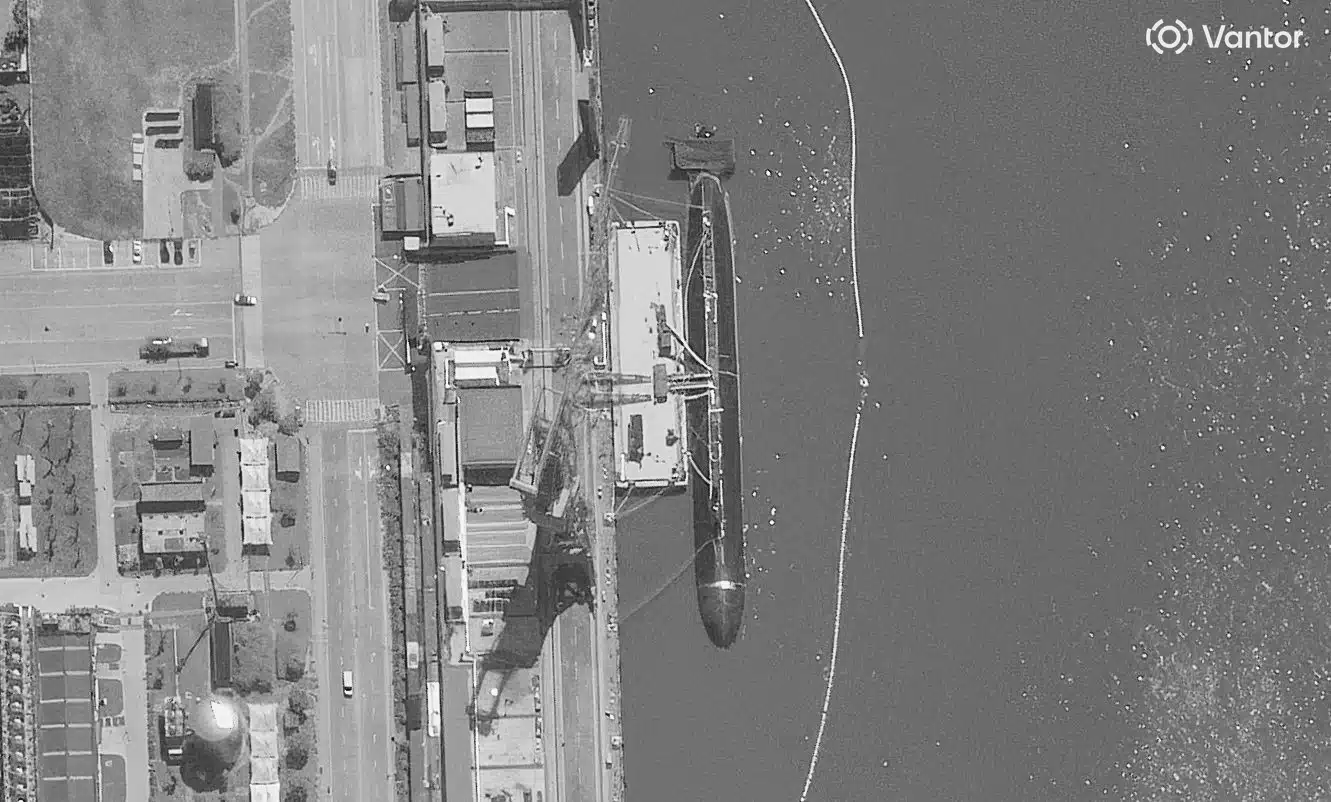
The latest Chinese submarine. Photo credits: Vantor

Satellite imagery has captured a previously unknown Chinese submarine featuring a new design that lacks a traditional sail (conning tower).

This was reported by researcher H I Sutton in a Naval News analysis.

Since there is no official information about the submarine, assessments of its purpose and capabilities are currently based on satellite imagery and expert analysis.

The submarine was spotted in images dated May 31 and June 1, moored near a barge outside the Jiangnan (JN) shipyard in Shanghai.

Although the shipyard is primarily known for building large surface combatants, it also produces non-nuclear submarines.

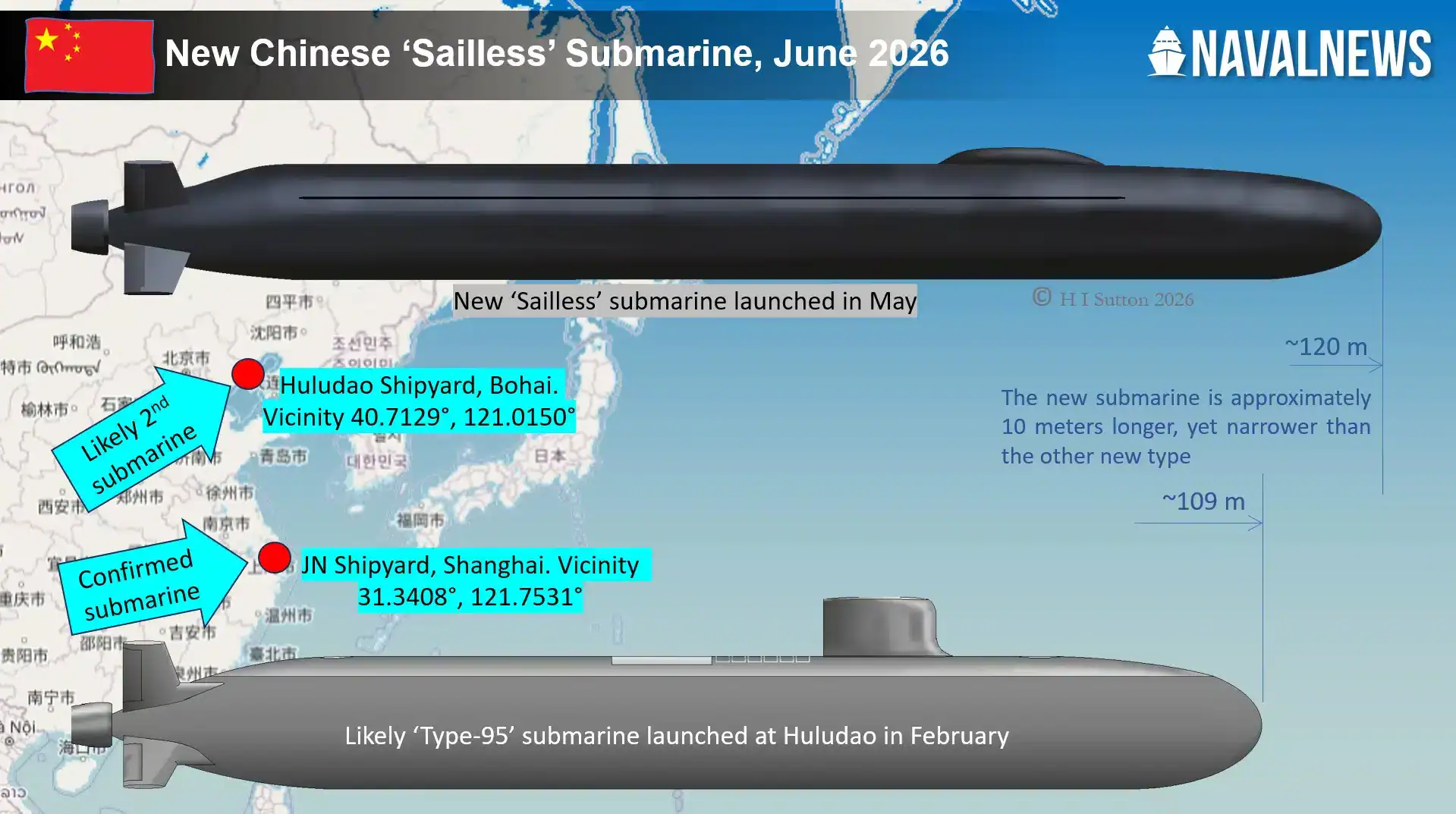
A graphic representation of the new Chinese submarine. Photo credits: H I Sutton/Naval News

Traditionally, China has not officially announced the launch of such submarines, and state media has provided no comment.

Key visible features include a streamlined bow, an X-shaped stern, and an extremely low profile above the waterline.

China has previously experimented with submarines without a sail, including prototypes built at the same shipyard. The configuration is believed to reduce hydrodynamic drag.

Around the same time, another submarine may have been launched at the Huludao shipyard in the Bohai Sea, which specializes in nuclear submarine construction.

Although unconfirmed, there is speculation that both submarines may belong to the same program.

According to estimates, the new submarine is approximately 120 meters long and 10-11 meters wide, making it longer but narrower than another recently launched submarine in Bohai. Analysts suggest it represents a new class of submarine.

It is considered unlikely that the platform is a strategic ballistic missile submarine (SSBN), as such a role would likely require a larger hull, particularly given the size of the JL-3 ballistic missile.
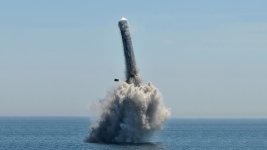
Pusky-mizhkonynentalnoyi-balistychnoyi-rakety-JL-3.jpg
JL-3 intercontinental ballistic missile launch

At the same time, the submarine’s role and propulsion system remain unclear. Given its size, a nuclear power plant is considered the most likely option. If conventionally powered, it could become the largest non-nuclear submarine in the world.

China is also developing compact nuclear power systems in which a low-power reactor serves as an independent energy source without reliance on atmospheric air.

The concept resembles other air-independent propulsion (AIP) systems such as Stirling engines or fuel cells, but could potentially provide higher power output and near-unlimited endurance.

Earlier reports in January stated that China had become the second-largest operator of nuclear submarines globally, surpassing Russia.

 
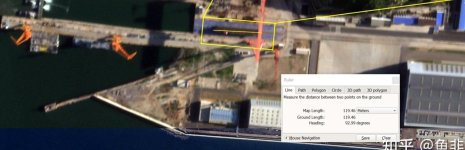
JN's new SSGN is about 120 meters long and over 11 meters in beam.

It should be displaced around 10,000 tons, which is similar to the Virginia class block V.

1.jpg
2.jpg
 
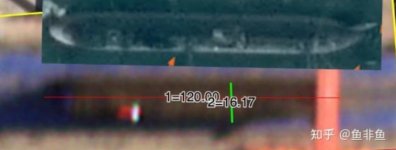
Bohai in fact is ready to launch another sailless monster which is bigger than both Type 095 and JN SSGN.

It is over 120 meters long and has a beam over 16 meters.

3.jpg

4.jpg
 

Users who are viewing this thread

Pakistan Defence Latest

Latest Posts

Back
Top