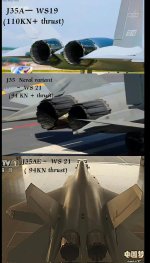
At present, all the information points to the thrust of WS19 being above 110KN. However, the exact value is not clear as each piece of information varies.
Those who know the actual figures dare not speak; those who do not are free to make wild guesses.
Dwelling on this issue serves no practical purpose.
=============================================
BTW.
After careful scrutiny, it can now be essentially confirmed that:
The export-variant J-35 aircraft recently brought to light is not a newly manufactured airframe. Rather, it is the result of a modification applied to an early experimental prototype of the J-35A.
As early as the eve of the PLAAF's 75th anniversary, the J-35A aircraft showcased by the PLAAF actually consisted of two distinct airframes. One was powered by the WS-21 engine, while the other utilized the WS-19 engine. Naturally, beyond the difference in engines, there were also several very subtle structural distinctions between the two airframes.
According to internal conventions within the defense industrial complex, only the J-35 fighter equipped with the WS-19 engine is officially designated as the J-35A. However, at that time, SAC (Shenyang Aircraft Corporation) did not possess a sufficient number of genuine J-35A units available for public display. Consequently, this early experimental prototype—the J-35A (WS-21)—was temporarily loaned to the PLAAF to serve in display events, training exercises, and subsequent military parades.
In reality, however, the PLAAF never placed an order for the WS-21 engine. Therefore, as the production volume of the genuine J-35A (WS-19) gradually increased, this specific J-35A (WS-21) airframe was returned to SAC. SAC subsequently refurbished and modified the aircraft; by removing the PLAAF insignia and repainting it with the AVIC logo, it was transformed into the very J-35 fighter currently being presented for export purposes.
Upon close examination, numerous specific details can be discerned that substantiate this account.