Indian Missiles and Guided Munitions

Typical quasi-ballistic missiles still go upward first, then follow a depressed arc, dip in and out of atmosphere, actively maneuvers during descent. But this particular Indian system never even commits to that arc. Never creates a clean ballistic arc: it turns early, stays low, keeps adding energy and keeps maneuvering the whole way. Uses aerodynamic lift (cruciform surfaces) instead of pure gravity driven descent.
Those mid-body aerodynamic surfaces generate those lifts at hypersonic speeds, allow skip like or sustained glide behavior, helps it to perform lateral + vertical maneuvers. Anyway, it’s up to you what you choose to believe.
So according to you it's not even a quasi ballistic missiles, then all it is is a hypersonic anti ship missile that's boosted with a sustainer motor for the second stage and augmented for lift with fins. You can spin it however you like, but that's all it is. In that respect, it's nothing more than a glorified Exocet with a booster stage.
 
Last edited:
To view this content we will need your consent to set third party cookies.
For more detailed information, see our cookies page.
 
augmented for lift with fins.
Short span, long chord, cruciform layout. Allows roll + pitch + yaw control simultaneously. It uses mid-body fins that stay fixed and generate lift, creating vortex lift along the body. That gives it better stability and keeps aerodynamic efficiency high over a longer part of the flight. At hypersonic speeds, lift doesn’t behave in the usual way. When you say vortex lift, it means the missile is deliberately creating stable vortices along its body to hold lift even at high angle of attack during maneuvers. That basically tells you it’s designed to operate in semi-unstable aerodynamic regimes on purpose, so it can stay controllable while maneuvering.

The inline fin setup keeps things cleaner: less roll coupling headache, simpler control logic and lower parasitic drag at hypersonic speeds. Compared to canted fins (which can squeeze out more lift but also bring extra drag and heating), this setup clearly favors control precision over raw aerodynamic aggressiveness.
 
Last edited:
Somehow the Pakistani media convinced the world SMASH is some kind of hypersonic missile (even though the "S" in the name stand for supersonic). But LR-AShM which is clearly stated as HGV is somehow ballistic missile with fins.

Hypocrisy at peak
 
then all it is is a hypersonic anti ship missile that's boosted with a sustainer motor for the second stage.
A long burn, high energy solid motor. It is the thing due to which it is able to maintain sustained hypersonic speed within dense atmosphere. It helps compensate for the energy lost due to drag. Helps sustain velocity during complex maneuvers. This is very different from traditional glide vehicles which lose energy continuously.
 
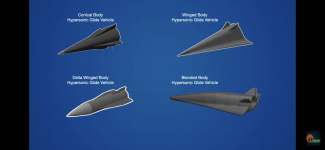
1000051779.pngfor reference not all hgv look the same. There are different types
 
So according to you it's not even a quasi ballistic missiles,
Have you seen the thrust termination port of the Indian missile? The booster stage has active thrust cut-off capability. This isn’t your typical burn to completion solid rocket. It actually manages its energy during the boost phase shaping velocity as it climbs instead of sticking to a fixed path. That lets it adjust trajectory mid-boost, avoid overshooting and set up a much cleaner hypersonic entry into the atmosphere. So it’s not really fire and forget in terms of trajectory. The path is being controlled right from launch which is the kind of sophistication you see in systems like the DF-ZF. With guided boost (FNC active) + thrust termination, India's LR-HM is genuinely competitive just in a different altitude band.
 
Last edited:
A long burn, high energy solid motor. It is the thing due to which it is able to maintain sustained hypersonic speed within dense atmosphere. It helps compensate for the energy lost due to drag. Helps sustain velocity during complex maneuvers. This is very different from traditional glide vehicles which lose energy continuously.
Somehow the Pakistani media convinced the world SMASH is some kind of hypersonic missile (even though the "S" in the name stand for supersonic). But LR-AShM which is clearly stated as HGV is somehow ballistic missile with fins.

Hypocrisy at peak
It's pretty easy to have fins on the final stage of your ballistic missile and say it's a hypersonic weapon. That doesn't mean it's capable of high enough maneuverability at hypersonic speed to count as one.

STANDARD-MISSILE-LAUNCH.jpg

Looking at the picture of it being test launched, the final stage isn't that different to a scaled up SM-6, sat on a ballistic missile first stage. This would likely give low hypersonic terminal speed (Mach 6, not 10), without HGV maneuverability. .
 
It's pretty easy to have fins on the final stage of your ballistic missile and say it's a hypersonic weapon. That doesn't mean it's capable of high enough maneuverability at hypersonic speed to count as one.

View attachment 195778

Looking at the picture of it being test launched, the final stage isn't that different to a scaled up SM-6, sat on a ballistic missile first stage. This would likely give low hypersonic terminal speed (Mach 6, not 10), without HGV maneuverability. .
Short span, long chord fins in a cruciform layout let it control roll, pitch and yaw at the same time. The mid-body fins are fixed and generate lift, creating vortex lift along the body, which keeps it stable and maintains aerodynamic efficiency for longer during flight. At hypersonic speeds, lift doesn’t behave normally. Here, vortex lift means it’s deliberately forming stable vortices so it can hold lift even at high angle of attack while maneuvering. That basically means it’s built to operate in semi-unstable aerodynamic regimes on purpose, so it can stay under control while turning instead of just flying straight.
The inline fin setup keeps things simpler: less roll coupling issues, cleaner control logic and lower parasitic drag at hypersonic speeds. Compared to canted fins, which can give more lift but also bring extra drag and heating, this design clearly focuses more on control precision than raw aerodynamic aggressiveness.
 
Have you seen the thrust termination port of the Indian missile? The booster stage has active thrust cut-off capability. This isn’t your typical burn to completion solid rocket. It actually manages its energy during the boost phase shaping velocity as it climbs instead of sticking to a fixed path. That lets it adjust trajectory mid-boost, avoid overshooting and set up a much cleaner hypersonic entry into the atmosphere. So it’s not really fire and forget in terms of trajectory. The path is being controlled right from launch which is the kind of sophistication you see in systems like the DF-ZF.
A truly advanced hypersonic missile possesses an aerodynamic shape with a high lift-to-drag ratio (such as a waverider), sustained scramjet propulsion, and extensive lateral maneuverability. This necessitates the coordination of thrust, thermal protection, and flight control systems, and cannot be achieved merely by adding four small winglets, as India has done.
 
A truly advanced hypersonic missile possesses an aerodynamic shape with a high lift-to-drag ratio (such as a waverider), sustained scramjet propulsion, and extensive lateral maneuverability. This necessitates the coordination of thrust, thermal protection, and flight control systems, and cannot be achieved merely by adding four small winglets, as India has done.
As I thought, our neighbours only consider waverider and blended body as HGV but by that standard - the dark eagle of usa is also not an HGV but I don't see you guys arguing if dark eagle is hgv or not.

Like I said hypocrisy at peak
 
Short span, long chord fins in a cruciform layout let it control roll, pitch and yaw at the same time. The mid-body fins are fixed and generate lift, creating vortex lift along the body, which keeps it stable and maintains aerodynamic efficiency for longer during flight. At hypersonic speeds, lift doesn’t behave normally. Here, vortex lift means it’s deliberately forming stable vortices so it can hold lift even at high angle of attack while maneuvering. That basically means it’s built to operate in semi-unstable aerodynamic regimes on purpose, so it can stay under control while turning instead of just flying straight.
The inline fin setup keeps things simpler: less roll coupling issues, cleaner control logic and lower parasitic drag at hypersonic speeds. Compared to canted fins, which can give more lift but also bring extra drag and heating, this design clearly focuses more on control precision than raw aerodynamic aggressiveness.

This is the aerodynamic principle of this layout in sub-/transonic maneuvering. However, if it is directly applied to hypersonic flight conditions, several obvious errors will arise.

1,At hypersonic speeds (>5 Mach), the traditional "vortex lift" almost disappears. At this point, the lift mainly comes from shock wave compression (the shock wave body principle) and the effect of high-temperature and high-pressure gases. The vortex edge flaps are difficult to generate effective vortex lift and instead may cause serious problems such as shock wave/fan layer interference.

2,At hypersonic speeds, any protrusions (including the wings) will generate wave drag (the resistance caused by shock waves) and intense aerodynamic heating. The drag usually increases rather than decreases. The concept of "reducing parasitic drag" is applicable to sub-/transonic speeds but not to hypersonic speeds.

3,At hypersonic speeds, even very small airfoils can generate extremely strong rolling moments (due to extremely high dynamic pressure), which may instead cause dangerous inertial rolling coupling. The control difficulty is far greater than that in low-speed flight. This is why many hypersonic missiles adopt wingless, axisymmetric designs - to avoid control risks.

That is to say, if this type of missile is a hypersonic missile throughout its flight, then India's materials science, thermodynamics, and control theory will be several centuries ahead of the rest of the world
.😂😂
 
A truly advanced hypersonic missile possesses an aerodynamic shape with a high lift-to-drag ratio (such as a waverider), sustained scramjet propulsion, and extensive lateral maneuverability. This necessitates the coordination of thrust, thermal protection, and flight control systems, and cannot be achieved merely by adding four small winglets, as India has done.
A waverider + scramjet is one path (like DF-ZF concepts on the glide side or 3M22 Zircon on the cruise side). It optimizes for high L/D or sustained cruise but it also brings huge integration penalties: inlet/combustion stability, narrow flight envelopes, thermal hotspots and more complex basing. India’s LR-HM is solving the same problem in a different way. It uses a solid motor sustainer to keep hypersonic speed inside the atmosphere instead of relying on a scramjet or a pure glide phase. The boost phase is guided during boost (FNC active) with thrust termination, so the missile shapes its trajectory from the first seconds instead of boost → coast → correct. That gives a smoother vertical to horizontal transition, lower structural stress and cleaner setup for the sustainer phase. Conceptually, that kind of guided boost is closer to how systems like DF-ZF handle trajectory shaping than older dumb boost profiles.

The boost phase is guided and has thrust termination, so the vehicle can shape its energy and trajectory early instead of just burning to completion and hoping the path works out. After that, it flies in dense air with continuous control. The mid-body cruciform surfaces generate vortex lift and stabilize the flow while the tail fins handle pitch, yaw and roll. That separation of lift and control lets it maneuver without constantly breaking its own aerodynamic stability which is actually critical at high Mach and high angle of attack. Because it stays low and flies a non-ballistic path, tracking is harder and engagement timelines get compressed. And it’s canisterized on a TEL using mature solid propulsion which matters for reliability, storage and real deployment.
 
images_1777955592720.jpeg
@DÂZÂI
Haha, you've got the difference between the American Dark Eagle missile and this Indian-made missile wrong. The American Shadow missile is called C-HGB. It is mainly connected by two conical bodies. It is first pushed to the edge of the atmosphere, then uses the two conical shapes to create a slanted shock wave, gliding like a water ball. This shock wave can provide shock wave lift, which is the key for it to become a hypersonic missile.
images_1777955970732.jpeg
There are many similar configurations of missiles as well. However, since the Dark Eagle missile uses high specific impulse propellants and high-strength carbon fiber casings, its speed exceeds 10 Mach and can generate stronger lift.
 
View attachment 195782
@DÂZÂI
Haha, you've got the difference between the American Dark Eagle missile and this Indian-made missile wrong. The American Shadow missile is called C-HGB. It is mainly connected by two conical bodies. It is first pushed to the edge of the atmosphere, then uses the two conical shapes to create a slanted shock wave, gliding like a water ball. This shock wave can provide shock wave lift, which is the key for it to become a hypersonic missile.
View attachment 195783
There are many similar configurations of missiles as well. However, since the Dark Eagle missile uses high specific impulse propellants and high-strength carbon fiber casings, its speed exceeds 10 Mach and can generate stronger lift.
The U.S. system you’re referring to is the Common Hypersonic Glide Body used by Dark Eagle / LRHW. It’s a hgv with a waverider type forebody, designed to ride its own shock and generate compression (shock) lift after a boost to high altitude. That lift mechanism comes from the shock attached flow over a shaped lifting body not from just having two cones. Lift depends on geometry, AoA and the pressure field created by the shock system. Speed helps but you get lift by shaping the flow correctly and staying within thermal and control limits. Materials like carbon composites help with mass fraction and heat tolerance but they don’t magically create lift. And gliding like a water ball isn’t how it works. An HGV follows a skip-glide / depressed trajectory with controlled AoA, trading altitude for range while managing heating and control authority.
 

Users who are viewing this thread

Pakistan Defence Latest

Back
Top