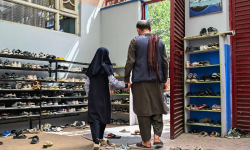
Afghan women / Girls bar from education and job.

The restrictions have transformed the face of Herat, once known as Afghanistan’s cultural capital where female university students outnumbered men before the Taliban government returned.

Taliban authorities have vowed to boost economic self-sufficiency and move off a reliance on foreign aid, which once formed the backbone of the previous US-backed government’s finances.

But economists say that is only possible if Afghanistan, recovering from decades of war, develops its private sector.

The country is in the grips of a humanitarian crisis, exacerbated by the slashing of foreign assistance and the need to integrate millions of Afghans pushed back from neighboring Iran and Pakistan.

The UN estimated shortly after Taliban authorities took power that policies excluding women could cost the economy $1 billion annually.

– ‘No woman, no bazaar’ –

Women in Herat told AFP that they no longer go out unless absolutely necessary, fearing they could be stopped by the Taliban’s Ministry for the Propagation of Virtue and the Prevention of Vice (PVPV) officers over alleged dress-code violations.

A 27-year-old woman said she used to take private transport to attend language classes every weekday. Since June, she has barely left the house.

“I’ve been gripped by fear and terror. I truly gave up everything out of fear,” she told AFP.

Her daily transport costs were around $0.78, a small but significant injection into the local economy in a country where most of the population live beneath the poverty line.

Farshid Karimi, a 21-year-old autorickshaw driver, said his profits used to hit around $9 a day, but in the last few weeks he is lucky if he earns $4.

“Before, the women could freely take the rickshaw to go around. Now, as the restrictions have been imposed, they do not go out so there is no work for us,” Karimi said.

A 31-year-old woman told AFP she used to spend more than $20 at a time on clothes, but that she had stopped her shopping trips.

That has reverberated through the economy to those like the tailor, Ghafoori.

“The bazaar (market) revolves around women,” he said. “If there is no woman, there is no bazaar.”
 
Translated from Persian
On the eve of the fifth anniversary of the Taliban's return to power in Afghanistan, a group of protesting women staged a symbolic performance depicting the arrests and violence against women for their attire and leaving home without a male guardian.

In this video, a woman dressed in common Afghan attire, with a mask on her face, steps out of the house. Another woman, clad in Taliban forces' clothing and holding a mock weapon, then stops her and asks why she has left home with this attire and without a male guardian. Afterward, two other women, playing the roles of Taliban forces, enter the scene and symbolically beat this woman before taking her away.

The protesting women have intensified their protest activities on the eve of the fifth anniversary of the fall of Kabul and the Taliban's return to power. Alongside disseminating messages and holding protest rallies, they are using symbolic performances to depict the consequences of five years of Taliban rule on the lives of Afghan women.

To view this content we will need your consent to set third party cookies.
For more detailed information, see our cookies page.
 
Don't care

Afghans deserve everything they get, men or women

I am however annoyed we are still allowing any of this haram kaum access to Pakistan
 
Either this is propaganda or lies.

Tell go tell Saudi Arabia to teach these Afghanistanis on what Islam teaches for Women's education.

Kind of retarded to ban girl's education.

I do not know what the truth is about the situation in that Afghanistan country.
 
Don't care

Afghans deserve everything they get, men or women

I am however annoyed we are still allowing any of this haram kaum access to Pakistan

There are still over 1 million legal afghans in Pakistan. They pose just as much a threat to Pakistan as the illegal ones. Unfortunately Pakistan is slow to send them back home ALTHOUGH they have kicked out another of the illegal afghans.

afghan women are nothing more than breeding machines for anti-Pakistani terrorist scum. Something DRASTIC needs to be done about them. A FINAL SOLUTION is needed.
 
Last edited:
Translated from Persian
Over the course of five years of the Taliban regime's renewed rule, the Ministry for the Promotion of Virtue has transformed into a ministry with a large number of armed personnel. Taliban Promotion of Virtue agents patrol the streets with Kalashnikovs and American M-4 weapons.

In the past five years, the Taliban Ministry for the Promotion of Virtue has increased the number of its forces, and the arming of this ministry's agents has continued.

To view this content we will need your consent to set third party cookies.
For more detailed information, see our cookies page.
 

'I hide to cry': Torment of Afghan fathers as daughters deprived of education


The Taliban authorities justify the ban — the only one of its kind in the world — on their interpretation of Islamic law.

AFP
August 11, 2026

Father after father AFP spoke to in Afghanistan about the education ban that stops their daughters from going beyond primary school choked up in despair.

The pain and anguish it is causing behind closed doors is clear from interviews AFP conducted across the country, with even deeply religious fathers questioning the ruling.

The Taliban authorities justify the ban — the only one of its kind in the world — on their interpretation of Islamic law.

But “you will never find in the Quran that education is only for men”, said one devout father, while another — who praised the Taliban government for restoring security and reducing corruption — said he couldn’t “find any proper justification for this”.

All the men — whose identities AFP is protecting — described the emotional turmoil the bar is causing, with fathers losing sleep over what to do to help their bright and frustrated daughters.

Nine out of 10 Afghan men questioned in a UN survey last year said it was important for girls to go to secondary school, with nearly two-thirds considering it “pious” for a father to support his daughter’s education.

Some men have gone to prison for protesting the ban.

Girls were barred from secondary schools in March 2022 after the Taliban authorities returned to power, with universities closed to young women later that year.

The Taliban government did not respond to AFP questions about the ban.

Officials insist the ban is temporary. But after more than four years, the UN reckons “at least one million girls have been directly affected by the restrictions on secondary education”.
 

Dreaded day approaches​

Engineer Ahmad — whose wife is a secondary school maths professor who is no longer allowed to teach — said he never imagined that “one day my daughters would be illiterate”.

The father of four girls said “stopping at the sixth grade” will leave them effectively “illiterate” for the demands of “the 21st century”.

“Every day and every night, my wife and I … are getting closer to the moment when our daughters will have to stay home,” he said.

This photograph taken on July 21, 2026 shows Afghan schoolgirls along with their father walking to a primary school in Kabul. —AFP/File
With his eldest nearing the end of her time in primary school — and clandestine courses in their northern city costing more than half his salary — he sees no option but to leave.

As an ex-employee of an international organisation, he was well on track to get his family to the United States before President Donald Trump slammed that door shut.

Despite European countries regularly denouncing the restrictions Afghanistan puts on women, Sweden, Denmark and Germany have also refused them visas.

The children “do not know that we are losing our hope,” Ahmad, 40, told AFP, adding that leaving illegally was “too risky”.

“Every day” the children ask, “‘When do we leave?’”

They try to keep their spirits up whatever way they can. Their eldest might fail her final year after breaking a bone during her exams.

“She was sad, but I said to her: ‘If you have to repeat, you’ll have an extra year at school.’”

Mohammad, a doctor in a small town in Kabul province, said he always dreamed of sending his two daughters to one of the best universities.

“For the development of Afghanistan we need women, not only for the home,” he said.
 
For the last four years he has been trying to come up with ways around the ban — including sending them to school in neighbouring Pakistan, now impossible since the land border was sealed after hostilities intensified between the two countries.

Then he was told about a school that secretly teaches general subjects alongside its religious curriculum.

“It’s a private school” that charges higher fees of “around 10,000 Afghanis ($153)” a month for the two girls because “they are taking more risk”.

And there is no graduation certificate.

But Mohammad is afraid officials might inspect the school and “take my daughters into custody”.

“The most important … is that they go on learning,” the 42-year-old told AFP, adding that he told his daughters: “While I’m alive, I will find a solution for your education.”

N — who only wanted to be identified by an initial — is from Kandahar province in the south, a bastion of the Taliban movement, where he said girls can be excluded from school even before the end of primary if they are tall.

He has three sons and a 12-year-old daughter.

She “is very interested in astronomy. The other day, she did a collage of the solar system. She asked me a lot of questions, on gravity for example, and I told her that … ‘you will learn’“.

“‘How can I learn … if I cannot go beyond grade six,’ she told me.”

He moved his family to Kabul to find work and told AFP that “we have to be patient” and explore ways around the “poison” of the ban, like underground schools and online design or computer courses.

“Now I am working, I can afford the education of my children. But the opportunities are decreasing day by day, and I may not be able to support that,” with international aid also dwindling, he said.

In the meantime, he tries to shield his daughter, with her school days already numbered.

“She does not know that there is this other stress on us,” he said.
 

‘I hide to cry’​

It was a feast day and everyone was celebrating, but M’s daughter stayed in her room crying. At 13, she could no longer go to school.

“Beside the school [ban], girls are not allowed to go to parks for sightseeing or refreshments, it’s really stressful,” M told AFP, clearly shaken by his child’s plight.

He tries to take her to a restaurant once a week just to get her out.

A devout logistics manager from a poor background, he worked hard to educate and improve himself, and praises the Taliban authorities for restoring security and fighting corruption.

But “I cannot find any proper justification for” barring girls from secondary education, he said.

“Sometimes when she gets so disappointed at home,” he cannot bear it, he admitted.

“I go to another room and … I hide to cry.”


1786449091849.png


This photograph taken on July 21, 2026 shows an Afghan schoolgirl holding her father’s hand leaving after taking a midterm exam at a primary school in Kabul. —AFP

M wants his daughter to go to university, and saved every cent so they could move to Iran so she could study there. But the war put an end to that.

So she could have some “social interactions”, he enrolled her in a Quranic school, “because staying at home all the time is stressful.”

However, recently she has refused to go.

“Even if I continue, there will be no future for me,” she told him.
 

Home schooling​

“My daughter and her classmates were in a very bad mood” on the last day of primary school. “It was tragic,” said Nasir, who had already witnessed the pain his 15-year-old went through when her education was cut short.

The trophies the girls won for excellence at school sit alongside the books on the shelves of the home library he and his wife, a teacher, have proudly put together for them.

They tutor their daughters at home with secondhand high school textbooks they salvaged, making them stick to a strict weekday routine going “early to bed, wake up at the same time as if you were going to school.”
 
Maybe a large Astroid hit Afghanistan, its nation is even behind stone age and there is no hope for these people and the ones who are currently ruling them.
 
Maybe a large Astroid hit Afghanistan, its nation is even behind stone age and there is no hope for these people and the ones who are currently ruling them.


Try explaining to the afghans that they are the most inferior, failed and backward nation and people on earth.....................the afghans ACTUALLY believe they are a superior warrior race.............................:ROFLMAO::ROFLMAO::ROFLMAO::ROFLMAO::ROFLMAO::ROFLMAO::ROFLMAO::ROFLMAO::ROFLMAO::ROFLMAO:
 
Try explaining to the afghans that they are the most inferior, failed and backward nation and people on earth.....................the afghans ACTUALLY believe they are a superior warrior race.............................:ROFLMAO::ROFLMAO::ROFLMAO::ROFLMAO::ROFLMAO::ROFLMAO::ROFLMAO::ROFLMAO::ROFLMAO::ROFLMAO:
Truly hopeless case, and this virus is spreading fast in Parts of Pakistan by certain people.
 

Users who are viewing this thread

Country Watch Latest

Latest Posts

Back
Top