PAF SAM based Air Defense System - News, Discussion & Updates

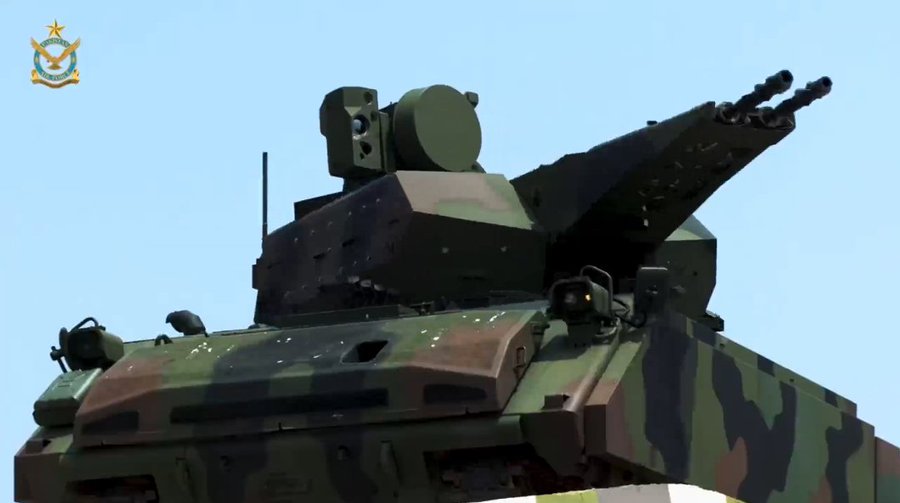
The images aren't lying. Both the systems are in service. Korkut and Sahin.

HQ17 also in induction process as i said earlier back in july.
Considering HQ 17 AE isn't ARH, how will it fare against brahmos and other cruise missile strikes?
 
Considering HQ 17 AE isn't ARH, how will it fare against brahmos and other cruise missile strikes?
It is not really optimized for Brahmos problem because Brahmos wasnt really a problem -- Scalp was.
Scalp is tackled very well with this.

The updates to Brahmos India is making are to counter the spoofing which basically neutralized at least 50%(if not more) of Brahmos shots which then went on their merry way to Afghanistan at times.

The hard kill for brahmos is already tackled by HQ-16 which is also why it was made a priority target for Harop strikes.

If you want to figure what stack is best to cater for all - look at the Type 55 DDG.

The HQ-17AE wont work against another Harop or loitering munition barrage and would be a waste - that is where you have Korkut to kill your harops and other loitering ones - and then Sahin catches those FPV and other drops right before the actual target.
 
It is not really optimized for Brahmos problem because Brahmos wasnt really a problem -- Scalp was.
Scalp is tackled very well with this.

The updates to Brahmos India is making are to counter the spoofing which basically neutralized at least 50%(if not more) of Brahmos shots which then went on their merry way to Afghanistan at times.

The hard kill for brahmos is already tackled by HQ-16 which is also why it was made a priority target for Harop strikes.

If you want to figure what stack is best to cater for all - look at the Type 55 DDG.

The HQ-17AE wont work against another Harop or loitering munition barrage and would be a waste - that is where you have Korkut to kill your harops and other loitering ones - and then Sahin catches those FPV and other drops right before the actual target.

The issue I find is that, HQ17AE and Korkut are incompatible. Yes, both can do what you are describing, but if there was a way have them layered and networked, it would have been far more optimised and redundant no? So why go for two different OEM for two different layers of AD coverage? Chinese do have similar solution like Korkut.
 
HQ17 is part of a wider integrated network of air defence

its not meant to operate on its own

the bigger picture is that Pakistans Air Force is now operating in its own heavy air defence network

this is additional pressure on the Air Force and will take years of training no doubt
 
The issue I find is that, HQ17AE and Korkut are incompatible. Yes, both can do what you are describing, but if there was a way have them layered and networked, it would have been far more optimised and redundant no? So why go for two different OEM for two different layers of AD coverage? Chinese do have similar solution like Korkut.
Mix of availability and class specific battle tested aspects.
The initial goal is coordinated(as it was with many system early) so you get to see engagement range and common IFF which you can send through Skyguard since the focus has been to make it less "air centric" in terms of picture but it can assign shooters.

Lets see you delay a bit on IFF and you have a Indian loitering munition and a Shahpar crossing back and forth for whatever reason and the Korkut blows the wrong thing out of the sky.

You need both a local facility(AB/Infra etc) C2 - that is what the Indians hit I think(except they hit the empty shell - project delays actually being useful here) in Nur Khan.

There is an agreement with the Turks for interop DL but its in infancy.

Today, Skyguard (with @side-winder sweating in his own seat somewhere) can paint a good picture of targets coming in and assign it to a sector(s)(this is apparently and then they coordinate the last mile (hopefully quick).

The goal is Skyguard picks the sector automatically and then local C2 takes over with full insight to unit statuses, sight and range picture including getting small RCS(the DJI type) which then KNOWS what effect to assign where.

And did I mention this all has to be done in milliseconds(if not less).
 
@Oscar
There is a problem here.

The HQ-17AE is a mobile air defense system designed to accompany field forces. This is its greatest advantage.

Therefore, its proper employment would be with the Pakistan Army's armored formations, rather than the PAF.

Ground-based air defense systems operated by air force units are primarily designed for point defense—protecting critical fixed assets such as airfields and radar stations. Deploying a mobile air defense system like the HQ-17AE for this type of mission does not appear to be a logical choice.
 
@Oscar
There is a problem here.

The HQ-17AE is a mobile air defense system designed to accompany field forces. This is its greatest advantage.

Therefore, its proper employment would be with the Pakistan Army's armored formations, rather than the PAF.

Ground-based air defense systems operated by air force units are primarily designed for point defense—protecting critical fixed assets such as airfields and radar stations. Deploying a mobile air defense system like the HQ-17AE for this type of mission does not appear to be a logical choice.
Perhaps they had rapid relocation in mind?
But I agree - what system do you think suited that specific use case of subsonic cruise + potential supersonic intercept?

Lets say there is a coordinated TOT 同时弹着射击 with Brahmos, Scalp and also loitering munitions?
 
Perhaps they had rapid relocation in mind?
But I agree - what system do you think suited that specific use case of subsonic cruise + potential supersonic intercept?

Lets say there is a coordinated TOT 同时弹着射击 with Brahmos, Scalp and also loitering munitions?
The HQ family of air defense systems covers a wide range of operational requirements. For short-range air defense, the early HQ-7, the subsequent HQ-10 and HQ-11, and the improved HQ-12 all serve as viable options. Regarding terminal-phase defense, Pakistan appears to have procured the 625E system.

A key distinction of the HQ-17AE compared to other air defense systems is its capability to launch missiles while on the move; other systems typically require the vehicle to come to a halt before firing.

Armored formations on the move are highly vulnerable to aerial threats, and the HQ-17AE was specifically designed to address this challenge. Its radar remains active throughout the movement, allowing interceptor missiles to be launched immediately upon threat detection without the need to stop.

However, judging by currently available photographs, the chassis of the HQ-17AE units procured by Pakistan differs slightly from the version used by the PLA Ground Force (PLAGF). It is possible that the manufacturer made specific adjustments to meet the customer's requirements.
 
The HQ family of air defense systems covers a wide range of operational requirements. For short-range air defense, the early HQ-7, the subsequent HQ-10 and HQ-11, and the improved HQ-12 all serve as viable options. Regarding terminal-phase defense, Pakistan appears to have procured the 625E system.

A key distinction of the HQ-17AE compared to other air defense systems is its capability to launch missiles while on the move; other systems typically require the vehicle to come to a halt before firing.

Armored formations on the move are highly vulnerable to aerial threats, and the HQ-17AE was specifically designed to address this challenge. Its radar remains active throughout the movement, allowing interceptor missiles to be launched immediately upon threat detection without the need to stop.

However, judging by currently available photographs, the chassis of the HQ-17AE units procured by Pakistan differs slightly from the version used by the PLA Ground Force (PLAGF). It is possible that the manufacturer made specific adjustments to meet the customer's requirements.
So, in an assumed scenario where the enemy is looking to pinpoint the emissions of the HQ-17AE for a fix to have anti-radiation systems target it - even if the HQ-17AE is protecting a fixed site - it can relocate to various sites around the base to help prevent an accurate fix.
 
1788921444887.png
The HQ-11. It is better suited than the HQ-17AE to the PAF's requirements for point air defense of critical assets.

It would be more appropriate to hand over the HQ-17AE to the Pakistan Army's armored units.
 
supersonic, high-subsonic missiles
1st chance intercept : HQ-17A
2nd chance intercept: 625E

medium-low subsonic drones
1st chance intercept: LD-76,
2nd chance intercept: 35mm/40mm air burst gun/missile

FPV drones
35mm/40mm air burst
 
View attachment 214626
The HQ-11. It is better suited than the HQ-17AE to the PAF's requirements for point air defense of critical assets.

It would be more appropriate to hand over the HQ-17AE to the Pakistan Army's armored units.

You are right that HQ-11 is definitely better choice as point defense while HQ17ae is purpose built mobile air-defense.

But transferring to Pakistan army units is unlikely to happen now since when PAF has acquired it already. PAF will certainly keep it. It can happen that army procures separately.


here's role for both systems as per AI.

  • HQ-17AE (The "Hunter"): This system is built for extreme frontline survival. Because it consolidates radars, command elements, and 8 vertical missiles onto a single platform, it can keep up with fast-moving main battle tanks and launch interceptors on the go. It excels at swatting down low-altitude threats like loitering munitions, cruise missiles, and attack helicopters before they reach friendly troops.
  • HQ-11 (The "Gatekeeper"): The HQ-11 acts as a multi-layered shield. It fires longer-range active radar homing missiles out to 30 km, but if an incoming threat (like a swarm of kamikaze drones or a guided bomb) slips past, its secondary vehicle deploys an ultra-fast naval-grade 11-barrel rotary gun to physically shred the target at close range.

I wonder why PAF would have chosen HQ17AE, they must have had evaluated it. In recent Pak-india engagements, it was experienced that both sides will target each other sam sites as priority. So probably PAF valued extreme high-mobility and wanted a SAM system that cannot be targeted by enemy. But again main purpose is to protect key installations / bases.
 
Air defence is forever on the backfoot.

It requires perfect placement of the air defence units and this is already an area which most nations and combat scenarios can never get right even 80% of the time. Even China doesn't have the numbers to protect every semi valuable and important target.

It requires perfect and advanced knowledge/detection and ample targeting time. This means most air defence (even exceptional ones) will struggle against terrain hugging and/or stealth cruise missiles and of course hypersonic maneuoverable missiles (so far only China actually outside of Russia's Avangard since Kinzhal barely turns). Brahmos is piss easy for even 1980s air defence. It's a relatively high flying, only around mach 2.9, large and low turning missile. US has been practising against Brahmos like Soviet and Chinese supersonic missiles since the 1970s with a lot of success in the more recent decades. Only trick against Brahmos is that Pakistan needs to have the right AD in the right place to defend against it. And of course, be willing to spare the shots if the target of the Brahmos is considered valuable enough (hint some Brahmos shots during Sindoor landed in middle of nowhere possibly due to EW but also maybe some failures).

Then it requires the air defence to be functioning perfectly, the entire system from networked nodes to the missile.

After all this, the missile(s) launched at the target need to be able to hit or at least disable the target.

All these are things that even multi-layered, integrated, overlapping air defences can't get even 90% right in all scenarios.

Air defence only makes mission planning for the attacking side more troublesome, resource and time costly. That is all.

All air defences, everywhere in the world can and will be overcome, often quite easily if the desire and resources spent to overcome them is here.

It is a matter of a calculus of asset protecting air defence resources spent vs enemy's desire and resources afforded to destroy the target.

Pakistan will never have anywhere near infallible air defence. Indeed US and China both don't have infallible air defence. India has a loose sieve of a barely functioning, very limited IAD system. Pakistan should focus on being able to absolutely devastate India with offense if India chooses to spend the resources to dump hundreds of drones (mostly Israeli) and missiles on Pakistan in future. A good offense is the only form of defense.
 
Last edited:
even if the HQ-17AE is protecting a fixed site - it can relocate to various sites around the base to help prevent an accurate fix.

This use case is why PAF probably procured this platform. We live in the era of sensors and drones, and long range SEAD(as demonstrated in the Iran war with Iran taking out radars at range).
 

Users who are viewing this thread

Pakistan Defence Latest

Latest Posts

Back
Top