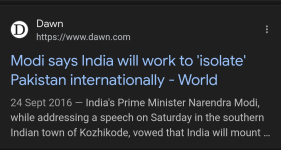
Opinion Piece- Beyond Partition: Imagining an India-Pakistan Friendship

Ultimately, my question remains: must we resolve every grievance, establish trust and reconcile our historical differences before we can even begin to establish a functional relationship?

It is not the future or existing governments of india that need to apologize, it is the common street indian who believed lies about Pakistanis and Pakistan, who intentionally jumped the band wagon of "Ghar may ghuss kay mary gay".

Establishing anything prior to that realisation is fruitless, after all it wasn't us attacking the Sri Lankan cricket team, it weren't us refusing to play with each other, it weren't us bragging about our money and we do not want you, the common street indian needs to first apologize for refusing to shake hands and insults. Everything else comes after this.


Or can we attempt to do some of those things alongside one another?

Should Pakistanis be hypocrite? Is that the question you are asking us?
 
Not in the slightest. They made a diplomatic response while in position of power (same as a Mod) as expected of them, you ask Modi the same question and he will say the same thing "Dialogue". An average India would want nothing to do with Pakistan except maybe some odd fellas who still see some bhaichara (expect the same on that side as well).

There is simply no benefit for either of us to have a relationship. Our trade partners are sitting thousands of miles away and neither of us are dependent on each other for trade. Basically we can have zero trade and be just fine. You don't produce things we need desperately, we don't produce things you need desperately. So I don't know why there is a great need for reapproachment. We have our disagreements and let it continue. We are not agreeing to your demands for plebiscite in Kashmir, so fundamentally the Indo - Pak reapproachment is a non starter.
I think you're making an interesting distinction between diplomatic rhetoric and genuine public sentiment. Fair enough, political statements advocating dialogue don't necessarily translate into a genuine appetite for rapprochement.

But I think we're approaching this from different starting points.

I'm not particularly interested in making a case for why India and Pakistan must become friends, or in convincing anyone that closer relations are necessarily desirable.

What I'm interested in is stepping back for a moment and examining where we've arrived, how we've arrived here, and what perpetuating this state of affairs has cost both societies.

We have lived with this relationship for generations. Its consequences aren't confined to diplomatic posturing or military expenditure. They permeate the lives of ordinary people and shape the circumstances inherited by future generations.

We've chosen, for whatever reasons, to sustain this arrangement. Perhaps there are compelling reasons for doing so. But have we ever really stopped to examine the costs, consider the alternatives and ask ourselves whether this is how we want the next generation to inherit the relationship?

That's really the thought experiment. I'm not particularly invested in convincing everyone of an alternative. I'm interested in having the conversation, including hearing why others believe the status quo is preferable.
 
It is not the future or existing governments of india that need to apologize, it is the common street indian who believed lies about Pakistanis and Pakistan, who intentionally jumped the band wagon of "Ghar may ghuss kay mary gay".

Establishing anything prior to that realisation is fruitless, after all it wasn't us attacking the Sri Lankan cricket team, it weren't us refusing to play with each other, it weren't us bragging about our money and we do not want you, the common street indian needs to first apologize for refusing to shake hands and insults. Everything else comes after this.


Should Pakistanis be hypocrite? Is that the question you are asking us?
If I'm understanding you correctly, your position is that:

- It isn't sufficient for the Indian government to change its approach or for diplomatic channels to reopen.
- Ordinary Indians who participated in, endorsed or encouraged hostility towards Pakistan and Pakistanis must first acknowledge their conduct and apologise.
- This acknowledgement must precede any meaningful attempt at normalisation. Anything less would amount to hypocrisy on Pakistan's part.

I fundamentally disagree with making this a precondition. You're effectively making the actions and attitudes of an entire population the determining factor in whether two countries can move forward. This isn't a condition that can realistically be fulfilled, and certainly not one that can be meaningfully imposed on an entire society.

The practical consequence is that normalisation becomes indefinitely conditional on an act of collective contrition that may never materialise. In effect, no change in government, no change in policy and no improvement in circumstances would be sufficient unless this prior condition was met.

And this brings me back to the thought experiment I'm proposing. Let's put aside, for a moment, whether we believe rapprochement is desirable or even achievable.

Let's examine two scenarios on their respective merits: continuing along the trajectory we've followed for decades, and exploring what an alternative relationship might look like without making the resolution of every historical grievance a prerequisite.

What are the respective costs, benefits, risks and opportunities foregone? What does each scenario mean for the ordinary Indian and Pakistani today, and for the generations that follow?

I'm not asking anyone to arrive at a predetermined conclusion. I'm suggesting that both possibilities deserve the same degree of scrutiny.

indian state carried out the will of its people in 2019 and 2025 and killed common Pakistanis including children (even if I ignore their support for terrorist entities against Pakistan), how do you expect Pakistanis to reconcile this with what you are proposing now? Forget? Why? indians already believe they have nothing to gain from Pakistan, and Pakistan has survived without having relations at all with india.

We have witnessed nothing but pure hatred out of india for more than a decade. Big slogans, childish policies, stupid statements. The indian child born 14 years ago knows nothing about Pakistan but this only. That is an ordinary indian, and I want the 14 years old Pakistani child not to forget all this.

You had the upper hand in relations, you were able to subtly belittle us, now that is gone, if you are curious to know what is foregone. Now, you have your partners and we have ours. Lets limit this circus to the Wagha border and not beyond, Aman ka tamasha candle should only be relit with apology first. Trust is earned not granted.
 
If Pak and India had full economic relations (Not impossible, even rivals like China and Japan do), the implications for both would be immense. For Pakistan we could import cheaper Indian agri and industrial products and export our own products to 1. 4 Billion. Indians companies would have access to another 250 million consumers and direct land access to Iran and Europe and the Gulf.
 
indian state carried out the will of its people in 2019 and 2025 and killed common Pakistanis including children (even if I ignore their support for terrorist entities against Pakistan), how do you expect Pakistanis to reconcile this with what you are proposing now? Forget? Why? indians already believe they have nothing to gain from Pakistan, and Pakistan has survived without having relations at all with india.

We have witnessed nothing but pure hatred out of india for more than a decade. Big slogans, childish policies, stupid statements. The indian child born 14 years ago knows nothing about Pakistan but this only. That is an ordinary indian, and I want the 14 years old Pakistani child not to forget all this.

You had the upper hand in relations, you were able to subtly belittle us, now that is gone, if you are curious to know what is foregone. Now, you have your partners and we have ours. Lets limit this circus to the Wagha border and not beyond, Aman ka tamasha candle should only be relit with apology first. Trust is earned not granted.
I think I understand your position. You've experienced the hostility of the last 14 years, believe ordinary Indians share responsibility for it, want that experience preserved in the national memory of future generations, see little benefit in bilateral relations, and consider an apology a prerequisite for any rapprochement.

But here's where I struggle with this reasoning.

I could make almost the exact same argument from the Indian side, and I suspect you could anticipate what that would look like. We have our own catalogue of grievances, casualties, attacks, humiliations and historical grievances. We can point to our own experiences, insist that Pakistanis acknowledge them, demand apologies and conclude that there is little to be gained from engaging with a country that has caused us so much grief.

And so what? We arrive at precisely where we are today, with each side's grievances serving as justification for the other's continued estrangement.

I also find your interpretation of my position rather curious. You seem to assume that my interest in exploring better relations stems from a belief that Pakistan is ascending, India is losing ground, and that this somehow creates an opportunity or incentive to seek friendship. I don't see the connection. My position would be exactly the same irrespective of which country was economically, militarily or geopolitically ascendant.

I'm not making a case for friendship because Pakistan needs something from India, or because India needs something from Pakistan. I'm questioning the value of perpetuating an adversarial relationship simply because both sides have convinced themselves that the other deserves nothing better.

The question I'm exploring is what this arrangement has cost us, what continuing it will cost us, and what an alternative might look like.
 
If Pak and India had full economic relations (Not impossible, even rivals like China and Japan do), the implications for both would be immense. For Pakistan we could import cheaper Indian agri and industrial products and export our own products to 1. 4 Billion. Indians companies would have access to another 250 million consumers and direct land access to Iran and Europe and the Gulf.
There's quite a bit to unpack here, both in terms of the opportunities and the potential complications.

For Pakistan, access to the Indian market could create opportunities for textiles, agricultural produce, pharmaceuticals, surgical instruments and other manufactured goods. Cheaper Indian industrial inputs and agricultural products could also benefit Pakistani consumers and manufacturers.

For India, access to a neighbouring market of 250 million people offers its own commercial opportunities. Indian manufacturers, pharmaceutical companies, agricultural businesses and service providers would gain another sizeable consumer base. Overland connectivity through Pakistan could also open up trade routes towards Iran, the Gulf and potentially Europe.

There are, however, some important considerations.

The two economies aren't on equal footing. India's industrial base, capital availability and manufacturing scale are considerably larger. Unrestricted access to each other's markets could expose Pakistani manufacturers to competition they may struggle to withstand. Some domestic industries could contract, businesses could close and employment could be affected. There could also be concerns around trade imbalances and increasing dependence on Indian imports.

India would have its own considerations, including security, transit arrangements, regulatory barriers and the political reliability of cross-border commercial relationships.

There would also be adjustment costs on both sides. Trade liberalisation isn't simply a matter of opening borders; it requires customs integration, banking arrangements, standards harmonisation, transport infrastructure and mechanisms to address disputes and protect vulnerable industries.

I'm not suggesting these complications outweigh the potential benefits. Equally, I'm not suggesting that the benefits automatically justify unrestricted free trade.

But I do think there's an interesting economic proposition here. What would a phased opening of trade look like? Which sectors would benefit, which would be exposed, and what safeguards would each country need?

It would be interesting to actually examine the possibilities rather than simply assume that either the benefits or the costs are self-evident.
 
It is naive to believe that the problems between India and Pakistan arise due to religion or terrorism or partition. Fact is that both countries have overwhelmingly mediocre populations with low IQ, low morals, poor self regulation. Instead what we have is cunning and inflated egos. We are a stupid, selfish people who are repeatedly used and abused and thrown away like toilet paper by the tiny powerful minority. Above all, we are cowardly people who allow this to happen to us. Cowardly people do not take control of their future. Case closed.
 
It is naive to believe that the problems between India and Pakistan arise due to religion or terrorism or partition. Fact is that both countries have overwhelmingly mediocre populations with low IQ, low morals, poor self regulation. Instead what we have is cunning and inflated egos. We are a stupid, selfish people who are repeatedly used and abused and thrown away like toilet paper by the tiny powerful minority. Above all, we are cowardly people who allow this to happen to us. Cowardly people do not take control of their future. Case closed.
The way out, is to talk and more importantly, to listen

You underestimate the transformative power a conversation can have
 
1776425681208.png

While the sentiments on this thread are genuine and worthy of documenting, the reality remains far removed from such thought experimentation.

I think that of the two nations, it is India that has officially chosen a path of "total war", encompassing kinetic, economic, political, and social hostility. Certainly, individual Indians may seek rapprochement and civil discourse but the hatred we observe towards our culture, our sportsmen, our businesses and citizens cannot be swept under the carpet. The civil (or "uncivil") backlash against ANY publicised attempt at cordial engagement is rabid and immediate. Why should Pakistanis overlook this? Indeed, for many years, Pakistan tried through official channels to remind Indians that separation of regional politics from civilian life was possible - to no avail.

I, for one, remain satisfied with Pakistan's approach towards India. It seems as though Modi bit off far more than he could chew when deciding to confront Pakistan directly and unashamedly. In fact, I feel our officials remain far too LENIENT towards such an incorrigible and hostile attitude.

Take sports, for example. If Hindustanis see fit to refuse to engage in sportsmanlike conduct when playing against Pakistanis, then kindly "do one" properly! India should unilaterally forfeit all sporting fixtures against Pakistan, as Iran does with Israel over similar ideological rationale, and take whatever consequences come (mostly financial) on the chin, in reverence to their ideological mantra. Of course, we all know the rupee is worth more than these falsified ideologies that are brandished by these fraudsters, so no principled boycott of Pakistan will be forthcoming. In this scenario, Pakistan should reject sporting interactions of any kind with any Indian team that refuses basic on-field civility.
 
@Krptonite
Couple of days ago - India juniors played Pakistan at cricket. India won. The response of the Indian kids was next level. They made gestures and swore at the mothers of the Pakistan players. Was a horrible watch. This anger seems to be next level and its rife.
Not suggesting Pak youth arent with guilt - some of their behavior too is unacceptable but the hatred coming and stemming from those in charge is propagating on dangerous levels.
There is far less animosity and hatred from those that are for example living in the UK by both parties - those that have been recently imported - wow - next level.
 

Users who are viewing this thread

Pakistan Defence Latest

Country Watch Latest

Back
Top