PAF SAM based Air Defense System - News, Discussion & Updates

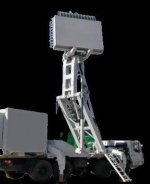
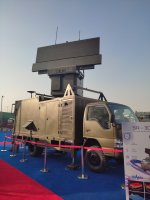
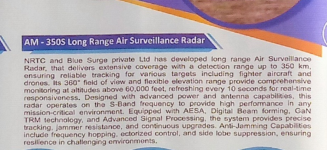
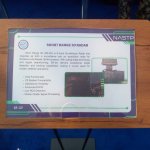
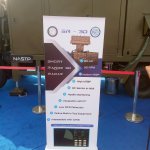
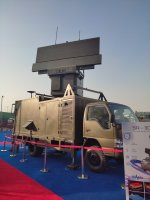
How do we know this is indeed an AESA based radar ? Where does it say that ??

( dont get me wrong - i would love it to be an AESA radar, that is real progress, but i am looking for verifiable confirmation ).

If this is indeed an AESA, then PAF has taken a big leap towards being able to build its own AEW&C as it has all the intellectual property for everything else ( datalinks, command and control consoles, secure comms, etc). Sea Sultan project will help Pakistan learn what it needs to do for a home-grown AESA based AEEW&C/AWACs.

Additionally, NRTC does need to look at its industrial design capabilities. This does not look like a robust military product, but a mockup of some description ... ( take a lesson or two from Turkish designed products that do look the business interms of robustness and therefore reliability as a military tool ).
My dude you do literally know that NASTP and AWC both gave separate Aesa radar programs that have produced the 3D-SRR and G-RAD radar as a result and those radars are active since several years now. This NRTC radar is the 3rd type of AESA radar operational now ...
 
My dude you do literally know that NASTP and AWC both gave separate Aesa radar programs that have produced the 3D-SRR and G-RAD radar as a result and those radars are active since several years now. This NRTC radar is the 3rd type of AESA radar operational now ...

No i dont know - would love to know more on all 3 ! There is very poor persistent documentation of these things by both the manufacturers, and us as a community.
 
No i dont know - would love to know more on all 3 ! There is very poor persistent documentation of these things by both the manufacturers, and us as a community.
Yea that's not the case. Nastp SRR was shown on 23 March parade ... And now at expo. GIDS G-RAD is also operational but remains under shadow.

GIDS G-RAD (AWC?)
images (84).jpeg

NASTP 3D-SRR (V2.0)
IMG-20241119-WA0048.jpg
 
just the battery/launcher, but because the missile is constantly being fed guidance data, unless you suddenly stop i think the chances of a hit are lower
Ok but I could imagine that system failing quite easily. Will the launcher be guiding all of the missiles all of the time? I don't think any (or many) modern missiles are like that but they switch on active-homing using their own seekers in the terminal phase. This would create room for mistakes, especially if it is a crowded environment with a lot of targets and nontargets.


The system developed is able to classify tracks fairly well but whether it can prevent the airliner shootdown type incident in Iran is a question mark.

Which is why you see Pakistan more open immediately to airspace shutdown(also easier) than other folks because it relatively a smaller area with much less domestic traffic.

This civil traffic was mentioned as a reason why possibly the wayward brahmos was not launched against citing the Iranian incident as cautionary procedure although I suspect it had to do with capability at the time since its pretty clear you can track a supersonic missiles speed and path along with your airliners.
Right, but civil traffic is not what I was primarily worried about. In a war, lets assume that there is no civillian traffic. Let's say India attacks AWC. We scramble jets to intercept. There are friendlies and enemies all mixed up. You launch an air defense missile and it hits a friendly in the confusion. What prevents that from happening? Or will the air defense missiles be used in zones where we won't put friendly jets in? That is my question: What is the PAF doctrine on this.


Perhaps its even more complex with the command structure that is in place. There are SAM systems of two different military commands. The army air defense operates LY-80 & H-Q9Ps among other stuff. The airforce has its own line of SAM systems. So if there is a breach of airspace, there must be single command that take cares of it. At such situations you don't have any time that one service communicates with other to hold your horses, we are taking care of it. There's no time for communication, there should be a defined protocol which I hope already should be the case. But I think that as airforce is primary defender of the airspace, so long range SAMs should all be under airforce. The H-Q9Ps under army air defense don't make much sense. Ly-80 and medium to small range SAMs can be in army air-defense to protect specific command centers & installations. HIMAD should be airforce category, they'll know when to scramble fighters or when to use SAM solution. Back in 90s, ADA in every operational base required 6 minutes to be airborne. Perhaps its the same today, enemy knows this window of timing and will do the operation accordingly, so I assume the first responder could be the SAM solution when its a surprise attack and not an all out war. Rules of engagement in an all out war maybe even more tricky.
Right, I wasn't even thinking of that. Another layer of possible confusion.

All of the above doesn't fill me with confidence but solidifies the question I was raising.
 
Ok but I could imagine that system failing quite easily. Will the launcher be guiding all of the missiles all of the time? I don't think any (or many) modern missiles are like that but they switch on active-homing using their own seekers in the terminal phase. This would create room for mistakes, especially if it is a crowded environment with a lot of targets and nontargets.


Right, but civil traffic is not what I was primarily worried about. In a war, lets assume that there is no civillian traffic. Let's say India attacks AWC. We scramble jets to intercept. There are friendlies and enemies all mixed up. You launch an air defense missile and it hits a friendly in the confusion. What prevents that from happening? Or will the air defense missiles be used in zones where we won't put friendly jets in? That is my question: What is the PAF doctrine on this.


Right, I wasn't even thinking of that. Another layer of possible confusion.

All of the above doesn't fill me with confidence but solidifies the question I was raising.
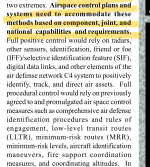
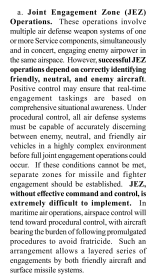
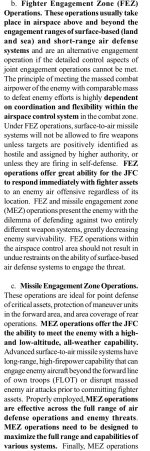
Here is an old US DoD AD procedures https://edocs.nps.edu/dodpubs/topic/jointpubs/JP3/JP3_52_950722.pdf- in a nutshell -

1732124761772.png


1732124829375.png

1732124895471.png
 
Not yet, but would certainly not discount it from PAF service if China is willing to sell us J-35.

HQ-19 in PAF service would effectively neutralise IAF's entire Western and South Western Air Commands and any Carrier within 1,000 miles of Pak coast.

Indians use the phrase "Game changer" a lot, this, along with Stealth would shift the air balance of power decisively in PAF's favour.

If you stationed it in Western Baluchistan you could shoot down Israeli aircraft and missiles in the Negav desert. Thing is a masterpeice
This is fanboy fantasy things that have made indian defence community a laughing stock in world for bold Bollywood specs and claims
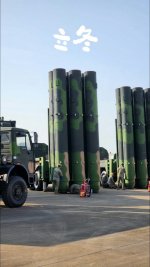
HQ 19 as per Public information is ABM system it has nothing to do with any aircraft target
It has ranges of 500 to 600 km as a proposed version THAAD ER
It can shoot down ballistic missiles when they are out of atmosphere
And show down targets with maximum range of 3000 to 5500 km
I.e agni series ballistic missiles
It can also shoot down hgv
China has it in active service for more than decade
Pakistan can buy it but will be expensive and Pakistan will have to correct foreign policy mess with china first
 

Attachments

  • 54123947672_74e3498daf_o.jpg
    54123947672_74e3498daf_o.jpg
    221.8 KB · Views: 10
Perhaps its even more complex with the command structure that is in place. There are SAM systems of two different military commands. The army air defense operates LY-80 & H-Q9Ps among other stuff. The airforce has its own line of SAM systems. So if there is a breach of airspace, there must be single command that take cares of it. At such situations you don't have any time that one service communicates with other to hold your horses, we are taking care of it. There's no time for communication, there should be a defined protocol which I hope already should be the case. But I think that as airforce is primary defender of the airspace, so long range SAMs should all be under airforce. The H-Q9Ps under army air defense don't make much sense. Ly-80 and medium to small range SAMs can be in army air-defense to protect specific command centers & installations. HIMAD should be airforce category, they'll know when to scramble fighters or when to use SAM solution. Back in 90s, ADA in every operational base required 6 minutes to be airborne. Perhaps its the same today, enemy knows this window of timing and will do the operation accordingly, so I assume the first responder could be the SAM solution when its a surprise attack and not an all out war. Rules of engagement in an all out war maybe even more tricky.
@Quwa is the resident expert on this topic, have a look at this in the mean time:

 
This is fanboy fantasy things that have made indian defence community a laughing stock in world for bold Bollywood specs and claims
HQ 19 as per Public information is ABM system it has nothing to do with any aircraft target
It has ranges of 500 to 600 km as a proposed version THAAD ER
It can shoot down ballistic missiles when they are out of atmosphere
And show down targets with maximum range of 3000 to 5500 km
I.e agni series ballistic missiles
It can also shoot down hgv
China has it in active service for more than decade
Pakistan can buy it but will be expensive and Pakistan will have to correct foreign policy mess with china first

Sure, if it can shoot down Ballistic missiles aircraft will not be a problem. You are right, we need to ensure China is comfortable selling it, but as mentioned, if they are happy giving Pakistan J-35 then HQ-19 can be next step. We do need to get our ducks in a row regarding safety of Chinese workers in Pak though. Situation is a mess.
 
Sure, if it can shoot down Ballistic missiles aircraft will not be a problem. You are right, we need to ensure China is comfortable selling it, but as mentioned, if they are happy giving Pakistan J-35 then HQ-19 can be next step. We do need to get our ducks in a row regarding safety of Chinese workers in Pak though. Situation is a mess.
Do you even know what ABM system is?
What kind of aircraft flies at 40 km or 131000 feet?
ABM can never shoot aircraft
These missiles only perform out of atmosphere where no air breathing craft flies.
 
Sure, if it can shoot down Ballistic missiles aircraft will not be a problem. You are right, we need to ensure China is comfortable selling it, but as mentioned, if they are happy giving Pakistan J-35 then HQ-19 can be next step. We do need to get our ducks in a row regarding safety of Chinese workers in Pak though. Situation is a mess.
its more of a cost to kill ratio
of course it is capable to shoot down an aircraft but would it be economically feasible?
this thing can manuver in the upper atmosphere that means it does not use fins as air is almost no existent there as it uses rocket assisted manuvering and that tech is bloody expensive
 
its more of a cost to kill ratio
of course it is capable to shoot down an aircraft but would it be economically feasible?
this thing can manuver in the upper atmosphere that means it does not use fins as air is almost no existent there as it uses rocket assisted manuvering and that tech is bloody expensive
It would suck more than HQ 16 a at shooting down aircraft just like thaad it is not made for and cannot shoot down any atmospheric aircraft threat
But it will give Pakistan defence against Indian missiles that can be used of nuclear threat plus give us anti satellite abilities that India have in limited form keeping us safe in that sphere
 
Any chance Pakistan would built OTH radars near Quetta, considering if the Indians go for the Su-57, its stealth may not be as optimized for detection from above. China is also studying the employment of satellites like star link to detect stealth aircraft, which could corroborate the returns found by the Pakistani OTH radar and Chinese OTH radars, if built in Tibet and Xinjiang.

Feeding the data to Sam batteries that have their radars turned off could enable Pakistani air defense to be an always possible “pop-up” threat to any would be attacker.

 
its more of a cost to kill ratio
of course it is capable to shoot down an aircraft but would it be economically feasible?
this thing can manuver in the upper atmosphere that means it does not use fins as air is almost no existent there as it uses rocket assisted manuvering and that tech is bloody expensive
It would suck more than HQ 16 a at shooting down aircraft just like thaad it is not made for and cannot shoot down any atmospheric aircraft threat
But it will give Pakistan defence against Indian missiles that can be used of nuclear threat plus give us anti satellite abilities that India have in limited form keeping us safe in that sphere
Just to be clear, intercepting ballistic missiles and intercepting airplanes work on completely different principles, and they cannot coexist.

Anti-aircraft missiles that intercept aircraft use a fragmentation kill method. That is, the anti-aircraft missile explodes in the air as it approaches the aircraft, creating a large number of fragments, which are used to destroy the aircraft. At the same time, because of the high mobility of aircraft, the reaction sensitivity of anti-aircraft missiles is very high.

Almost all modern medium- and long-range ballistic missiles use armored warheads. It enhances the defensive capability of the warhead on the one hand and the penetrating power of the warhead on the other. Therefore, air defense missiles that intercept ballistic missiles use kinetic impact for interception. Ballistic missiles are fast, but their trajectories are predictable. Even a variable-trajectory HGV, which has a very limited ability to maneuver to change trajectory, still has some possibility of prediction.

If a fighter interceptor with a fragmentation kill method is used to defend against a ballistic missile, it will not be able to damage the warhead of the ballistic missile, even if it hits accurately. If a kinetic interceptor is used to intercept a fighter, it will be very difficult to hit.

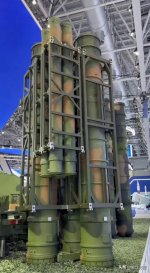
The HQ-19 is an air defense system for defending against low- and medium-orbit ballistic missiles, and it uses a kinetic energy warhead. Therefore, it cannot defend against fighter jets. The air defense system deployed by China to intercept high orbital ballistic missiles is the HQ-26.

The latest approach now is to have a defense system that contains multiple interceptors, with different interceptors being fired depending on the target.
w700d1q75cms.jpg
 
Last edited:
How do we know this is indeed an AESA based radar ? Where does it say that ??

( dont get me wrong - i would love it to be an AESA radar, that is real progress, but i am looking for verifiable confirmation ).

If this is indeed an AESA, then PAF has taken a big leap towards...

1732319516150.png
 

Users who are viewing this thread

Back
Top