JF-17 PFX program

Airframe design is for PAC to decide. How much change they want to so.

Yes, but a Mk.2-style new design is IMO no longer just a variant and even more beyond common sense. An almost J-10-sized fighter developed almost alone (besides if within the capabilities?) makes barely any sense and if doable given their budget is another question.
 
No. If there's anything to be taken away from my post it is that we should focus on low-hanging fruit. I really think UCAVs are a niche that we can get into with RELATIVELY smaller investment. C-130 replacement is unrealistic for several reasons:
1. We will never use or sell enough airframes to justify the development costs
2. A transport aircraft is still a complicated aircraft that needs all of the things in existence before development starts.
Defense indigenous development will never make sense economically it never has or will

Its for self reliance since noone is a reliable partner apart from self

But then it also comes to economy which in total shit show
Even countries like Vietnam have now become more developed which would have been laughable thing just 20 yrs ago

Problem is you cant even have any hope for that to change

Pakistan army needs to either take full control or no control of the economy
 
Yes, but a Mk.2-style new design is IMO no longer just a variant and even more beyond common sense. An almost J-10-sized fighter developed almost alone (besides if within the capabilities?) makes barely any sense and if doable given their budget is another question.
Problem is that beyond a name : PFX no has any idea at all !! We all are simply speculating !
1. Its not 5th Gen jet for sure.
2. It's not a twin engine jet either
3. Is it Block 4 ? Makes little sense since Block 3 was launched just an year back and only 50 Nos were ordered.
4. Is it Block 3 without chinese sub system. May be!! but why they want to replace chinese system.
5. Is it Block 3 with new engine. Probability are high!! But which engine ! How much extra power that engine will deliver and what changes will be done along in the Jet ?
 
My point is.
The “JF-17 PFX program” is a product of a political struggle. It's pointless to analyze any of its technical indicators right now.

Whatever Pakistan does with the JF-17 PFX program, it will change the existing political landscape in Pakistan.

Sorry didn't get your point. What Political struggle has to do with JF17 PFX? What's the relation?
 
They have given some hints at what they seek, a redesign, which I hope they go for, considering the JF-17 has reached the end of what can be done with the design.

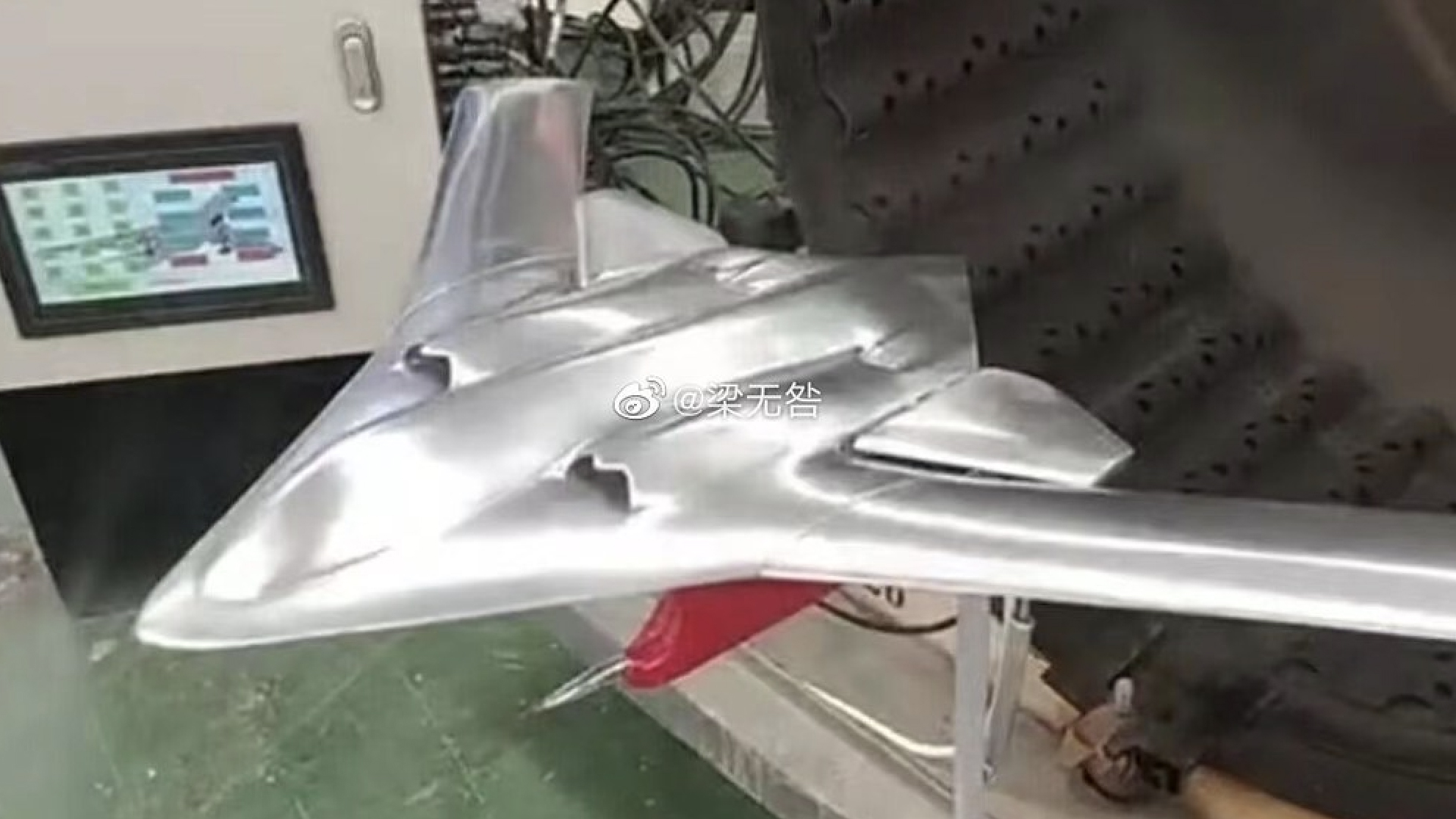
I don’t know the name of the wing shape, but the W shape (split/wedge ailerons/flaps ?) in the wings is something seen in the PFX video. Also the stabilizer looks to be two and canted.

The PFX should study the McDonnell Douglass JAST designs particularly “JAST 6” design. A 30 year old design, but now probably very economical to make, if done in volume.

The original design was for a 156 kn F-119 engine, so if the PAF wants to scale up as @MastanKhan has always advocated this is the way to go. But I disagree with Mastan Khan, and say if the PAF needs a fighter in that weight class, buy more of the capable J-35A. We need a JF-17 replacement that fills a 4 BVR and 2 WVR role, but can also carry adequate internal A2G munitions in an air strike configuration.

If the PAF wants to stay in the JF-17 size, then stay with a WS-19 at 116 kn.

If you are going to scale down but still have a design that allows the plane to carry 4 PL-15 and 2 PL-10 INTERNALLY, that is possible, but I don’t want to share it on the open forum. Hint the main internal weapons bay is a 2 over 2 configuration for the PL-15 which would make a large enough to carry some standoff and strategic weapons internally. The WVR missiles are in a unique INTERNAL position.

Change the intake to the Mach 1.8 DSI from the J-35A, and perhaps change the exhaust to a YF-23 style one to reduce the IR signature.

If the PAF is really ambitious, go for a “Pelikan tail” along with the YF-23 exhaust. That would give TVC level maneuverability but much lighter.

Look at the wing shape and the tail shape. Even the intake is a standard intake; the design is inspired by the JAST IMHO
View attachment 86322
View attachment 86326

Skip the first 15 seconds, not relevant to the JAST design I’m discussing. From 0:15-1:35
To view this content we will need your consent to set third party cookies.
For more detailed information, see our cookies page.


View attachment 86325

A wind tunnel tested design
View attachment 86337

The exhaust modification is not theoretical, it was tested at NASA’s Langley Windtunnel
View attachment 86346

Just to show how nearly horizontal the tail is, and how low the RCS, see the following picture. Even if the design doesn’t eventually have an internal bay(s), it will still be lower signature then any non-5th gen manned platform out there, and could easily make a decent loyal wingman.
View attachment 86348

It may seem the tail work will be a lot, and delay the project, but if you consider the years of work done on Chinese bomber projects, specifically the H-20 and its tail, a lot could be applied to this project.

H-20_MODEL_AVIC.jpg

Hi,

I have posted a video from Millenium 7 over here that is worth watching---.

Size change or no size change---that is what the paf is going for---.

Other thins will change as well with that upgrade BY DEFAULT of the change---.

So---overall---a win win situation---.
 
My point is.
The “JF-17 PFX program” is a product of a political struggle. It's pointless to analyze any of its technical indicators right now.

Whatever Pakistan does with the JF-17 PFX program, it will change the existing political landscape in Pakistan.
Hi,

Thanks for the post---.

Modern fighter aircraft are a secret hidden in an enigma---.

Their abilities & capabilities are hidden from the public to the extent that the public can only speculate from the visuals what lies beneath the veil---or whatever the entity wants to disclose---or what the analysts can dig out from the visuals.

Bottomline---the PFX will take the JF17 to the max limit of gen 4.5 technology---.
 
Regardless of the criticism of the project and the lack of encouragement of some for its success, the success of the Pakistani development program depends on providing new export and production contracts for the JF-17 BLOCK III aircraft. Simply providing a production volume of 120 aircraft until 2030, most of which are for export, will provide sufficient funding for the Pakistani local development program because the export profits are what will finance the development and production program for the new version, whether with one or two engines. Pakistan can also produce a UCAV version of the aircraft. Any project that starts out simplified with UCAV versions saves a lot of effort and reduces the risks for the project by showing results that encourage taking financing and research steps that lead to the success of such projects. Therefore, if Pakistan can secure new export contracts, whether to countries in Asia or Africa, it will be one of the factors for the success of the project.
 
I don't know whether your view is personal or general in Pakistan. But this view is far from the truth.
Let us first review the history of JF-17.

Phase 1
1986. Pakistan puts forward the SABRE II program and invites bids. In the end, only GRUMMAN was deeply involved in the program and presented the actual proposal.
1988. Pakistan and GRUMMAN failed to agree on a design, and for other reasons, Pakistan terminated the SABRE II program, and GRUMMAN used its existing R&D results to market to China. The United States and China launched the SUPER 7 program.
1989. Due to the “Tiananmen Incident”, the US terminated all US-China cooperation programs, and the SUPER 7 program was terminated.

Phase 2
1991. Dissolution of the Soviet Union. China cooperates with Mikoyan, and CAC seeks to restart the SUPER 7 program on its own.
1992. China seeks cooperation from Pakistan. But Pakistan's actual willingness is not high. Both sides signed a memorandum of cooperation, but no formal contract was signed.
1993. China and Russia signed a cooperation agreement on RD-93 engines. After that, China officially restarts the SUPER 7 program.
1995. China and Pakistan signed a memorandum of understanding for cooperation in the development of new fighter jets, but still no formal contract was signed. The two sides disagreed on some technical details and could not reach an agreement. (At this time, Pakistan did not trust China's technical capabilities and wanted to use a lot of Western equipment and weapons)

Phase 3
1998. India and Pakistan conduct nuclear tests successively. Both sides are subject to international sanctions. Pakistan's access to Western equipment and weapons is cut off.
1999. Kargil War breaks out between India and Pakistan, and a month after the war begins, Pakistan quickly reaches an agreement with China. Formal contracts were signed. The fighter jet was named FC-1. The ratio between China and Pakistan is 50:50.
2003. 01 prototype fighters left the factory on May 21st and completed its maiden flight on August 25th.
2004. FC-1 was officially named. Chinese name “FC-1 枭龙”, Pakistani name “JF-17 Thunder”.
2006. The heavily modified prototype 04 completed its maiden flight.
2007. The first JF-17s were delivered to PAF.
In 2008, PAC officially began assembly of the JF-17, marking the end of the initial development of the JF-17.

What happens after that is simple and public. I will not rehash it.

Combining this information feeds into a couple of questions.
1, The JF-17 program, a collaborative effort between China and Pakistan, is not at all the same concept as the Chinese production of the iPhone.
APPLE has full ownership of the iPhone, it is completely independent and autonomous in finding any suitable partner to manufacture it, and it can also be completely independent and autonomous in building its own factory completely anywhere.
The JF-17 program is jointly owned by China and Pakistan, it does not fully belong to Pakistan. Neither party has the right to do anything over the objection of the other. Based on the reality, China has no objection to Pakistan looking for other alternative subsystems and even supports Pakistan's efforts to localize the production of the JF-17. But this does not mean that China is giving up the other half of the ownership of the JF-17 program.
2, In China's original plan, PLAAF will buy this fighter. However, because Pakistan's technical requirements for this fighter are completely different from PLAAF's, and because Pakistan's constant hesitation has led to a very slow progress of the project's preliminary work, PLAAF finally decided to give up on purchasing this fighter. ------ The J-10 had completed its maiden flight in 1998, a year before Pakistan officially signed the contract.
My dear Chinese friend , you are so bogged down in nitty gritties of technicalities and political / strategic voodoo that you fail to see the things that are on plan sight ... don't get offended , just blame it on our western thought process that you relish to point out .
 
Hi,

Thanks for the post---.

Modern fighter aircraft are a secret hidden in an enigma---.

Their abilities & capabilities are hidden from the public to the extent that the public can only speculate from the visuals what lies beneath the veil---or whatever the entity wants to disclose---or what the analysts can dig out from the visuals.

Bottomline---the PFX will take the JF17 to the max limit of gen 4.5 technology---.
What exactly will change in J F 17 to transform it into JFX ?
 
Have Pakistan and China ever considered shifting the J-10 line or open an additional j-10 line in Pakistan. This would allow Pakistan to focus on manufacturing skills while develop a small fifth gen single engine plane with smaller weapon bay. China can assist on this but on a minority partnership such as 20-30%. Pakistan would improve its manufacturing process and initiate the lead in a new plane designing.
 
Hi,

Thanks for the post---.

Modern fighter aircraft are a secret hidden in an enigma---.

Their abilities & capabilities are hidden from the public to the extent that the public can only speculate from the visuals what lies beneath the veil---or whatever the entity wants to disclose---or what the analysts can dig out from the visuals.

Bottomline---the PFX will take the JF17 to the max limit of gen 4.5 technology---.
Don’t you think they should be more ambitious and at least carry weapons internally? Carrying weapons internally would improve so many performance metrics, even if the design isn’t fully optimized or have the most modern ram coatings.
 
Have Pakistan and China ever considered shifting the J-10 line or open an additional j-10 line in Pakistan. This would allow Pakistan to focus on manufacturing skills while develop a small fifth gen single engine plane with smaller weapon bay. China can assist on this but on a minority partnership such as 20-30%. Pakistan would improve its manufacturing process and initiate the lead in a new plane designing.
Pakistan would probably not buy J-10s in the numbers to make it worthwhile.
 
First thing we have to know about the PFX is the engine class; is it WS-21, WS-19, or WS-10B class? From this we can extrapolate what the PAF is seeking.
 
Don’t you think they should be more ambitious and at least carry weapons internally? Carrying weapons internally would improve so many performance metrics, even if the design isn’t fully optimized or have the most modern ram coatings.
Hi,

One thing about the Paf is that it is not an AMBITIOUS organization when it comes to procurement of fighter aircraft---.

It is extremely utilitarian---goes for the best bang for the buck and not for show & strut---.
 

Users who are viewing this thread

Latest Posts

Back
Top