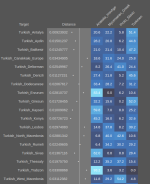
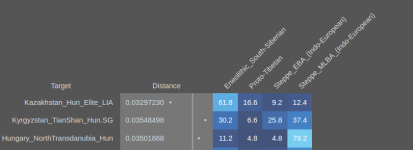
The Central Asian Turkic admixture in Turks is 10% to 50% depending on the region. "Turkic" itself isn't pure East Asian, but a mix of ancient Iranic and proto-Turkic ancestry.
View attachment 105808
Turkic peoples are not East Asians, but Huns are East Asians.
According to the <Sui-shu>, the ancestral Ashina tribe of the Turkic peoples was a branch of the Miscellaneous Hu Frustration Clan, which was located to the north of the Huns people(Located in what is now Mongolia).
The Frustrated Qu Clan was once a subordinate hu tribe under the rule of the King of Xiongnu, but was not of Xiongnu ethnicity. During the Northern Wei Dynasty, the Frustrated Qu Clan established a small state called the “Northern Liang State”. In 439 AD, the Northern Wei Emperor Tuoba To personally led an army to destroy the Northern Liang State. The Ashina family and about 500 other Frustrated Qu families fled to the Altai Mountains.
In 552 A.D., the Ashkenazi family annihilated the Zoran Khanate and established the Turkic Khanate, which is the origin of the Turkic people.
As for the Huns, the royal ancestor of the Huns was Chun Wei, a descendant of a Chinese minister of the Xia Dynasty. After the Shang Dynasty destroyed the Xia Dynasty, Chun Wei led his family to flee to the steppe, forming the earliest Xiongnu community and royal family. After that, the nomadic tribes that were defeated and destroyed by the successive Chinese imperial dynasties, such as the Shanrong, the long-snouted tribes, the Meat Porridge, the Gifang, the Mianyi, the Cunning and so on, were successively annexed by the Xiongnu royal family to form the final Xiongnu community. It is true that the Xiongnu royal family had Han Chinese blood, but that was thousands of years ago. So the Huns were a large collection of East Asian steppe peoples. It was East Asian, but not representative of East Asian Confucian culture.